The Plain-English Guide to Search Engine Optimization
Search engine optimization (SEO) is the process of improving your website so search engines like Google can discover, understand, and rank your pages in unpaid (organic) search results.
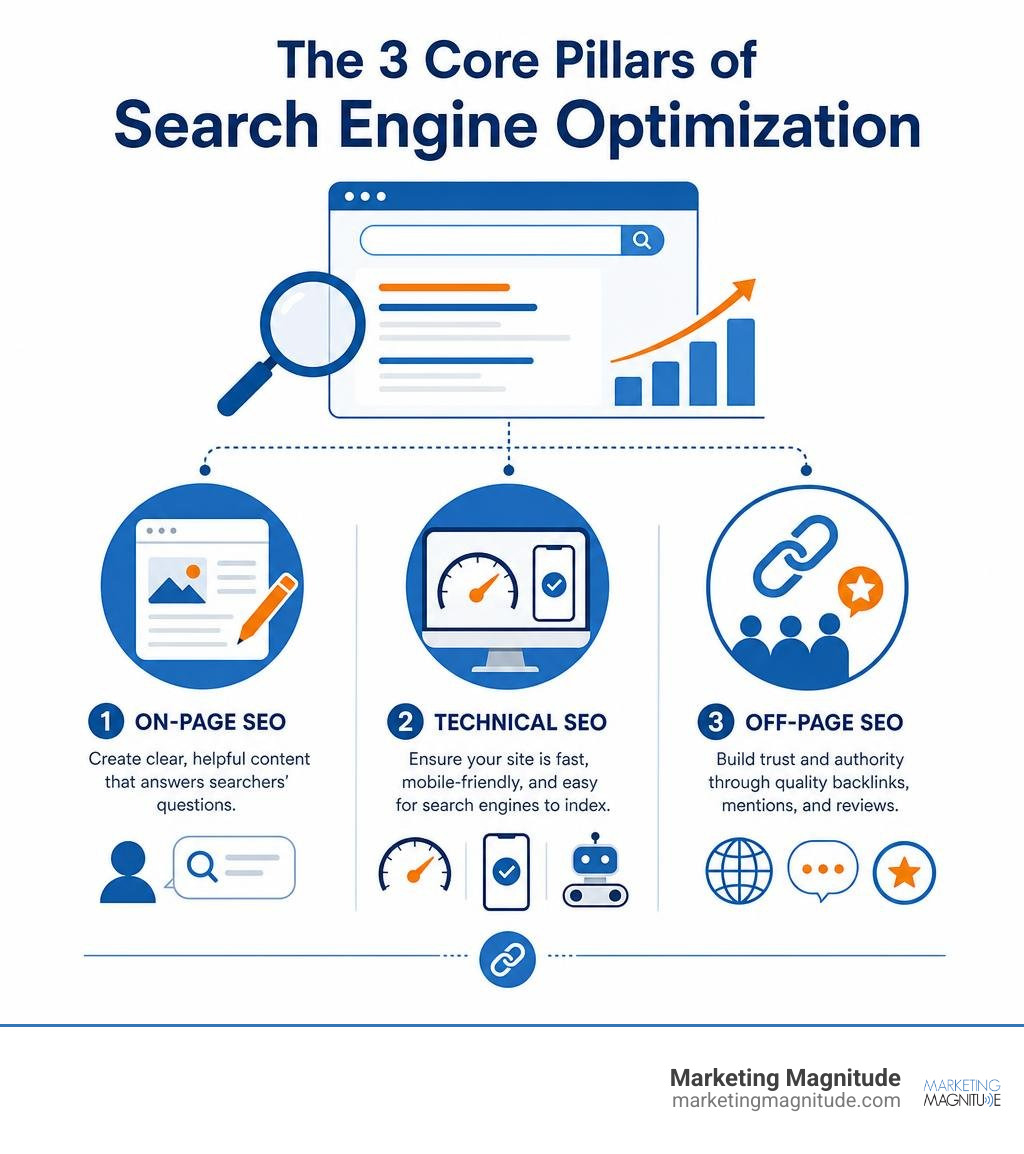
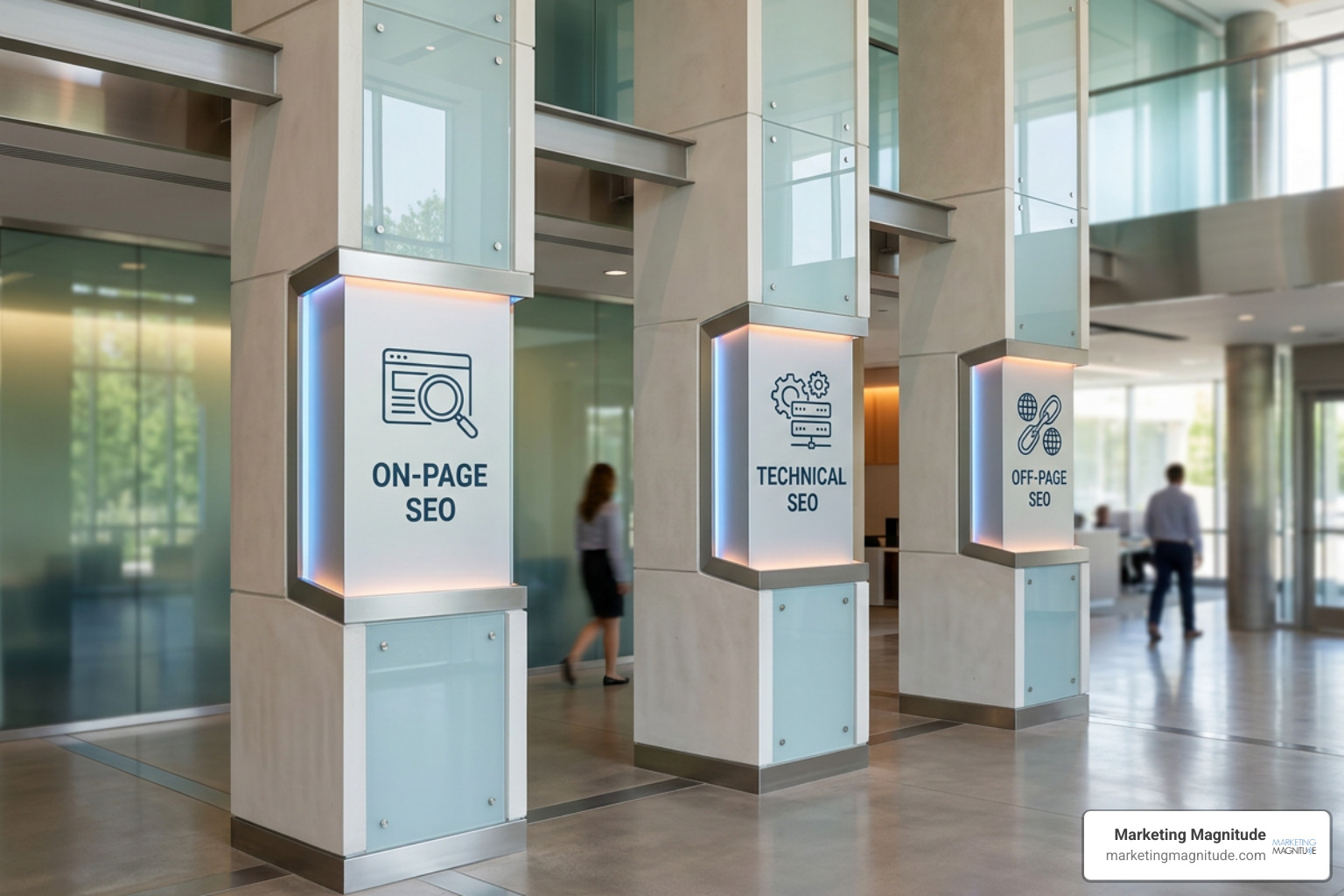
Instead of paying for every click with ads, SEO earns sustainable, long-term visibility by aligning your site with what real searchers want. Getting started comes down to three connected pillars:
- On-Page SEO: Creating clear, useful content that directly answers the exact questions your ideal customers are typing into search boxes.
- Technical SEO: Making sure your website loads fast, works seamlessly on mobile phones, and lets search crawlers index your pages without errors.
- Off-Page SEO: Building real-world authority and trust across the web through quality backlinks, brand mentions, and customer reviews.
When these three pieces work together as an integrated system, organic search becomes your most reliable channel for steady leads and revenue.
I’m Kelly Rossi, founder of Marketing Magnitude, and over the last two decades I’ve helped service businesses scale by turning complex search engine optimization into practical, revenue-focused marketing systems. Let’s look at how modern search actually works so you can build real organic visibility with confidence.
What Is SEO and How Does Organic Search Function?
To understand how organic visibility drives real business growth, we first need to define what is Search Engine Optimization? and why it matters to your bottom line.
At its core, search engine optimization is the strategic practice of organizing your digital presence so search engines recognize your site as the most authoritative, relevant answer for a user’s query.
When prospective clients need a solution, they open a search bar. They might be looking for immediate emergency plumbing, searching for an anxiety therapist, or researching commercial roofing materials. Organic search captures this active intent at the exact moment a prospect is looking for answers.
Unlike cold outreach, where you interrupt someone’s day, organic search delivers high-intent prospects directly into your customer acquisition funnel.
Many business owners confuse organic optimization with paid marketing channels. Understanding SEO vs SEM: What’s the Difference? is essential for building a balanced marketing allocation:
| Feature | Search Engine Optimization (SEO) | Search Engine Marketing (SEM) | Pay-Per-Click Advertising (PPC) |
|---|---|---|---|
| Payment Model | Free organic clicks | Paid search auction model | Pay per individual click or impression |
| Visibility Timeline | Compounding, long-term asset growth | Immediate placement upon launch | Instant visibility while budget runs |
| Traffic Duration | Sustained traffic after initial setup | Ceases immediately when spend stops | Drops to zero once ad spend ends |
| Click-Through Intent | High trust; users often bypass ads | Captures immediate commercial queries | Direct transactional and lead focus |
| Primary Focus | Content, technical health, authority | Paid text ads, landing pages, bidding | Ad creative, bidding, targeting |
Organic search accounts for over 53% of all trackable website traffic across the web, rising to 64% for B2B organizations. When you invest in organic search, you build a digital asset that continues generating leads month after month without paying for every click.
Understanding Search Engine Optimization Mechanics
Search engines like Google don’t browse the web like humans do. Instead, they rely on automated software programs known as web crawlers (or spiders), such as Googlebot, to constantly discover, evaluate, and organize billions of web pages.
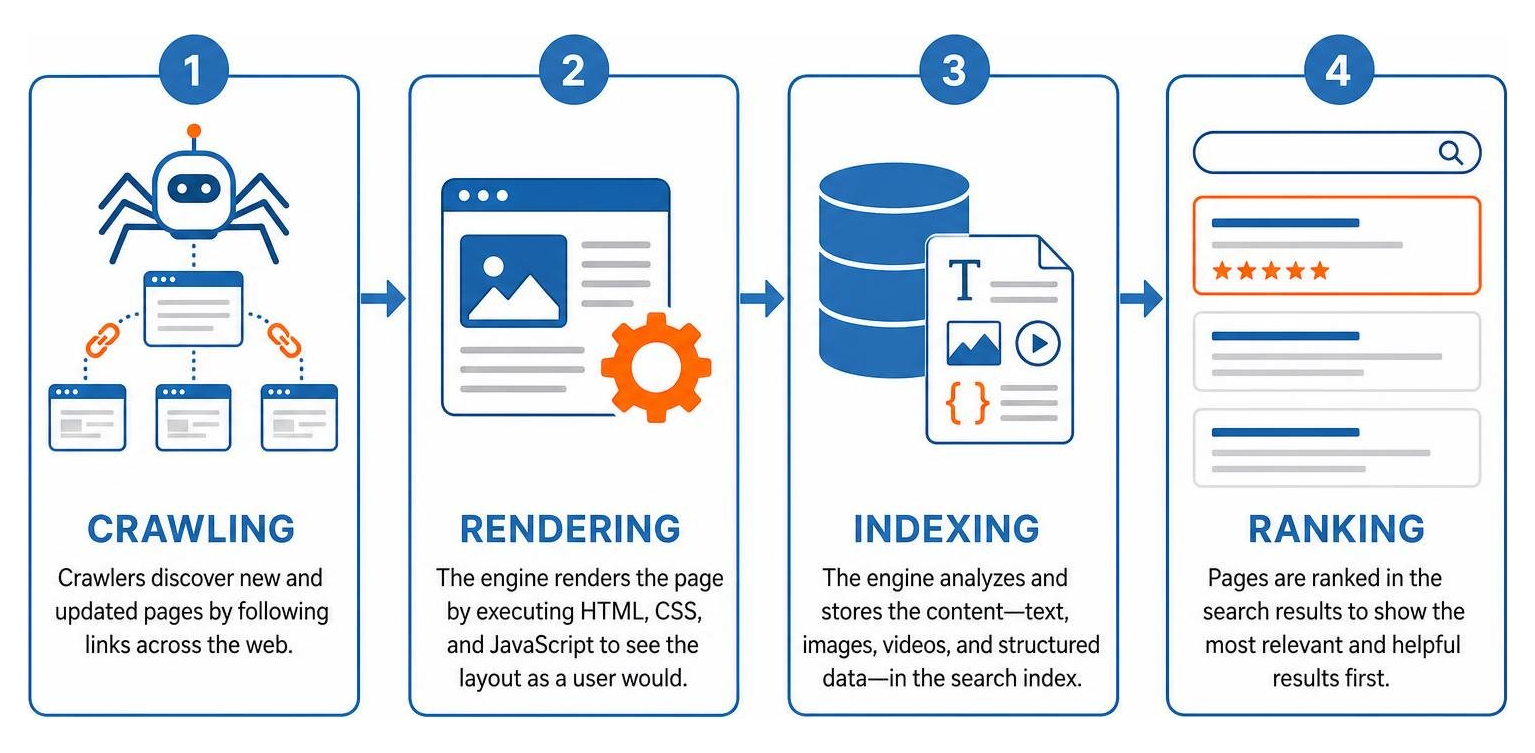
As outlined in the official Google SEO Starter Guide, this process follows four distinct mechanical stages:
- Crawling: Crawlers discover new and updated web pages by following hyperlinks from known pages across the indexed web, which currently contains well over 4.3 billion pages.
- Rendering: The search engine executes the page’s underlying HTML, CSS, and JavaScript code to see the layout and visual presentation exactly as a real user would in their browser.
- Indexing: The engine parses the text, images, videos, and embedded structured data, categorizing the content within a massive database called the search index.
- Ranking: When a user enters a query, proprietary ranking algorithms—originally rooted in Larry Page’s PageRank mathematical model—scan the index to return the most relevant, high-quality results.
How Search Engines Rank Web Pages Today
Modern search engines evaluate hundreds of complex, interacting ranking signals to determine which pages deserve top placement. If you review A Brief Glossary of 12 Essential SEO Terms, you will find that these ranking systems revolve around three primary goals: query intent, user experience, and domain authority.
With over 63% of search queries in the United States occurring on mobile devices, Google evaluates all websites using mobile-first indexing. This means the search engine crawls and grades the mobile version of your page rather than the desktop version.
Modern ranking systems also emphasize Google’s Core Web Vitals, which evaluate technical page experience:
- Largest Contentful Paint (LCP): Measures perceived loading speed. Your main content should load in under 2.5 seconds.
- Interaction to Next Paint (INP): Measures page responsiveness. Pages should respond to user clicks or taps in under 200 milliseconds.
- Cumulative Layout Shift (CLS): Measures visual stability. Content elements should not shift unexpectedly as assets load, maintaining a score below 0.1.
The Core Pillars of Search Engine Optimization
Successful search visibility requires treating optimization as an interconnected growth framework rather than a series of isolated tasks. When technical health supports quality content, and authority signals reinforce your brand, search engines reward your website with consistent rankings.
On-Page Optimization: Creating People-First, Relevant Content
On-page SEO involves optimizing everything visible on your individual web pages to help search engines and users understand your message. Mastering The Secret Sauce of On-Page Optimization starts with matching user search intent—the underlying goal someone has when typing a query:
- Informational Intent: Searchers seeking knowledge (e.g., “how to fix a leaking pipe”).
- Commercial Investigation: Searchers comparing potential solutions (e.g., “best water filtration systems for homes”).
- Transactional Intent: Searchers ready to purchase or book a service (e.g., “emergency plumber in Las Vegas”).
To optimize your on-page elements effectively:
- Page Titles (Title Tags): Write unique, descriptive titles under 60-70 characters that include your primary topic and compelling value propositions.
- Meta Descriptions: Draft concise 150-character summaries that invite searchers to click through without making misleading promises.
- Heading Structure (H1, H2, H3): Use a single, clear H1 heading for your page title, followed by logical H2 and H3 subheadings formatted as complete, context-rich questions.
- Descriptive URLs: Structure clean, readable URL slugs using hyphens (e.g.,
/services/water-heater-repair) rather than random alphanumeric strings. - Image Optimization: Compress images to modern formats like WebP, descriptive filenames, and descriptive image alt text for accessibility and image search indexing.
Technical SEO: Building a Flawless Site Foundation
Technical SEO ensures your website is easily accessible to search crawlers and provides a fast, secure experience for visitors. Think of technical SEO as your operational defense—without it, your content cannot perform.
Key technical elements include:
- Site Architecture: Maintain a clean, logical folder structure that keeps important pages within three clicks of the homepage.
- XML Sitemaps: Generate and submit an updated XML sitemap via Google Search Console and Bing Webmaster Tools to streamline URL discovery.
- Robots.txt Configuration: Place a
robots.txtfile in your root directory to instruct crawlers which administrative paths to ignore, preserving crawl budget. - Canonical Tags (
rel="canonical"): Use canonical link tags to point search engines to the preferred version of a page, preventing duplicate content confusion across parameter URLs. - HTTPS Encryption: Secure your site with an SSL certificate to protect visitor data and meet basic security baselines.
Off-Page SEO: Building Trust, Authority, and Quality Backlinks
Off-page optimization encompasses all external signals that demonstrate your site’s credibility, reputation, and authority across the broader web.
A primary signal in off-page optimization is the backlink—a hyperlink from an external domain pointing back to your website. Check out our In-Depth Guide to Backlinks: What They Are and Why You Need Them to understand how search engines view these links as third-party votes of confidence.
Sustainable off-page authority is built through:
- Digital PR and Thought Leadership: Publishing original research, industry survey insights, and expert commentary that journalists cite naturally.
- Unlinked Brand Mentions: Building a recognized, reputable brand that customers and industry peers discuss across forums, review platforms, and news outlets.
- Local Citations and Directory Listings: Maintaining consistent Name, Address, and Phone Number (NAP) information across trusted regional business directories.
Navigating the Future: Generative Search, AI, and Social Discovery
The way consumers discover information is undergoing a major shift. With the global search market continuing to expand and over 82% of consumers finding AI-powered search answers helpful, organic search strategies must adapt to changing user habits.
Implementing proactive Search Engine Optimization (SEO) Strategies for Improved Online Visibility now requires optimizing for both traditional search engine pages and generative answer engines.
Modern Search Engine Optimization in the Age of AI
Search engines increasingly synthesize conversational answers directly at the top of the results page using AI Overviews and generative interfaces. This has introduced two complementary disciplines: Generative Engine Optimization (GEO) and Answer Engine Optimization (AEO).

Recent search studies reveal that over 76% of all AI Overview citations originate from websites already ranking within the top 10 traditional organic search results. Generative search engines use a “query fan-out” method, breaking a single prompt into multiple related sub-queries to gather comprehensive source material.
To optimize for AI discovery:
- Focus on Intent Density: Provide clear, direct answers within the first 40 to 60 words of your content sections before expanding into detailed analysis.
- Demonstrate Real Experience: Include specific case data, original workflows, and first-hand clinical or field observations that AI language models cannot fabricate.
- Implement Structured Data (Schema.org): Mark up your articles, FAQs, local business profiles, and service pages with JSON-LD schema to help machine models extract key entities accurately.
Social Search and Multi-Channel Visibility
Search behavior is no longer confined to traditional search boxes. Today, 66% of searchers in the United States use a mix of search engines and social media channels to evaluate service providers and research purchases.
Consumers frequently search platforms like YouTube, LinkedIn, Reddit, and TikTok for authentic peer reviews, step-by-step video tutorials, and direct professional recommendations. Modern organic growth means ensuring your brand’s educational resources, video content, and thought leadership appear across every channel where your prospects seek answers.
Common SEO Myths and Outdated Tactics to Avoid
As search engine algorithms have matured, many legacy optimization tactics have become ineffective or actively harmful. Understanding the historical evolution of search engine optimization helps clarify why deceptive shortcuts no longer work in modern search.
Debunking Algorithm and Ranking Factor Misconceptions
Several persistent myths continue to confuse new website owners:
- The Meta Keywords Tag Myth: Google Search algorithms have completely ignored the
tag for more than fifteen years. Spending time filling out keyword fields in your CMS has zero impact on rankings. - Arbitrary Word Count Targets: Search engines do not require pages to meet arbitrary word counts (such as “every post must be 2,000 words”). Quality is evaluated on how comprehensively and efficiently you answer the searcher’s question.
- Strict Heading Hierarchy Rules: While semantic HTML formatting (H1, H2, H3) helps accessibility and user readability, search algorithms do not penalize sites if a heading tag level is skipped.
- E-E-A-T as a Direct Algorithmic Factor: Experience, Expertise, Authoritativeness, and Trustworthiness (E-E-A-T) are human principles from Google’s Search Quality Rater Guidelines used to evaluate system performance—not a direct, numeric scoring metric hard-coded into the algorithm.
Risky Link Schemes and Low-Quality Shortcuts
Attempting to manipulate search rankings through artificial tactics violates webmaster guidelines and introduces severe operational risk:
- Buying Link Packages: Purchasing mass backlinks from private blog networks (PBNs) or spam directories leads to algorithmic link suppression or manual penalties.
- Keyword Stuffing: Repeating exact search phrases unnaturally throughout your copy creates an unreadable user experience and triggers automated spam filters.
- Automated Thin Content: Publishing hundreds of generic, unedited AI-generated pages without expert oversight results in low engagement, high bounce rates, and index exclusion.
- Deceptive Doorway Pages: Creating dozens of nearly identical geographic pages that offer no unique local value clutters crawl resources and degrades brand trust.
Measuring SEO Success and Setting Realistic Timelines
Organic search is an operational investment that compounds over time. To track your return on investment accurately, consult The Ultimate Guide to Digital Marketing SEO Basics and set up a reliable measurement framework.
Connecting Google Analytics 4 (GA4) and Google Search Console (GSC) allows you to track leading indicators alongside real business outcomes:
- Google Search Console: Monitors crawl health, index status, total search impressions, average position, and organic click-through rates (CTR).
- Google Analytics 4: Tracks user engagement time, multi-touch session paths, and key conversion events such as form submissions, consultation bookings, and phone calls.
Understanding SEO Timelines and Compounding Growth
SEO is not an overnight tactic. While paid search delivers immediate traffic that stops the moment ad spend ends, organic optimization builds permanent digital assets:
- Months 1–2: Technical audits, correcting crawl errors, configuring site structure, fixing Core Web Vitals, and conducting audience research. Technical improvements often reflect in search indexes within 2 to 4 weeks.
- Months 3–4: Publishing high-intent, people-first content clusters, optimizing existing metadata, and structuring internal links. Early ranking movements and impression growth typically accelerate during this window.
- Months 5–6+: Compounding organic authority, steady increases in qualified search traffic, and higher conversion volumes.
Core Performance Metrics vs. Vanity Numbers
Avoid judging organic performance solely on vanity metrics like raw traffic volume or broad keyword rankings. Instead, measure performance against key operational indicators:
$$\text{SEO ROI} = \left(\frac{\text{Revenue from Organic Search} – \text{Cost of SEO}}{\text{Cost of SEO}}\right) \times 100$$
Focus on:
- High-Intent Conversion Rates: The percentage of organic visitors who convert into qualified leads, consultations, or paying clients.
- Pipeline Attribution: The total sales pipeline value generated by organic search touchpoints across the customer journey.
- Customer Acquisition Cost (CAC): The long-term reduction in blended customer acquisition costs as organic traffic scales.
Frequently Asked Questions About Search Engine Optimization
How long does it typically take to see tangible results from SEO?
Most websites begin seeing initial ranking adjustments and organic impression growth within 3 to 6 months of executing a consistent strategy.
Technical fixes can show crawl improvements within a few weeks, while newly published content clusters and authority-building efforts typically require several months to mature and achieve top positions.
What is the primary difference between SEO, SEM, and PPC?
SEO focuses exclusively on earning unpaid visibility in organic search listings through content relevance, technical performance, and earned authority.
PPC is an advertising model where businesses pay a specific fee each time an ad is clicked. SEM is the broader discipline encompassing both organic optimization (SEO) and paid search advertising (PPC) strategies.
Is E-E-A-T an explicit algorithmic Google ranking factor?
No. Google has confirmed that E-E-A-T (Experience, Expertise, Authoritativeness, and Trustworthiness) is not a direct mathematical ranking signal.
Instead, it is a conceptual framework taught to human Search Quality Raters to grade search result quality, helping engineers refine algorithms to reward helpful, expert-led content.
Conclusion
Search engine optimization is not about chasing algorithmic tricks or manipulating search engines. True organic visibility comes from building an integrated, human-centered digital ecosystem where technical performance, exceptional content, and authentic domain authority work together.
When your organic search strategy connects directly with clear communication, automated lead follow-up, and measurable analytics, search traffic becomes a reliable, sustainable engine for business growth.
Ready to build an organic search system that scales your business efficiently? Explore our complete Search Engine Optimization (SEO) Services to turn search visibility into predictable revenue.
Get Started Now
Fill out this form to start your journey to next-level marketing solutions for your business.