

The Digital Storefront: Why Online Visibility Matters
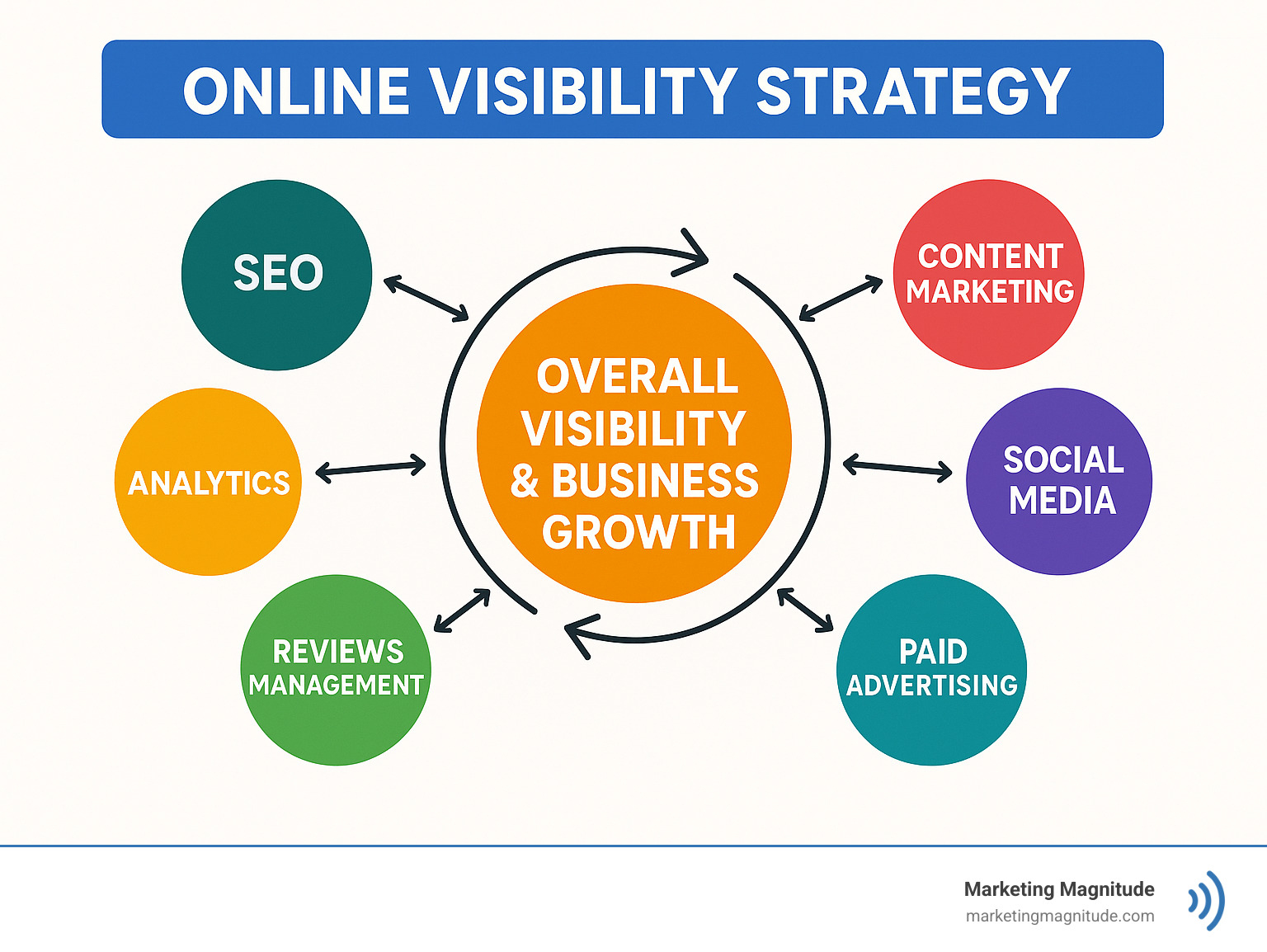
An online visibility strategy is a structured plan to increase how easily your business can be found across digital channels including search engines, social media, review sites, and online directories.
Here’s what every effective online visibility strategy includes:
- Search Engine Optimization (SEO) – Optimizing your website to rank higher in organic search results
- Content Marketing – Creating valuable content that attracts and engages your target audience
- Social Media Presence – Active engagement on platforms where your customers spend time
- Online Reviews Management – Generating and responding to customer feedback
- Paid Advertising – Strategic use of PPC, display ads, and social media advertising
- Directory Listings – Consistent business information across relevant online directories
In today’s digital landscape, being visible online isn’t optional—it’s essential. Consider this: 97% of consumers search online for local products and services, and 88% research online before making a purchase either online or in-store. Your potential customers are spending over eight hours daily on digital activities, actively seeking solutions to their problems.
Whether you’re a small local business or a growing enterprise, your online visibility strategy directly impacts your credibility and bottom line. With 56% of consumers refusing to consider businesses without websites and 75% judging a company’s credibility based on their online presence, visibility has become the foundation of digital trust.
Think of online visibility as your digital storefront—one that’s open 24/7, reaching potential customers wherever they are. Unlike traditional marketing, a comprehensive online visibility strategy allows you to track performance in real-time, optimize based on data, and reach highly targeted audiences at precisely the right moment.
I’m Kelly Rossi, and as a digital marketing expert with over 20 years of experience implementing effective online visibility strategies for businesses of all sizes, I’ve seen how the right approach can transform a company’s online presence and drive sustainable growth.
Why Online Visibility Matters for Every Business
Local businesses might wonder if online visibility is truly essential for them. The data speaks volumes: 97% of people search online to find local businesses, and 63% of shopping journeys begin online—even when the purchase happens in a physical store. In fact, according to BrightLocal, 83% of consumers visit a store within 24 hours of conducting a local search.
For businesses of all sizes, the benefits of a strong online visibility strategy extend far beyond mere presence:
- Increased traffic and leads: Businesses that publish blogs four times a week get 3.5x more traffic and 4.5x more leads than those blogging just once a week.
- Improved credibility: 75% of consumers admit to judging a company’s credibility based on their website design alone.
- 24/7 availability: Your online presence works around the clock, capturing interest and generating leads even when you’re sleeping.
- Data-driven decision making: Online channels provide rich analytics that help refine your marketing approach.
- Expanded reach: Even small local businesses can reach customers beyond their immediate geographic area.
In Las Vegas and Austin, where our Marketing Magnitude offices are located, the competition for online visibility is particularly fierce. Local businesses must work even harder to stand out in these dynamic markets.
Crafting Your Online Visibility Strategy: Core Channels
An effective online visibility strategy isn’t about finding that one magical marketing channel—it’s about creating a seamless presence across multiple platforms where your customers are already spending their time. I like to think of it as filling “every nook and cranny” of the internet where your potential customers might be looking.
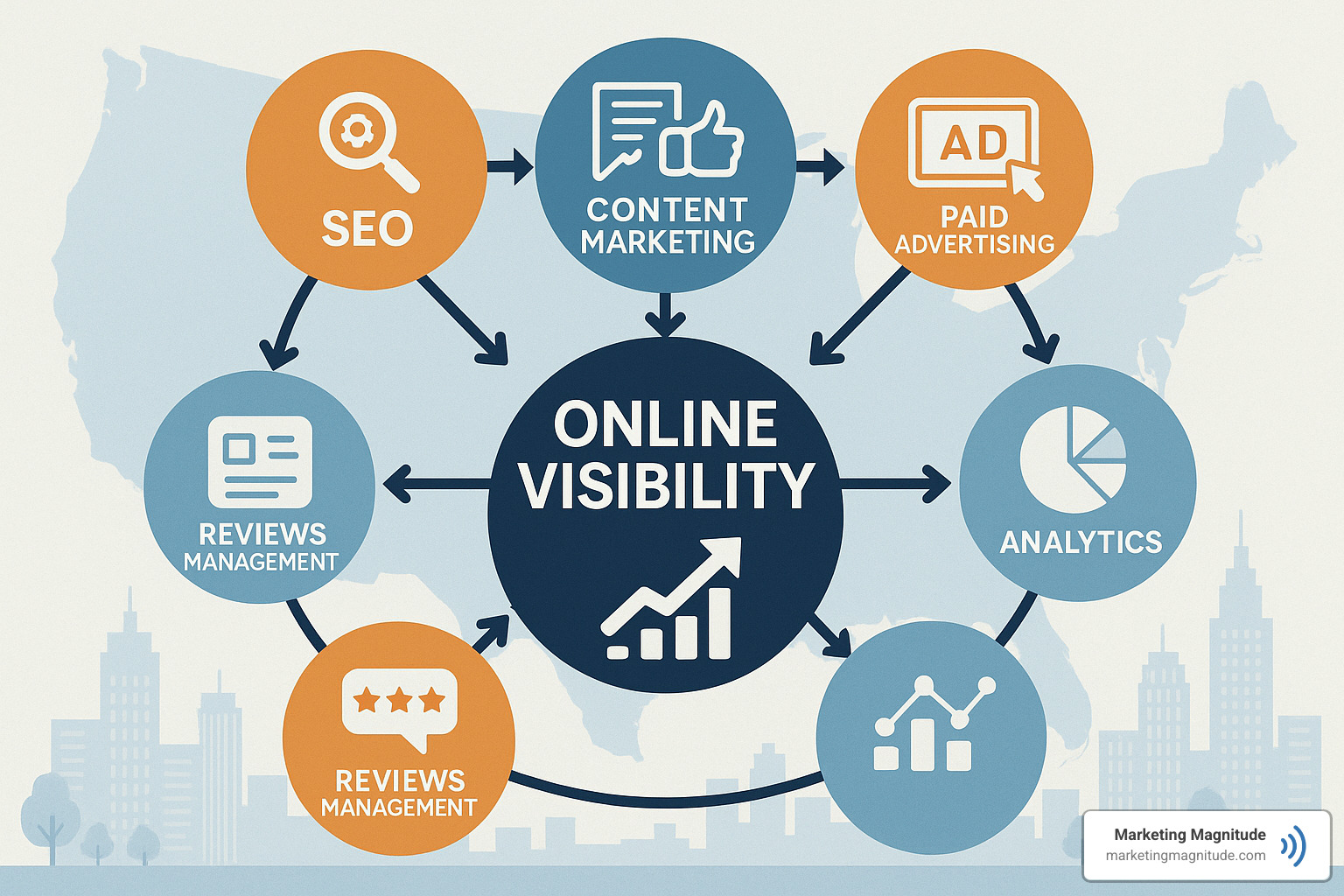
The most successful businesses understand that different channels serve unique purposes throughout the customer journey. Here’s how these key components work together:
| Channel | Primary Purpose | Visibility Timeline | Cost Efficiency | Measurement Metrics |
|---|---|---|---|---|
| SEO | Long-term organic visibility | 3-6 months | High (time investment) | Rankings, organic traffic, conversions |
| PPC | Immediate visibility, specific targeting | Immediate | Medium (pay per click) | Impressions, clicks, conversions, ROAS |
| Social Media | Community building, brand awareness | 1-3 months | Medium (organic + paid) | Engagement, reach, followers, referral traffic |
| Content Marketing | Authority building, SEO support | 3-6 months | High (time investment) | Traffic, time on page, lead generation |
| Email Marketing | Direct communication, nurturing | Immediate to days | Very high | Open rates, click rates, conversions |
| Directories/Listings | Local visibility, NAP consistency | 1-2 months | High (many free options) | Citation accuracy, local rankings |
We’ve seen at Marketing Magnitude that when these channels work together, they create a multiplier effect—the whole visibility ecosystem becomes greater than the sum of its parts. It’s like a well-orchestrated band rather than solo performers.
According to recent research on online advertising, businesses that integrate multiple channels see significantly higher conversion rates than those relying on a single approach.
SEO + Content: The Foundation of any Online Visibility Strategy
Search Engine Optimization remains the bedrock of any comprehensive online visibility strategy. Why? Because 89% of customers begin their buying process with a search engine query. When done right, SEO delivers sustainable, long-term visibility without the ongoing costs of paid advertising.
Think of SEO as building equity in your digital home. The work you put in continues paying dividends long after it’s done. The key elements of an effective SEO foundation include keyword research to find what your audience is actually searching for, not just what you think they want. Tools like Google Keyword Planner can reveal these golden opportunities.
On-page optimization is where the rubber meets the road—structuring your content to align with search intent by including target keywords in titles and headers, creating compelling meta descriptions, and using schema markup to enable those eye-catching rich snippets in search results.
Your site’s technical health matters enormously too. Technical SEO ensures your site meets Google’s Core Web Vitals standards with fast page loading (under 2.5 seconds), mobile-friendly design, and secure HTTPS encryption. Google now uses mobile-first indexing, so how your site performs on phones is more important than desktop.
The heart of SEO is your content strategy. Publishing high-quality, valuable content consistently pays enormous dividends. We’ve seen businesses that blog four times weekly attract 3.5x more traffic than those blogging just once a week. Each piece should address a specific customer question, be structured for featured snippets, and include internal links to other relevant content on your site.
Google’s algorithm keeps evolving toward rewarding content that genuinely helps users. As I often tell our clients in Nevada and across the United States, focus on solving problems for your audience, and visibility will naturally follow. For more detailed guidance, check out more info about Search Engine Optimization.
Paid Media: Fuel to Accelerate Your Online Visibility Strategy
While SEO builds your foundation, paid advertising provides the rocket fuel to accelerate your online visibility strategy. The primary advantage? Immediate visibility at the precise moment of customer intent.
From our experience at Marketing Magnitude, businesses typically see results from paid search campaigns within days—compared to the months required for organic SEO efforts to mature. It’s like the difference between planting a garden (SEO) and buying produce at the market (paid ads)—both valuable, but on different timelines.
Google Ads remain the powerhouse of paid search, letting you appear at the top of search results for specific keywords. The secret to success here is improving your Quality Score by creating harmony between your ad copy, keywords, and landing pages. We’ve seen conversion rates double simply by creating unique landing pages for each ad group.
Display advertising helps build brand awareness through visual ads across the web. The magic happens when you retarget visitors who’ve already shown interest in your products. One client saw a 70% increase in conversions after implementing a strategic retargeting campaign.
Social media advertising lets you reach highly targeted audiences based on incredibly detailed demographics and interests. Facebook and Instagram ads work wonders for B2C businesses, while LinkedIn ads deliver for B2B targeting. The platform you choose should reflect where your audience naturally spends their time.
For service-based businesses in Las Vegas, Austin, and beyond, Local Service Ads provide a powerful advantage with that trust-building Google guaranteed badge. Plus, you only pay per lead rather than per click.
The key to successful paid media is continuous optimization and testing. Our real-time tracking lets clients see exactly how their campaigns are performing and make data-driven adjustments on the fly. Want to see how your current ads stack up? Try Our FREE Ads Grader!
Social Media Amplifiers & Employee Advocacy
Social media has evolved far beyond simple broadcasting—it’s now a vibrant, essential component of any online visibility strategy. The numbers tell the story: 91% of consumers will visit a brand’s website after following them on social media, 89% will buy from the brand, and 85% will recommend the brand to others.
Success on social media isn’t about being everywhere at once. Platform choice is crucial—focus on quality over quantity by selecting the platforms where your audience is most active. A focused presence on two platforms beats a mediocre presence on five every time.
The heart of social media is engagement, not broadcasting. It’s about building relationships through two-way conversations. Respond to comments, ask thoughtful questions, and create genuine connections. One of our clients saw engagement triple simply by changing their approach from promotional to conversational.
Finding the right posting cadence matters too. Consistency trumps frequency—it’s better to post thoughtfully three times a week than to spam daily with low-quality content. For most businesses, this means 1-2 posts daily on visual platforms like Instagram and more frequent updates on micro-blogging sites like Twitter.
One of our favorite visibility boosters is employee advocacy. Your team members have networks that, collectively, can reach 10x more people than your brand channels alone. Content shared by employees receives 8x more engagement than content shared through brand channels.

Don’t overlook the power of user-generated content (UGC). Authentic content created by your customers builds trust in ways your own marketing simply can’t match. Encourage reviews, testimonials, and social sharing with branded hashtags. Many platforms now offer AI captions to help make your content more accessible and engaging across different formats.
Social video deserves special mention—it generates 1200% more shares than text and image content combined. Whether it’s short-form content for TikTok or longer educational videos for YouTube, video content should be a core component of your online visibility strategy.
Email & Video: Direct Lines to Your Audience
While social media and search are vital visibility channels, email marketing remains the most direct and controlled way to reach your audience. Here’s a surprising fact: while 79% of people check social media daily, a whopping 99% check their email daily—often multiple times.
Email marketing shines as part of your online visibility strategy because you actually own the list. Unlike social platforms where algorithm changes can decimate your reach overnight, your email list is an asset you control completely. Plus, email boasts higher conversion rates with an average ROI of $42 for every $1 spent, making it one of the most cost-effective channels available.
The magic happens when you use segmentation to deliver highly relevant content based on behavior, interests, or demographics. One of our clients increased their open rates by 30% simply by dividing their list into three interest-based segments.
Crafting irresistible subject lines is an art form worth mastering—47% of recipients open emails based solely on the subject line. We’ve found that personalized subject lines with a hint of curiosity consistently outperform generic announcements.
Video content has become indispensable for online visibility. Viewers retain 95% of a message when watching a video compared to just 10% when reading text. What’s more, websites with video are 50x more likely to reach the front page of Google.
The most effective videos aren’t necessarily the most polished. Authentic content that answers customer questions or demonstrates products often outperforms high-budget productions. Live streams create especially strong connections by allowing real-time interaction with your audience.
At Marketing Magnitude, we help businesses in Nevada and beyond develop integrated email and video strategies that maintain visibility throughout the customer journey—from initial awareness to post-purchase loyalty. We’ve seen how these direct channels create lasting relationships that algorithmic platforms simply can’t match.
Winning the Reputation & Trust Game: Reviews, Listings, Local SEO
Let’s talk about something that keeps many business owners up at night – their online reputation. The truth is, your reputation is already living online whether you’re actively managing it or not. Any solid online visibility strategy must include reputation management, particularly through reviews and business listings.
I’ve seen how dramatically reviews can transform a business’s success. The numbers tell the story: customer reviews can boost conversion rates by a whopping 270%, with 95% of shoppers reading online reviews before making a purchase decision. Perhaps most telling is that 85% of consumers trust these online reviews just as much as recommendations from friends and family.
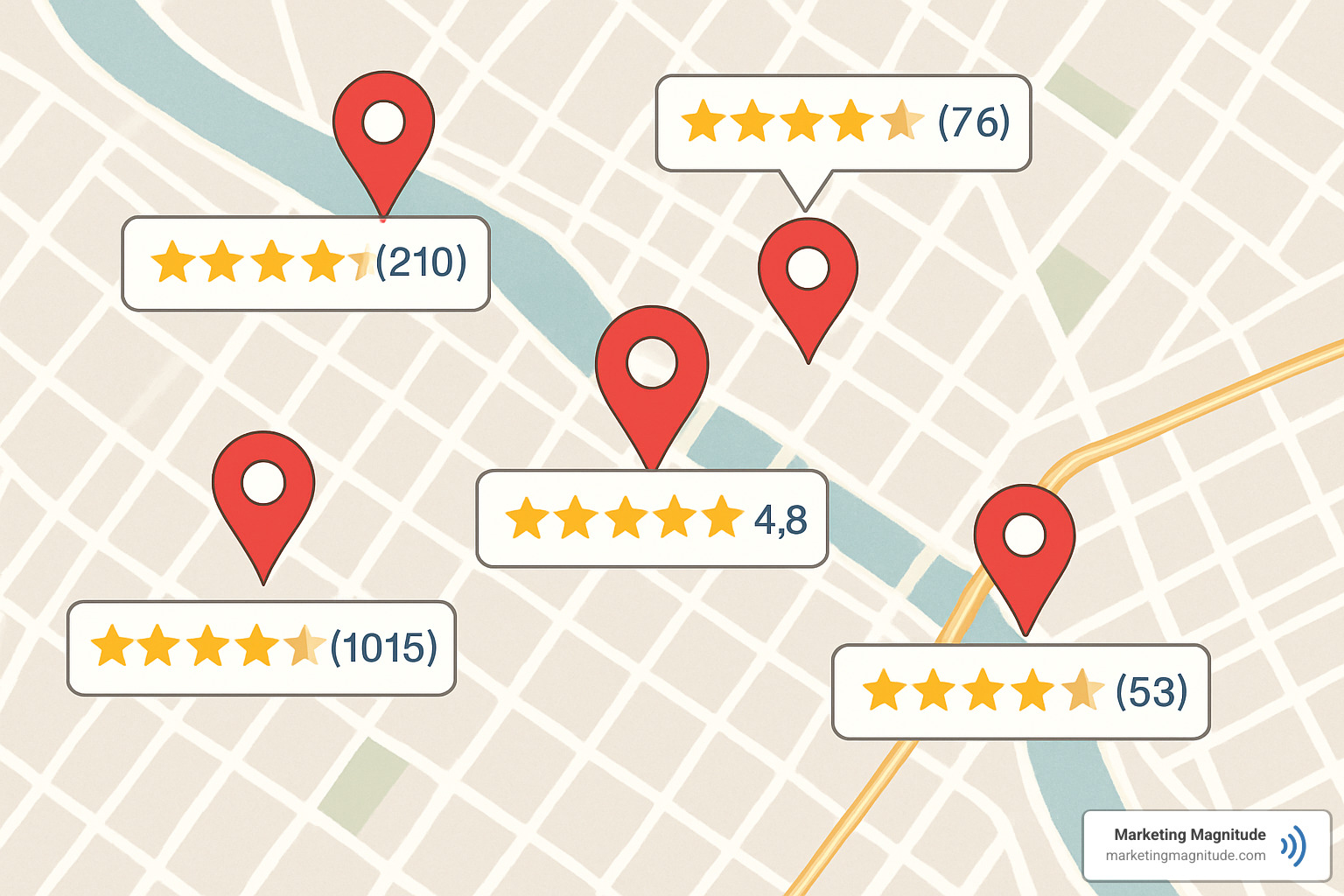
For our local clients in vibrant markets like Las Vegas and Austin, local SEO is absolutely essential. When someone searches for a service “near me,” Google’s local pack (those map results at the top) determines visibility based on three key factors:
Relevance – How perfectly your business matches what the person is searching for. This is why being specific about your services matters so much.
Proximity – How close your business is to the searcher or their searched location. This is the one factor you can’t directly control, but it highlights why accurate address information is crucial.
Prominence – How well-known and reputable your business appears to be. This is largely determined by the quality and quantity of your reviews and citations across the web.
The good news? You can influence all three factors with the right approach to reviews and listings.
Review Generation & Management
Getting reviews isn’t something you can leave to chance. You need a thoughtful, systematic approach to generating, monitoring, and responding to what customers say about you online.
Start by asking consistently. We help our clients develop simple processes for requesting reviews at just the right moment in the customer journey – maybe it’s right after they’ve expressed satisfaction with your service, when a project wraps up successfully, or after they’ve had time to enjoy their purchase.
Make the review process ridiculously easy for customers. Nobody wants to hunt around for where to leave feedback. Provide direct links to your preferred review platforms in follow-up emails or text messages. For most businesses, Google Business Profile should be your top priority, followed by industry-specific sites like Yelp, TripAdvisor, or Houzz.
Here’s something many businesses miss: respond to every single review, positive or negative. Did you know 89% of consumers read businesses’ responses? When you thank positive reviewers and address negative feedback thoughtfully, you’re not just speaking to that one customer – you’re showing everyone else how you treat people.
We also help clients monitor sentiment beyond just review platforms. Using social listening tools, you can track mentions across the web and address concerns before they escalate into bigger issues.
I’ve seen businesses implement these proactive review strategies and typically enjoy a 15-20% increase in conversion rates within just three months. That’s real money in your pocket from simply managing what people already say about you.
Power Listings & Local Citations
Think of your business listings as digital real estate – property you need to claim and maintain across the internet. Consistent business information across online directories (what we call citations) is absolutely crucial for local visibility.
Your Name, Address, and Phone number (NAP) should be identical everywhere they appear online. Even small differences like “Street” vs. “St.” can confuse search engines and potentially harm your visibility.
The must-have directories include Google Business Profile (absolutely essential for local search), Yelp (with its impressive 178 million monthly visitors), Facebook Business, Bing Places, Apple Maps, and any industry-specific directories relevant to your specific business.
According to research from Chatmeter, 80% of consumers lose trust in local businesses when they find incorrect or inconsistent online information. Yet surprisingly, many businesses neglect this fundamental aspect of their online visibility strategy.
Beyond just getting the basic information right, take time to optimize your listings with high-quality photos (businesses with photos receive 42% more requests for directions!), complete business details like hours and services, special features like booking buttons, and accurate category selections that truly reflect what you do.
For businesses with multiple locations, maintaining consistent information across dozens or hundreds of listings can be a real headache. At Marketing Magnitude, our listings management service ensures your NAP consistency across all major platforms, giving your local visibility a serious boost whether you’re in Nevada, Texas, or anywhere nationwide.
The best part? Most of these listings are completely free – they just require the time and knowledge to set up correctly. It’s one of the highest-ROI activities in any comprehensive online visibility strategy.
Monitoring, Benchmarking & Adapting Your Strategy
Your online visibility strategy isn’t something you can set up once and forget about. The digital world moves too quickly for that! Think of your strategy like a garden that needs regular tending—you’ll need to monitor performance, compare yourself to competitors, and make adjustments based on what the data tells you.
Here’s what smart businesses are tracking:
- Website traffic that shows you who’s visiting, where they’re coming from, and what they’re doing
- Search rankings for the keywords that matter most to your business
- Social engagement metrics that reveal what content resonates with your audience
- Share of Voice that compares your visibility against competitors
- Presence Score that gives you a simple 0-100 measurement of your overall online visibility
- Conversion metrics that connect visibility to actual business results like leads and sales

At Marketing Magnitude, we believe transparency is everything. That’s why our clients get access to real-time tracking dashboards that show exactly how their visibility efforts are performing. No waiting for monthly reports or wondering what’s happening behind the scenes—you see what we see, when we see it.
Tools & Techniques to Track Online Visibility
You don’t need a massive budget to keep tabs on your online visibility strategy. Here are some powerful tools that can help:
Google Analytics forms the backbone of your visibility tracking. It shows you not just how many people visit your site, but how they found you, what they did while visiting, and whether they took the actions you wanted. Setting up custom dashboards for your key metrics makes monitoring even easier.
Google Search Console is your window into SEO performance. It reveals which search terms are bringing visitors to your site, how often your pages appear in search results, and any technical issues that might be holding you back. It’s completely free and invaluable for understanding your search visibility.
Social listening tools help you track mentions across the web—even when people don’t tag you directly. This gives you a more complete picture of your online presence and helps you spot potential problems before they escalate.
For local businesses, keeping an eye on reviews and listings is crucial. Tools like Google Alerts (free!) can notify you whenever your business is mentioned online. This simple setup can help you find new backlink opportunities and stay on top of your reputation.
The real magic happens when you combine automated monitoring with regular human review. At Marketing Magnitude, we’ve found that setting up anomaly detection—systems that flag sudden changes in metrics—helps our clients spot both problems and opportunities that require immediate attention.
Staying Ahead of Digital Trends
The only constant in digital marketing is change! A forward-thinking online visibility strategy needs to account for emerging trends and shifts in the landscape.
Search engines like Google make thousands of algorithm changes yearly, with several major updates that can dramatically impact visibility overnight. Staying informed about these changes helps you adapt quickly rather than wondering why your traffic suddenly dropped.
The social media landscape is equally dynamic. Remember when TikTok seemed to come out of nowhere? Platforms rise and fall in importance, and your strategy needs to evolve accordingly. This doesn’t mean chasing every new platform, but rather understanding where your audience is spending their time.
Voice search continues to grow, with 27% of the global online population now using voice search on mobile devices. This shift toward conversational queries means optimizing your content for how people talk, not just how they type.
Content formats are evolving too. Short-form video, interactive content, and other emerging formats are gaining prominence in visibility algorithms. The businesses that experiment with these formats often gain early advantages in visibility.
Inclusivity matters more than ever. Content that serves diverse audiences and meets accessibility standards isn’t just the right thing to do—it’s increasingly rewarded with better visibility in search and social algorithms.
At Marketing Magnitude, we help businesses in Las Vegas, Austin, and across the United States stay ahead of these trends through continuous learning and adaptation. We focus on building strong visibility foundations that can withstand algorithm changes while remaining flexible enough to capitalize on new opportunities. Our LocalIQ grader can help you understand where you stand today, while our Position Tracking tools monitor your progress over time.
Want to dive deeper into the science behind SEO visibility? Check out this scientific research on SEO visibility that explains the underlying principles that drive search rankings.
Frequently Asked Questions about Online Visibility
How does an online visibility strategy differ from brand awareness?
I get this question all the time from our clients in Las Vegas and Austin. While they’re certainly cousins in the marketing family, online visibility and brand awareness serve different purposes in your digital marketing mix.
Think of online visibility as your digital findability factor—it’s how easily potential customers can find you when they’re actively searching. This includes your search rankings, directory listings, social media presence, and anywhere else you appear online. It’s measurable and actionable.
Brand awareness, on the other hand, lives in people’s minds. It’s about recognition and familiarity with your company, regardless of where someone encounters you. A person might recognize your logo or name without ever having visited your website.
Then there’s online presence, which simply means having digital assets like a website or social profiles—but without strategy, these might be virtually invisible to your target audience.
The beauty of a comprehensive online visibility strategy is that it naturally boosts brand awareness while focusing specifically on making your business findable when people are actively looking for solutions you provide. It’s the difference between being known and being found when it matters most.
What key metrics should I watch to gauge success?
When clients ask me which numbers really matter, I always tell them it depends on their specific business goals—but there are certainly universal indicators worth tracking.
Organic search traffic shows how many visitors are finding you through non-paid search results, which is the lifeblood of sustainable visibility. Closely related are your search rankings for target keywords—the closer to position one, the better your visibility.
Pay attention to your click-through rates (CTR) too. A high ranking doesn’t help much if nobody clicks! This percentage tells you how compelling your listings appear to searchers.
Engagement metrics like comments, shares, and interactions across platforms indicate how your audience responds to your content once they find you. Meanwhile, conversion rates reveal whether your visibility is attracting the right audience who takes desired actions.
For competitive insight, track your Share of Voice—how visible you are compared to competitors for key terms. And don’t forget about citation accuracy (consistency of your business information across directories) and review volume and sentiment, which heavily influence local visibility.
At Marketing Magnitude, our clients love our real-time reporting dashboards that track these metrics (and many more) in one place, giving them a comprehensive view of their visibility performance without drowning in data.
How can small businesses compete with bigger brands?
I love this question because I’ve seen so many small businesses punch above their weight class online. The digital playing field is more level than many realize!
Small businesses actually have several advantages they can leverage. First, local focus is a superpower—dominating geo-specific searches with an optimized Google Business Profile and locally-relevant content can put you ahead of national brands in your area.
Your niche expertise is another asset. While big companies try to be everything to everyone, you can target specific long-tail keywords that may have less competition but high relevance to your exact offerings.
Agility is perhaps your greatest advantage. Without layers of corporate approval, you can adapt quickly to algorithm changes and emerging trends while bigger competitors are still scheduling meetings to discuss them.
Don’t underestimate authenticity either. Today’s consumers crave genuine connections. Showcasing the real people behind your business creates trust that faceless corporations struggle to match.
Finally, community engagement can set you apart. Active participation in local online communities and discussions builds relationships that big brands often can’t maintain at scale.
We’ve helped numerous small businesses in Las Vegas and Austin achieve remarkable visibility victories against much larger competitors by focusing on these strategic advantages rather than trying to outspend them. The key is working smarter, not bigger.
More info about our SEO services
Conclusion
Let’s face it—in today’s digital world, an online visibility strategy isn’t just nice to have. It’s as essential to your business as electricity. Whether you’re a corner bakery in Las Vegas or a tech startup in Austin, being found online directly impacts your bottom line.
Throughout this guide, we’ve explored how combining SEO, content marketing, social media, paid advertising, and reputation management creates a visibility ecosystem greater than the sum of its parts. The businesses that thrive online don’t just excel at one channel—they create a coherent presence across multiple touchpoints where their customers already spend time.
What makes a truly effective online visibility strategy? It comes down to a few key principles:
Your strategy should maintain consistent messaging while appearing everywhere your audience looks. It should balance the immediate impact of paid tactics with the long-term value of organic efforts. Most importantly, it should evolve based on real data, not hunches or assumptions.
At Marketing Magnitude, we’ve seen how businesses transform when they gain clarity about their digital presence. Our clients appreciate our transparent, real-time reporting that shows exactly how their visibility efforts perform across every channel—no smoke and mirrors, just clear insights you can actually use.
Online visibility isn’t a “set it and forget it” project. The digital landscape shifts constantly, with new platforms emerging, algorithms changing, and consumer behaviors evolving. Your strategy needs to be living and breathing, adapting to these changes while staying true to your core business goals.
The good news? You don’t have to figure it all out alone. Our team at Marketing Magnitude specializes in creating custom online visibility strategies for businesses just like yours. We understand the unique challenges of standing out in competitive markets like Las Vegas and Austin because we live and work here too.
Ready to become more visible to the customers who matter most? Contact our team today for a free visibility audit. We’ll identify specific opportunities to improve your digital presence and help you develop a roadmap for sustainable online growth.
The best time to improve your online visibility was five years ago. The second best time is today.
Get Started Now
Fill out this form to start your journey to next-level marketing solutions for your business.


