
Why Most SEO Agencies Fail Before Day 90 — And What Should Actually Happen
Why most SEO agencies fail in the first 90 days (and what should actually happen) comes down to one core problem: the gap between what agencies promise and what they actually deliver in those early weeks.
Here is the quick answer:
| What Bad Agencies Do | What Good Agencies Do |
|---|---|
| Promise page-one rankings fast | Set realistic 4-12 month timelines |
| Skip technical audits | Start with a full site audit in Month 1 |
| Send vague reports | Share clear roadmaps and GSC data |
| Chase vanity metrics | Track impressions, indexing, and intent |
| Go quiet after onboarding | Communicate weekly with clear next steps |
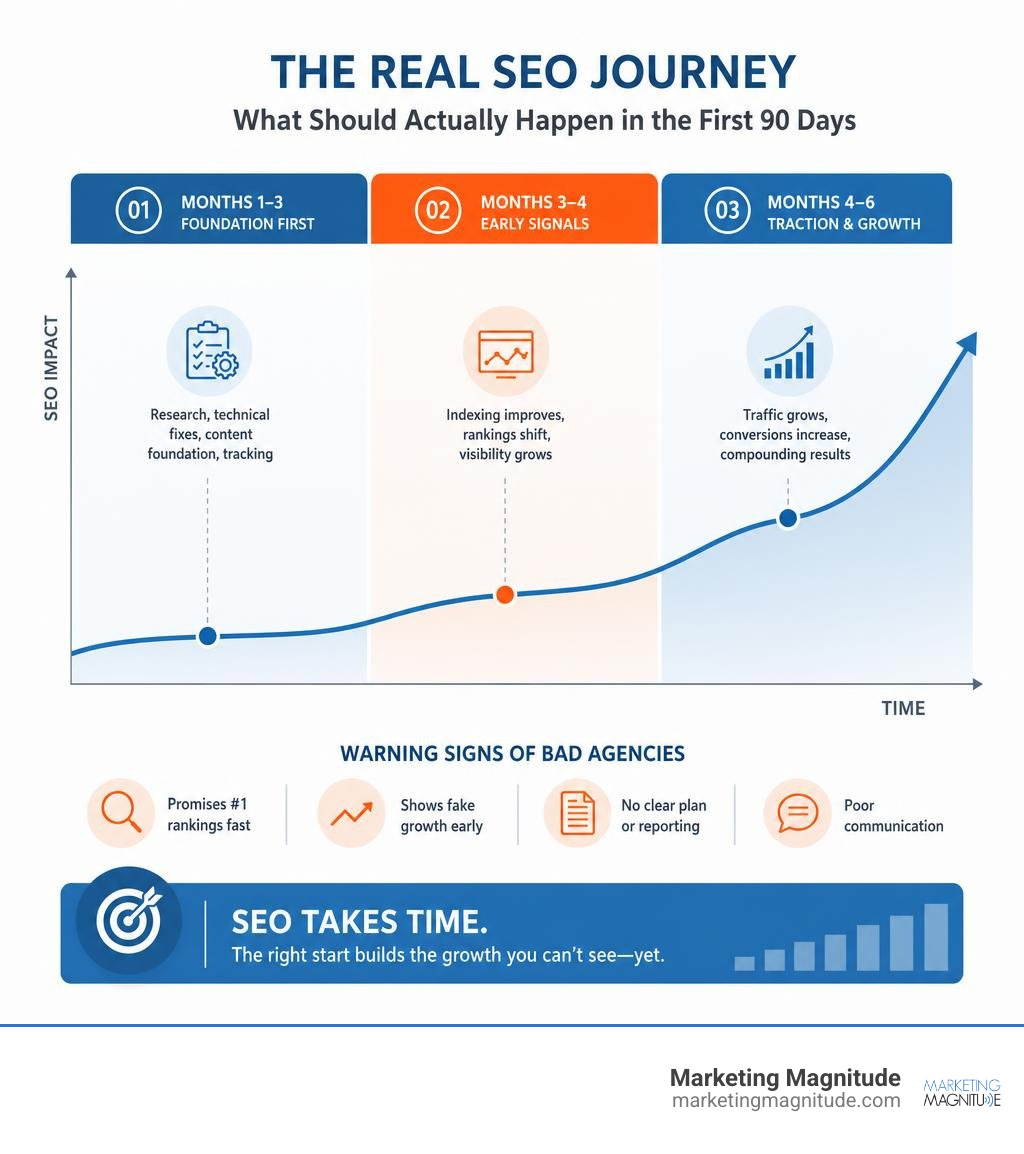
The reality: Google itself states that SEO typically takes 4 to 12 months to deliver sustainable results. Most businesses see early signals — like impression growth and indexing improvements — within 60 to 90 days. Meaningful traffic growth usually starts between months four and six.
Month one feels hopeful. Month two feels quiet. Month three can feel downright frustrating — and that is exactly when most businesses pull the plug, right before the work starts paying off.
That frustration is almost never caused by SEO failing. It is caused by wrong expectations set at the start.
I’m Kelly Rossi, founder of Marketing Magnitude and a digital marketing strategist with over 20 years of experience running SEO campaigns across dozens of industries. Understanding why most SEO agencies fail in the first 90 days — and what should actually happen instead is something I have lived firsthand, both fixing broken campaigns and building ones that compound over time.
“Why Most SEO Agencies Fail in the First 90 Days (And What Should Actually Happen)” Set expectations: What early SEO SHOULD look like Warning signs of bad agencies Real timeline vs fake promises
The first 90 days are the “foundation phase” of any digital marketing effort. Just as you wouldn’t judge a skyscraper’s stability while the crew is still digging the hole for the basement, you cannot judge an SEO campaign solely by its traffic in Month 2. However, many agencies fail because they treat these first three months as a “waiting period” rather than an active construction period.
To understand the difference, we must first define what is search engine optimization. It is a structured process of improving your site’s visibility in search engines. When agencies ignore the “structured” part and skip straight to “tactics,” the campaign is doomed before it begins.
“Why Most SEO Agencies Fail in the First 90 Days (And What Should Actually Happen)”
Most agency failures stem from a lack of strategic alignment. They might write a few blog posts or change some meta tags, but if they haven’t performed a deep dive into your business goals, they are just throwing spaghetti at the wall.
- The Strategy Gap: Many agencies use a “one-size-fits-all” checklist. They don’t take the time to understand your commercial priorities. If you sell high-ticket B2B consulting in Austin, your SEO needs are vastly different than a plumber looking for affordable SEO Las Vegas.
- Skipping the Hard Stuff: A comprehensive technical audit is time-intensive. Some agencies skip this and go straight to “content,” leaving your site with broken links, slow load speeds, and indexing bloat that prevents new content from ever ranking.
- Communication Blackouts: After the initial sales call, many agencies disappear. You might get a generic PDF report at the end of the month, but you have no idea what was actually done. At Marketing Magnitude, we prevent this through real-time tracking, so you never have to wonder about progress.
- Misunderstanding the Language: If your agency can’t explain their work without hiding behind jargon, they might be masking a lack of results. We recommend reviewing a brief glossary of 12 essential SEO terms to ensure you can hold your provider accountable.
Set expectations: What early SEO SHOULD look like Warning signs of bad agencies Real timeline vs fake promises
If you are wondering why most SEO agencies fail in the first 90 days (and what should actually happen), look at the roadmap. A healthy campaign should feel active and transparent. By Day 30, you should have a prioritized list of technical fixes and a keyword strategy. By Day 60, you should see those fixes being implemented on your site. By Day 90, you should see “momentum signals.”
If your agency is “faking it,” they will often focus on “vanity metrics” like total keyword count (for irrelevant terms) rather than impressions for your high-value pages. To protect your investment, you should learn how to know your SEO person is faking it before the 90-day mark passes. Knowing SEO terms you need to know will help you spot when an agency is using “fluff” to cover for a lack of implementation.
The Real Timeline vs. Fake Promises: Why SEO Takes Time in 2026
In May 2026, the digital landscape is more competitive than ever. Google’s algorithms have become incredibly sophisticated at judging E-E-A-T (Experience, Expertise, Authoritativeness, and Trustworthiness). This means there are no “hacks” left.
According to Scientific research on ranking speed from Ahrefs, the vast majority of pages that reach the first page of Google took more than a year to get there. In fact, only 5.7% of newly published pages rank in the top 10 within a year of going live. This is why any agency promising “instant rankings” is likely using risky “black-hat” tactics that could eventually get your site penalized.
Google’s official guidance on SEO timelines states that SEO typically takes 4 to 12 months to see a return. This timeline is necessary because search engines need time to:
- Crawl: Discover the new or updated pages.
- Index: Process the content and understand where it fits in the web’s ecosystem.
- Rank: Test the page against competitors and measure user engagement signals.
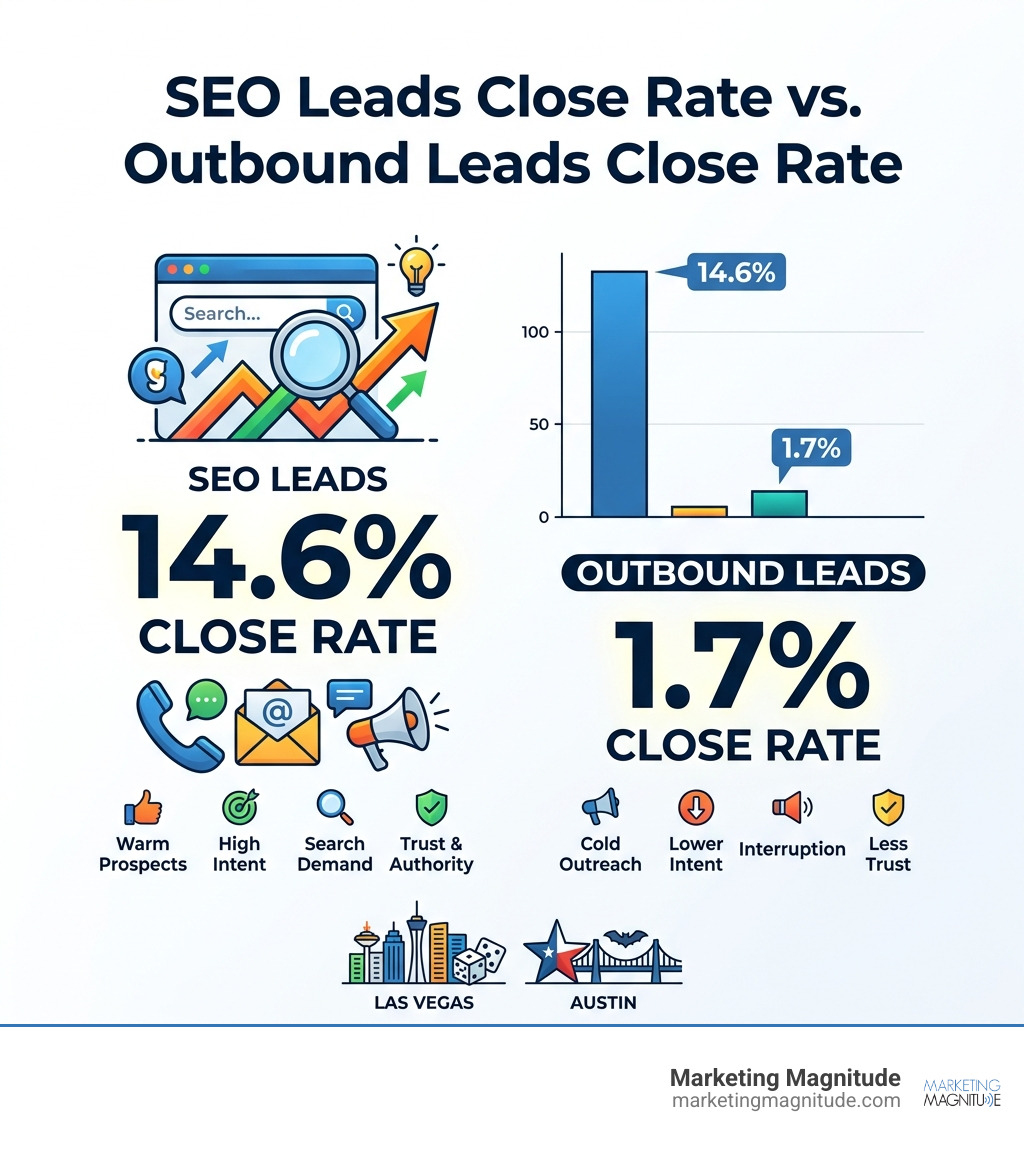
While SEO is a long-term play, it is often compared to SEM (Search Engine Marketing/PPC). Understanding SEO vs SEM whats the difference is vital. SEM provides instant traffic for a price; SEO builds an asset that drives traffic for “free” over time. Organic search drives 53% of all website traffic across industries, and SEO leads have a 14.6% close rate, compared to just 1.7% for outbound leads. The wait is worth it, but you must be patient.
What Early SEO SHOULD Look Like: A 90-Day Roadmap for Success
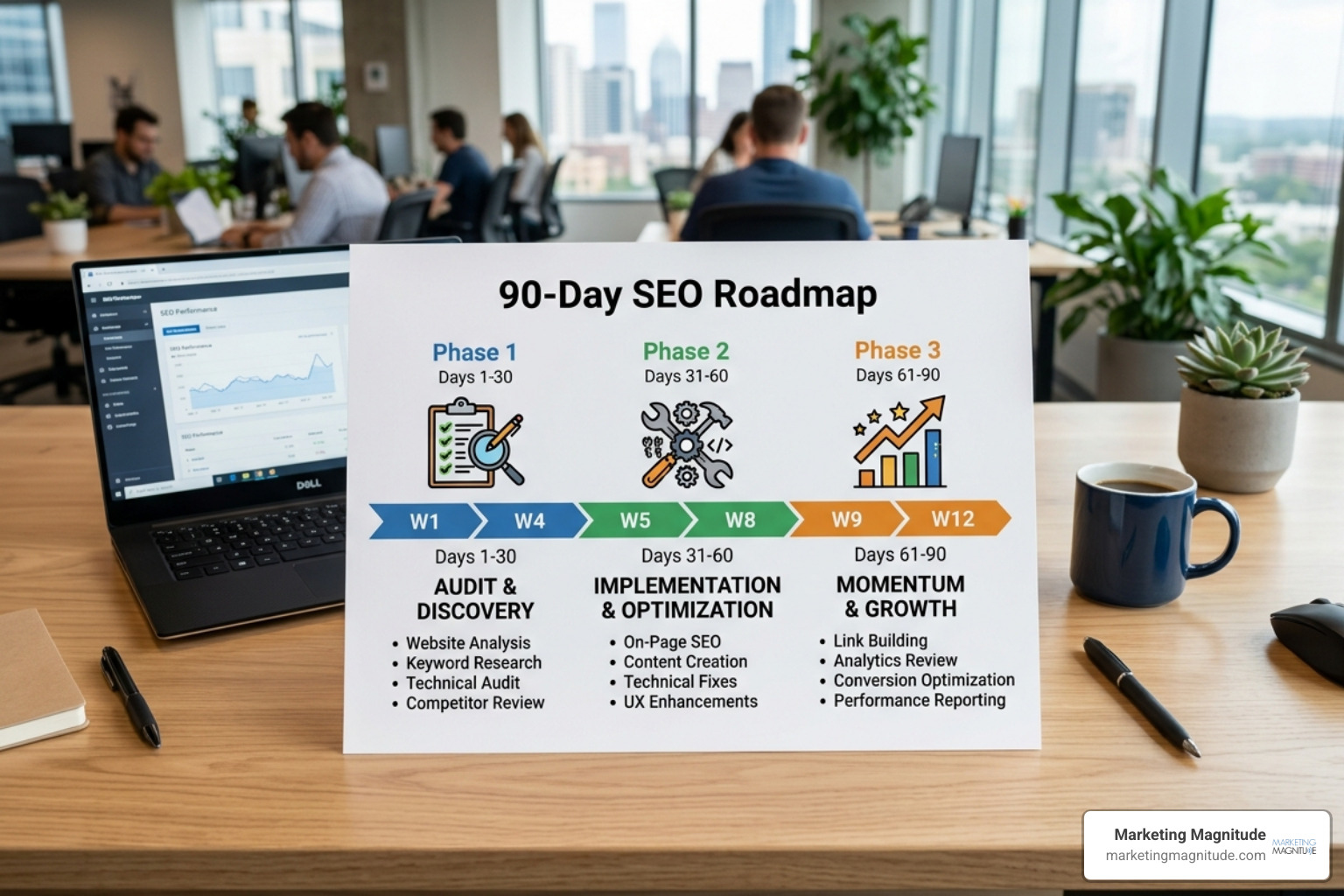
To avoid the common pitfalls, we follow a rigorous 90-day framework. This ensures that every hour of billable time is spent on activities that actually move the needle.
Month 1: Audits, Research, and Strategy
The first 30 days are about diagnosis and planning. If an agency starts writing blogs on Day 2 without looking at your technical health, they are building on sand.
- Technical Audit: We look for “crawl errors,” “index bloat,” and “Core Web Vitals” issues. If Google can’t read your site, it won’t rank your site.
- Keyword Mapping: We don’t just look for high-volume words; we look for “commercial intent.” We want people ready to buy your search engine optimization services.
- Competitor Analysis: We analyze what your top 3-5 competitors are doing right and where their “content gaps” are.
- Baseline Metrics: We set up Google Search Console (GSC) and Google Analytics 4 (GA4) to track exactly where you are starting from.
Month 2: Implementation and Visible Changes
Month 2 is the most “invisible” month for clients, but the most active for the agency. This is where the heavy lifting happens.
- On-Page Optimization: Updating titles, headings, and meta descriptions across your priority pages.
- Technical Fixes: Resolving the issues found in the Month 1 audit, such as fixing broken redirects or improving mobile load speed.
- Internal Linking: Connecting your pages so that “authority” flows from your strongest pages to your new content.
- Content Velocity: Starting the rollout of new, high-quality content that answers specific customer questions. For businesses in Nevada, this might include local SEO services the sneak attack to Google rankings to dominate local map packs.
Month 3: Early Signals and Positive Momentum
By Day 90, you shouldn’t expect a 500% increase in sales, but you should see “traction.”
- Indexing Coverage: Seeing more of your site’s pages successfully indexed by Google.
- Impression Growth: Even if you aren’t on page one yet, you should see your “impressions” (how many times your site appears in search results) trending upward in GSC.
- Ranking Movement: Seeing keywords move from position 80 to position 40. It’s not a “trophy” yet, but it’s proof the strategy is working.
- Local Signals: If you are a brick-and-mortar business, you should see improved visibility in Google Maps by implementing local SEO strategies to boost your business.
Warning Signs of Bad Agencies and How to Spot a Failing Campaign

If you are at the 60 or 90-day mark and feeling uneasy, look for these specific red flags. These are the indicators of why most SEO agencies fail in the first 90 days (and what should actually happen) instead.
- Guaranteed Rankings: No one owns Google. If an agency guarantees a #1 spot for a competitive term in 90 days, they are lying or using “churn and burn” tactics that will get you banned.
- Lack of Transparency: If you ask, “What did you do this month?” and the answer is “We worked on your SEO,” that is a failure. You should receive a list of specific pages optimized, links built, or technical bugs fixed.
- Vague Reporting: Reports should focus on business outcomes (leads and sales) and momentum signals (impressions), not just “total keywords.”
- No Access to Data: You should always own your Google Analytics and Search Console accounts. If an agency refuses to give you access, they are holding your data hostage.
- Confusing Services: A bad agency won’t explain the difference between organic SEO services vs local SEO services whats the difference. They will just sell you a generic package that doesn’t fit your business model.
Conclusion and Frequently Asked Questions
At Marketing Magnitude, we believe that the first 90 days should be a period of intense activity and radical transparency. We provide real-time tracking so you can see the work happening in Las Vegas, Austin, or anywhere else your business operates. We don’t hide behind monthly PDFs; we show you the data as it happens.
SEO is a compounding asset. The work we do in the first 90 days builds the “infrastructure” that allows your traffic to explode in months 6 through 12. If you are ready for a search engine optimization SEO services partner that prioritizes ROI over “fluff,” it’s time to set the right expectations.
Is it normal to see no traffic growth in the first 90 days?
Yes, it is very common. Traffic is a “lagging indicator.” Before traffic grows, your site must be crawled, indexed, and moved up the rankings. In the first 90 days, you should focus on “leading indicators” like:
- Crawl Rate: How often Google visits your site.
- Impression Volume: How often you are appearing in searches.
- Technical Health Score: Reducing the number of errors on your site.
If these signals are moving up, the traffic will follow.
What questions should I ask my SEO agency at the 90-day mark?
To ensure your campaign is on track, ask these four questions:
- “Can you show me the growth in impressions for our ‘priority’ pages in Google Search Console?”
- “What percentage of the technical audit fixes from Month 1 have been fully implemented?”
- “Which of our competitors have we successfully ‘gained ground’ on in terms of keyword overlap?”
- “What is the content plan for the next 90 days, and how does it align with our highest-margin services?”
How does the first 90 days differ for local vs. ecommerce businesses?
The focus shifts based on how your customers find you:
- Local SEO: The first 90 days are heavy on Google Business Profile optimization, local citations, and building “local relevance.” If you are in Clark County, you need local SEO marketing Las Vegas to show up when people search “near me.”
- Ecommerce SEO: The focus is on technical site structure, category page optimization, and managing “product variants” to prevent duplicate content issues.
- B2B SEO: The focus is on building “topical authority” through deep-dive white papers and service pages that build trust during a long buying cycle.
By setting realistic expectations and demanding transparency, you can avoid becoming another statistic of an SEO campaign that failed before it ever had a chance to succeed. If you’re looking for Las Vegas SEO services or a SEO consultant Austin Texas, we are here to help you build a foundation that lasts.
Get Started Now
Fill out this form to start your journey to next-level marketing solutions for your business.