Why Every Dental Practice Needs to Know About Email Automation
Email automation for dentists is one of the most practical, high-return tools available to modern dental practices — and most offices are barely scratching the surface of what it can do.
Here is a quick answer if you are short on time:
What is email automation for dentists?
Email automation for dentists means using software to send pre-written, triggered emails to patients automatically — based on actions, dates, or patient data — without your staff manually hitting “send” every time.
The most common automated dental emails include:
- Appointment reminders and confirmations
- New patient welcome sequences
- Post-treatment care instructions
- Lapsed patient reactivation campaigns
- Educational newsletters
- Birthday greetings and special offers
- Review requests after visits
These emails run in the background, 24/7, while your team focuses on patient care.
The numbers behind email marketing are hard to ignore. For every $1 spent, email marketing returns an average of $36. And with 64% of patients reading emails on their phones, a well-timed automated message can fill an empty chair faster than almost any other channel.
But here is the problem most dental practices face: they are either sending nothing, or they are sending generic blasts to their entire patient list and wondering why no one books.
Strategic email automation is different. It sends the right message, to the right patient, at exactly the right moment — without adding more work to your already full plate.
I’m Kelly Rossi, founder of Marketing Magnitude and a digital marketing strategist with over 20 years of experience building automated marketing systems for service-based businesses, including healthcare and dental practices. Throughout my career, I’ve seen how properly implemented email automation for dentists transforms patient retention, reduces no-shows, and drives sustainable practice growth. In the sections below, I’ll walk you through everything you need to build a system that works while you sleep.
Why Email Automation for Dentists is Essential for Modern Practices
In the highly competitive dental landscape of July 2026, relying solely on traditional direct mail or manual phone calls to manage patient relationships is a recipe for operational bottlenecks. Manual follow-ups are slow, expensive, and incredibly prone to human error. When our front desk staff is buried under a mountain of billing, in-office patient check-ins, and incoming phone calls, outbound patient nurturing is inevitably the first task to fall through the cracks.

Automating patient communication changes the entire operational dynamic of your practice. Instead of your team spending hours dialing overdue hygiene patients or manually typing out post-operative instructions, an automated engine handles these touchpoints instantly. Because patients naturally expect and prefer professional healthcare communications via email over invasive phone calls, this transition actually improves the patient experience.
Furthermore, email marketing provides direct, permission-based access to your patients. Unlike social media marketing, where organic reach is entirely at the mercy of unpredictable algorithm changes, or paid advertising, where acquisition costs continue to rise, your email list is an asset you own.
To help you choose the right system, we often recommend evaluating specialized platforms. You can explore some of the top industry options in this guide to the 9 best email marketing tools for dentists in 2025.
To visualize how automation transforms daily operations, let us look at how manual outreach compares directly to an automated workflow:
| Operational Area | Manual Patient Outreach | Automated Email Workflows |
|---|---|---|
| Time Investment | 10–15 hours per week of staff phone time | 0 hours after initial setup and integration |
| No-Show Rates | High (relying on patients remembering calls) | Low (multi-touch confirmation sequences) |
| Reactivation | Sporadic, manual list pulling and calling | Continuous, automated campaigns based on last visit date |
| Post-Operative Care | Verbal instructions easily forgotten by patients | Instant, written care instructions sent post-visit |
| Scalability | Limited by front desk staff hours | Unlimited; scales effortlessly as your patient list grows |
Key Benefits of Automating Dental Email Campaigns
Implementing email automation for dentists delivers immediate, measurable financial and operational benefits:
- Significant No-Show Reduction: Reducing appointment no-shows is the most immediate financial win. Automated confirmation and reminder sequences ensure that patients have multiple opportunities to confirm or reschedule, keeping your chairs filled.
- Increased Case Acceptance: Many patients leave the office with diagnosed, unscheduled treatment plans. By setting up automated, educational follow-up sequences that explain the clinical importance of the treatment and address common barriers (like financing), we can systematically recover this missed revenue.
- Maximized Patient Lifetime Value (LTV): It is a well-known industry fact that acquiring a new patient is five times more expensive than retaining or reactivating an existing one. Automation keeps your practice top-of-mind, ensuring patients return every six months for routine preventive care.
- Reduced Administrative Overhead: By shifting routine communications to an automated system, your front desk team saves hours every week. This allows them to focus on providing an exceptional, face-to-face experience for the patients physically standing in your office.
To learn more about how we build these systems to scale your practice, explore our specialized Email Marketing Automation Services.
Core Automated Campaigns to Implement First
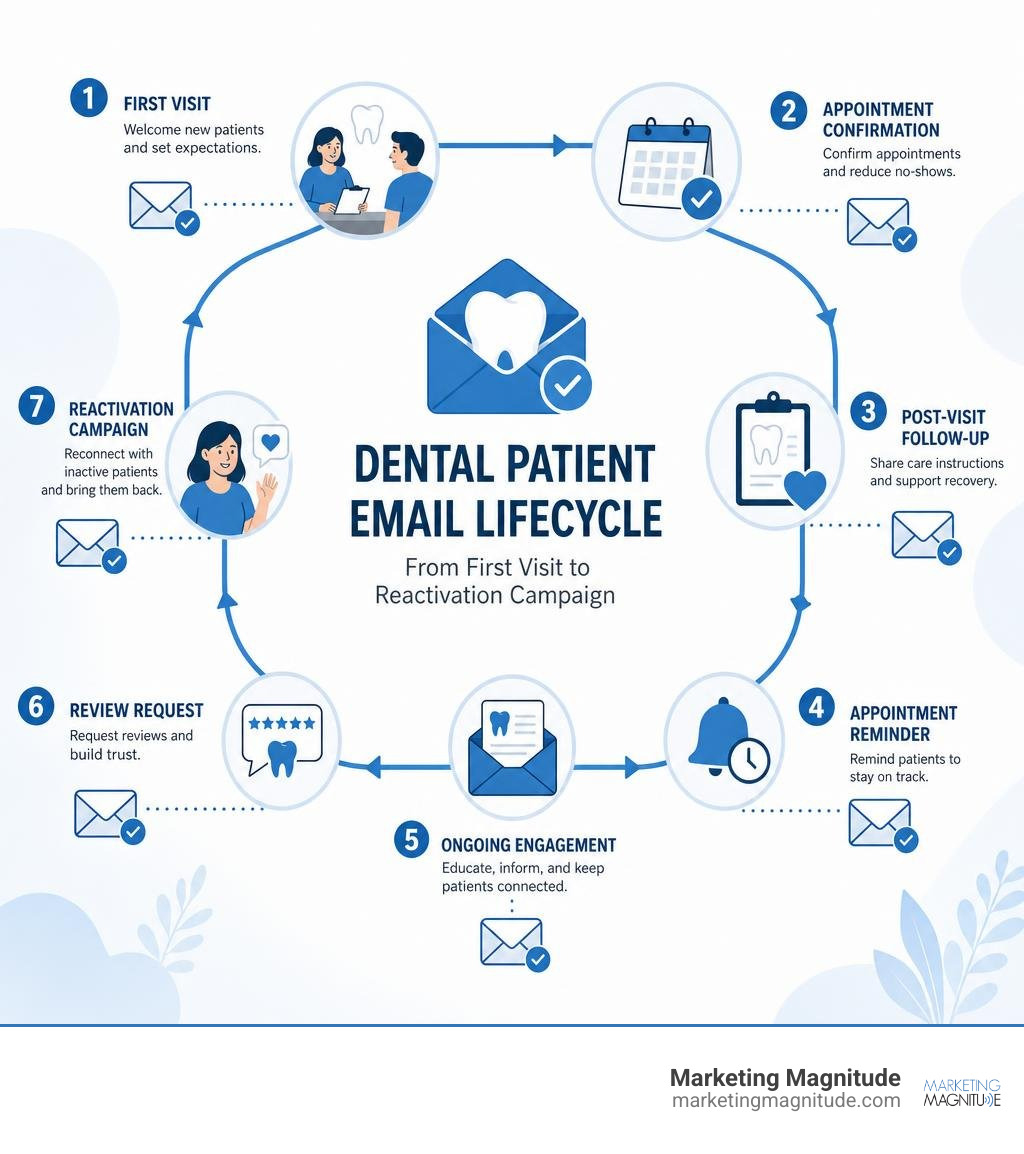
When launching an automated communication system, trying to build dozens of complex workflows all at once is a common trap. Instead, we advise dental practices to focus on the core “high-impact” campaigns that directly influence patient retention, operational efficiency, and revenue.

By mapping these campaigns to the natural lifecycle of your patients, you establish a consistent, professional brand presence that guides them from their very first appointment inquiry all the way through long-term preventative care.
Setting Up Automated Appointment Reminders and Follow-Ups
An effective appointment reminder sequence is not just a single email sent the day before a visit. It should be a strategic, multi-step sequence designed to secure confirmations early and minimize gaps in your schedule.
A standard best-practice sequence looks like this:
- Immediate Confirmation: Sent the moment the appointment is booked, containing a calendar invite link and basic practice details.
- Seven-Day Reminder: Sent one week prior, prompting the patient to confirm their slot or request a change if a conflict has arisen.
- 24-Hour Final Confirmation Request: Sent one day before the visit, requiring a clear action (such as clicking a “Confirm Appointment” button).
- Two-Hour Quick Alert: A final, mobile-friendly email or text reminder with parking instructions or check-in protocols.
Equally important are post-visit follow-ups. Patients frequently forget verbal post-operative instructions delivered immediately after clinical procedures due to lingering anesthesia or mild anxiety. Automatically triggering procedure-specific post-op care instructions (e.g., after an extraction, crown placement, or root canal) 24 hours after their appointment ensures they have clear, written recovery guidelines. This reduces urgent, post-op phone calls to your office and improves clinical outcomes.
Additionally, you can automatically trigger a review request email immediately following a successful appointment. Since 9 out of 10 people check online reviews before choosing a business, automating this process is the fastest way to build your local reputation. For a deeper look at utilizing campaigns to grow your patient base, see this guide on how to use dental email marketing to grow your practice.
Structuring a Welcome Email Sequence for New Dental Patients
First impressions are incredibly powerful. A new patient welcome sequence is a multi-part “drip” campaign that begins the moment a new patient schedules their first visit. This sequence is designed to reduce pre-appointment anxiety, introduce your team, and streamline the onboarding process.
We recommend structuring your welcome sequence over a two-week period:
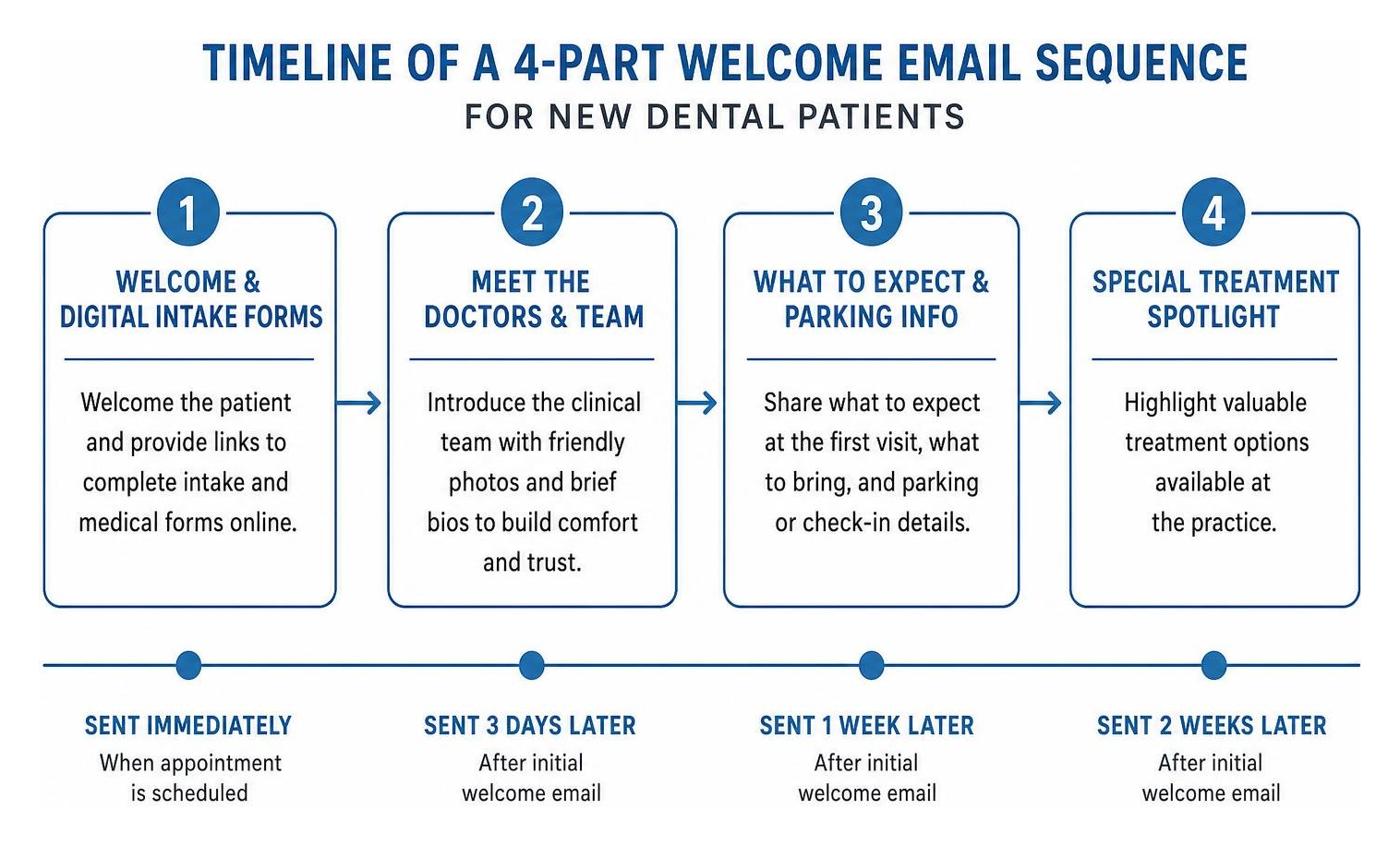
- Email 1: Welcome & Digital Intake Forms (Sent Immediately): Welcome the patient to your practice family. Include direct links to digital intake and medical history forms so they can complete them online before arriving, reducing wait times in your reception area.
- Email 2: Meet the Doctors & Team (Sent 3 Days Later): Introduce the clinical staff with warm, friendly headshots and brief bios. This humanizes your practice and helps ease dental anxiety.
- Email 3: What to Expect & Parking Info (Sent 1 Week Later): Provide clear, practical details. Where should they park? What should they bring? What will happen during their first comprehensive exam and cleaning?
- Email 4: Special Treatment Spotlight (Sent 2 Weeks Later): Introduce high-value services they might not know you offer, such as cosmetic teeth whitening, clear aligners, or dental implants.
Reactivating Lapsed Patients with Email Automation for Dentists
Dormant patients—those who have not visited your clinic in 6 to 12+ months and have no upcoming appointments scheduled—represent a massive source of unrealized revenue sitting in your database.
A strategic reactivation campaign uses gentle, automated reminders to bring these patients back into your active hygiene schedule. Instead of sending a single, aggressive “We Want You Back” email, stagger your outreach at 1, 6, 9, and 12 months after their last missed recall window.
Keep the tone warm, conversational, and focused on their health rather than a sales pitch. For example, replace clinical phrases like “Your prophylactic cleaning is overdue” with a friendly alternative: “We miss your smile! You are due for your 6-month cleaning. Ready to book?”
To drive action, include a direct, one-click booking link in the email body. You can also offer a subtle incentive, such as a complimentary teeth whitening special or a returning-patient discount on preventive care. For step-by-step guidance on setting up these workflows, refer to this resource on email marketing for dentists: a step-by-step guide 2026.
Integrating Practice Management Software and CRM Systems
To unlock the true power of email automation for dentists, your email marketing tool cannot operate in a silo. It must integrate directly with your Practice Management Software (PMS) like Dentrix, Eaglesoft, or Open Dental.
This integration allows for seamless, real-time data synchronization. When a patient books an appointment, completes a procedure, or cancels a visit, that information is instantly synced with your marketing platform. This prevents the administrative nightmare of manually importing and exporting Excel spreadsheets, and it ensures that your automated emails are always clinically accurate.
To build a truly connected growth ecosystem, we recommend linking your PMS data directly with a centralized customer relationship management (CRM) platform. This allows you to track the entire patient journey from their first website visit, through email nurturing, to their actual booked appointments and completed treatment plans.
To explore how we integrate these backend systems for maximum efficiency, check out our CRM Software & Marketing Automation solutions.
Patient Segmentation and Personalization Strategies
Sending a single, generic email blast to your entire database is the fastest way to drive up your unsubscribe rates and end up in the spam folder. Modern dental email marketing relies heavily on patient database segmentation.
By dividing your patient list into distinct, highly targeted groups, you can ensure that every email sent is highly relevant to the recipient. We recommend segmenting your database by:
- Demographics: Segment by age (e.g., targeting parents with pediatric care tips vs. older adults with implant or restorative education).
- Treatment History: Group patients based on completed procedures. For example, do not send a “Invisalign Special” email to a patient who recently completed full-mouth reconstructive surgery.
- Insurance Status: Run targeted year-end “Use It or Lose It” campaigns between October and December, reminding patients with remaining insurance benefits to utilize them before they expire on December 31st.
- Engagement Level: Separate active patients from those who are dormant or overdue for recalls.
Advanced personalization goes far beyond simply using a merge tag to insert the patient’s first name into the subject line. True personalization leverages clinical and operational data to reference their last appointment date, their preferred hygienist, or their specific pending treatment plans.
How Behavioral Triggers Work in Dental Email Automation
Behavioral triggers are the ultimate form of automated personalization. Instead of scheduling emails to go out on a specific calendar date, behavioral triggers fire automatically in real-time based on specific actions (or lack of actions) taken by a patient.
For example, if a patient leaves your office after a consultation with an active, unscheduled treatment plan for a crown, that event in your PMS can automatically trigger a multi-day educational email sequence. The first email, sent 3 days later, might explain why addressing the decayed tooth early prevents a costly root canal. The second email, sent 10 days later, might offer flexible 0% financing options to make the treatment more accessible. The moment the patient calls to book the appointment, the “smart stop” rules in your automation engine instantly pause the campaign, preventing redundant communication.
To see how advanced, AI-driven platforms handle these complex, real-time communication flows, you can read about this AI-powered dental email platform with auto-translation.
Overcoming Common Mistakes in Email Automation for Dentists
While automation is highly efficient, implementing it incorrectly can alienate patients and harm your practice’s reputation. Here are the most common mistakes we help dental practices avoid:
- Over-Communication: Flooding patient inboxes with daily or weekly emails leads to “email fatigue,” driving up unsubscribe rates. Keep marketing communications (like newsletters and specials) to a consistent monthly or bi-monthly cadence, while reserving higher frequencies strictly for transactional appointment reminders.
- Sounding Too Robotic: Automated emails do not have to sound cold, clinical, or robotic. Write in a warm, friendly, conversational tone. Use contractions (e.g., “you’re” instead of “you are”) and write as if you are speaking directly to a patient in your chair.
- Ignoring Mobile Optimization: Because 64% of patients read emails on their phones, your templates must be designed for mobile first. Use a clean, single-column layout, a minimum font size of 14pt for body copy, and make your call-to-action buttons at least 44×44 pixels so they are easy to tap on a mobile screen.
- Neglecting List Hygiene: If your email bounce rate exceeds 2%, it indicates that your database contains outdated, incorrect contact information. Regularly audit and clean your list, and train your front desk staff to verify patient email addresses during physical check-ins.
Frequently Asked Questions about Dental Email Marketing
How often should a dental practice send automated emails?
The ideal frequency depends entirely on the type of email being sent. Transactional emails—such as appointment confirmations, reminders, and post-operative care instructions—should be triggered dynamically as needed based on the patient’s schedule.
For marketing and educational content, such as practice newsletters, seasonal specials, or oral health tips, we recommend a consistent monthly or bi-monthly cadence. This frequency is high enough to keep your practice top-of-mind without overwhelming the patient’s inbox or triggering spam filters.
How do automated educational newsletters improve treatment acceptance?
Educational-first messaging consistently outperforms purely promotional offers in the long term. Many patients delay dental treatments simply because they do not fully understand the clinical necessity of the procedure or because they harbor unaddressed anxieties.
By sending automated educational newsletters that explain restorative or cosmetic treatments in clear, non-clinical language—such as “How Dental Implants Can Restore Your Confidence” or “The Truth About In-Office Teeth Whitening”—you build deep trust and authority. When patients understand the “why” behind a treatment, they are significantly more likely to accept and schedule their diagnosed procedures.
How do we ensure our automated emails are HIPAA-compliant?
HIPAA compliance is a non-negotiable requirement for any healthcare communication. To protect patient privacy and avoid severe compliance penalties, we must adhere to several strict guidelines:
- Avoid Protected Health Information (PHI): Never include specific clinical details, diagnostic information, or sensitive medical histories directly in the body of a standard, unencrypted marketing email. Instead, use generalized terms like “your recent visit” or “your upcoming appointment” rather than “your root canal on tooth #3.”
- Use Secure, Compliant Platforms: Ensure that any email marketing or automation software you use is fully HIPAA-compliant and willing to sign a formal Business Associate Agreement (BAA).
- Obtain Explicit Opt-In Consent: Always obtain and document explicit opt-in consent from patients before adding them to any automated marketing or newsletter lists, and provide a clear, one-click unsubscribe link in every email.
Conclusion
Implementing strategic email automation for dentists is no longer just a luxury for tech-savvy offices—it is a fundamental operational infrastructure required for sustainable practice growth in 2026. By connecting your patient communications directly to your Practice Management Software, you can systematically reduce costly no-shows, reactivate dormant patients, and increase case acceptance rates, all while freeing up your front desk staff to focus on what matters most: your in-office patients.
At Marketing Magnitude, we specialize in helping healthcare and dental practices bridge the gap between complex technology and authentic, human-centered patient relationships. We don’t just generate leads; we build fully integrated, automated growth ecosystems that help your practice operate more efficiently and scale sustainably.
Ready to take your patient communication from ordinary to extraordinary and fill your chairs on autopilot? Contact us today to explore our custom Email Marketing Automation Services and let us build a system that works for your practice 24/7.
Get Started Now
Fill out this form to start your journey to next-level marketing solutions for your business.