
SEO Content Strategies That Turn Search Into Business Growth
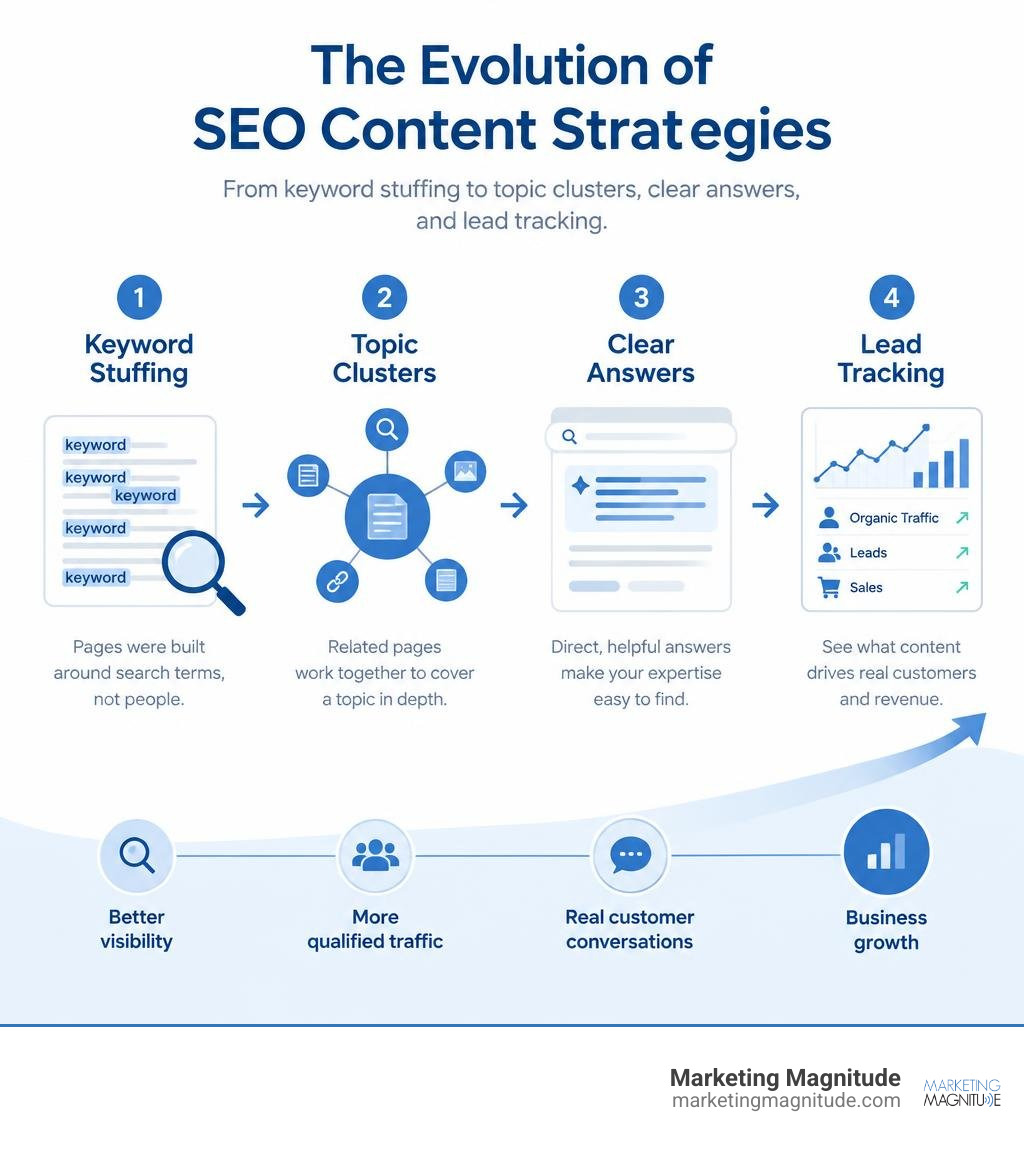
Start with the customers you want to reach and the questions they ask. Group those questions by topic and search intent. Then create useful pages that answer them, link related pages together, and give readers a clear next step. Track leads and sales alongside organic traffic so you know which content helps your business grow.
In 2026, that plan also needs to work when search results show an AI-generated answer. Clear, direct answers can help people find your expertise, but visibility alone is not the goal. The goal is to turn the right searches into real customer conversations.
I’m Kelly Rossi, founder of Marketing Magnitude. Since launching my first agency in 2002, I’ve built SEO content strategies for service businesses and a local publishing brand, with a focus on connecting search visibility to measurable growth.
Glossary for seo content strategies:
- What is a backlink, and why do I need it?
- “Why Most SEO Agencies Fail in the First 90 Days (And What Should Actually Happen)” Set expectations: What early SEO SHOULD look like Warning signs of bad agencies Real timeline vs fake promises
- search engine optimization services
Modern SEO Content Strategies: Frameworks for Long-Term Authority
Search dynamics have changed fundamentally. With 51% of all website traffic originating from search engines and organic leads converting at an impressive 14.6%—compared to just 1.7% for outbound advertising—organic search remains the highest-ROI channel for sustainable growth. However, treating SEO as a game of individual keyword targeting no longer works.
Modern content architecture requires deep audience research, comprehensive entity mapping, and an understanding of the end-to-end buyer journey. If you want sustainable organic growth that feeds your sales pipeline, your content must satisfy both human searchers and complex machine learning algorithms. We break down the broader operational blueprint in our guide to SEO for business growth, but building real organic authority starts with a coherent content engine.
Core Components of Modern SEO Content Strategies
A mature SEO content strategy is not a loose collection of weekly blog posts. It is a structured operational system designed to establish topical expertise, capture high-intent demand, and channel qualified prospects directly into your customer relationship management (CRM) pipeline.
| Strategy Component | Traditional SEO Approach | Modern 2026 Content Framework |
|---|---|---|
| Topic Selection | High-volume single keywords | Entity-based topic clusters and user problem silos |
| Search Intent | Keyword density matching | Multidimensional intent (informational, commercial, transactional) |
| AI Optimization | Ignored or treated as thin keyword spam | Answer Engine Optimization (AEO), entity citation, structured summaries |
| Site Structure | Flat blog architectures with orphaned posts | Interlinked topic clusters anchored by authoritative pillar pages |
| Success Metrics | Raw impressions and total traffic volume | Pipeline velocity, assisted conversions, qualified lead revenue |
| Maintenance | Publish once and abandon | Scheduled quarterly content refresh cycles and decay audits |
To build an organic growth engine that compounds over time, your foundational strategy must account for both user experience and algorithmic structure. You can learn the core mechanics in our overview on what search engine optimization is and how it powers modern digital discovery.
SEO Content Marketing vs SEO Content Strategy
Many teams use the terms “content marketing” and “SEO content strategy” interchangeably, but conflating them leads to wasted budgets and missed revenue targets.
- SEO Content Marketing represents the creative execution layer. It involves writing articles, designing visual assets, recording multimedia, and distributing stories across social channels or newsletters to engage target personas.
- SEO Content Strategy serves as the overarching governance system. It dictates which commercial pain points to solve, which topical entities to prioritize, how internal link equity flows to high-converting service pages, and how search touchpoints convert into pipeline opportunities.
When content marketing functions without a strategic SEO architecture, businesses end up with what we call a “publishing habit” rather than a growth system. We explore how to bridge these disciplines effectively in our guide on how to build a content marketing strategy that supports long-term commercial goals.
Architectural Foundations: Intent, Topic Clusters, and Authority
Search engines no longer evaluate content in isolation. Modern indexing systems assess your site’s overall topical authority across entire subject verticals. If your website publishes three articles on healthcare technology and immediately pivots to unrelated generic advice, search engines struggle to categorize your core expertise.
According to industry research on modern search workflows, building deep authority requires establishing connected topical silos that exhaustively answer user queries across every stage of awareness.
Building Topical Authority with Content Pillars and Topic Clusters
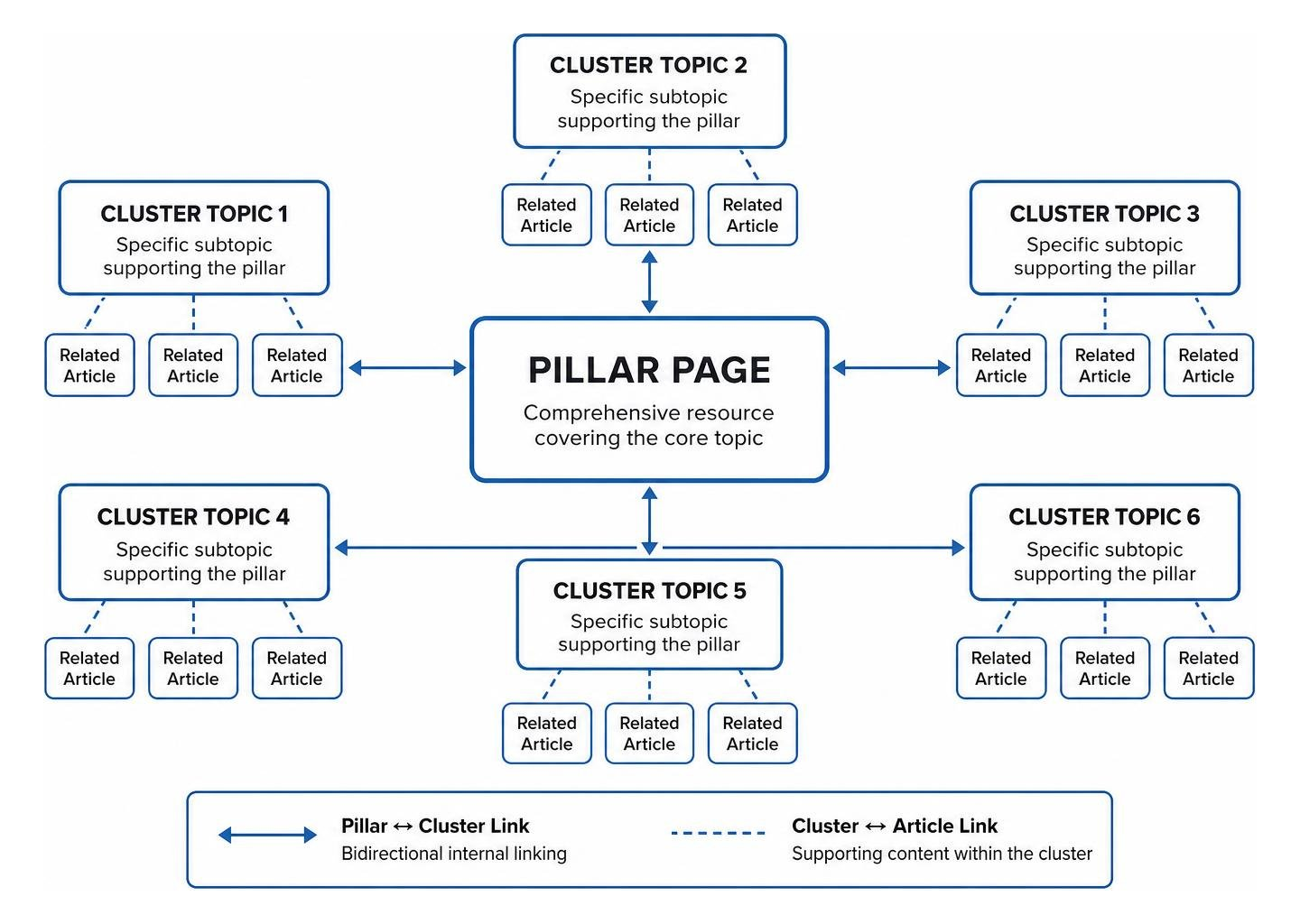
The pillar-cluster model organizes your digital footprint into an intuitive, machine-readable library:
- Pillar Pages: Comprehensive, authoritative resource pages covering a broad core topic (e.g., “Medical Practice CRM Automation” or “Commercial HVAC Maintenance Systems”).
- Cluster Pages: Specialized, in-depth sub-articles targeting specific long-tail keywords, secondary questions, and nuanced use cases (e.g., “HIPAA-Compliant Patient Communication Workflows” or “Seasonal Heat Pump Diagnostic Checklists”).
- Contextual Internal Linking: A strict, deliberate linking hierarchy where every cluster article links back to its parent pillar page using descriptive, natural anchor text, while cross-linking laterally to relevant sibling articles.
This architecture completely eliminates orphaned content—pages that receive zero internal links and remain invisible to search crawlers. When one cluster article earns backlinks and user engagement, the internal linking network distributes that page authority across the entire cluster, elevating your primary service pages simultaneously.
Search Intent Classification and Funnel Stage Mapping
Approximately 50% of all search queries contain long-tail terms. These longer, specific phrases often carry significantly higher commercial intent than broad, top-of-funnel head terms. To turn organic searchers into qualified clients, every piece of content must map directly to a stage in your conversion funnel:
- Top of Funnel (TOFU) – Informational Intent: Prospects seek answers to broad industry challenges (e.g., “Why are patient no-show rates increasing?”). Goal: Provide authoritative answers, build brand recall, and offer helpful downloadable resources.
- Middle of Funnel (MOFU) – Commercial Investigation: Prospects evaluate potential solution frameworks (e.g., “Automated SMS reminders vs manual follow-up systems”). Goal: Demonstrate domain expertise, present comparative data, and showcase actionable workflow improvements.
- Bottom of Funnel (BOFU) – Transactional Intent: Decision-makers are ready to partner with a specialized provider (e.g., “Integrated CRM and marketing automation platform for clinics”). Goal: Provide clear service breakdowns, client case studies, and seamless consultation scheduling pathways.
Optimizing for Modern Search: AEO, Structured Data, and On-Page Signals
Search engine results pages (SERPs) are evolving rapidly. With Google AI Overviews and answer engines answering queries directly on the results page, zero-click searches account for nearly 60% of search activity. Research indicates that traditional web links are clicked only 8% of the time when an AI summary is present, compared to 15% when it is absent.
However, content cited directly inside an AI Overview earns 35% more clicks than standard organic listings ranking below the fold. Success today requires optimizing for both traditional search crawlers and AI answer engines, a process covered in detail by industry guides to multi-platform search optimization.
Structuring Content for AI Overviews and Semantic Search
To ensure language models and search engines extract and cite your content, structure your pages around conversational clarity and direct answers:
- Answer-First Formatting (The Inverted Pyramid): Begin major H2 sections with a direct, 2–3 sentence answer summarizing the core solution before diving into granular explanations and data.
- Question-Based Header Tags: Formulate H2 and H3 tags to reflect natural search queries (e.g., “How do automated follow-up sequences reduce customer churn?”).
- Dedicated FAQ Sections: Conclude pillar assets with concise question-and-answer modules targeting related user queries.
- Entity-First Contextual Writing: Explicitly name industry software, operational roles, technical protocols, and domain entities to help semantic indexing algorithms establish topical associations.
If you are exploring how conversational AI indexes digital assets, review our breakdown on ranking in modern AI search ecosystems for actionable implementation techniques.
On-Page Technical Fundamentals: Headers, Metadata, and Schema Markup
Clean on-page technical optimization ensures search engines can effortlessly crawl, understand, and index your expertise. We detail these exact mechanics in our guide to on-page optimization fundamentals, focusing on the core structural signals:
- Title Tags & Meta Descriptions: Keep titles under 60 characters with the primary keyword front-loaded alongside a value proposition. Write action-oriented meta descriptions (150–165 characters) that feature a clear call to action.
- Schema Markup (Structured Data): Implement JSON-LD schema—including
Article,FAQPage,Service, andLocalBusinesstypes—to provide explicit semantic clues that earn rich SERP snippets. - Image Optimization: Use descriptive filenames, modern compressed formats (WebP), and contextual alt text containing relevant secondary keywords to maximize image search visibility and screen-reader accessibility.
- Core Web Vitals: Ensure fast load times (Largest Contentful Paint < 2.5s), immediate responsiveness (Interaction to Next Paint < 200ms), and zero visual layout shifts (Cumulative Layout Shift < 0.1).
Execution, Maintenance, and Avoiding Critical Strategic Mistakes
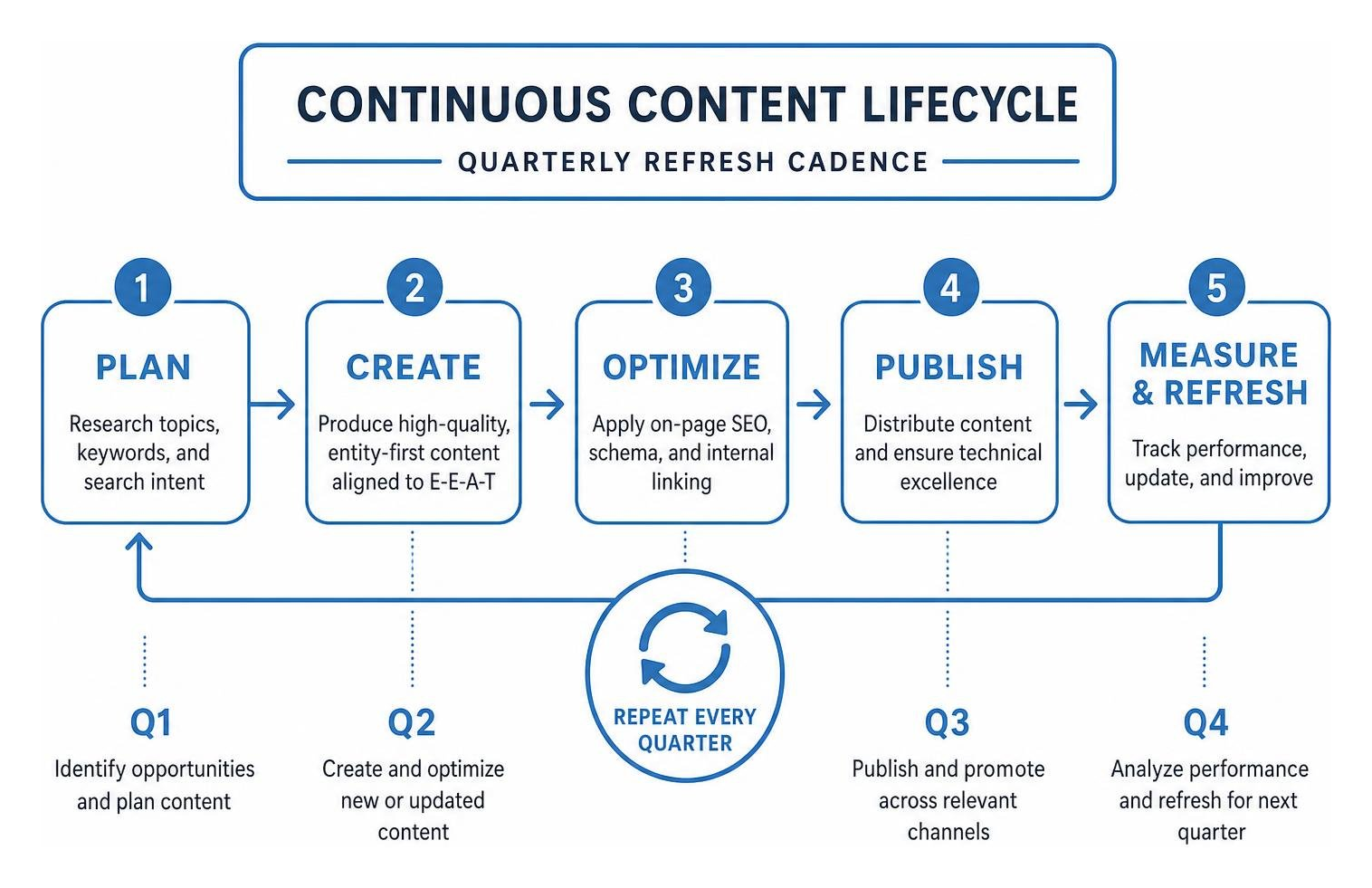
A well-crafted plan is only as good as its execution engine. Without structured editorial workflows and continuous performance tracking, even comprehensive strategies succumb to content decay and keyword cannibalization. To maintain momentum, companies must implement proven search optimization strategies for online visibility across every operational phase.
Scaling SEO Content Strategies with Subject Matter Expertise
Data reveals that businesses publishing 16 or more optimized posts per month generate over 3x the organic traffic of businesses publishing sporadically. However, scaling content production must never compromise content depth or Google’s E-E-A-T (Experience, Expertise, Authoritativeness, and Trustworthiness) standards:
- Standardized Editorial Briefs: Every assignment should clearly outline the primary target entity, secondary long-tail keywords, search intent classification, required heading hierarchy, target word count ranges based on SERP analysis, and specific internal linking targets.
- Subject Matter Expert (SME) Collaboration: Interview internal leaders, clinicians, or technical consultants to capture proprietary data, real-world case studies, and authentic insights that generic AI writers cannot replicate.
- Rigorous Quality Assurance: Establish a human editorial review process to verify factual accuracy, ensure authentic brand voice, and eliminate low-value fluff.
Content Refresh Cycles and Common Strategic Pitfalls
Publishing content is not a one-time task. Over time, rankings degrade as competitor pages launch, industry data shifts, and user expectations change. HubSpot’s internal testing revealed that strategically updating historical posts with new examples, refreshed data, and optimized headers produced traffic gains exceeding 100%.
We break down the decision framework for auditing your legacy assets in our guide on whether to update or delete old blog posts.
Key Strategic Mistakes to Avoid:
- Chasing Vanity Metrics Over Revenue: Measuring success purely by total impressions rather than pipeline generation, form fills, and customer acquisition costs.
- Keyword Cannibalization: Publishing multiple uncoordinated articles targeting the same core search query, causing your own pages to compete against each other in the SERPs.
- Premature Strategy Abandonment: Expecting immediate top-three rankings within weeks. SEO assets typically require 60 to 90 days to stabilize and 3 to 6 months to generate compounding organic traffic.
- Ignoring the Follow-Up Infrastructure: Driving thousands of qualified organic visitors to a website that lacks clear conversion paths, fast-loading contact forms, or automated CRM follow-up sequences.
Frequently Asked Questions About SEO Content Planning
What is the primary difference between SEO content strategy and standard blogging?
Standard blogging focuses on writing periodic, topically disconnected articles based on internal company updates or casual brainstorming. An SEO content strategy is a data-backed business framework that uses entity research, search intent mapping, topic cluster architecture, and structured internal linking to systematically capture organic demand and drive qualified leads into a conversion pipeline.
How long does an SEO content strategy take to show measurable business ROI?
Most new content assets take between 60 to 90 days for search engines to index, crawl, and rank competitively. A cohesive cluster strategy typically begins showing measurable traffic and lead generation growth within 3 to 6 months, compounding significantly between months 6 and 12 as domain authority and internal link equity mature.
How do AI Overviews impact content creation and click-through rates?
While AI Overviews reduce traditional click-through rates for basic informational queries, they prioritize concise, authoritative answers. By formatting content with direct answer-first summaries, structured data schema, and clear entity definitions, your website can earn direct citations inside AI summaries, driving highly qualified, high-intent traffic directly to your business.
Transform Search Visibility Into Sustainable Business Growth
Search engine visibility is only the first step in building a scalable company. Generating organic traffic creates meaningful enterprise value only when it connects seamlessly to an integrated business growth platform—unifying modern SEO architecture with intelligent CRM workflows, automated lead nurturing, high-performance web development, and closed-loop revenue analytics.
Whether you operate in professional services, healthcare, or local markets, we help organizations replace fragmented marketing tactics with predictable growth engines. Explore our integrated search engine optimization SEO services to turn search engine demand into measurable business revenue.
Get Started Now
Fill out this form to start your journey to next-level marketing solutions for your business.