Understanding Website Development Packages: What You Need to Know
Website development packages are bundled services that include design, development, and often maintenance of a website at a fixed price. These packages typically come in different tiers to meet various business needs and budgets.
Quick Guide to Website Development Packages:
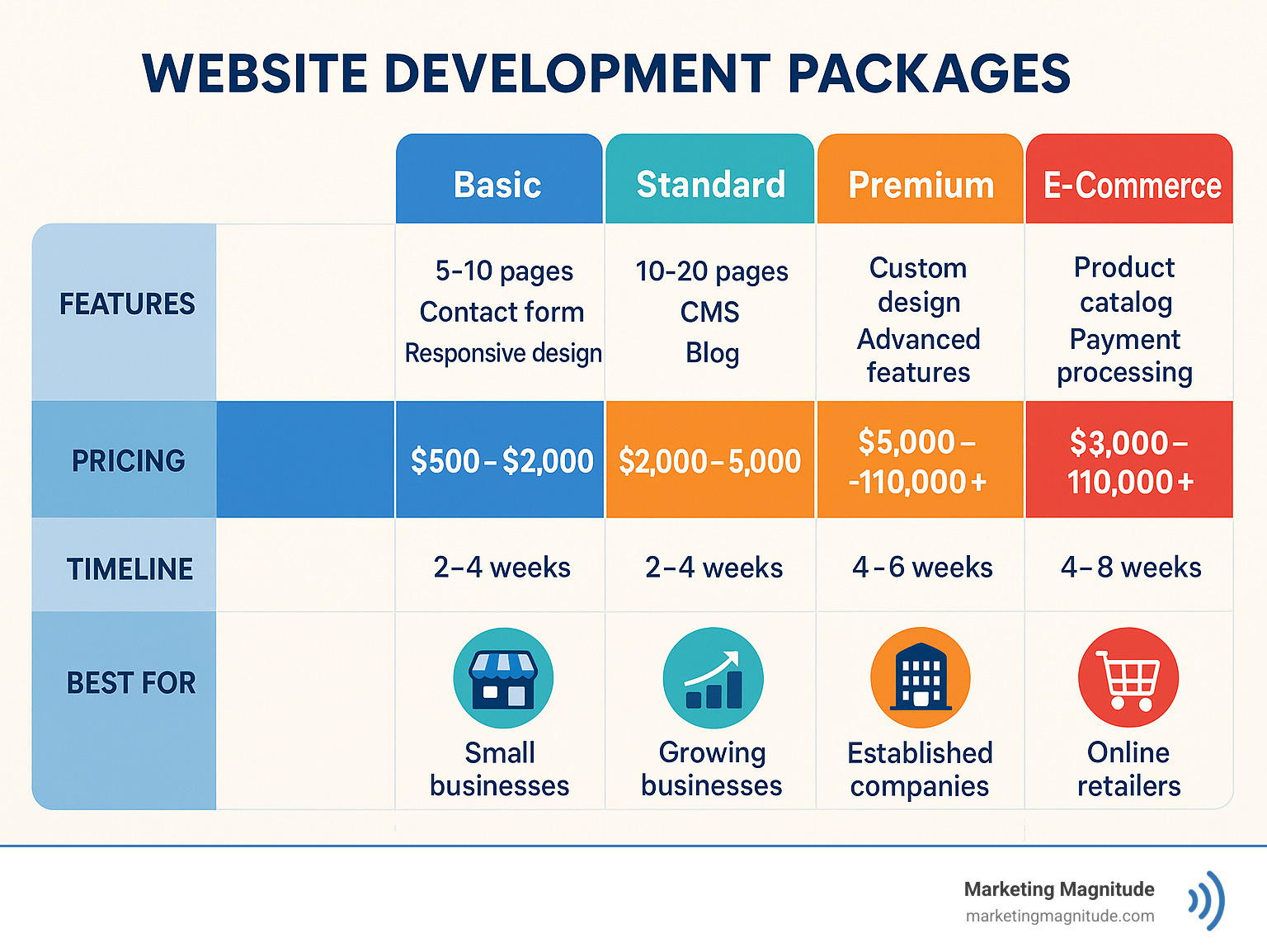
| Package Type | Price Range | Typical Features | Best For |
|---|---|---|---|
| Basic/Starter | $500-$2,000 | 5-10 pages, contact form, responsive design | Small businesses, startups |
| Standard/Business | $2,000-$5,000 | 10-20 pages, CMS, blog, SEO basics | Growing businesses |
| Premium/Enterprise | $5,000-$10,000+ | Custom design, advanced features, integrations | Established companies |
| E-commerce | $3,000-$10,000+ | Product catalog, payment processing, inventory | Online retailers |
Choosing the right website package can feel overwhelming. With options ranging from simple template-based sites to fully custom builds, the differences in pricing and features can be confusing.
A professionally designed website is crucial for business success. Consider these statistics from WebFX:
- 40% of visitors will leave if a site takes more than 3 seconds to load
- A well-placed call-to-action can increase gross income by 83%
- Website downtime can cost businesses up to $5,000 per minute
Most website development packages include domain registration, hosting, design, and basic functionality. However, the level of customization, support, and additional features varies significantly between packages and providers.
I’m Kelly Rossi, and I’ve spent over 20 years helping businesses select and implement the right website development packages through my agency Marketing Magnitude, where we’ve delivered hundreds of successful web projects across various industries and budgets.
Why This Guide Matters
The impact of your website on business success cannot be overstated. With most visitors forming impressions in as little as 50 milliseconds, your site needs to load quickly and look professional immediately.
Consider these eye-opening facts from Google’s research:
- A 1-second delay in website loading time can reduce visitor satisfaction by around 15%
- Most visitors (26.6% or more) will only wait 1-3 seconds for a site to load on their phone
- Only 11.5% of users will wait more than 11 seconds for a site to load
Your website serves as your 24/7 salesperson, building credibility and generating leads even while you sleep. Understanding what goes into website development packages ensures you invest wisely in this critical business asset.
What Are Website Development Packages?
Website development packages are like buying a complete meal deal instead of individual dishes. They bundle all the essential ingredients needed to create your online presence into one fixed-price offering. Rather than purchasing design, development, and features separately, you get everything wrapped up in a neat, predictable package.
When you invest in a quality website package, you’re typically getting a comprehensive solution that includes the visual design that captures your brand identity, the technical functionality that makes everything work smoothly, a content management system that lets you update your site, mobile-friendly design, basic SEO elements to help you get found online, and some level of support after your site launches.
One of the most valuable aspects of these packages is that they provide you with full ownership rights to your finished website. This means you maintain complete control of your digital presence – something that’s absolutely essential for your business’s long-term success.
“Website development packages” vs À-la-carte Services
Choosing between website development packages and picking individual services comes down to how much certainty and flexibility you need.
Package deals offer peace of mind through clearly defined deliverables and fixed pricing that eliminates budget surprises. They follow streamlined processes with established workflows, saving you time and headaches. Plus, the bundled nature of packages often means you’re getting more value for your investment.
In contrast, à-la-carte services allow for complete customization of every element and the flexibility to add or remove specific components as needed. However, this approach typically comes with less predictable timelines and budgets, and often higher overall costs since you’re not benefiting from bundled pricing.
For most small to medium businesses looking to establish or upgrade their online presence, packages strike that sweet spot between quality, customization options, and budget control.
Template-Based vs Custom Builds
The choice between template-based or custom-built websites significantly impacts both the cost and uniqueness of your site.
Template-based websites are built on pre-designed themes (often using WordPress) that can be customized to some degree. They’re faster to develop, typically taking just 3-4 weeks, and more affordable at $500-$5,000. While they offer less uniqueness, they’re perfectly suitable for standard business needs where having a professional online presence matters more than standing out with a one-of-a-kind design.
Custom-built websites, on the other hand, are designed from scratch specifically for your brand. They require more time (usually 6-12 weeks) and a higher investment ($7,000-$20,000+). The payoff is complete design freedom and truly unique functionality custom to your specific requirements – ideal for businesses with complex or specialized needs.
Many modern website development packages, including those offered by Marketing Magnitude, take a smart hybrid approach with flexible components. This gives you the efficiency and cost-effectiveness of templates while offering more customization options. The real benefit? You’ll be able to create and edit pages yourself after launch without needing developer assistance every time you want to make a change.
Main Types of Website Development Packages & Their Core Features
Let’s face it – choosing a website package feels a bit like ordering coffee these days. Too many options! But don’t worry, I’m here to break down the main types of website development packages into simple, digestible options that actually make sense for your business.
Basic / Starter Packages – For Simple Presence
Think of basic packages as your “digital business card” – they give you a professional online presence without all the bells and whistles.
For $500-$2,000, you’ll typically get a clean, mobile-friendly website with about 5-10 pages that covers all your essentials. This includes a contact form so customers can reach you, social media links to build your community, and basic SEO setup to help people find you online. Most basic packages include a WordPress CMS (or similar) so you can make simple updates yourself, plus an SSL certificate to keep things secure.
These packages are perfect if you’re just starting out or run a small local business. While they often use templates rather than custom designs, they still look professional and can be completed relatively quickly – usually within 2-4 weeks.
Standard / Business Packages – Growing Brands
As your business grows, so should your website. Standard packages offer that next level of polish and functionality for established businesses looking to make a bigger impact online.
Priced between $2,000-$5,000, these packages build on the basics with more pages (typically 10-20), a blog to showcase your expertise, and improved UI/UX customization that better reflects your brand. You’ll also get more robust SEO optimization, better-performing media, and social feed integration to keep your content fresh. Most importantly, you’ll get extended support (usually 2-3 months) to help you steer your new site.
The timeline stretches to 4-8 weeks, giving developers time to add those custom touches while still leveraging templates for efficiency. These packages hit the sweet spot for growing businesses that need more than a basic site but aren’t ready for a fully custom solution.
Premium / Enterprise Packages – Custom Experience
When off-the-rack just won’t cut it, premium packages deliver a custom digital experience built specifically for your business needs.
Starting at $5,000 and often exceeding $10,000, these high-end packages include everything in the standard tier plus extensive customization. You’ll get 20+ custom-designed pages, advanced integrations with your CRM or marketing tools, and interactive elements that engage visitors. The development team will implement a comprehensive SEO strategy and set up heat mapping to track user behavior. The cherry on top? A generous 90-day support period to fine-tune everything post-launch.
These packages take 8-12 weeks to complete and involve more planning and stakeholder input. They’re ideal for established businesses with specific functionality requirements or unique brand positioning that demands a custom approach.
E-Commerce Packages – Selling Online
If you’re selling products or services online, you need specialized features that regular websites don’t offer.
E-commerce packages (ranging from $3,000-$10,000+) include essential selling tools like product catalogs, secure payment processing, shopping carts, and inventory management. They also handle order processing, customer accounts, and improved security measures to protect sensitive data.
The wide price range reflects the vast difference between a simple boutique store with a few products and a complex marketplace with thousands of items and custom checkout flows. Most e-commerce sites take 6-12 weeks to build properly, ensuring everything works seamlessly from browsing to purchase.
Add-On Services That Boost Results
Even the best website development packages can benefit from strategic add-ons that amplify your results:
SEO services go beyond basics with in-depth keyword research and technical optimization. Content creation provides professional copy that converts visitors into customers. Maintenance plans keep your site secure and performing at its best. Analytics setup gives you insights into visitor behavior, while marketing integration connects your website to your broader digital strategy.
At Marketing Magnitude, we offer these improvements as part of our comprehensive web services because we know a great website isn’t just about looking good – it’s about driving real business results.
Pricing Breakdown, Hidden Costs & How to Budget
Talking budget is where most projects hit turbulence, so let’s keep the numbers clear and the jargon light. Below is a realistic snapshot of what different website development packages cost to build and to keep running.
| Website Type | Initial Investment | Typical Timeline | Annual Ongoing Costs |
|---|---|---|---|
| Basic Template | $500 – $2,000 | 2 – 4 weeks | $200 – $500 |
| Standard Business | $2,000 – $5,000 | 4 – 8 weeks | $500 – $1,000 |
| Custom Premium | $5,000 – $10,000+ | 8 – 12 weeks | $1,000 – $2,500 |
| E-commerce | $3,000 – $10,000+ | 6 – 12 weeks | $1,000 – $3,000+ |
These figures combine our two decades of agency data with industry benchmarks, so they’re solid planning numbers rather than wishful thinking.
Why Prices Swing So Much
• Design complexity – A lightly-tweaked theme might take 10 hours; a fully custom interface can take 80+.
• Content requirements – Supplying your own copy keeps costs low. Professional copywriting averages $100+ per page.
• Technical features – Membership areas, custom apps, or deep CRM integrations all add development hours.
• Compliance & security – ADA, HIPAA, or multi-language support require extra testing and often third-party tools.
Hidden Costs to Plan For
- Domain, hosting & SSL – $15–$250 per year, depending on provider and security level.
- Premium plugins or licenses – $50–$300 yearly per tool.
- Media – Stock photos ($10–$50 each) or custom video ($500+ per finished minute).
- Post-launch tweaks – Expect at least a few hours of developer time for minor fixes or improvements.
- Downtime insurance – Gartner pegs the cost of an outage at up to $5,000 per minute for some businesses, so reliable hosting matters.
Smart Ongoing Investment
Routine maintenance (updates, backups, security scans) typically runs 2-5 % of the site’s original build cost each year. That’s far cheaper than a full rebuild caused by neglect. According to Glassdoor salary data, hiring a full-time web designer costs $50k+ annually; most of our clients prefer a $50–$200 monthly plan that bundles the essentials.
Choosing the Right Website Development Package for Your Business
Finding the perfect website development package feels a bit like shopping for a new car—you need something that fits your needs, budget, and style. Let’s make this decision easier by breaking down what really matters.
Match Features to Business Goals
Your website should be built to achieve specific business objectives, not just look pretty. Think about what you really need your site to do:
If you’re focused on generating leads, you’ll want a package that includes strong calls-to-action, well-designed lead capture forms, and CRM integration. These elements work together to turn visitors into prospects, with analytics that show you exactly what’s working.
For businesses building brand authority, look for packages with professional custom design, an easy-to-use blog system, and spaces to showcase testimonials and case studies. These features help establish trust and position you as an industry leader.
E-commerce businesses need specialized functionality—secure checkout processes, inventory tracking, payment processing, and order management tools. These technical elements can make or break your online store’s success.
Here at Marketing Magnitude, we always start by establishing SMART goals for your website—Specific, Measurable, Achievable, Relevant, and Time-bound. This approach ensures we’re not just building a pretty site, but a hardworking business tool that delivers real results.
Questions to Ask Before Signing
Before you sign on the dotted line for any website development package, arm yourself with these essential questions:
About the basics: What exactly is included in the package? How many pages or templates will you get? What happens when you inevitably need something that falls outside the package scope?
Regarding timeline: What does their development process look like from start to finish? When can you expect your site to launch? What will they need from you, and by when? (This last question is crucial—many delays happen because clients don’t realize how much input they’ll need to provide!)
On design and content: How many design concepts will you see before choosing a direction? How many revision rounds are included before additional charges kick in? Who’s responsible for writing the website content? (Good copy can make or break a website!)
For the technical details: What content management system will power your site? Is mobile responsiveness guaranteed? What specific SEO elements are built in? How will they ensure your site loads quickly? (40% of visitors abandon sites that take more than 3 seconds to load!)
About ownership and support: Who owns the website when it’s done? What kind of support can you expect after launch? Are there ongoing fees you should budget for? How are future updates handled?
Getting clear answers upfront prevents those “I thought that was included” moments that can strain both your budget and relationship with your developer.
DIY, Freelancer, or Agency Package?
Each path to website development comes with its own set of tradeoffs:
DIY Website Builders offer the lowest upfront cost and immediate gratification. You maintain complete control and can make changes anytime. However, they demand significant time investment, typically offer limited functionality, often look amateur, and frequently underperform in search engines. They’re best suited for personal projects or temporary pages.
Freelancer Packages strike a middle ground with lower costs than agencies and more personalized communication. You’ll work directly with your developer and often get more flexibility. The downside? Limited resources, potential reliability issues (what happens if they get sick or take on too many clients?), and typically narrower expertise in specialized areas like SEO or conversion optimization. These work well for simple projects with tight budgets.
Agency Packages provide comprehensive expertise from a team of specialists, reliable processes refined over many projects, consistent support, and generally higher quality outcomes. The trade-offs include higher investment, potentially longer timelines, and more formal processes. These packages shine for professional business sites and complex requirements.
At Marketing Magnitude, we believe agency packages offer the best long-term value for serious businesses. While the initial investment might be higher, you benefit from a team of specialists (designers, developers, SEO experts, and content creators) working together with established processes and ongoing support. This approach typically delivers better results and fewer headaches than trying to coordinate multiple freelancers or struggling with DIY limitations.
The Website Development Process: From Kickoff to Post-Launch Success
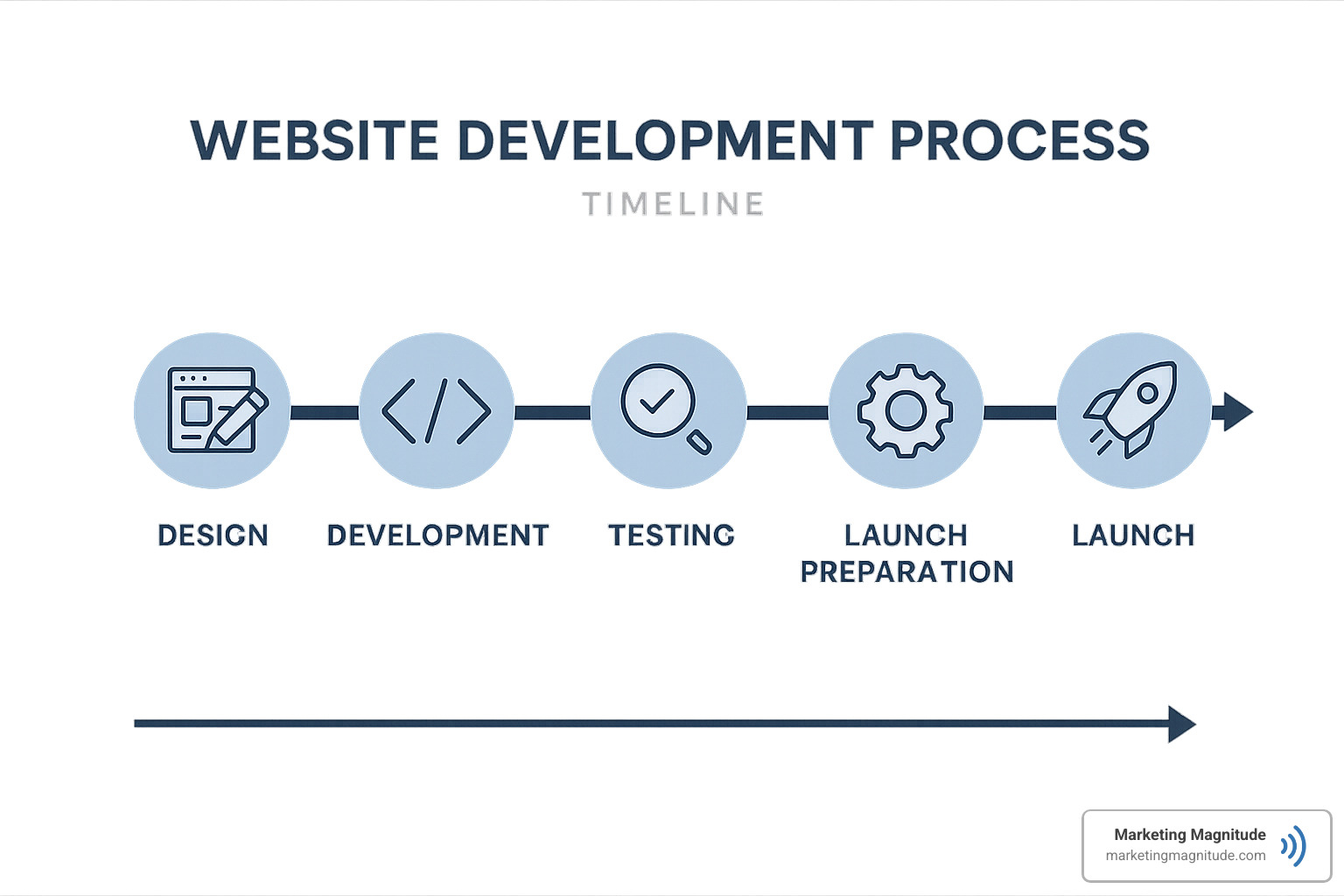
Understanding the roadmap keeps everyone on schedule and on budget. At Marketing Magnitude we follow a proven six-stage process, each with clear checkpoints.
-
Findy and Planning (1–2 weeks)
• Define business goals, target audiences, feature list, and success metrics.
• Create a sitemap and set a firm timeline. -
Design (2–3 weeks)
• Build wireframes to nail down layout and flow.
• Produce full-color mock-ups that reflect your brand.
• Revise until you sign off. -
Development (2–4 weeks)
• Code front-end and back-end, install the CMS, and integrate any third-party tools.
• Populate provided content. -
Testing & Quality Assurance (≈1 week)
• Browser/device tests, form checks, speed optimization, and accessibility review. -
Launch Prep (≈1 week)
• Final approval, server configuration, domain switch, analytics setup. -
Launch & Post-Launch (ongoing)
• Soft launch, monitor, and fix any hiccups.
• 90-day support window for tweaks, training, and performance reviews.
Typical Timelines
• Basic sites: 4–6 weeks
• Standard business sites: 6–8 weeks
• Complex or e-commerce: 8–12 weeks
The biggest timeline variable is client feedback and content delivery. Quick approvals keep the project moving; delays push deadlines.
After the Champagne Pops
A website is a living asset. Our maintenance plans cover security updates, backups, performance tuning, and incremental improvements so your site keeps pace with your business.
For common pitfalls that can tank traffic after launch, skim our guide on Web Design Mistakes That Lower Your Web Traffic (And How to Fix Them Today).
Frequently Asked Questions about Website Development Packages
How much does a basic package cost and what’s included?
When small business owners ask me about website development packages, they’re often surprised by the value a basic package delivers. Typically priced between $500 and $2,000, these starter packages include everything you need to establish a professional online presence.
For this investment, you’ll generally receive a 5-10 page website with mobile-responsive design (so it looks great on phones and tablets), a contact form for visitor inquiries, and basic SEO setup to help people find you online. Most packages also include a user-friendly content management system so you can make simple updates yourself, one year of domain registration, hosting setup, and an SSL certificate to keep your site secure.
According to HubSpot’s research, while DIY website builders might seem cheaper initially, they often lack the professional polish and functionality that comes with even basic professional packages. I always tell my clients that these packages are perfect for small businesses or startups looking to make a good first impression online without breaking the bank. They provide a solid foundation that can grow with your business over time.
Will my site be mobile-friendly and SEO-ready at launch?
In today’s digital landscape, a mobile-friendly website isn’t a luxury—it’s an absolute necessity. With more than half of all web traffic now coming from mobile devices, any reputable website development package should include mobile responsiveness as a standard feature.
As for SEO readiness, basic packages typically cover the essential technical elements that help search engines understand and index your site properly. This includes creating an SEO-friendly URL structure, proper heading hierarchy, basic meta titles and descriptions, image optimization, XML sitemap creation, and Google Search Console setup.
At Marketing Magnitude, we believe in giving our clients a strong start, which is why all our packages include mobile-first design and these essential on-page SEO elements. That said, more comprehensive SEO work like in-depth keyword research, competitor analysis, and strategic content optimization usually requires additional investment, either as add-ons or as part of our higher-tier packages.
What ongoing maintenance do I need to budget for?
One thing I always emphasize to clients is that a website is more like a garden than a building—it needs regular care to flourish. For a typical business website, here’s what you should realistically budget for:
Monthly essentials include hosting ($10-$50), CMS and plugin updates ($50-$100), security monitoring ($20-$50), and reliable backup systems ($10-$30). Then there are periodic needs like content updates (typically $50-$150 per hour), quarterly performance optimization ($100-$300), and occasional feature additions (costs vary based on complexity).
Many of our clients find it more cost-effective and stress-reducing to invest in a monthly maintenance package (ranging from $50-$200) that bundles these services together. This approach not only saves money compared to addressing issues individually but also provides peace of mind knowing professionals are keeping your site healthy.
According to WordPress VIP, the average business spends between 2-5% of their initial website investment on annual maintenance. I’ve seen what happens when businesses neglect website maintenance—security vulnerabilities, performance issues, and eventually the need for a complete rebuild. Trust me, regular maintenance is far more affordable than starting from scratch because a neglected site has become unusable or compromised.
Your website is often the first impression potential customers have of your business. Keeping it fresh, secure, and performing well isn’t just a technical necessity—it’s a smart business investment that continues to pay dividends long after launch.
How do website development packages differ from custom development?
Many clients wonder about the difference between packaged solutions and fully custom development. Website development packages offer pre-defined scopes of work with clear deliverables and pricing, making them ideal for businesses with standard needs and defined budgets. They typically include essential features that work for most business websites.
Custom development, by contrast, starts with a blank slate and builds everything specifically for your unique requirements. According to Clutch’s research on development costs, custom development can cost 2-3 times more than packaged solutions but provides complete flexibility for businesses with specialized needs.
At Marketing Magnitude, we’ve found that most businesses actually benefit from our hybrid approach – starting with a structured package as the foundation, then adding custom elements where they provide the most value. This gives you the predictability of package pricing with the flexibility to address your specific business challenges.
How long does website development typically take?
Timeline is often a critical concern for businesses launching a new website. Based on our experience with hundreds of projects, most standard business websites take 6-8 weeks from kickoff to launch. Basic sites might be completed in 4-6 weeks, while complex e-commerce or custom sites typically require 8-12 weeks.
The development process includes several phases: findy and planning (1-2 weeks), design (2-3 weeks), development (2-4 weeks), content population (varies based on client input), testing (1 week), and launch preparation (1 week). These phases often overlap to maximize efficiency.
It’s worth noting that the single biggest factor affecting timelines is client feedback and content delivery. When clients provide prompt feedback and deliver content on schedule, projects stay on track. When there are delays in these areas, the timeline inevitably extends.
Conclusion
Choosing the right website development package is more than just a business decision—it’s an investment in your company’s digital future. The perfect package delivers not just an attractive design, but a strategic asset that actively drives growth and connects with your customers.
Here at Marketing Magnitude, we’ve seen how businesses transform when they find their perfect website fit. We’ve designed our website development packages with flexibility and scalability in mind, because we know your business won’t stand still—and neither should your website.
What makes our approach different isn’t just what we build, but how we work with you after launch. Our transparent reporting and real-time tracking tools show you exactly how your website performs, from visitor behavior to conversion rates. No mysteries, no smoke and mirrors—just clear data you can use to measure your return on investment.
We’ve helped everyone from small local shops in Las Vegas looking for their first professional website to growing enterprises in Austin needing sophisticated custom solutions. Each project starts with understanding your specific goals and ends with a website that works as hard as you do.
The truth is, your website often forms the first impression potential customers have of your business. In today’s digital-first world, that online handshake matters more than ever. A professional, strategic web presence doesn’t just look good—it actively works to convert visitors into customers around the clock.
Ready to explore which website development package might be the right fit for your unique business needs? Learn more about our full-service approach or reach out today for a friendly, no-pressure consultation.
We believe the best websites aren’t just built—they’re crafted through partnership. And we’d love to be your partner in digital success.
Get Started Now
Fill out this form to start your journey to next-level marketing solutions for your business.