
The Real Reason So Many Business Owners Feel Burned by Marketing Agencies
Why business owners feel burned by marketing agencies is one of the most searched frustrations in the small business world — and for good reason.
Here’s the short answer:
- Lack of transparency — Agencies hide behind jargon, curated reports, and “black box” strategies that keep you in the dark about where your money actually goes.
- Overpromising — You’re sold on guaranteed rankings, explosive growth, and fast results. Reality rarely matches the pitch.
- No attribution — You never find out which campaigns actually drove leads or revenue. You just see colorful graphs and vague numbers.
The data backs this up. According to industry research, 68% of businesses admit to spending money on ineffective campaigns, yet only 22% ever measure true ROI. Meanwhile, 57% of clients who leave an agency cite poor communication and transparency as the reason.
This isn’t bad luck. It’s a pattern.
You hired an agency to grow your business. Instead, you got monthly reports full of impressive-sounding metrics — impressions, reach, clicks — while your phone stayed quiet and your revenue stayed flat. That sinking feeling is real, and you’re not alone.
I’m Kelly Rossi, founder of Marketing Magnitude and a digital marketing professional with over 20 years of experience running agencies and managing campaigns across SEO, PPC, and analytics — and I’ve seen how lack of transparency, overpromising, and no attribution leave business owners disillusioned and hesitant to invest in marketing again. In this guide, I’ll walk you through exactly what goes wrong and how to protect yourself.
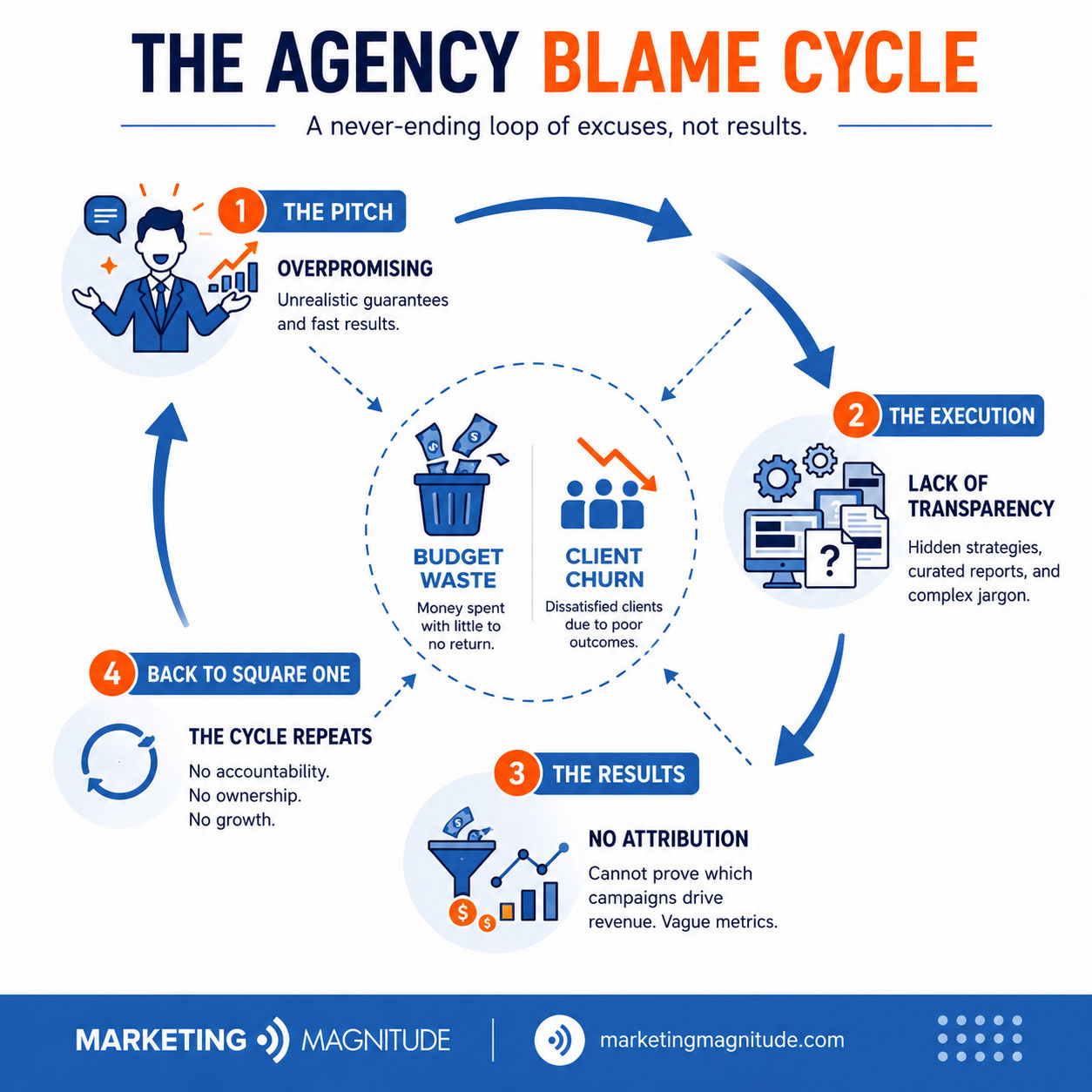
Basic “Why Business Owners Feel Burned by Marketing Agencies (And How to Avoid It)” Call out: Lack of transparency Overpromising No attribution glossary:
Why Business Owners Feel Burned by Marketing Agencies (And How to Avoid It) Call out: Lack of transparency Overpromising No attribution
The digital marketing landscape in May 2026 is more crowded than ever. With low barriers to entry, anyone with a laptop can claim to be a “marketing guru.” This saturation has led to a crisis of trust. When we talk to business owners in Las Vegas or Austin, the story is usually the same: they spent thousands, saw “green arrows” on a PDF, but didn’t see any more money in their bank account.
The core of the issue lies in the misalignment of goals. Most agencies are incentivized to keep you paying the retainer, not necessarily to grow your bottom line. They focus on “vanity metrics”—things that look good on paper but don’t pay the bills.

To help you distinguish between a partner and a “burner,” consider the following comparison:
| Feature | Burner Agency | Growth Partner (Marketing Magnitude) |
|---|---|---|
| Reporting | Static PDFs once a month | Real-time, 24/7 dashboard access |
| Communication | Reactive (only when you call) | Proactive strategic guidance |
| Focus | Impressions and Clicks | Leads, Sales, and ROI |
| Data Ownership | They own the accounts | You own all accounts and data |
| Attribution | “We think it’s working” | “Here is the exact source of this sale” |
Lack of Transparency: Why Business Owners Feel Burned by Marketing Agencies (And How to Avoid It)
Transparency is the foundation of any healthy relationship, yet it’s the first thing to go in a bad marketing partnership. Many agencies operate as a “black box.” They take your money, perform “optimizations” behind a curtain, and send you a bill.
One of the biggest red flags is gatekeeping data. If an agency refuses to give you administrative access to your Google Ads or Analytics accounts, they are essentially holding your business hostage. They do this to make it harder for you to leave, as you’d lose all your historical data if you did.
Furthermore, hidden fees can eat away at your budget. Some agencies take a percentage of your ad spend but don’t disclose the actual media cost vs. their management fee. This lack of clarity makes it impossible to calculate your true customer acquisition cost. We often get asked, FAQ: What makes you different from other agencies? and our answer always starts with our commitment to real-time tracking and open-book reporting.
You might wonder, Should you make your own changes to your digital marketing? While we encourage ownership, the real solution is having an agency that shows you exactly what they are doing so you don’t feel the need to “fix” things yourself out of fear.
Overpromising: Why Business Owners Feel Burned by Marketing Agencies (And How to Avoid It)
We’ve all heard the pitches: “Page 1 of Google in 30 days!” or “Double your leads overnight!” These are classic examples of overpromising. In SEO and PPC, there are no “guarantees” because we don’t own the platforms (Google and Meta do).
Overpromising often happens because agencies are desperate to close the sale. They tell you what you want to hear rather than the hard truth about what it actually takes to win in your market. This leads to unrealistic timelines and inevitable disappointment.
When it comes to paid search, many owners ask, Should I hire someone to manage my PPC campaign? The answer is yes—but only if they are honest about the costs. Understanding how much should it cost to manage PPC campaign? is vital. If an agency quotes a price that seems too good to be true, they are likely cutting corners on the actual work.
A real partner will walk you through how to manage PPC campaigns strategically, explaining that it takes 60-90 days of data collection before a campaign is truly optimized. They won’t promise the world on day one; they will promise a process that leads to results.
No Attribution: The Missing Link to ROI
If you can’t point to a sale and say, “This came from that specific ad,” you don’t have a marketing strategy—you have a gambling habit.
Shockingly, 42.3% of all Google Ads accounts have no conversion tracking set up at all. This leads to a global waste of $37 billion annually on poorly targeted ads. Without website conversion tracking, you are flying blind.
Attribution is the process of identifying which touchpoints a customer interacted with before making a purchase. In a local service market like Las Vegas, this often involves phone calls. This is why call tracking for marketing campaigns: Why is it important? is a question every business owner should ask. If your agency isn’t tracking calls back to the keyword level, they are wasting your money.
Proper website marketing analytics allow us to see the entire journey. Without this, agencies often claim credit for “brand” searches (people who were already looking for you) rather than proving they brought in new, incremental business.
5 Red Flags Your Agency is Burning Your Budget

Recognizing the signs of a failing partnership early can save you tens of thousands of dollars. Here are the most common red flags we see when auditing accounts for new clients:
- High Employee Turnover: If you have a new account manager every three months, your strategy is constantly starting over.
- Broad Match Abuse: 64% of ad budgets are wasted on irrelevant keywords because agencies use “broad match” without a robust negative keyword list.
- The “Check-In” Ghost: If you only hear from your agency when the invoice is due, they aren’t managing your account; they’re just monitoring it.
- No Access to Accounts: As mentioned, if you don’t own your Google Ads or Analytics login, you’re in a “hostage” situation.
- Lack of Strategy: If they can’t explain why they are making changes based on a guide to online marketing analysis, they are just “painting by numbers.”
When you ask, FAQ: How do you measure success?, the answer should always involve your bottom line, not just “engagement.”
The “Senior Strategist” Bait-and-Switch
This is a classic agency tactic. You meet the brilliant founder or a senior strategist during the sales pitch. They dazzle you with insights and case studies. But the moment the contract is signed, your account is handed off to a junior staffer who is fresh out of college and managing 15 to 20 other clients.
At that volume, active management is mathematically impossible. They become reactive, only looking at your account when something breaks or when you complain. This leads to the 26% average budget waste reported by Entrepreneur. You want an agency where the person doing the work actually has the time to think about your business.
Vanity Metrics Over Revenue
CFOs are becoming increasingly skeptical of marketing, and for good reason. 36% of CFOs cite the use of vanity metrics as a top concern. What are vanity metrics?
- Impressions: How many people “saw” your ad (even if they scrolled right past).
- Reach: The total number of unique users who saw your content.
- Clicks: People visiting your site but not necessarily buying.
While these have their place in brand awareness, they don’t equal revenue. Bad agencies use “color-coded trend lines” (usually green) to distract you from the fact that your cost-per-lead is skyrocketing. If your report doesn’t show a clear path from Spend → Leads → Sales, you’re being “burned.”
How to Conduct Due Diligence and Protect Your Digital Assets
Before you sign your next marketing contract, you need to protect yourself. Think of it like a prenuptial agreement for your business. You hope for the best, but you prepare for the worst.
First, ensure you have administrative access to everything. This includes your domain registrar, website hosting, Google Business Profile, Google Ads, and Meta Business Suite. You should be the “Owner,” and the agency should be a “Manager” or “Partner.”
For more detailed strategies, you can read about Avoid Being Burned by a Marketing Agency: Essential Tips for Business Owners. Additionally, consider the pros and cons of Hiring an Agency vs In-House to see which model truly fits your current growth stage.
Vetting the Process, Not the Pitch
Don’t be swayed by a polished slide deck. Instead, dig into the agency’s actual process.
- Ask about account ratios: Specifically, how many PPC campaigns can one person manage? If the answer is more than 8-10, run the other way.
- Check Credentials: Are they a verified Google Partner? This ensures they meet specific spend and performance requirements.
- Request Case Studies: Look for businesses in your industry or location (like Nevada or Texas) to see if they understand your specific market nuances.
- Interview Past Clients: A reputable agency will have no problem putting you in touch with a current or former client.
Contractual Safeguards and Exit Strategies
Your contract should be a shield, not a trap. Look for these three things:
- Ownership Clauses: It must explicitly state that you own all creative assets, ad accounts, and data generated during the partnership.
- Termination Notice: A 30-day “out” clause is standard. Avoid long-term “lock-in” contracts that don’t allow you to leave if performance fails.
- Defined Deliverables: The contract should list exactly what you are getting—how many posts, how many hours of optimization, and what type of reporting.
If you find yourself in a situation where an agency has breached these terms or caused significant financial loss, don’t hesitate to seek legal recourse. Document every communication and every unmet promise.
Frequently Asked Questions about Agency Partnerships
How long should it take to see real marketing results?
In the current May 2026 landscape, most digital campaigns require a 60-90 day window for meaningful optimization.
- Days 1-30: Data collection and baseline setting.
- Days 31-60: Identifying winning keywords/ads and cutting the “losers.”
- Days 61-90: Scaling what works to drive consistent ROI.
If an agency promises “instant” results, they are likely using “black hat” tactics that could get your site penalized in the long run. Setting SMART (Specific, Measurable, Achievable, Relevant, Time-bound) goals upfront ensures everyone is on the same page.
What is a typical marketing budget for a growing business?
While every business is different, most successful companies allocate 5-10% of their total revenue toward marketing. For aggressive growth, that number can climb higher.
- Maintenance Mode: 2-5% of revenue.
- Steady Growth: 5-10% of revenue.
- Aggressive Expansion: 10-20% of revenue.
The key is budget alignment. If you want to dominate the Las Vegas market but only have a $500/month budget, even the best agency will fail you. You must align your financial input with your desired output.
What should I do if I’ve already been burned by an agency?
First, don’t let “relationship trauma” stop you from growing. Marketing works; you just had a bad partner.
- Audit Your Accounts: Get a third-party audit to see exactly where the waste occurred.
- Secure Your Assets: Change passwords and ensure you have full admin control.
- Export Your Data: Before you fire them, make sure you have all historical performance data so you don’t have to start from zero with a new partner.
- Demand Transparency: Moving forward, only work with agencies that provide real-time tracking.
Conclusion
The feeling of being “burned” by a marketing agency is a setback, but it’s also an expensive education. It teaches you to look past the jargon and demand accountability. At Marketing Magnitude, we’ve built our entire business model around solving the three biggest pain points: Lack of transparency, overpromising, and no attribution.
Whether you are looking for PPC management in Austin or SEO in Las Vegas, you deserve a partner who treats your budget like their own. We provide real-time tracking so you never have to wonder if your marketing is working—you can see it for yourself, every single day.
Ready to stop the waste and start growing? Work with a transparent digital marketing agency that puts your ROI first.
Get Started Now
Fill out this form to start your journey to next-level marketing solutions for your business.