Why Your PPC Campaign Success Depends on Making the Right Choice
Should I hire someone to manage my PPC campaign is a question that keeps many business owners awake at night, especially when they see their ad spend disappearing without clear returns. The answer depends on your budget, expertise, and business goals:
Quick Decision Framework:
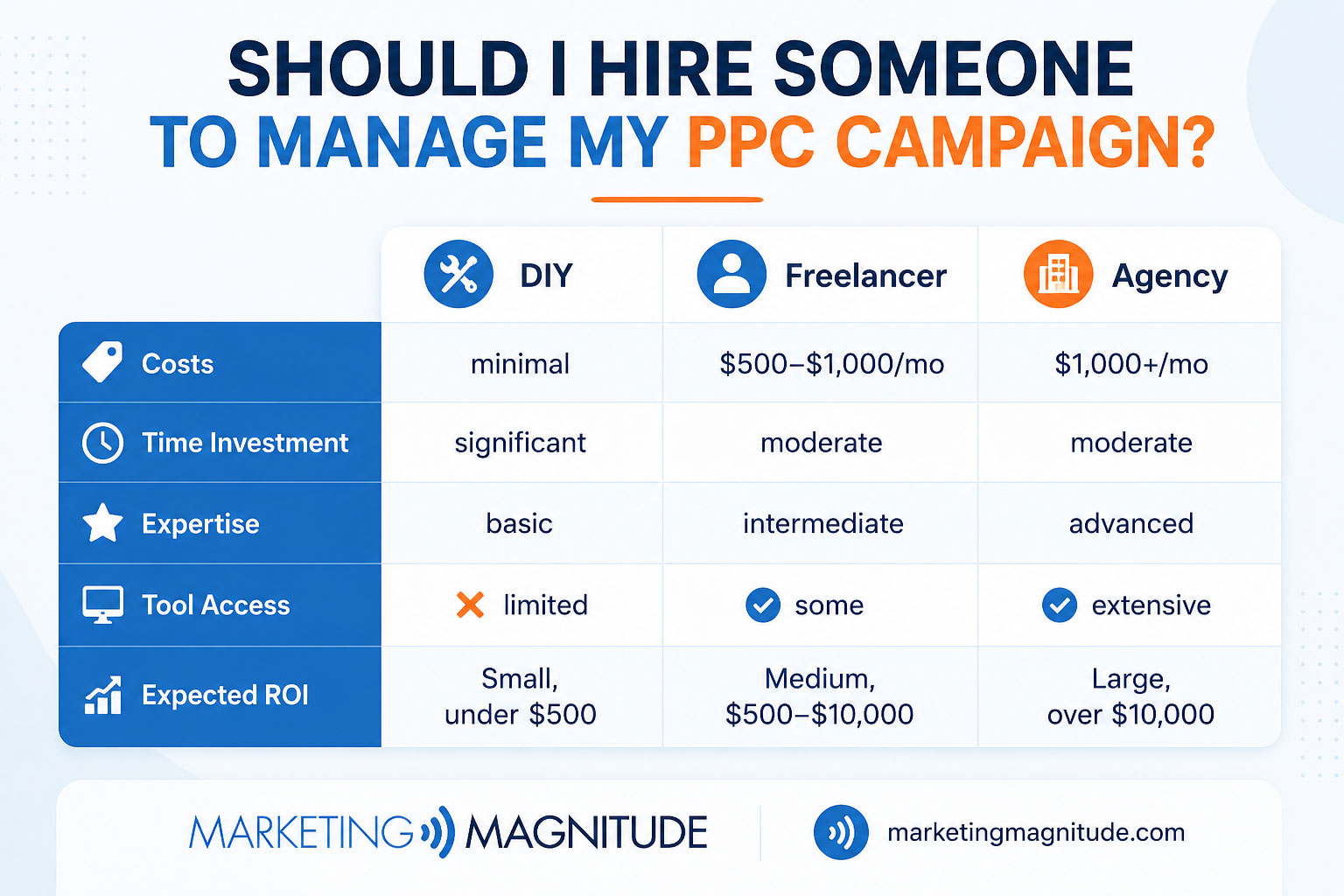
- DIY: Monthly ad spend under $500, you have time to learn
- Freelancer: Monthly spend $500-$1,000, need basic optimization
- Small Agency: Monthly spend $1,000-$10,000, want dedicated support
- Large Agency/In-House: Monthly spend over $10,000, need advanced strategies
The stakes are high. PPC advertising returns an average of $2 for every $1 spent – that’s a 200% ROI when done right. But here’s the catch: 41% of clicks go to the top three sponsored ads, and users who click PPC ads are 50% more likely to make a purchase than organic visitors.
Getting it wrong means burning through your marketing budget faster than you can say “Google Ads.”
The reality is brutal: Most business owners who try to manage PPC themselves end up wasting money on poorly structured campaigns, missing conversion tracking, and competing against agencies with advanced tools and years of experience.
I’m Kelly Rossi, and over my 20+ years in digital marketing, I’ve seen countless businesses struggle with the should I hire someone to manage my PPC campaign decision. Through my agency Marketing Magnitude, I’ve helped businesses save thousands in wasted ad spend while dramatically improving their returns.
Quick should i hire someone to manage my ppc campaign terms:
- how many ppc campaigns can one person manage
- how to manage ppc campaigns
- how to run and manage amazon ppc campaigns
Setting the Stage
Let’s be honest – when you’re staring at your monthly ad spend and wondering if those clicks are actually turning into customers, the pressure is real. We’ve worked with businesses in Las Vegas and Austin who’ve burned through $10,000+ before realizing they needed professional help. The question isn’t just about money – it’s about time versus expertise, and whether you can afford to learn PPC while your competitors are already dominating the search results.
PPC Basics & Why They Matter
Here’s the thing about PPC – it looks deceptively simple from the outside. You pick some keywords, write an ad, set a budget, and boom – instant traffic, right? If only it were that easy.
The reality is that successful PPC campaigns are built on four critical pillars that many business owners find the hard way. Let me walk you through what actually determines whether your should I hire someone to manage my PPC campaign question becomes urgent or optional.
Quality Score is your campaign’s secret weapon. Think of it as Google’s way of grading your homework. When your ads, keywords, and landing pages work together seamlessly, Google rewards you with lower costs and better ad positions. I’ve watched businesses slash their cost-per-click by 40% simply by aligning their keyword strategy with their ad copy and landing page content.
Conversion rate optimization separates the winners from the wannabes. Driving traffic feels good, but are those clicks actually paying your bills? The average conversion rates vary wildly – e-commerce sites typically see 3-5%, B2B companies often hit 5-10%, and lead generation campaigns can reach 10-30%. But here’s what matters more: are you tracking the right actions? Phone calls, form submissions, actual purchases – not just website visits.
Bid strategy is where DIY campaigns often crash and burn. Manual bidding gives you control but demands constant attention. Automated bidding uses machine learning but needs enough conversion data to make smart decisions. The sweet spot? Start manual to gather intelligence, then graduate to Smart Bidding once you’re seeing 15-30 conversions monthly.
Real-time tracking transforms guesswork into strategy. At Marketing Magnitude, we believe transparency isn’t optional – it’s essential. You should know exactly where every dollar goes and which keywords drive actual business results, not just pretty charts. Scientific research on ad relevance confirms that proper tracking setup can literally make or break your campaign performance.
Want to dive deeper into these fundamentals? Check out our comprehensive guide: More info about PPC 101.
What Is PPC & Where It Fits in the Funnel
PPC isn’t just Google Ads (though that’s often where people start). Paid search covers Google and Bing, paid social includes Facebook, LinkedIn, and Instagram, while display advertising spreads across thousands of websites through various ad networks.
Unlike SEO, which plays the long game, PPC delivers immediate visibility. But here’s the catch – it only works if you’re showing the right message to the right person at the right moment in their buying journey.
PPC works at every stage of your marketing funnel, but differently. Top-of-funnel display ads introduce your brand to people who don’t know they need you yet. Mid-funnel search ads catch people actively researching solutions. Bottom-funnel remarketing ads nudge previous visitors toward conversion.
Business Outcomes You Can Expect
Let’s talk numbers that actually matter to your business. Customer Acquisition Cost (CAC) versus Customer Lifetime Value (LTV) is the relationship that determines whether your PPC investment makes sense. Your LTV should be at least 3x your CAC – anything less and you’re essentially paying customers to shop with you.
Lead velocity increases dramatically with well-managed PPC because you’re capturing high-intent traffic. These aren’t casual browsers – they’re people actively searching for what you offer, right now.
Revenue impact varies by business model, but our clients typically see 200-400% ROI when campaigns are properly managed. Local businesses often see results faster due to less competition and clearer intent signals. Global campaigns require more sophisticated targeting and budget allocation, but the scalability potential is enormous.
Should I Hire Someone to Manage My PPC Campaign?
Let me paint you a picture. It’s 11 PM, you’re still at your computer, and you’ve spent the last three hours trying to figure out why your Google Ads campaign is eating through your budget without generating a single lead. Sound familiar?
This is the moment when “should I hire someone to manage my PPC campaign” stops being a casual thought and becomes an urgent necessity.
The truth is, PPC has become incredibly complex. We’re not talking about the simple days of just bidding on a few keywords. Today’s campaigns involve data overload that would make your head spin – Google Ads alone tracks hundreds of metrics, and that’s before you add Facebook, LinkedIn, and whatever other platforms you’re juggling.
Then there are the algorithm changes. Google made over 40,000 changes to their advertising platform in just one year. That’s more than 100 changes every single day. Unless you’re reading Google’s update blogs religiously (and who has time for that?), you’re always playing catch-up.
But here’s what really hurts: opportunity cost. Every hour you spend wrestling with bid adjustments is an hour you’re not spending on growing your actual business. If your time is worth $100 per hour and you’re spending 10 hours weekly on PPC management, that’s $4,000 monthly in lost opportunity – often more than hiring a professional would cost.
The Benefits of Professional Help—answering “should i hire someone to manage my ppc campaign”
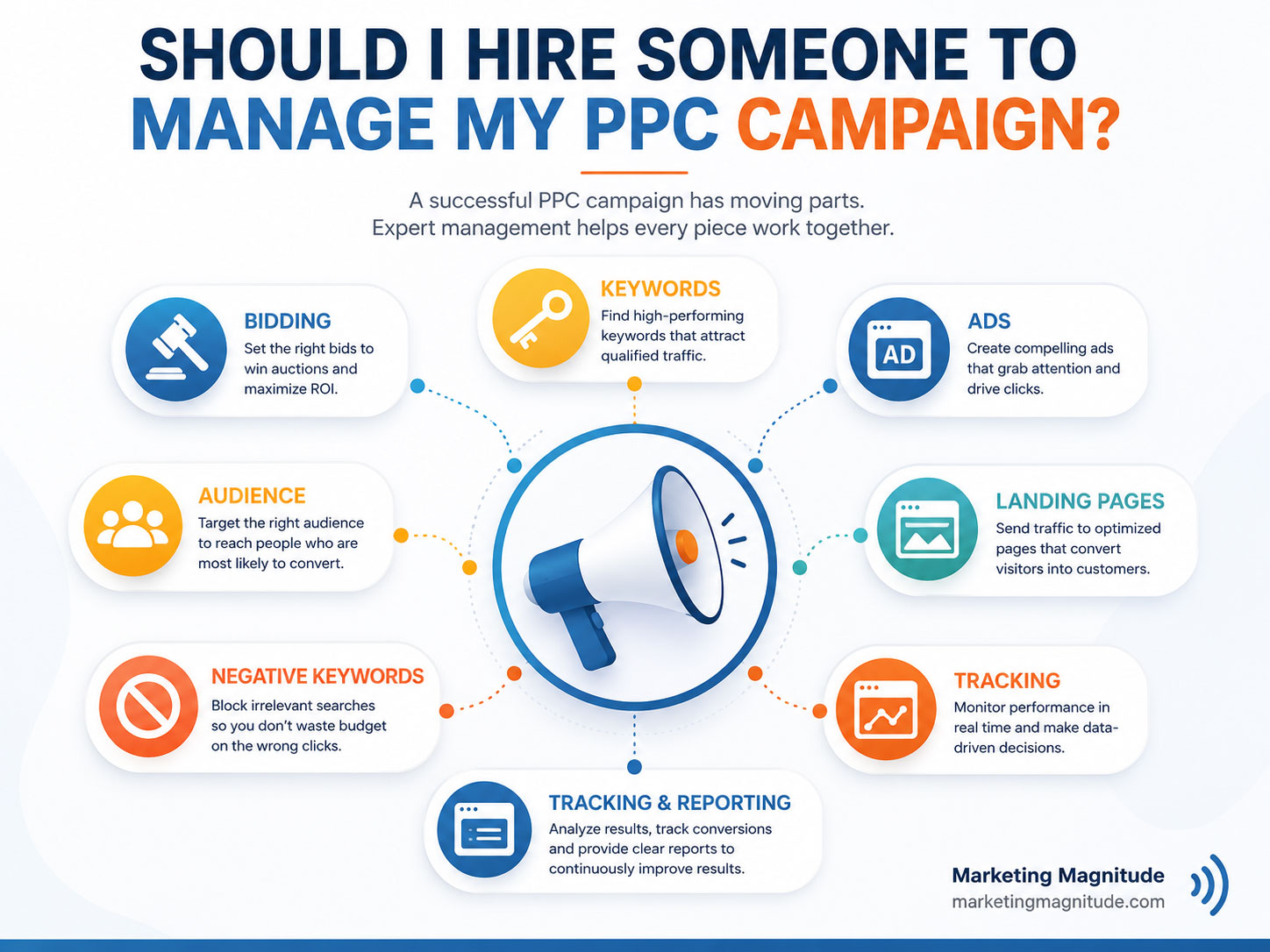
When you work with a professional PPC manager, you’re not just buying their time – you’re buying years of hard-won expertise. We know which bidding strategies actually work for different business types, how to structure campaigns for maximum Quality Score, and which audience targeting options drive real results versus just pretty reports.
The advanced tools alone make a huge difference. Professional managers have access to bid management software, competitive intelligence platforms, and analytics tools that can cost $500-2,000+ monthly. These tools enable optimization at a scale that’s impossible to achieve manually.
Smart Bidding and automation aren’t just “set it and forget it” solutions. They require proper setup, quality conversion data, and ongoing optimization. Professionals know how to feed Google’s algorithms the right information, set realistic target CPAs, and layer on bid adjustments that actually improve performance.
Cross-channel insights are where the magic really happens. Your PPC data should inform your SEO strategy, your social media targeting should leverage your email list, and your remarketing campaigns should connect with your CRM. This level of integration requires both technical know-how and strategic thinking that comes from managing hundreds of campaigns. More info about Small-Biz PPC benefits shows exactly how these advantages translate to real business growth.
DIY Risks & Hidden Costs—when “should i hire someone to manage my ppc campaign” becomes a resounding yes
Wasted spend is the most painful risk. When we audit DIY campaigns, we regularly find 30-50% budget waste on irrelevant keywords, poor ad scheduling, and missing negative keywords. One client came to us after spending $2,000 monthly on broad match keywords that were triggering for completely unrelated searches.
Poor tracking setup means you’re flying blind. Without proper conversion tracking, you can’t tell which keywords, ads, or audiences are actually driving business results. We’ve seen businesses shut down profitable campaigns because they couldn’t measure the phone calls and offline conversions their ads were generating.
Escalating CPCs happen when your Quality Score drops due to poor campaign management. What starts as $2 per click can quickly balloon to $5-10 per click as Google penalizes irrelevant ads and poorly structured campaigns.
Lost market share is the long-term consequence that really stings. While you’re learning PPC basics through trial and error, your competitors are capturing your potential customers with professionally managed campaigns. In competitive industries, this can mean losing thousands in potential revenue every single month.
The question “should I hire someone to manage my PPC campaign” usually answers itself once you add up these hidden costs and missed opportunities.
Cost & ROI: Comparing Management Models
Let’s cut through the marketing fluff and talk real numbers. When you’re wrestling with should I hire someone to manage my PPC campaign, the decision often comes down to dollars and cents – but the cheapest option upfront isn’t always the smartest choice.
DIY management looks tempting at first glance. You’re only paying for tools – maybe $50-300 per month for basic software. But here’s the reality check: you’ll spend 10-20 hours weekly learning, optimizing, and troubleshooting. If your time is worth $50 per hour, that’s $2,000-4,000 monthly in opportunity cost. DIY works best when your monthly ad spend is under $500 and you genuinely enjoy diving into data.
Freelancer management offers a sweet spot for many businesses. You’ll pay $500-2,000 monthly, depending on their experience and your campaign complexity. Good freelancers bring specialized expertise without agency overhead costs. The downside? You’re dependent on one person. Freelancers work well for focused campaigns with monthly ad spends between $500-5,000.
Small agency management typically costs $1,000-5,000 monthly or 10-20% of your ad spend. You get a dedicated team, proven processes, and diverse experience across multiple clients and industries. The trade-off is less personal attention than a freelancer provides, but more reliability and broader expertise. This sweet spot works for businesses spending $1,000-20,000 monthly on ads.
Large agencies and in-house teams represent the premium tier. Large agencies might charge $5,000-15,000+ monthly, while hiring in-house means salaries from $50,000-120,000 annually plus benefits and tools. You get advanced software access, beta features, and dedicated resources.
The math that really matters is your break-even analysis. Let’s say you’re spending $10,000 monthly on ads and considering a 15% management fee ($1,500). That investment pays for itself if professional management improves your ROI by just 15%. In practice, we typically see 50-200% ROI improvements when businesses switch from DIY to professional management. More info about PPC services shows how transparent reporting makes these improvements measurable and sustainable.
Agency vs Freelancer vs In-House vs DIY
Access to beta features gives established agencies a real competitive advantage. Google Premier Partners get new ad formats, bidding strategies, and targeting options 3-6 months before general release. That early access can mean capturing market share while your competitors are still using yesterday’s tools.
Scalability varies dramatically between options. A talented freelancer might effectively manage 5-10 accounts, providing excellent personal service but limited growth capacity. Agencies can handle hundreds of accounts with specialized teams for different industries or campaign types.
Account ownership should be non-negotiable regardless of which option you choose. You must own your Google Ads account, Facebook Business Manager, and all associated data. Any provider who won’t give you admin access is essentially holding your data hostage – a massive red flag that should end the conversation immediately.
Payment Structures & What They Really Mean
Flat fee pricing offers budget predictability, which appeals to many business owners. You know exactly what you’ll pay each month regardless of ad spend fluctuations. However, flat fees can create misaligned incentives.
Percentage of spend aligns everyone’s interests beautifully. When your campaigns succeed and spending increases, your provider earns more. When performance drops, their fees decrease too. The challenge comes with budget allocation decisions – providers might push for higher spend even when it’s not optimal for your business goals.
Performance-based pricing sounds perfect in theory but often creates problems in practice. Defining “performance” fairly is surprisingly difficult. Should you pay based on clicks, conversions, revenue, or profit? Different metrics can lead to very different optimization strategies.
Hybrid models often provide the best balance by combining multiple approaches. You might pay a base retainer for ongoing management plus performance bonuses for hitting specific targets. These structures provide predictability while maintaining aligned incentives for long-term success.
Hiring Checklist: Red Flags, Questions, KPIs & FAQs
The moment you start interviewing PPC managers, you’ll quickly separate the pros from the pretenders. I’ve seen too many business owners get burned by smooth talkers who promise the moon but can’t deliver basic campaign optimization.
Red flags should make you run, not walk, away from a potential hire. If they can’t demonstrate solid Excel or data analysis skills, you’re looking at someone who’ll be overwhelmed by the complexity of modern PPC management. The platforms give you thousands of data points – your manager needs to know how to slice and dice that information to find actionable insights.
Even more concerning is when a potential manager shows no intellectual curiosity about your business or the industry. PPC changes faster than fashion trends. If your candidate can’t discuss recent algorithm updates or new ad formats, they’re already obsolete.
Here’s the biggest red flag of all: they don’t ask about your business goals first. Any legitimate PPC professional should immediately want to understand your customer lifetime value, sales cycle, and what success actually looks like for your business. If they jump straight into tactics without understanding strategy, you’re dealing with an order-taker, not a strategic partner.
The scientific research on dynamic search ads proves that campaign success depends heavily on proper goal alignment from day one. Without that foundation, even perfect technical execution will miss the mark.
Must-Ask Questions Before Signing
Before you sign any contract or shake any hands, these questions will reveal whether you’re dealing with a true professional or someone who’s just good at talking.
Start with tracking and attribution: “How will you track conversions, and how will you handle phone call attribution?” The answer should include Google Tag Manager, call tracking with dynamic number insertion, and offline conversion imports. If they look confused or mention “we’ll just track website clicks,” keep looking.
Demand proof of past performance: “Can you provide specific examples of campaigns you’ve managed with similar budgets and business models?” Don’t accept vague promises. You want actual numbers – percentage improvements in cost per acquisition, return on ad spend increases, conversion rate improvements.
Landing page expertise matters more than most people realize: “How do you approach landing page optimization and what tools do you use for conversion rate optimization?” Your PPC success often depends as much on what happens after the click as the ad itself. Look for answers that include A/B testing methodologies, mobile optimization strategies, and page speed considerations.
Communication expectations need to be crystal clear: “What’s your reporting schedule and how quickly do you respond to questions or concerns?” Monthly reports are standard, but you should have access to real-time data. We provide transparent, real-time dashboards so you’re never wondering about campaign performance.
The should I hire someone to manage my PPC campaign decision often comes down to finding someone who can answer these questions confidently and specifically. More info about Red Flag makeovers covers additional warning signs that indicate your current strategy needs professional help.
Key Skills & Certifications to Demand
Google Partner certification is just the starting point, not the finish line. It proves basic competency, but you want someone who goes deeper. Look for Google Analytics Individual Qualification, Facebook Blueprint certifications, and Microsoft Advertising certifications if you’re planning multi-platform campaigns.
Analytics prowess separates the good from the great. Your PPC manager should be comfortable with Google Analytics 4, understand attribution modeling, and create custom reports that tie campaign performance to actual business outcomes.
A/B testing methodology is where science meets art. Running split tests is easy. Proper statistical significance testing, holdout groups, and iterative improvement processes? That takes real expertise. Your manager should understand sample sizes, confidence intervals, and how to avoid testing bias.
Quick FAQs
What should I expect to pay for professional PPC management?
Freelancers typically charge $25-100+ per hour or $500-2,000 per month. Agencies usually charge 10-20% of ad spend or $1,000-10,000+ monthly retainers. In-house specialists cost $50,000-120,000 annually plus benefits and tools.
How long should I commit to a PPC management contract?
Avoid long-term contracts initially. Month-to-month or 3-month agreements let you evaluate performance before making longer commitments. Quality providers are confident enough in their results to offer flexible terms.
What metrics should I use to measure success?
Focus on business outcomes, not vanity metrics. Track cost per acquisition, return on ad spend, conversion rates, and customer lifetime value. Your should I hire someone to manage my PPC campaign decision should ultimately be measured by whether professional management improves these bottom-line metrics.
Conclusion & Transparent Next Steps

So here we are at the end of our journey through the should I hire someone to manage my PPC campaign decision. I know it feels overwhelming – trust me, I’ve had this exact conversation with hundreds of business owners over the years.
The truth is, this decision comes down to being honest with yourself about three things: your budget, your available time, and how much risk you’re comfortable taking with your marketing dollars. If you’re just dipping your toes in the water with under $500 monthly ad spend and genuinely enjoy learning new marketing skills, DIY might be your path. But if you’re serious about growing your business and your marketing budget reflects that commitment, professional management isn’t an expense – it’s an investment that pays for itself.
At Marketing Magnitude, we’ve built everything around what frustrated us most about the PPC industry: the lack of transparency. You’ll own your accounts completely – no games, no holding your data hostage. Our real-time dashboards mean you never have to wonder what’s happening with your campaigns or wait for a monthly report to see if your money is working hard enough.
What really drives me is seeing businesses finally get the results they deserve. Whether you’re a local business here in Las Vegas trying to outrank the competition on “emergency plumber near me” searches, or you’re an Austin tech startup ready to scale nationally, we customize everything to fit your specific situation and goals.
Here’s what keeps me up at night: knowing that right now, businesses are burning through their marketing budgets while their competitors capture customers with professionally managed campaigns. The cost of getting PPC wrong – wasted ad spend, missed opportunities, and lost market share – almost always exceeds what you’d invest in expert management.
Your path forward is clearer than you might think. Start by calculating what DIY management really costs you when you factor in your time, the learning curve, and inevitable mistakes. Then get crystal clear on what success looks like for your business and what you’re willing to invest to get there.
The competitive landscape isn’t getting easier, and the businesses that invest in professional PPC management today will dominate their markets tomorrow. Every month you wait is another month your competitors are capturing your potential customers.
Ready to see what professionally managed PPC can do for your business? More info about Pay-Per-Click Management shows exactly how we deliver transparent, results-driven campaigns that actually grow your bottom line.
The real question isn’t whether you can afford to hire professional PPC management – it’s whether you can afford to keep doing what you’re doing now.