Why Paid Advertising Management Is the Fastest Way to Grow Online
Paid advertising management is the process of planning, running, and continuously optimizing paid digital ad campaigns — across platforms like Google, Meta, and LinkedIn — to generate qualified traffic, leads, and sales while keeping costs under control.
Here’s what it covers at a glance:
| What It Is | What It Does |
|---|---|
| Managing paid ads on Google, Meta, LinkedIn, etc. | Drives immediate, targeted traffic to your site |
| Keyword research, bidding, and ad copy | Puts your business in front of high-intent buyers |
| Ongoing optimization and A/B testing | Lowers cost per click and improves conversion rates |
| Performance tracking (ROAS, CPA, CTR) | Shows exactly what your ad spend is producing |
Unlike SEO, which can take months to gain traction, paid advertising delivers immediate visibility — right when someone is actively searching for what you offer. Google alone processes up to 3.5 billion searches per day, and well-managed PPC ads convert 50% better than other forms of advertising.
But “set it and forget it” doesn’t work here. Campaigns left unmanaged waste budget fast. That’s exactly why active, strategic management makes the difference between ads that drain money and ads that drive real growth.
I’m Kelly Rossi, a digital marketing expert with over 20 years of experience in paid advertising management and the founder of Marketing Magnitude, a Las Vegas-based agency focused on measurable growth. I’ve managed PPC campaigns across dozens of industries — from entertainment brands to local service businesses — and I’m sharing everything that actually works.
The Fundamentals of Paid Advertising Management
To master paid advertising management, we first have to understand the “under the hood” mechanics of the ad auction. Many people think the highest bidder always wins the top spot on Google. In reality, it’s a bit more democratic than that.
Ad Auction Mechanics and Quality Score
Search engines use a formula that combines your maximum bid with your Quality Score. Think of Quality Score as Google’s way of rewarding relevance. It’s measured on a scale of 0 to 10 based on your click-through rate (CTR), ad relevance, and the quality of your landing page. If your ad is highly relevant to the user’s search, you can actually pay less per click than a competitor who is bidding more but has a poor-quality ad.
Keyword Intent and Bid Management
At the heart of any campaign is PPC 101: Basics of Pay-Per-Click Management. We categorize keywords by “intent.” For example, someone searching for “what is a plumber” has informational intent, while someone searching for “emergency plumber in Las Vegas” has high-purchase intent. We focus your budget on those high-intent terms to ensure your dollars go toward people ready to buy.

Ad Extensions and Budget Allocation
Professional paid advertising management also involves using ad extensions—those extra bits of info like phone numbers, site links, or location details that make your ad bigger and more clickable. Effective How to Manage PPC Campaigns requires a balanced budget allocation. We typically suggest a 70/20/10 split: 70% of your budget goes to proven “bread and butter” keywords, 20% to optimizing existing campaigns, and 10% to testing new, experimental strategies.
Strategic Channels and Campaign Types
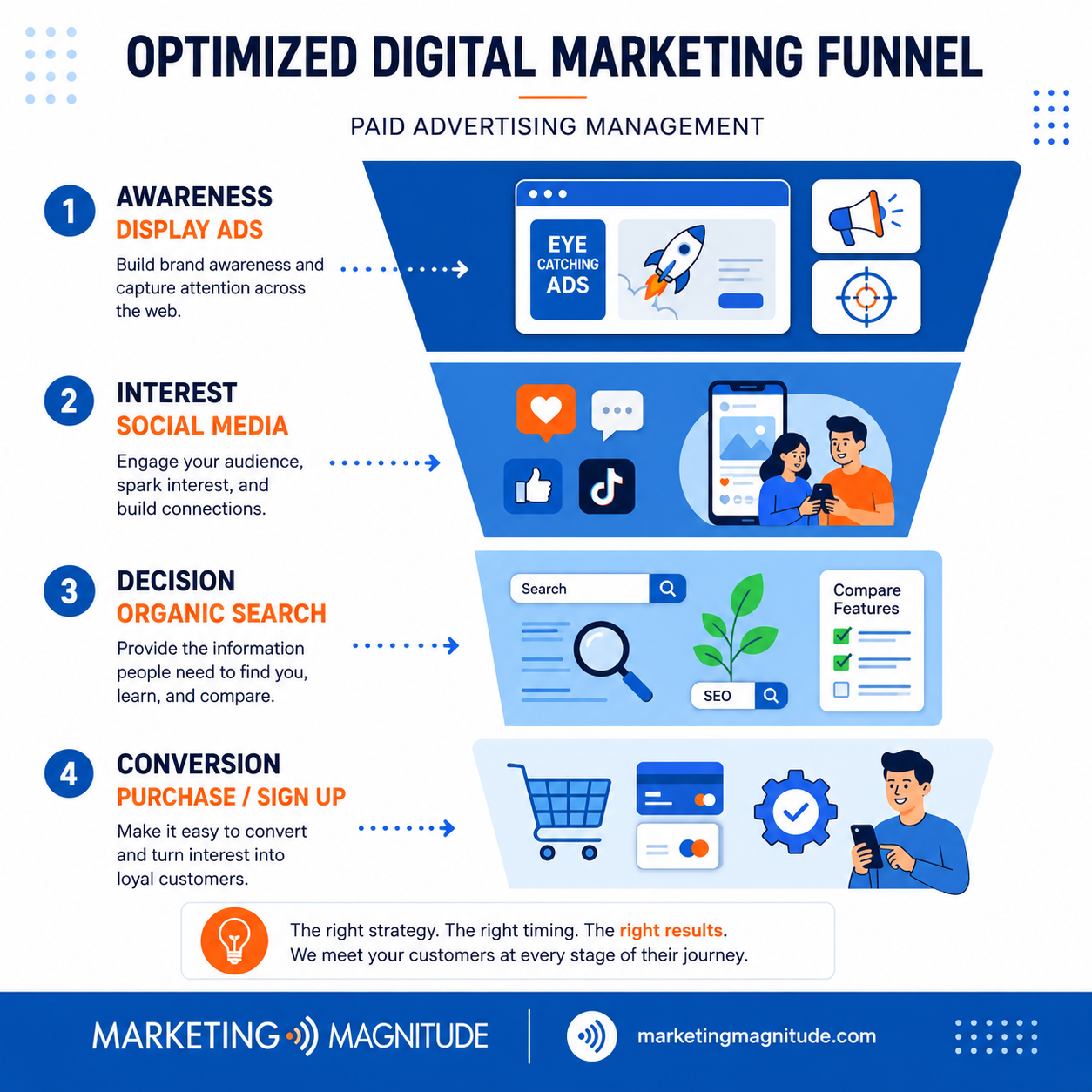
Not all ads belong on a search results page. Depending on your business goals, we might use a mix of several different channels.
- Search Advertising: The classic “pull” marketing. You show up when someone is looking for you.
- Display Network: These are visual ads that appear on news sites, blogs, and apps. While the average CTR is lower (around 0.46% compared to 3.17% for search), it’s fantastic for brand awareness.
- Remarketing: Ever visited a site and then seen their ads everywhere? That’s remarketing. It’s a powerful way to bring back the 97% of people who don’t convert on their first visit.
- Video Ads: With YouTube being the world’s second-largest search engine, video is essential for storytelling.
- Shopping Campaigns: If you sell physical products, these ads show your product photo and price directly in the search results.
When selecting a partner for Paid Search Management Services, it’s important to look for a team that understands how these channels interact. Choosing the Right Paid Media Partner means finding someone who doesn’t just “push buttons” but looks at your entire business ecosystem.

Effective Paid Advertising Management for Search and Social
Social media platforms like Meta (Facebook/Instagram) and LinkedIn offer “push” marketing. We aren’t targeting what people type, but who they are.
Through Services / Paid Advertising (PPC) Management, we can filter audiences by demographics, interests, and job titles. For our B2B clients in Austin or Las Vegas, LinkedIn is the gold standard, allowing us to target decision-makers at specific company sizes. For B2C, Meta’s custom audiences allow us to find “lookalikes” of your current best customers, which is incredibly effective for scaling.
Measuring and Optimizing Performance
In paid advertising management, if you can’t measure it, it didn’t happen. We track several Key Performance Indicators (KPIs) to ensure your campaigns are healthy:
- ROAS (Return on Ad Spend): How many dollars do you make for every dollar spent? A 3:1 ratio is a common benchmark, but we’ve seen clients hit 5:1 or higher with proper optimization.
- CPC (Cost Per Click): The average price you pay for a single visitor.
- CTR (Click-Through Rate): The percentage of people who see your ad and actually click it.
- Conversion Rate: The percentage of clickers who take a desired action (like calling you or filling out a form).
Search vs. Display Benchmarks
It’s important to know what “good” looks like. Here is a quick comparison based on 2026 industry data:
| Metric | Search Ads (Avg) | Display Ads (Avg) |
|---|---|---|
| Click-Through Rate (CTR) | 3.17% – 6.5% | 0.46% |
| Conversion Rate | 4% – 7% | 0.5% – 1% |
| Cost Per Click (CPC) | $2.69 | $0.60 |
One of the biggest Pay-Per-Click Advertising Benefits is the ability to pivot quickly. We use A/B testing to compare two different headlines or images to see which performs better. We also relentlessly prune negative keywords. If you’re a high-end lawyer, you don’t want to pay for clicks from people searching for “free legal advice.” Eliminating these PPC Mistakes That Harm Your Digital Marketing Strategy can instantly reduce wasted spend by 20% or more.
Advanced Paid Advertising Management Techniques
As we move through 2026, AI has become a central pillar of our strategy. Google’s AI Max and Performance Max campaigns use machine learning to find customers across all of Google’s surfaces (Search, YouTube, Gmail, Maps).
However, AI needs “guardrails.” We implement Consent Mode v2 and server-side tracking to ensure data privacy while still feeding the AI the high-quality data it needs to learn. This “Smart Bidding Exploration” allows the system to find up to 18% more unique search queries that a human might never think of. By focusing on Advanced PPC Strategies for 2026, we bridge the gap between human intuition and machine speed.
Frequently Asked Questions about Paid Media
How much does it cost to manage a PPC campaign?
Pricing usually follows one of two paths: a flat monthly fee or a percentage of ad spend (typically 10-20%). At Marketing Magnitude, we often prefer structures that align with your growth. For small businesses, we see average spends ranging from $1,000 to $5,000 per month, while mid-sized companies often spend $10,000+. You can find a deeper dive into these numbers in our guide: How Much Should It Cost to Manage PPC Campaign.
Should I hire an agency or manage ads in-house?
If you’re spending less than $1,000 a month and have plenty of time, DIY might work. But for most, the complexity of modern paid advertising management—from tracking pixels to AI optimization—makes an agency a smarter investment. Agencies provide access to expensive software and industry contacts that a solo business owner simply won’t have. If you’re on the fence, ask yourself: Should I Hire Someone to Manage My PPC Campaign? If you’re losing more than 5 hours a week to “fiddling” with ads, it’s time to outsource.
How does PPC differ from SEO?
SEO is a marathon; PPC is a sprint. SEO builds long-term equity and “free” traffic over time. PPC provides a “faucet” of traffic you can turn on or off instantly. The best strategy is to Manage Paid Search alongside SEO to dominate the search results page from both sides. This holistic approach is known as Search Engine Marketing (SEM).
Conclusion: Driving Real ROI with Marketing Magnitude
At Marketing Magnitude, we believe that paid advertising management shouldn’t be a “black box.” You deserve to know exactly where every dollar is going. That’s why our unique selling proposition is providing real-time tracking and reporting. Whether you are in Las Vegas, Austin, or anywhere across the United States, you can log in at any time to see your campaign performance.
We don’t just chase vanity metrics like “impressions” or “clicks.” We focus on the numbers that actually pay your rent: leads, sales, and ROAS. We’ve helped clients achieve incredible results, including a 312% increase in ROAS and a 47% reduction in acquisition costs.
Ready to turn your ad spend into a revenue engine?
Get started with professional Paid Advertising (PPC) Management today, and let’s build something great together.
Get Started Now
Fill out this form to start your journey to next-level marketing solutions for your business.