Understanding Paid Search Management: The Basics
Manage paid search effectively with these key steps:
- Set clear campaign goals (sales, leads, brand awareness)
- Structure your account properly (campaigns, ad groups, keywords)
- Research relevant keywords with commercial intent
- Create compelling ad copy that matches search intent
- Optimize landing pages for conversion
- Monitor and adjust based on performance data
Managing paid search campaigns can feel like throwing money into a black hole if you don’t have the right approach. Every day, businesses spend thousands on Google Ads without understanding what drives results. With over 3.5 billion Google searches performed daily and businesses making an average of $28 for every $1 spent on Google Ads, the opportunity is massive—but only if you know what you’re doing.
The truth is, paid search management isn’t just about bidding on keywords. It’s about creating a strategic framework that aligns your business goals with user intent, ad messaging, and conversion optimization.
Think of it as tending a garden rather than playing the lottery. You need to plant the right seeds (keywords), nurture them properly (optimize bids and ad copy), and harvest at the right time (convert visitors). Without this systematic approach, you’re just hoping for random success.
I’m Kelly Rossi, founder of Marketing Magnitude and a digital marketing specialist with over 20 years of experience helping businesses effectively manage paid search campaigns to drive measurable ROI. Throughout my career managing paid search for companies ranging from small local businesses to large enterprises like the Maloof Companies, I’ve developed proven frameworks that consistently deliver results.
What You’ll Learn
In this comprehensive guide, we’ll break down how to manage paid search campaigns effectively, covering:
- The difference between keywords and intent (and why intent matters more)
- How to set up campaigns that convert from day one
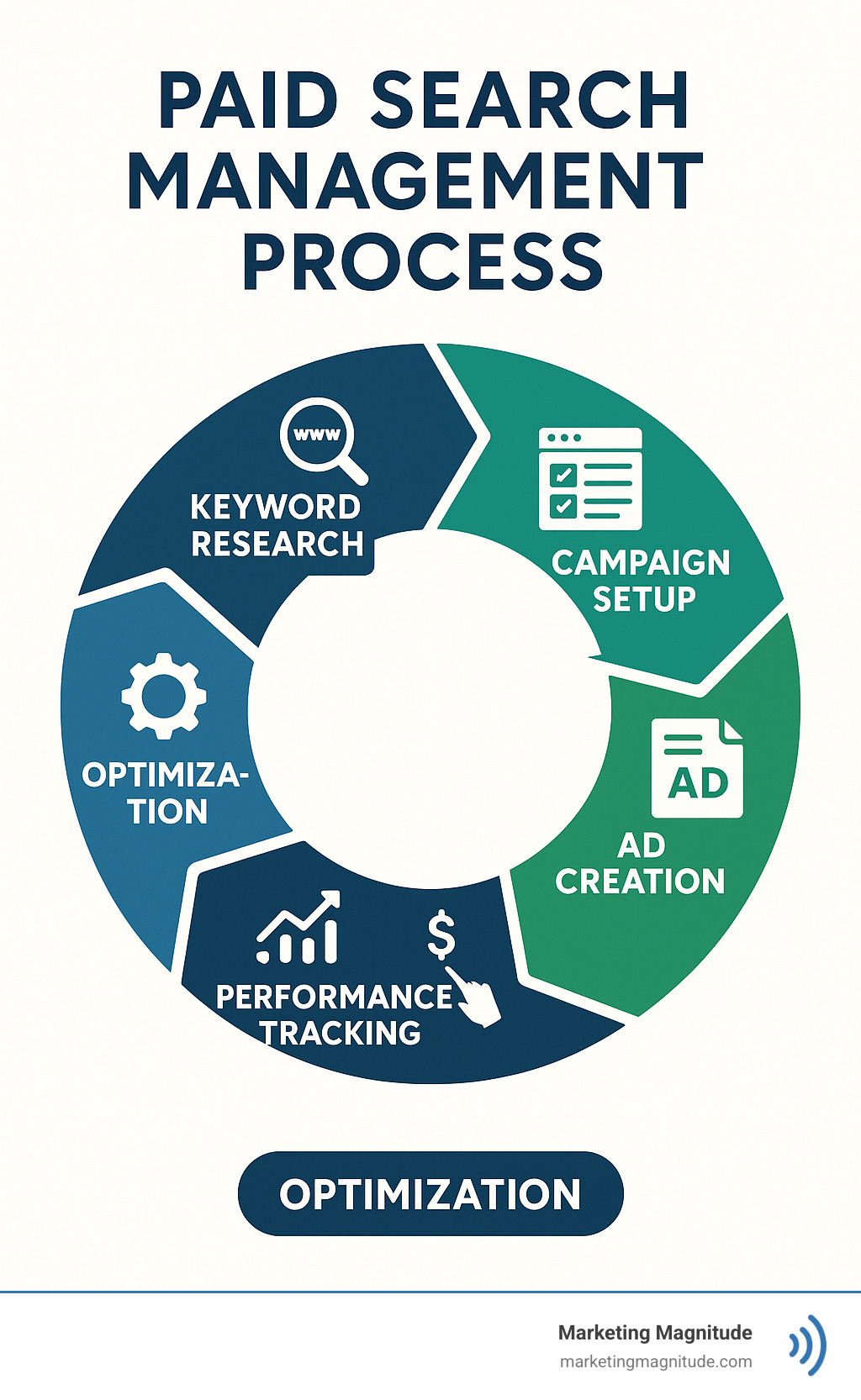
- The optimization loop that continuously improves performance
- Tracking ROI beyond simple clicks and impressions
- Common mistakes that waste your budget
- Tools that make management easier and more effective
By the end, you’ll have a clear roadmap for managing paid search campaigns that deliver measurable results.
Paid Search 101: How It Works & Why It Matters
Ever wonder what happens in the split second between typing a search and seeing those ads at the top? Let’s pull back the curtain on how paid search actually works.
Think of paid search like a lightning-fast auction that happens with every search. When someone types “best running shoes” into Google, an instant auction kicks off among advertisers who want to appear for that phrase. But here’s where it gets interesting – it’s not just a matter of who throws the most money at Google.
The search engines use a clever formula that rewards relevance just as much as spending:
Ad Rank = Bid × Quality Score
Your Quality Score evaluates how well your ad matches what the searcher wants – including expected clickthrough rate, how relevant your ad is to their search, and whether your landing page delivers what you promised. This means a small business with laser-focused, highly relevant ads can absolutely outrank bigger spenders with generic messaging. That’s the beauty of effectively managing paid search campaigns.
The numbers tell a compelling story: Google dominates with 92% of global search market share, while Microsoft Ads (formerly Bing) powers 26% of U.S. desktop searches. With 3.5 billion Google searches happening daily, and businesses earning an average of $28 for every $1 spent on Google Ads, the opportunity is massive. Plus, paid search ads convert visitors at more than twice the rate of organic results – people who click ads are often ready to take action.
Smart advertisers also leverage negative keywords to prevent their ads from showing for irrelevant searches, and explore specialized formats like shopping ads and local ads to capture specific customer segments.
Key Terminology at a Glance
To manage paid search effectively, you’ll need to speak the language. Here are the terms that matter most:
- CPC (Cost Per Click): What you pay when someone clicks your ad
- CPM (Cost Per Mille): The cost for a thousand impressions
- CTR (Click-Through Rate): The percentage of people who see your ad and click it
- Conversion Rate: How many clicks turn into actual customers or leads
- ROAS (Return on Ad Spend): The revenue you generate for every dollar spent
- Impression Share: How often your ads appear compared to all the times they could have
- Quality Score: Google’s 1-10 rating of how relevant and useful your ads are
SEM, PPC & SEO—Clearing the Confusion
I can’t tell you how often I hear these terms used interchangeably, so let’s set the record straight:
Paid search is specifically about advertising on search engines where you pay when someone clicks. PPC (Pay-Per-Click) is the pricing model used in paid search and other digital ads. SEM (Search Engine Marketing) is the umbrella term covering everything search-related, while SEO focuses on earning those free organic listings.
The magic happens when you combine approaches. At Marketing Magnitude, we’ve found that clients who implement both SEO and PPC strategies typically see a 69% increase in overall website traffic compared to using either strategy alone. They complement each other beautifully – paid search gives you immediate visibility while your organic presence builds, and the data from each can inform the other.
Want to dive deeper into the fundamentals? Learn more about PPC 101 basics on our dedicated resource page.
How to Manage Paid Search Campaigns Step-By-Step
Now that we’ve covered the basics, let’s roll up our sleeves and walk through exactly how to manage paid search campaigns that deliver real results.
1. Define Clear Campaign Goals
Before you spend your first dollar, you need absolute clarity on what success looks like. Are you trying to generate qualified leads? Drive e-commerce sales? Build brand awareness? Each goal requires a different approach.
For instance, when we helped a local accounting firm manage paid search campaigns, we focused on cost-per-lead and lead quality metrics. But for our e-commerce clients, we prioritize ROAS (return on ad spend) and average order value. Your goals shape everything that follows.
2. Create a Logical Account Structure
Think of your account structure as the blueprint for your paid search house. A solid foundation here makes everything else more stable and effective.
Your campaigns should be organized by logical divisions – perhaps product lines, service categories, or geographic regions. Within each campaign, create tightly focused ad groups. While Google used to recommend 5-30 keywords per ad group, our experience shows that about 6 related keywords per group delivers the best results.
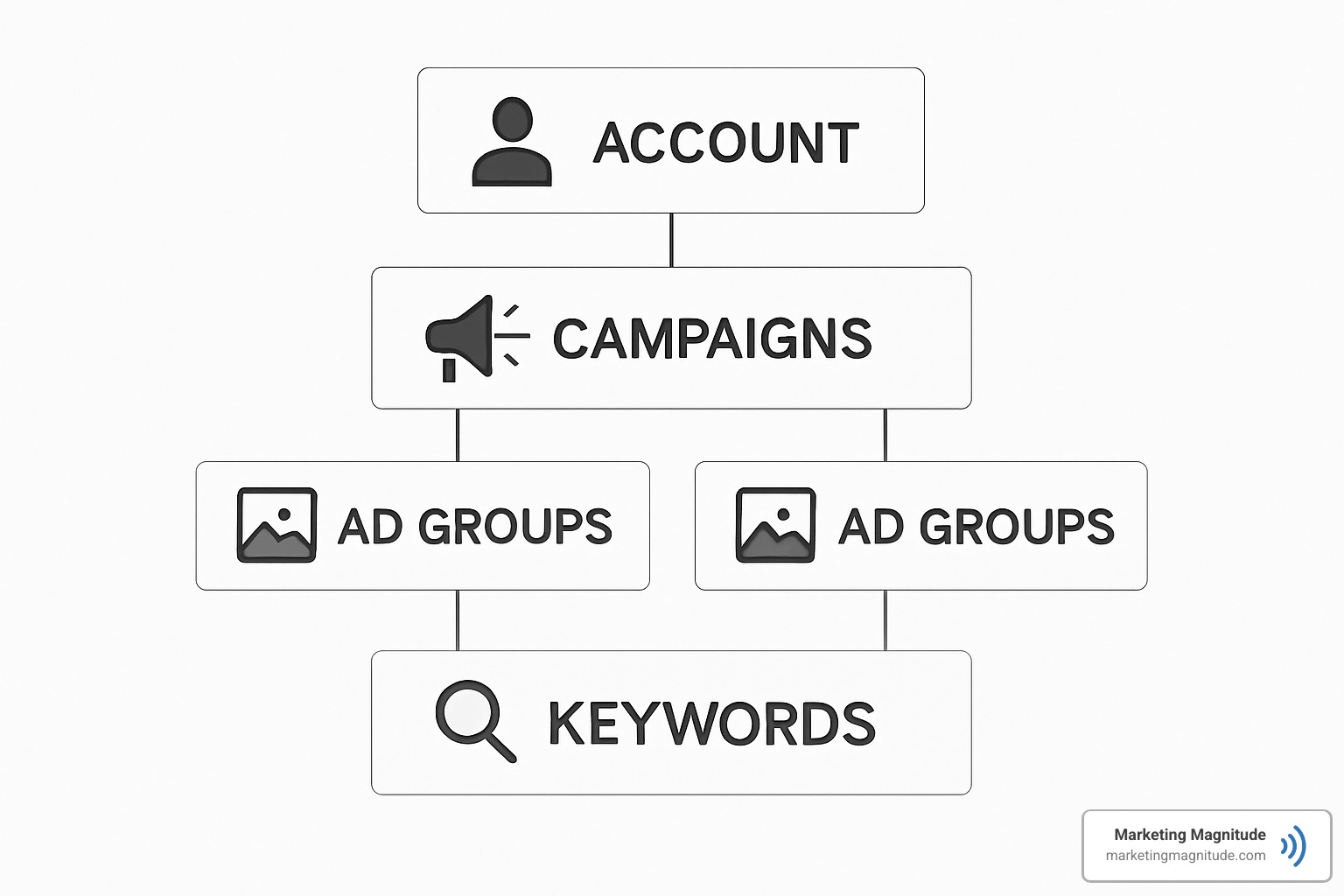
This tighter grouping allows you to craft hyper-relevant ads that speak directly to what searchers are looking for – which boosts your Quality Score and lowers your costs. It’s a win-win.
Manage Paid Search: Keyword Research & Intent
Keyword research isn’t just about finding words people search for – it’s about understanding the intent behind those searches. This distinction is crucial.
When someone searches “web developer,” are they looking for a job? Researching salaries? Or looking to hire a developer? Only one of these intents will convert for a web development agency.
We categorize keywords into four intent buckets:
Navigational: People looking for a specific website
Informational: People seeking knowledge or answers
Commercial: People researching products or services
Transactional: People ready to make a purchase
For most businesses, commercial and transactional keywords deliver the highest ROI. Focus your budget on phrases like “hire web developer,” “web development agency near me,” or “custom website design services” that signal buying intent.
Your keyword match types are equally important. We typically recommend starting with phrase and exact match types for high-intent keywords. This gives you better control over relevance and keeps costs in check. You can always expand to broader matches as you identify what works.
For more in-depth keyword research strategies, check out WordStream’s Ultimate Guide to Keyword Research.
Learn more about our SEO services
Manage Paid Search: Building Irresistible Ads
Your ads are where the magic happens – they’re your digital storefront. The difference between a mediocre ad and a great one can be dramatic.
Responsive Search Ads (RSAs) have changed the game by allowing you to provide multiple headlines and descriptions that Google mixes and matches to optimize performance. We’ve seen conversion rates improve by 18% when switching from standard to responsive ads.
Make sure your most important keywords appear in your headlines – this improves relevance and Quality Score. Highlight what makes you special. Is it your 24/7 customer service? Your 15 years of experience? Your money-back guarantee? Tell people!
And don’t forget a strong call-to-action. “Get a Free Quote,” “Shop Now,” or “Schedule a Consultation” tells users exactly what to do next.
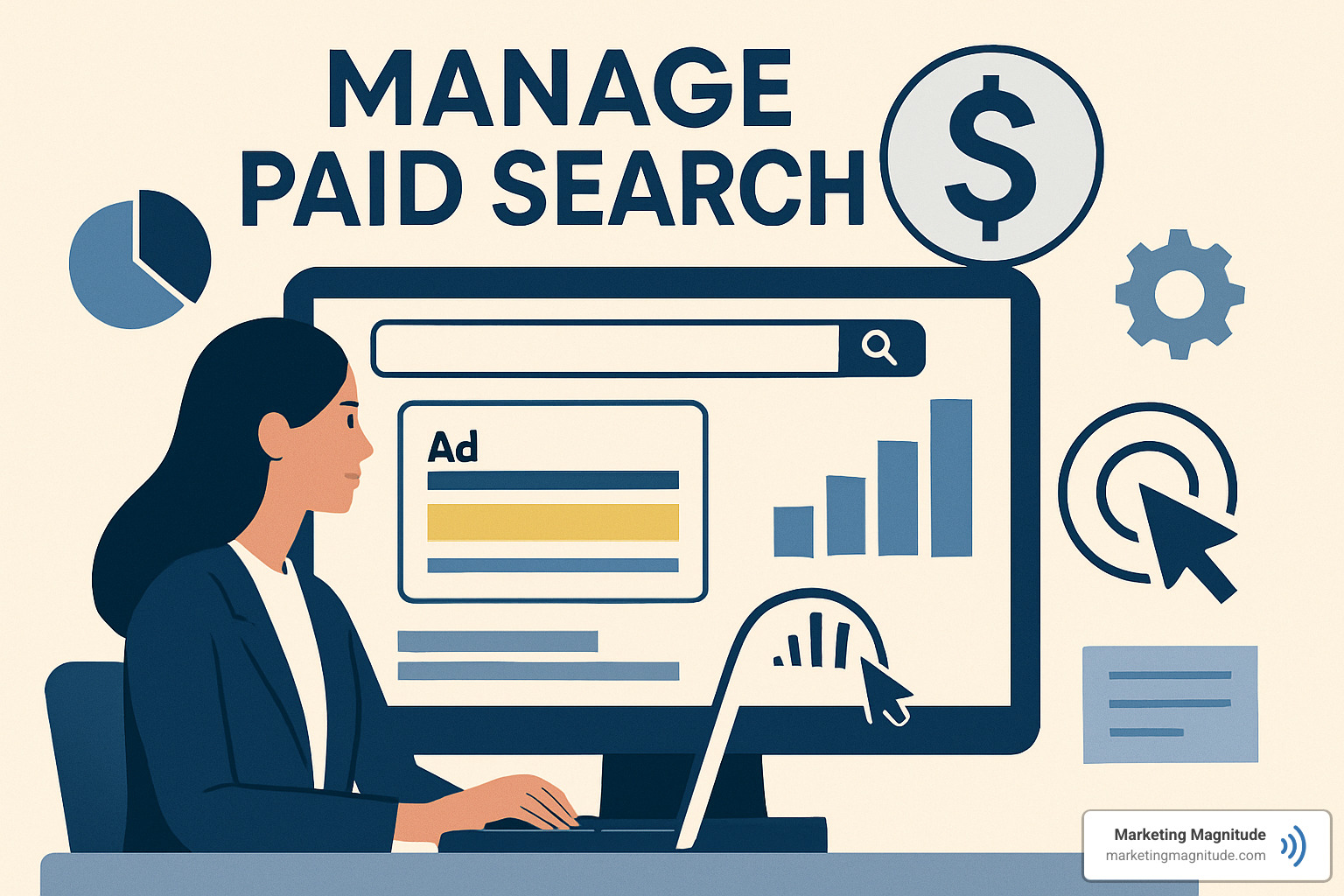
One of the biggest mistakes we see is a disconnect between ad copy and landing pages. Your ad promises a 20% discount, but your landing page doesn’t mention it? That’s a recipe for high bounce rates and wasted budget. Maintain consistency from keyword to ad to landing page for the best results.
Optimization & Automation: Getting More From Every Click
Let’s talk about taking your paid search campaigns to the next level. Once your campaigns are up and running, you’ll want to fine-tune them for maximum performance – that’s where optimization and automation come into play.
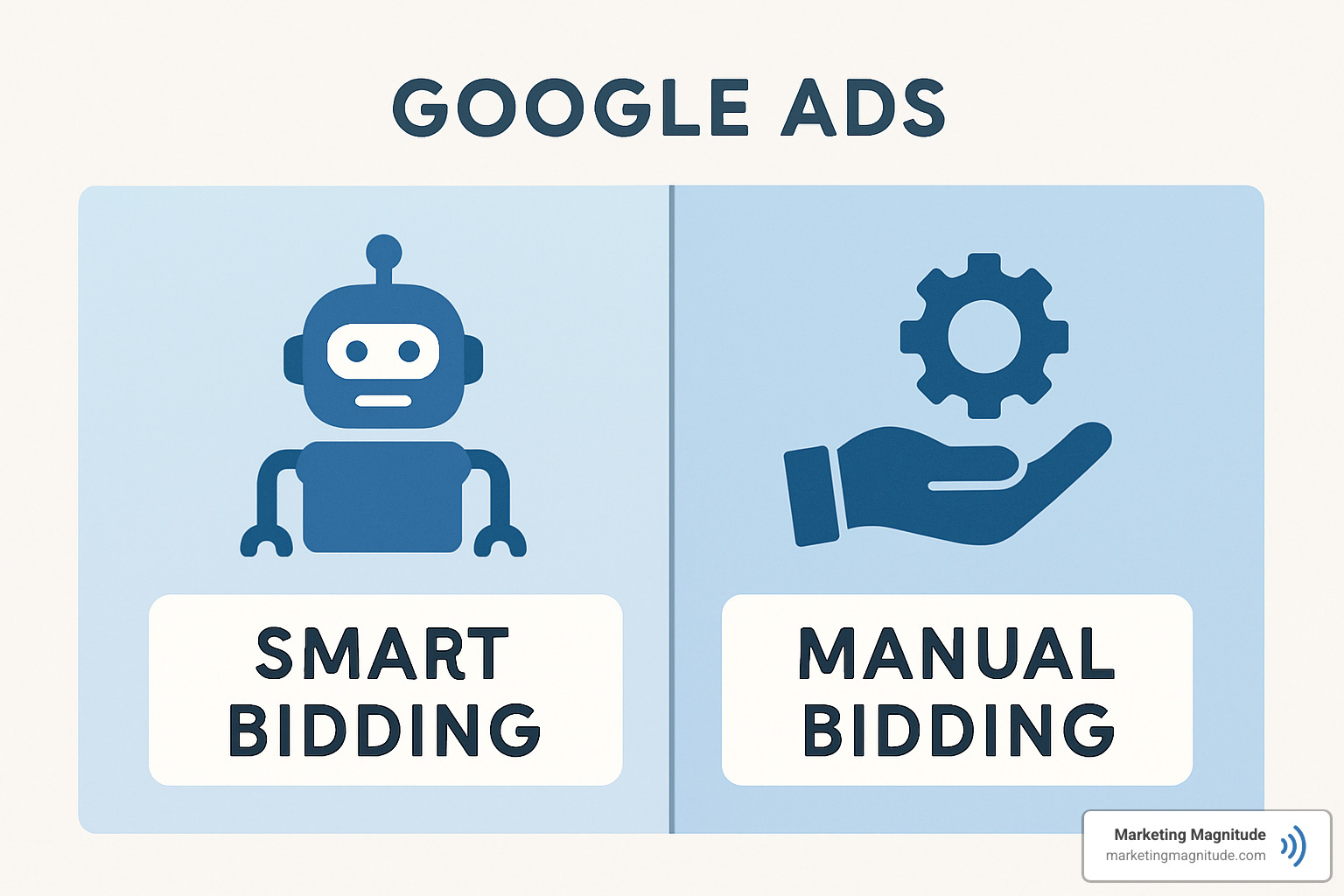
Smart Bidding vs. Manual Control
Google offers a buffet of automated bidding strategies that promise to make your life easier:
- Maximize Clicks
- Target CPA (Cost Per Acquisition)
- Target ROAS (Return On Ad Spend)
- Maximize Conversions
- Improved CPC
But here’s the thing – automation isn’t always the magic bullet it’s made out to be. In our experience at Marketing Magnitude, manual CPC bidding often outshines automation in certain situations.
Think of it like cooking – sometimes the slow, hands-on approach yields better results than the microwave. We’ve found manual bidding particularly effective for new campaigns still gathering data, accounts with modest conversion volumes, and those ultra-competitive keywords where every penny counts.
Google’s newest automation offering, Performance Max campaigns, combines various formats and placements under one umbrella. These can work wonders – but only if you feed them high-quality assets and keep a watchful eye on performance. According to research from Optmyzr, proper automation implementation can improve ROAS by up to 35% when configured correctly. But the key phrase here is “configured correctly.”
When Automation Helps—And When It Hurts
Automation shines brightest when:
- You’ve collected substantial conversion data (aim for at least 15-30 conversions monthly)
- Your conversion tracking is spot-on and comprehensive
- Your business goals and conversion values remain relatively stable
But automation can turn into a budget-draining liability when:
- You’re just dipping your toes in with limited historical data
- Your conversion tracking has gaps or inaccuracies
- You need granular control over specific keywords or audiences
- Your industry is highly regulated or fiercely competitive
At Marketing Magnitude, we’ve developed what we call the “hybrid approach.” We typically start with manual bidding to establish solid baseline performance, then selectively implement automation where it makes sense. This gives us the best of both worlds – the precision of manual control with the efficiency of automation where it truly adds value.
CRO & Landing Page Alignment
Let me share a secret that many advertisers miss: what happens after the click is just as important as getting the click in the first place. Your landing pages are where the magic of conversion happens – or doesn’t.
Message match is absolutely critical. When someone clicks your ad about “affordable family photographers,” they should land on a page that prominently features those exact words. This consistency builds trust and reduces bounce rates.
Clear value propositions need to hit visitors in the first few seconds. People make snap judgments – make sure they immediately understand why they should stick around.
Your call-to-action should be impossible to miss. Don’t make visitors hunt for how to contact you, make a purchase, or download your guide.
Mobile optimization isn’t optional anymore. Test your pages on multiple devices – a page that loads slowly or displays poorly on mobile will hemorrhage potential conversions.
Finally, accept A/B testing as a way of life. We’ve helped clients boost conversion rates by 30-50% through systematic landing page testing alone. Imagine cutting your cost per acquisition in half without spending an extra penny on ads!
The beauty of landing page optimization is that improvements compound over time. Every percentage point increase in conversion rate stretches your budget further, allowing you to either reduce spend or expand reach while maintaining results.
When you manage paid search campaigns with this holistic approach – combining smart bidding strategies with conversion-focused landing pages – you’ll extract maximum value from every click you pay for.
Avoiding Budget-Killer Mistakes & Structuring Accounts for Success
I’ve seen it countless times – businesses pour thousands into paid search only to wonder why they’re not seeing results. After managing millions in ad spend across dozens of industries, I’ve identified the budget-draining mistakes that can sink even the most promising campaigns.
Think of your paid search account like a house. With a solid foundation and proper framing, it’ll withstand the test of time. Build it haphazardly, and you’ll constantly be patching holes and wondering why your utility bills are so high.
Common Mistakes Checklist
The fastest way to waste your budget is by targeting keywords without real buying intent. “What is digital marketing” might get tons of searches, but those people aren’t looking to hire an agency – they’re just researching.
Poor account structure is another silent killer. I recently audited an account where a client had stuffed “website design,” “SEO services,” and “social media management” all in one ad group. Their ads couldn’t possibly address all these different intents effectively, and their Quality Score (and wallet) suffered accordingly.
Mismatched search intent might be the most common issue I see. When someone searches for “emergency plumber near me” and lands on your general “Our Plumbing Services” page instead of an emergency-focused landing page, they’ll bounce faster than you can say “leaky faucet.”
Other budget-killers include neglecting negative keywords (why pay for clicks from people searching “free website templates”?), blindly enabling Search Partners (often generating lower-quality traffic at premium prices), and over-relying on automation without proper oversight.
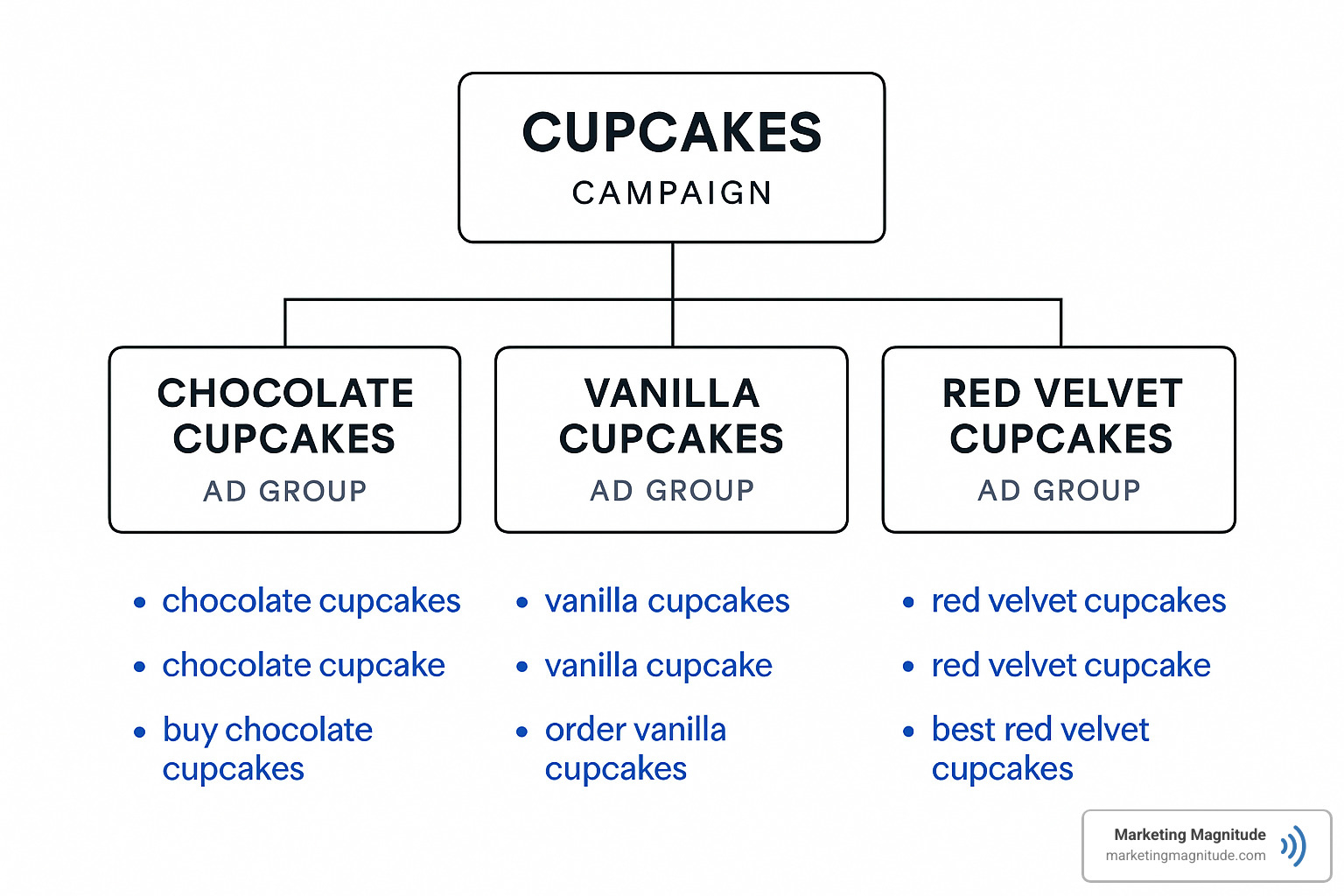
Ignoring Quality Score is like paying full price at a store where everything’s on sale. And while single keyword ad groups might sound precise, they often create unnecessary complexity that makes your account harder to manage paid search campaigns effectively.
Learn more about Three Red Flags Your PPC Strategy Needs a Makeover
Best-Practice Account Structure
A well-structured account is like a well-organized kitchen – everything has its place, making management efficient and performance stronger. Here’s how we approach it at Marketing Magnitude:
At the campaign level, organize by product lines, geographic regions, or business goals. This gives you control over budgets and settings for related groups of keywords.
For ad groups, cluster keywords by specific themes or intent. We’ve found limiting ad groups to 6-8 closely related keywords strikes the perfect balance between relevance and manageability. When keywords share similar intent, your ads can speak directly to what searchers are looking for.
Match type segmentation might sound technical, but it’s worth considering. Separating match types into different campaigns or ad groups gives you greater control over which keywords get priority and budget.
Always keep your networks separate. Search and Display are completely different animals, and mixing them is like trying to use the same strategy for both chess and basketball.
The PPC community often debates Single Keyword Ad Groups (SKAG) versus Single Theme Ad Groups (STAG). Here’s the honest comparison:
| Approach | Pros | Cons |
|---|---|---|
| SKAG | Extremely relevant ads, High Quality Scores | Time-consuming to set up, Complex to manage |
| STAG | Easier to manage, Still maintains relevance | Slightly less precise targeting |
At Marketing Magnitude, we’ve found a sweet spot with a modified STAG approach, using 5-6 very closely related keywords per ad group. This gives us the relevance we need without creating an account so complex it requires a full-time manager just to keep up with it.
This balanced approach has helped our clients achieve better Quality Scores and lower CPCs while keeping management time (and costs) reasonable. After all, the best structure is one you can actually maintain over time.
Essential Tools, Tracking & Reporting for Paid Search Managers
Let’s face it – trying to manage paid search campaigns without the right tools is like trying to build a house with just a hammer. I’ve spent years refining the perfect toolkit that makes PPC management more efficient and effective, and I’m excited to share these resources with you.
Core Platforms
The foundation of any paid search strategy starts with the platforms themselves. Google Ads remains the powerhouse where most of your budget will likely go, but don’t overlook Microsoft Ads if you want to capture those Bing, Yahoo, and DuckDuckGo users (which can often have less competition and lower CPCs).
Google Analytics provides the crucial post-click insights that tell you what happens after someone arrives on your site. Is your traffic bouncing immediately or engaging deeply? Are they converting? These answers make all the difference between wasted spend and profitable campaigns.
Meanwhile, Google Tag Manager has become indispensable for implementing conversion tracking without constantly bothering your web developer for new code installations.
Management & Optimization Tools
Beyond the basics, several tools can dramatically improve your efficiency when you manage paid search campaigns. The Google Keyword Planner remains my go-to starting point for research, while Google Ads Editor saves countless hours when making bulk changes across campaigns.
For teams managing substantial accounts, specialized tools like Optmyzr can automate routine optimizations and flag opportunities you might otherwise miss. And when you need competitive intelligence, SpyFu offers valuable insights into what your competitors are bidding on and which ads are working for them.

Building a Lean PPC Tech Stack
The good news? You don’t need to invest thousands in software when you’re just starting out. Google offers an impressive suite of free tools that can handle most of your needs:
Google Ads and Keyword Planner give you the essentials for campaign management and keyword research. Google Analytics provides the user behavior data you need for optimization. Tag Manager simplifies tracking implementation, and Looker Studio (formerly Data Studio) creates beautiful, shareable reports without any monthly subscription.
As your campaigns grow and prove their ROI, you can gradually add paid tools that address your specific pain points. At Marketing Magnitude, we’ve found that good PPC management tools typically pay for themselves quickly – we’ve seen time savings of 70-80% on routine tasks, freeing up valuable hours for the strategic thinking that actually moves the needle on performance.
Real-Time Reporting & Transparency
One of the things our clients appreciate most is transparency. Gone are the days of waiting for a monthly report to see how your campaigns are performing. We provide all clients with custom dashboards showing real-time performance data, including:
Current performance compared to goals, trend data that reveals momentum, cost per acquisition broken down by campaign, return on ad spend metrics, and your top-performing keywords and ads.
This level of transparency transforms the client relationship from “what have you done for me lately?” to a collaborative partnership. When everyone can see what’s working and what isn’t, we can make faster, better decisions together rather than spending meetings defending past performance.
The dashboard becomes a shared truth that keeps everyone aligned and focused on improvement, not just reporting. After all, the goal isn’t pretty charts – it’s better business results.
Learn more about our PPC Management Services
Learn more about how much you should spend on digital marketing
Frequently Asked Questions about Paid Search Management
How do search engines rank my ads?
Ever wonder why some ads appear at the top while others are buried? It’s not just about who has the deepest pockets. Search engines use an auction system that’s smarter than that:
Ad Rank = Bid × Quality Score
Your Quality Score is like your reputation score, determined by three key factors:
- How likely people are to click your ad (expected clickthrough rate)
- How relevant your ad is to what someone searched
- The experience visitors have when they land on your page
This is actually great news! It means a small business with highly relevant, well-crafted ads can outrank bigger competitors who throw money at poorly targeted campaigns. I’ve seen clients move from page 2 to top positions by focusing on improving their Quality Score components, which not only boosted visibility but also lowered their cost per click by up to 30%.
Which keyword match type should I start with?
When you’re just getting started with paid search, it’s tempting to cast a wide net with broad match keywords. But that’s like fishing with dynamite – expensive and messy!
For most businesses, I recommend starting with phrase match and exact match keywords that have clear buying intent. This approach gives you:
Better control over when your ads appear (no more showing up for “how to fix my own sink” when you’re a professional plumber)
Higher relevance between searches and your ads (which improves that Quality Score we just talked about)
Less money wasted on clicks that were never going to convert
Once you’ve collected some data and built a solid negative keyword list (words you don’t want to trigger your ads), you can selectively expand to broader targeting – but only for your proven performers.
When should I hire an agency versus DIY?
This is the question I hear most often from business owners, and the answer isn’t one-size-fits-all. Manage paid search yourself when:
You have a limited budget and agency fees would eat too much of your advertising dollars
Your campaign needs are straightforward with clear conversion goals
You genuinely enjoy learning the platforms and have time to devote to them
You’re in a specialized niche where your industry knowledge gives you an edge
Consider partnering with an agency like Marketing Magnitude when:
Your time is better spent running your business than learning PPC nuances
Your monthly ad spend exceeds $5,000 (making optimization more complex and the stakes higher)
You need sophisticated strategies like cross-channel attribution
You want to scale quickly without building an in-house team
Your campaigns have hit a performance plateau and need fresh expertise
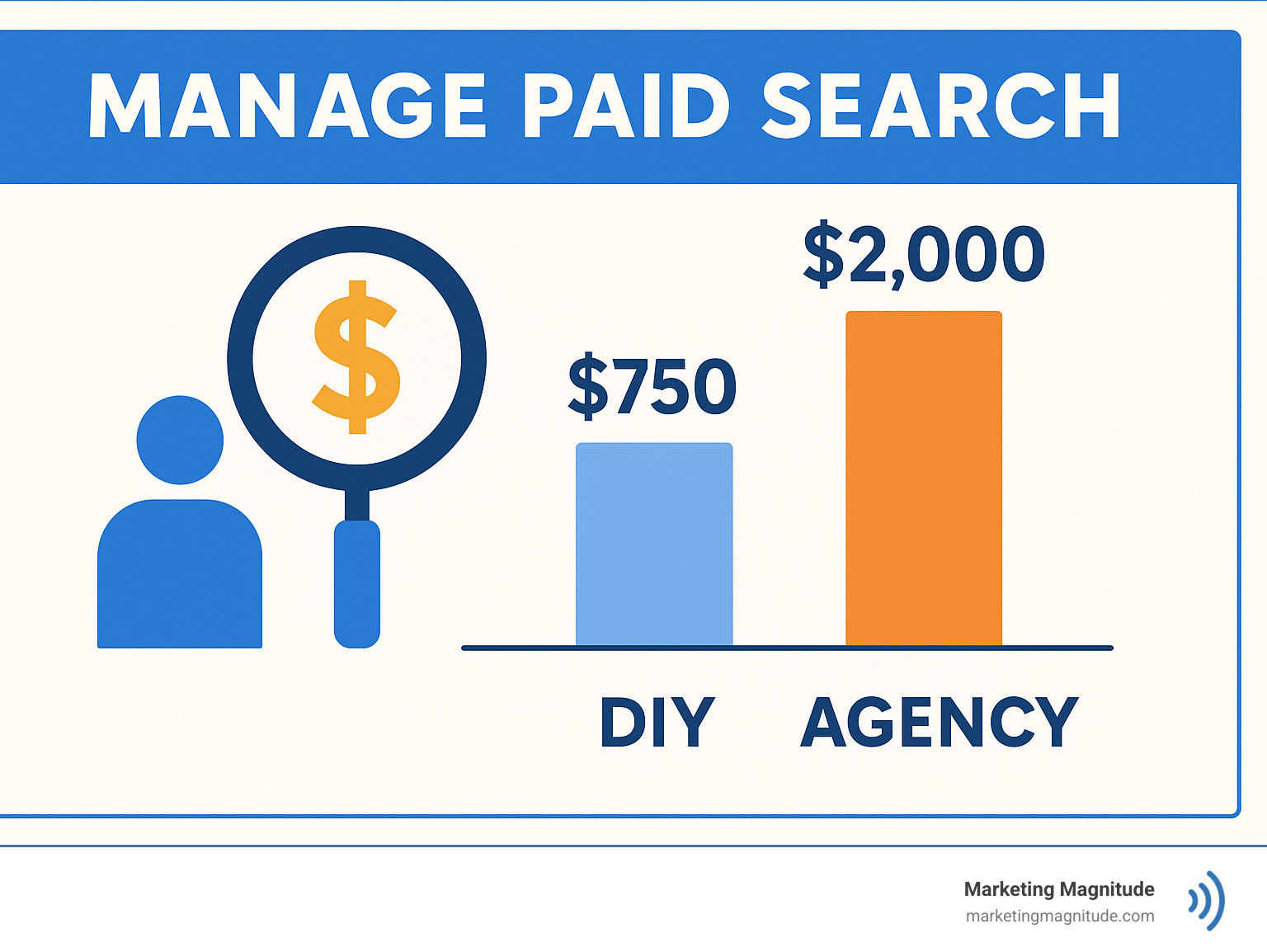
The bottom line? Results matter most. If your DIY efforts aren’t generating positive ROI after a reasonable learning period (usually 3-4 months), professional management often pays for itself through improved performance. I’ve seen businesses struggle for months with self-management, only to see their cost per lead cut in half within weeks of bringing in experts.
Good paid search management isn’t an expense – it’s an investment that should deliver measurable returns.
Conclusion: The Path to Paid Search Success
Let’s be honest—managing paid search isn’t just about throwing money at Google and hoping for the best. It’s about creating meaningful connections between what people are searching for and what your business offers. When I work with clients at Marketing Magnitude, I always emphasize that success comes from alignment, not just spending.
Think about it like dating. You wouldn’t show up to a first date talking only about yourself without listening to what the other person wants, right? The same principle applies here. The most effective paid search campaigns listen first (through keyword research and intent analysis) and then respond with exactly what the searcher needs.
After helping businesses from local Las Vegas shops to multi-location Austin enterprises transform their digital presence, I’ve noticed successful campaigns share some common DNA:
- They start with crystal-clear business goals (not just “more traffic”)
- They create a seamless experience from keyword to ad to landing page
- They accept data-driven optimization rather than “set and forget”
- They continuously test new approaches with genuine curiosity
- They connect every dollar spent to actual business results
What’s truly exciting is seeing the change when these principles are applied. Our clients typically see a 20% boost in overall revenue after we implement these strategies. This isn’t marketing magic—it’s simply aligning your business with what your customers are actively searching for.
The mindset shift that makes all the difference? Stop thinking of paid search as an expense and start seeing it as an investment with measurable returns. When properly managed, every dollar you put in should generate multiple dollars back. That’s not just good marketing—it’s good business.
I’d love to show you how our team at Marketing Magnitude can help transform your paid search campaigns with our real-time tracking and transparent reporting. There’s something powerful about seeing exactly how your campaigns are performing as they happen, rather than waiting for a monthly report that might be too late to make meaningful adjustments.
Ready to turn your paid search campaigns from a question mark into an exclamation point? Let’s talk about how our data-driven approach can help you achieve your specific business goals.
Get Started Now
Fill out this form to start your journey to next-level marketing solutions for your business.