
The Core Framework: Why Sequence Matters in a Comprehensive SEO Audit
To conduct a comprehensive seo audit, you must evaluate your website systematically from the ground up: verifying technical crawlability and indexation, optimizing on-page content relevancy, evaluating backlink authority, and streamlining user experience conversion pathways. Search engines follow a rigid technical sequence—discovery, fetching, rendering, indexing, and ranking. If a barrier blocks bots early in that chain, downstream efforts like keyword optimization or link building cannot generate results.
A multi-layered website evaluation ensures every layer of your digital presence functions cohesively. When you approach search diagnostics systematically, as outlined in the definitive guide to seo for business growth, you ensure every technical asset supports your bottom line. We view this process as building an integrated growth ecosystem where technical stability feeds organic visibility, which then drives pipeline volume.
Types of Website Evaluations: Technical, On-Page, Off-Page, and Local
A complete evaluation is divided into four distinct disciplines, each addressing a specific operational layer of search performance:
- Technical Infrastructure: Evaluates server responses, site architecture, crawl directives, XML sitemaps, indexation rules, and site speed.
- On-Page Signals: Inspects the topical relevancy of individual URLs, including heading structures, metadata, copy depth, schema markup, and internal linking.
- Off-Page Authority: Assesses external trust signals, such as referring domain quality, link velocity, anchor text naturalness, and brand citations.
- Local Search Visibility: Analyzes geographic relevancy, Google Business Profile configuration, citation consistency, and local review velocity for localized multi-location businesses.
The Bottom-Up Audit Pipeline: Crawl to Conversion
Order of operations matters. If you optimize meta titles on URLs blocked by robots.txt, no search engine will ever see your updates. We execute our diagnostic audits from the bottom up.
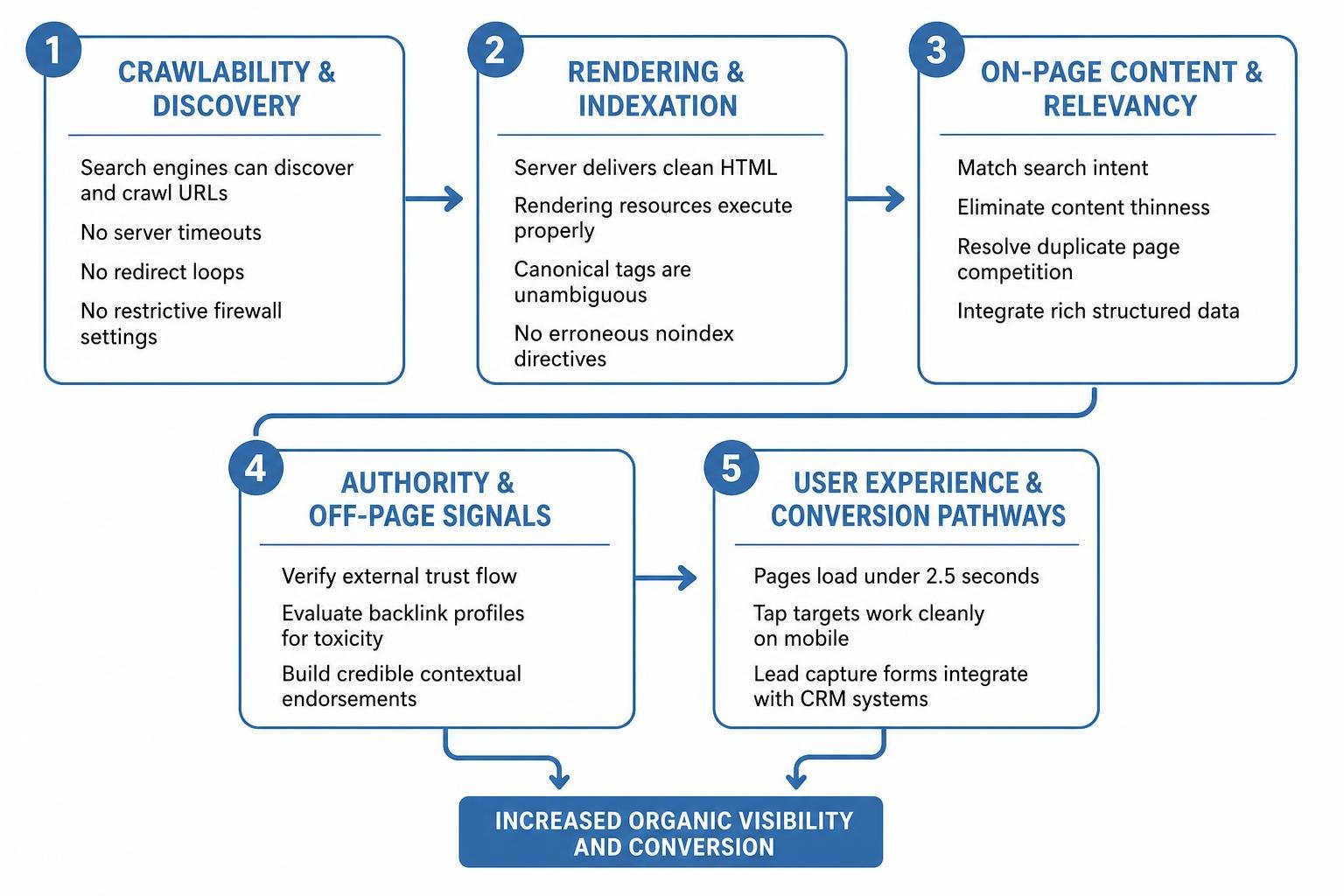
- Crawlability & Discovery: Ensure search engine bots can discover and crawl URLs without encountering server timeouts, redirect loops, or restrictive firewall settings.
- Rendering & Indexation: Confirm the server delivers clean HTML, rendering resources execute properly, canonical tags are unambiguous, and no intentional pages carry erroneous
noindexdirectives. - On-Page Content & Relevancy: Match search intent, eliminate content thinness, resolve duplicate page competition, and integrate rich structured data.
- Authority & Off-Page Signals: Verify external trust flow, evaluate backlink profiles for toxicity, and build credible contextual endorsements.
- User Experience & Conversion Pathways: Ensure pages load under 2.5 seconds, tap targets operate cleanly on mobile, and lead capture forms integrate directly with your customer relationship management systems.
Technical Foundation: Crawlability, Indexation, and Core Performance
The technical foundation represents the plumbing of your digital presence. Industry data reveals that the average website carries over 4,500 crawl-detected issues. Addressing these foundational elements can yield a 25% to 40% organic traffic uplift within 4 to 6 weeks.
Mastering technical seo means ensuring search bots spend their assigned crawl budget entirely on your revenue-generating pages. For a complete deep dive into technical verification, reference The Complete Technical SEO Audit: A 2026 Checklist.
Crawl Accessibility and Indexing Control
Crawl access dictates whether search engines can even view your content:
robots.txtReachability: Verify that yourrobots.txtfile returns a valid 200 HTTP status code. Ensure critical stylesheets, JavaScript files, and core service paths are not accidentally disallowed.- XML Sitemap Integrity: Ensure your sitemap is clean, containing only canonical, 200-status URLs. Exclude 301 redirects, 404 broken pages, and
noindexURLs. - Orphan Page Elimination: Identify pages that lack internal inbound links. Every important page should be reachable within three clicks of the homepage.
- Canonical Tag Resolution: Verify that self-referential canonical tags exist on unique pages and that parameterized duplicate URLs point back to the master source URL. Avoid canonical loops or canonicals pointing to 404 or redirected URLs.
noindexDirective Scrubbing: Perform an exhaustive crawl to verify that legacy staging tags () were not pushed to your production environment.- Redirect Chains and Latency: Shorten redirect paths to a single hop. Each redirect hop adds roughly 80ms of server latency and bleeds crawl budget.
Core Web Vitals and Mobile Performance Standards
Google assesses real-world user experience via the Chrome User Experience Report (CrUX). With mobile devices generating 63% of organic search engine visits, mobile performance is paramount. Yet, only 12% of mobile sites currently meet all Core Web Vitals thresholds.
- Largest Contentful Paint (LCP): Measures perceived loading speed. The primary above-the-fold content element must render in under 2.5 seconds. Optimize LCP by compressing hero images into modern WebP/AVIF formats and establishing server-level caching.
- Interaction to Next Paint (INP): Measures interface responsiveness. Your page must respond to clicks, taps, or key presses in under 200 milliseconds. Eliminate heavy main-thread JavaScript execution to keep pages snappy.
- Cumulative Layout Shift (CLS): Measures visual stability. Pages must maintain a CLS score of less than 0.1. Always include explicit width and height dimension attributes on image and video elements to prevent sudden layout jumps.
- Security Protocols: Ensure modern HTTPS encryption is enforced across every subdomain, supported by clean HTTP Strict Transport Security (HSTS) headers and valid SSL certificates.
Content Health, On-Page Optimization, and AI Search Readiness
Once the technical infrastructure is sound, the diagnostic focus shifts to relevancy, messaging clarity, and search intent alignment.
Understanding the secret sauce of on page optimization requires balancing human readability with the structural signals search algorithms need to interpret your authority.
Metadata, Heading Architecture, and Internal Link Equity
On-page optimization connects search intent to specific conversion pathways across your search engine optimization campaigns.
- Title Tags and Truncation: Keep title tags between 50 and 60 characters (under 600 pixels) to avoid awkward SERP truncation. Every tag should incorporate the primary topic and your brand identifier naturally.
- Meta Descriptions: Industry audits reveal that 34% of web pages are missing meta descriptions entirely. Write compelling, action-oriented descriptions between 120 and 155 characters that reinforce search intent and improve click-through rates.
- Heading Structure: Enforce a single H1 per URL that aligns with the title tag. Organize subsequent subtopics systematically using nested H2, H3, and H4 tags.
- Internal Linking and Anchor Text: Distribute link equity from high-authority pillar pages to deeper, conversion-focused service offerings using descriptive, contextual anchor text.
- Image Optimization: Ensure all imagery includes concise, descriptive alt text to aid accessibility and visual search algorithms.
Content Decay, Cannibalization, and E-E-A-T Compliance
Content quality requirements are stricter than ever. Following recent search quality updates, algorithms actively penalize thin content, weak E-E-A-T (Experience, Expertise, Authoritativeness, Trustworthiness) signals, and anonymous authorship.
- Content Decay: Use analytics to identify legacy articles experiencing steady traffic loss over the past 6 to 12 months. Update outdated statistics, refresh case studies, and expand actionable insights.
- Keyword Cannibalization: Spot multiple URLs ranking and competing for the exact same query intent. Consolidate competing posts into a definitive resource and implement 301 redirects for legacy URLs.
- Thin Content Remediation: Identify pages containing fewer than 300 words that provide zero unique insight. Either enrich them with comprehensive research or remove them using 410 Gone status codes.
- Author Verification: Ensure every informational piece displays an explicit author byline backed by verifiable professional bios, credentials, and social profiles.
Auditing for AI Visibility: The Modern SEO Audit Frontier
With AI Overviews appearing across nearly half of all informational searches and AI-driven search referrals growing rapidly, modern websites must audit for generative engine optimization (GEO).
- JSON-LD Schema Markup: Despite its value, 80% of websites have not implemented schema markup. Audit your structured data using Google’s Rich Results Test. Implement
Organization,LocalBusiness,Service,FAQPage, andArticleschema schemas to give AI engines clear entity context. - AI Crawler Permissions: Check your
robots.txtto ensure you are not unintentionally blocking generative AI discovery bots like GPTBot or ClaudeBot, unless specifically required by company data governance policies. llms.txtDeployment: Provide a structured/llms.txtmarkdown file at your domain root to offer LLM crawlers a clean, summary index of your core services, brand background, and technical offerings.- Entity Citability: Format informational content with clear definitions, bulleted summaries, and clean data tables. This structure makes your insights easily citable by large language models.
Off-Page Authority, Link Profiles, and Local Search Signals
Organic search accounts for 45.1% of all web result clicks. Ranking in competitive markets requires a healthy balance of technical excellence, deep content, and third-party authority. Pages ranking in Google’s top 10 average 3.8 times more backlinks than lower-ranking competitors, yet roughly 95% of all web pages online possess zero external links.
For service-oriented businesses, blending off-page authority with local visibility is essential. Deploying proven local seo services the sneak attack to google rankings ensures your business captures local, high-intent traffic directly from search maps and localized organic results.
Backlink Profile Analysis and Toxic Link Remediation
Your backlink profile acts as a public ledger of credibility. Auditing external links requires evaluating both quality and stability:
- Referring Domain Diversity: Evaluate the ratio of total backlinks to unique referring root domains. A natural profile features links earned across diverse, topical domains rather than thousands of links from a single site footer.
- Dofollow vs. Nofollow Balance: Ensure a natural ratio of standard dofollow links alongside nofollow, sponsored, and user-generated content (UGC) attribution tags.
- Anchor Text Distribution: A safe anchor text profile is dominated by branded terms, naked URLs, and natural topical variations. An over-optimized profile packed with exact-match commercial keywords can trigger algorithmic scrutiny.
- Identifying Toxic Links: Spot spam networks, automated link farms, and unindexed directory directories pointing to your brand. Use Google’s Disavow tool cautiously, reserving it strictly for manual actions or obvious negative SEO attacks.
- Competitor Backlink Gaps: Analyze competitor link profiles to find authoritative industry directories, local sponsorships, and guest publication platforms where your brand is missing.
Local Signal Verification and Google Business Profile Audits
Local signals dictate your visibility within the Google Map Pack and localized localized search results. If you manage multiple locations across regions like Nevada or Texas, local precision is non-negotiable.
Conduct regular reviews following our in-depth guide to google my business audits to keep profiles aligned.
- Google Business Profile (GBP) Completeness: Ensure every profile field—primary category, secondary classifications, operational hours, service areas, and direct booking links—is completely filled out.
- NAP Consistency: Confirm that your Name, Address, and Phone number match identically across major data aggregators, local business directories, and website footers.
- Local Review Velocity: Positive customer reviews can enhance your site’s credibility by up to 73%. Audit your review generation workflows, respond to customer feedback systematically, and integrate authentic review schema directly on your service landing pages.
- Geo-Targeted Service Pages: Ensure localized service landing pages contain genuine local content—such as neighborhood references, local imagery, and community case studies—rather than generic doorway pages.
Prioritization, Remediation Workflows, and Audit Cadence
An audit is only as valuable as the actions that follow. Too many businesses run automated audits, receive a 100-page PDF of warnings, and end up overwhelmed into inaction. Success requires categorizing issues by real-world business impact versus development effort.
| Issue Classification | Severity / Priority | Typical SEO Impact | Implementation Effort | Actionable Resolution |
|---|---|---|---|---|
Accidental noindex Tag on Core URLs |
Critical (Tier 1) | Severe drop in organic visibility | Very Low (<1 Hour) | Remove meta robots tag or headers immediately |
Broken robots.txt Blocking Bot Crawling |
Critical (Tier 1) | Total de-indexing of key site sections | Very Low (<1 Hour) | Update disallow rules; test via Search Console |
| Slow Mobile Largest Contentful Paint (>4.0s) | High (Tier 2) | Higher bounce rates, lower rankings | Moderate (1–3 Days) | Compress images, enable CDN, optimize cache |
| Keyword Cannibalization Across Services | High (Tier 2) | Split ranking power, lower conversions | Moderate (2–4 Days) | Merge pages, update internal links, add 301 redirects |
| Missing Meta Descriptions & Sub-Headings | Low (Tier 3) | Moderate click-through rate loss | Low (Ongoing) | Rewrite metadata and structure headers |
| Absence of JSON-LD Schema Markup | Low (Tier 3) | Reduced rich snippet & AI SERP pickup | Moderate (1–2 Days) | Deploy structured data via theme or tag manager |
Prioritizing SEO Audit Findings: The Tiered Action Framework
To maximize return on investment, we organize our audit findings into a simple, three-tiered operational framework:
- Tier 1: Immediate Blockers (Resolve This Week): Critical errors actively preventing crawl discovery, indexing, or basic site stability. This includes sitewide
noindextags, server 500 errors, broken sitemaps, and severe malware or SSL warnings. - Tier 2: Strategic Enhancements (Resolve This Month): Issues degrading your competitive rankings or user experience. This includes Core Web Vitals optimizations, resolving keyword cannibalization, updating decaying pillar content, fixing broken internal links, and refreshing incomplete Google Business Profiles.
- Tier 3: Ongoing Optimization (Quarterly Sprints): Incremental improvements that refine topical authority and click-through performance over time. This includes updating missing meta descriptions, applying advanced schema markup, refining image alt tags, and building fresh internal links.
Establishing an Audit Frequency Schedule for Long-Term Growth
Websites are living digital ecosystems. New content is published, plugins are updated, and code deployments occur regularly. To prevent technical drift, establish a regular audit schedule based on your site’s size and complexity:
- High-Volume & E-Commerce Websites (>10,000 pages): Run automated weekly technical crawls paired with monthly in-depth diagnostic audits.
- Standard Service & B2B Websites (100–1,000 pages): Conduct comprehensive quarterly SEO audits with bi-weekly automated tracking for crawl errors and broken links.
- Trigger-Based Audits: Always execute a full technical and indexation audit immediately following a CMS migration, domain rebrand, significant design overhaul, or sudden unexplained traffic drop.
Frequently Asked Questions About Website Diagnostics
What is the difference between an SEO audit and a content audit?
An SEO audit is an expansive diagnostic evaluation covering technical infrastructure, crawlability, indexation, speed, backlink authority, and on-page signals. A content audit is a dedicated subset of that process. It focuses exclusively on text depth, editorial quality, user engagement metrics, topical freshness, search intent alignment, and keyword cannibalization across existing pages.
How often should high-growth websites conduct a comprehensive audit?
Most growing service-based and commercial websites should conduct a full, comprehensive audit quarterly. This schedule keeps technical issues from compounding while giving newly implemented updates time to mature and rank. High-traffic e-commerce sites or dynamic platforms publishing daily content benefit from monthly technical reviews to catch indexation bugs early.
Can a website perform an effective audit using only free diagnostic tools?
Yes. You can uncover significant technical and on-page insights using free tools like Google Search Console, Google PageSpeed Insights, the Rich Results Test, and manual SERP inspections. Free tools provide direct, unfiltered data from search engines. However, enterprise crawling platforms and dedicated SEO software speed up the process for large websites by automating scans across thousands of URLs simultaneously.
Conclusion
A successful website audit is not a checklist of superficial fixes; it is a strategic blueprint for sustainable growth. When your technical foundation is stable, your content matches search intent, and your authority signals are strong, your website shifts from a static digital brochure into an active lead-generation engine.
At Marketing Magnitude, we believe search visibility works best when integrated directly with your broader business operations. By connecting modern SEO diagnostics with automated lead nurturing, clean conversion pathways, and reliable analytics, we help service businesses turn organic traffic into predictable, long-term revenue.
Take control of your organic search performance. Explore our comprehensive Services/Search Engine Optimization Seo Services and discover how our integrated growth platform can elevate your business.