
Why Google My Business Audits Are the Starting Point for Local Search Growth
Google My Business audits are one of the highest-ROI actions a local service business can take to recover lost visibility, fix silent ranking problems, and compete more effectively in the Google Map Pack.
What is a Google My Business audit?
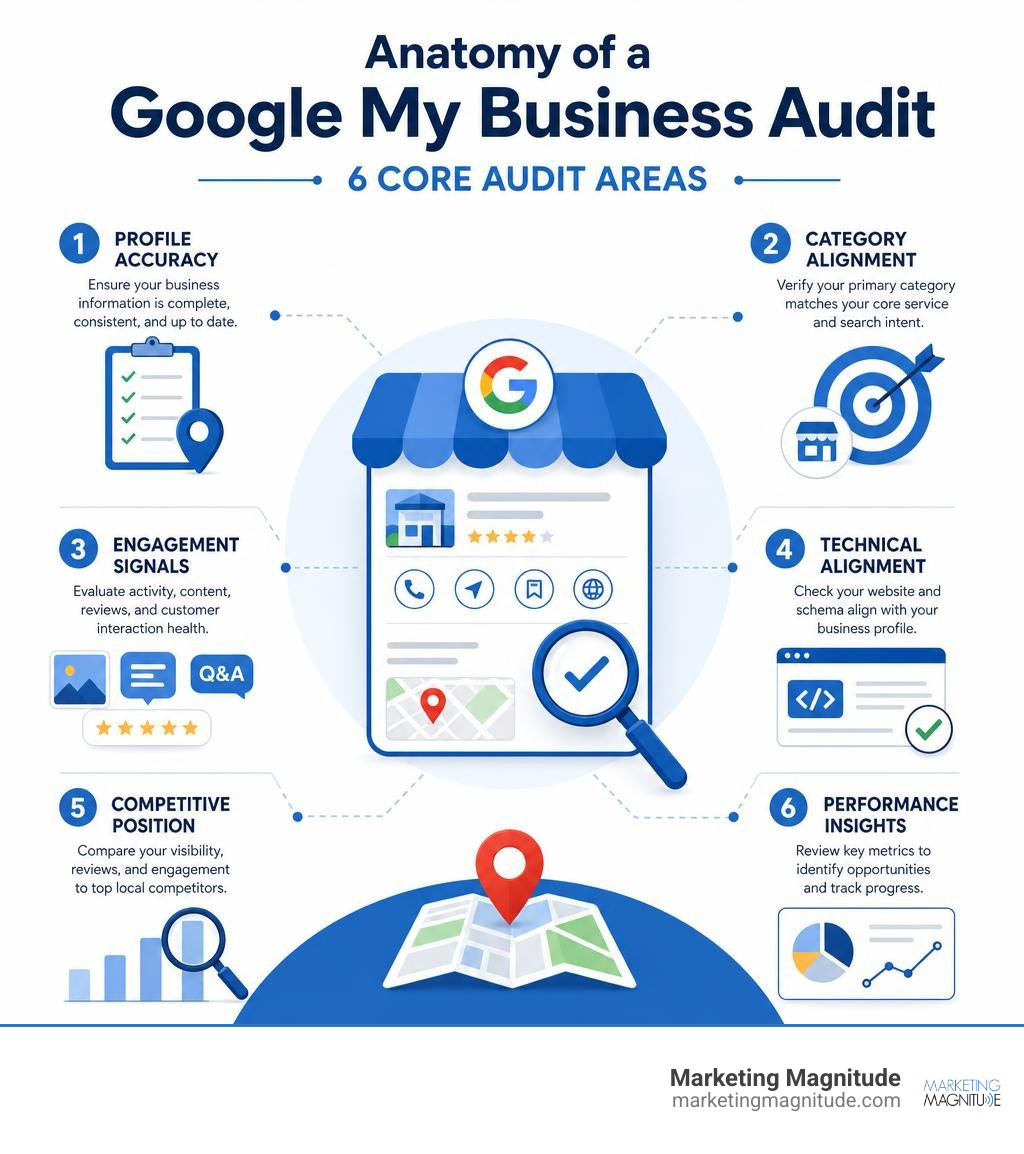
A Google My Business (now called Google Business Profile, or GBP) audit is a structured review of every element Google uses to rank your business in local search. It checks:
- Profile accuracy – business name, address, phone number, hours, and website URL
- Category alignment – whether your primary category matches your core service
- Engagement signals – photos, Google Posts, Q&A activity, and review health
- Technical alignment – whether your website and schema data match your profile
- Competitive position – how your listing compares to top-ranking local competitors
Most businesses set up their profile once and never revisit it. Over time, data drifts, categories go stale, and competitors pull ahead — often without any obvious warning sign.
The audit is where you find out exactly why.
You log into your Google Business Profile, glance at the basics, and everything looks fine. Then you search for the service you want to rank for, and a competitor shows up above you. That gap is where most business owners get stuck — and where a proper audit begins.
According to local SEO research, a business with 100 recent reviews can outrank a competitor with 500 reviews if those older reviews are all from over a year ago. Small, overlooked details consistently determine who wins the Map Pack and who gets ignored.
I’m Kelly Rossi, founder of Marketing Magnitude and a digital marketing strategist with over 20 years of experience helping service businesses improve their local search visibility — including running Google My Business audits that have transformed underperforming profiles into consistent lead-generation assets. In the sections below, I’ll walk you through a complete, actionable audit framework so you can identify exactly what’s suppressing your rankings and fix it.
What is a Google Business Profile Audit and Why Does It Matter?
A Google Business Profile (GBP) audit is a comprehensive diagnostic health check of your business’s presence across Google Search and Google Maps. While many business owners treat their profile as a static digital business card, Google views it as a dynamic node in a massive local entity database.
Every day, Google processes millions of searches with local intent—in fact, statistics show that 46% of all Google searches carry local intent, and 76% of nearby-mobile searchers visit a related business within 24 hours. If your profile is misconfigured or out of alignment, you are silently handing high-intent local leads directly to your competitors.
To understand why this happens, we must look at how Google connects the dots. Google uses a sophisticated process called entity resolution to cross-reference your Name, Address, and Phone (NAP) data across the entire web. When your business details are consistent, Google’s trust in your business entity increases, boosting your prominence in the Map Pack.
However, a GBP audit is not just about checking boxes on a standard checklist; it is a systematic review of how your profile, website, reviews, and local citations interact as a single, connected ecosystem. To dig deeper into how this process works, you can check out this guide on How To Perform a Google Business Profile Audit – AgencyAnalytics.
Understanding this interconnected system is also what separates local optimization from traditional search campaigns. For a clear breakdown of how these strategies differ, read our article on Organic SEO Services vs. Local SEO Services: What’s the Difference?.
The Core Differences Between Local SEO and Google My Business Audits
It is common to confuse a standard local SEO audit with a dedicated Google My Business audit, but they serve different purposes. A local SEO audit looks at the big picture: your website’s domain authority, local backlink profile, landing page optimization, and overall organic keyword rankings.
In contrast, a Google My Business audit focuses specifically on the on-page and backend signals of your Google Business Profile. It analyzes the direct levers that control Map Pack visibility, such as your primary category, photo upload frequency, review velocity, and user engagement metrics.
Crucially, many free public audit tools only scratch the surface because they rely on public Places API scrapes. These public scrapes miss roughly 80% of the active ranking signals—including posts, service lists, attributes, message reply rates, and pending edits. A professional GBP audit uses secure Google OAuth sign-in to access private owner data via the official API, catching silent edit rejections (where Google quietly reverts your changes without notifying you) and hard-to-spot policy violations. To learn more about how Google weighs these signals on Maps, read our A-Z Guide to Maps Pack Ranking.
Establishing a Baseline with Google My Business Audits
Before implementing any local optimization strategies, you must establish an objective performance baseline. Without a baseline, it is impossible to accurately measure your return on investment or understand which changes actually moved the needle.
To simplify this process, we recommend utilizing structured tools like the Free Google My Business Audit Tool — Free GBP Audit + Scan or the FREE Google My Business Audit Tool | GMB Analyzer. These tools analyze your profile across key factors—such as business description optimization, review frequency, reply rates, and image counts—to generate an overall numeric score from 1 to 100.
For example, the popular free GMB audit tool from Merchynt, which has earned over 1,000 5-star reviews, checks your profile across 10 key GBP factors and provides a 0–100% optimization score. Starting with an objective score allows you to systematically rank, prioritize, and address underperforming fields on your profile.
How Often to Conduct Google My Business Audits Based on Competition
How often you should audit your Google Business Profile depends heavily on your industry, location, and local competition level.

For businesses operating in highly competitive markets—such as personal injury law in Austin, TX, or emergency plumbing in Las Vegas, NV—we recommend conducting a comprehensive GBP audit once a month. In these high-stakes niches, competitors are constantly optimizing their profiles, collecting new reviews, and running local campaigns. A monthly check-in ensures you catch ranking drops early and adjust your strategy before leads dry up.
For businesses in moderate-competition environments or multi-location brands managing dozens of regional listings, a quarterly deep-dive audit paired with a quick monthly health check is a highly effective operating rhythm.
Regular audits are essential to combat data drift. Data drift occurs when Google auto-populates changes to your listing based on user suggestions, third-party database updates, or AI-driven edits, which can quietly alter your business hours, services, or even your primary category without your direct consent.
The Foundational Audit: Reclaiming Access, Fixing NAP, and Aligning Schema
The first phase of any serious GBP audit is securing your listing and verifying your data integrity. You cannot optimize a profile that you do not fully own or control.
A common issue we see when onboarding new clients in Las Vegas or Austin is that a former employee, digital agency, or third-party contractor holds the “Primary Owner” status of the Google Business Profile. If the relationship ends on poor terms, reclaiming this access can be a headache.
To reclaim primary ownership:
- Log into the Google account associated with your current business.
- Search for your business on Google Maps and select “Claim this business” or “Own this business?”.
- Fill out the request form. Google will automatically email the current primary owner.
- Under Google’s guidelines, you must wait a 7-day period for the current owner to respond. If they deny the request or do not respond within 7 days, Google will provide you with an option to appeal, verify your physical ownership (often via video verification or business documentation), and force-transfer the primary access back to you.
Once access is secured, you can begin aligning your listing with your overall digital presence. For ideas on how to structure this baseline, check out our Local SEO Strategies to Boost Your Business.
Resolving Silent NAP Errors and Schema Mismatches
Data consistency is the foundation of local search trust. If Google detects that your Name, Address, or Phone (NAP) details on your website do not match your Google Business Profile or your external citations, it creates an algorithmic conflict. Google’s entity resolution engine becomes confused about which information is correct, which silently suppresses your local rankings.
To fix this, we must audit and clean up our citations across major directories. A classic local industry case study involves a plumbing business in Dallas, TX (operating in a highly competitive market similar to Austin and Las Vegas). After performing a thorough GBP audit and cleaning up its old phone number across 11 major online directories, the business saw a 3x increase in monthly leads. Similarly, a regional roofing company achieved top 3 keyword rankings after aligning its Google Business Profile with its website’s local landing pages.
To ensure your website communicates seamlessly with Google’s crawlers, you must implement local schema markup. This is structured JSON-LD code added to your website that explicitly defines your business entity to search engines. Your LocalBusiness schema must match your GBP details exactly, down to the formatting of your street address and phone number.
Below is a comparison of common NAP errors and how to resolve them:
| Common NAP Error | Technical Impact | Actionable Fix |
|---|---|---|
| Keyword Stuffing in Business Name | Triggers automated soft or hard suspensions. | Change the name on your GBP to match your legal business name and physical signage exactly. |
| Using a P.O. Box or Virtual Office Address | Violates Google’s guidelines; results in immediate listing removal. | Use a staffed, physical location or configure the listing as a Service Area Business (SAB) with hidden address. |
| Mismatched Phone Numbers | Confuses search engines and customers; dilutes entity authority. | Ensure your primary GBP number matches your website’s header/footer phone number and local schema. |
| Inconsistent Suite/Unit Numbers | Google’s entity resolution engine fails to merge duplicate directory listings. | Standardize address formatting across GBP, website, and top citations (e.g., always use “Suite 100” vs. “Ste 100”). |
Optimizing Categories, Services, and Engagement Signals
Your primary business category is arguably the single most powerful ranking factor on your Google Business Profile. If you select a category that is too broad, you will struggle to rank for specific, high-intent search queries.
For example, if you run an Italian restaurant, setting your primary category to “Restaurant” instead of “Italian Restaurant” dilutes your relevance. We recommend keeping your secondary categories limited to 5 or 6 highly relevant options to avoid category dilution, which occurs when too many unrelated categories confuse Google’s ranking algorithm.
To find the perfect category mix, you should reverse-engineer what your top-ranking local competitors are doing. You can easily do this by using a dedicated Chrome extension like GMB Everywhere. With over 200,000 users and a 4.7 rating from 110 reviews, the GMB Everywhere – GBP Audit for Local SEO – Chrome Web Store extension overlays and highlights the actual primary category of any business directly on Google Maps with a star icon, allowing you to quickly map out your competitors’ category strategies.
Auditing Photos, Geotagging, and Google Posts
Google rewards active profiles that regularly engage users with fresh visual content. During your audit, check your media library. We recommend maintaining a baseline of at least 20 high-quality photos, including interior shots, exterior signage, your team in action, and completed projects.
For Service Area Businesses (SABs) that operate without a physical storefront, establishing a Map Pack presence can be challenging. An excellent example is a service area plumbing business in Palm Coast that successfully built strong Map Pack visibility by consistently uploading high-quality, real-world project photos.
Historically, many SEO professionals recommended photo geotagging—manually embedding precise GPS coordinates into an image’s EXIF metadata before uploading it to GBP—to signal local relevance. While Google’s algorithm has evolved and often strips or ignores manual EXIF data uploads to prevent spam, uploading native, unedited mobile photos taken directly at job sites is still incredibly valuable. Modern smartphones automatically embed authentic geotags and time stamps, which Google uses to verify that you are actively doing business in your declared service areas.
Additionally, audit your Google Posts. We recommend publishing a fresh update or offer at least once a week. To track the direct revenue and traffic driven by these posts, always append custom UTM tracking parameters to your call-to-action links (e.g., ?utm_source=google&utm_medium=organic&utm_campaign=gbp-posts). This allows you to monitor exact click-throughs and conversions within Google Analytics.
Managing Reviews, Q&A, and Google’s NLP
Online reviews are the lifeblood of local prominence. However, your total lifetime review count is not the only metric Google cares about. Google’s local algorithm heavily weights review velocity (how frequently you receive new reviews) and review recency (how fresh those reviews are). A business with 100 recent reviews can easily outrank a competitor with 500 reviews if the latter’s reviews are all over a year old.
Furthermore, Google uses Natural Language Processing (NLP) to read the actual text of your reviews. When customers write detailed descriptions of the specific services you performed (e.g., “repaired my water heater in Las Vegas”), Google extracts these semantic signals to understand your business’s capabilities, helping you rank for those specific keywords.
Do not ignore the Q&A section during your audit. Because anyone can ask and answer questions on your public listing, leaving this section unmanaged is a major risk. Proactively populate this section yourself by posting your business’s most frequently asked questions and answering them authoritatively as the owner. If you find inappropriate, off-topic, or competitor-spam questions, flag them immediately for removal.
Diagnostic Tools and Prioritizing Fixes with an Impact Matrix
To perform a deep-dive audit, you need professional tools that look beyond your immediate physical coordinates. Because local search results are highly proximity-dependent, your business might rank #1 for someone standing inside your office, but drop to #10 for a searcher just two miles away.
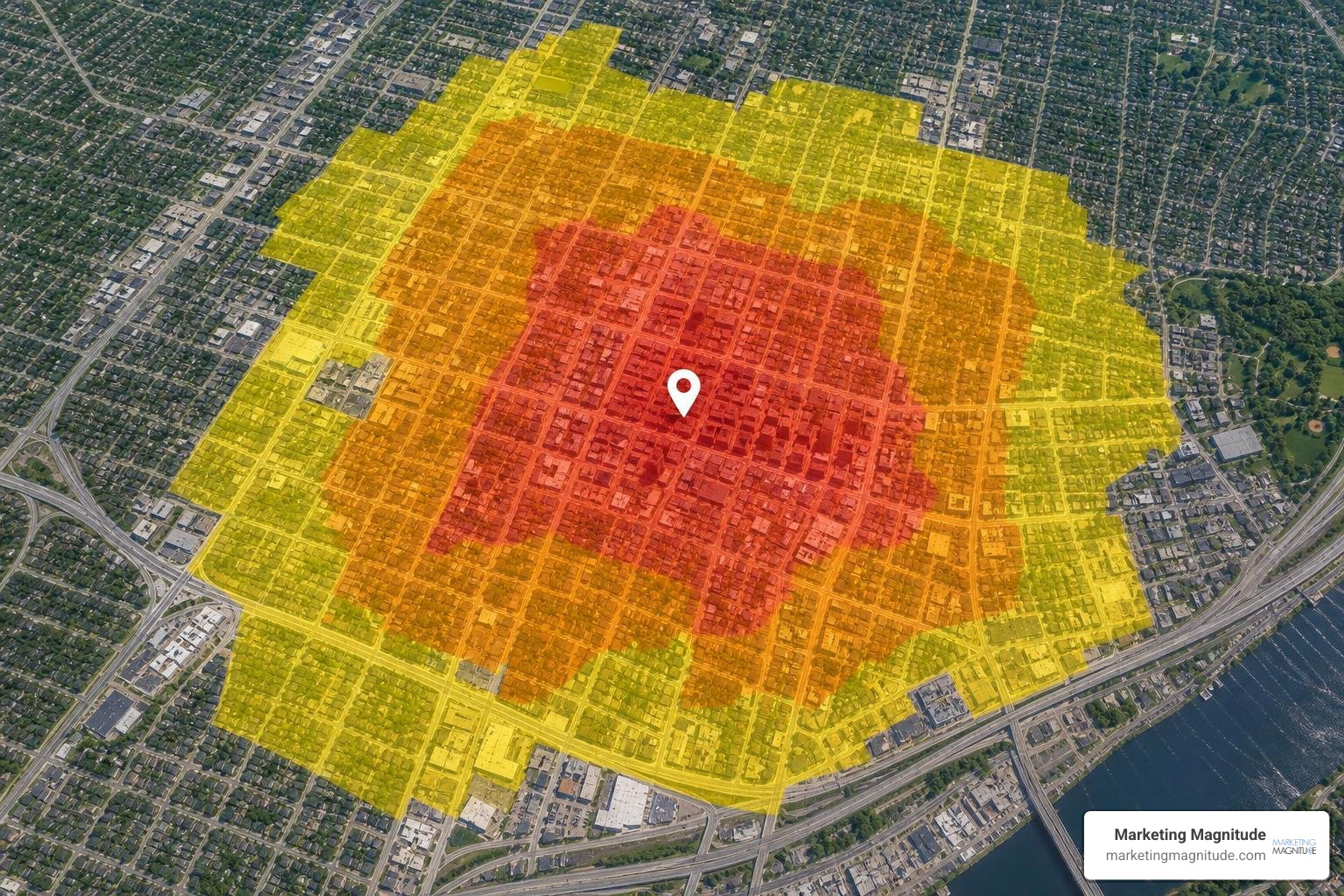
To map this variance, we use geo-grid scanners like Local Falcon or Places Scout. These tools simulate searches from a precise grid of coordinates across your target city (whether in Las Vegas or Austin) to show you exactly where your rankings drop off. By combining geo-grid data with your native GBP Insights (which track user actions like phone calls, direction requests, and website clicks), you can identify geographic ranking gaps and target your optimization efforts.
The Effort vs. Impact Matrix for Local SEO Fixes
Once your audit is complete, you will likely have a long list of recommended fixes. To avoid feeling overwhelmed, we prioritize these tasks using an Effort vs. Impact Matrix. This framework helps you focus on high-yield “quick wins” first before tackling complex, long-term technical projects.
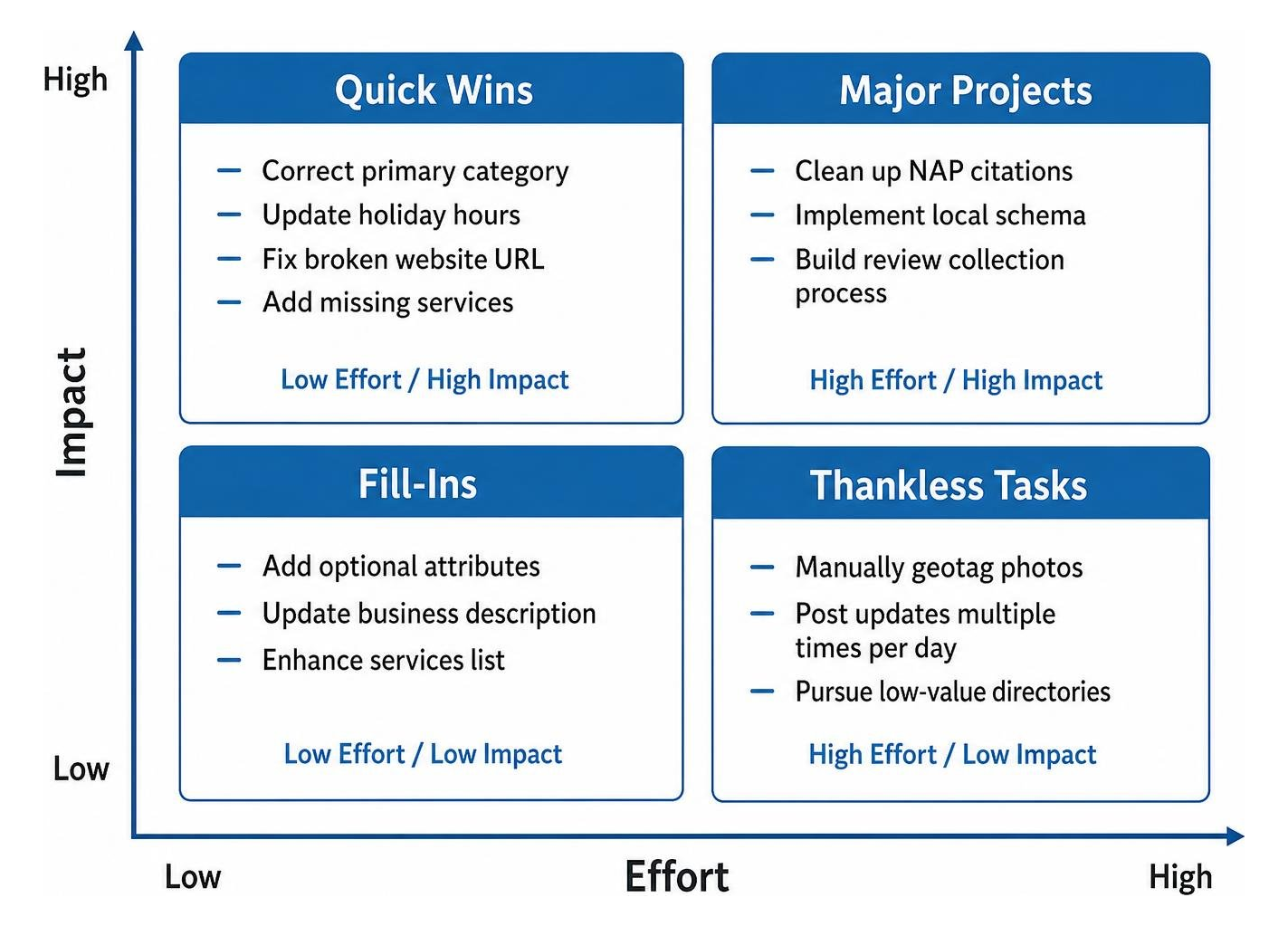
- Quick Wins (Low Effort / High Impact): Correcting your primary business category, updating holiday hours, fixing a broken website URL on your profile, and adding missing services.
- Major Projects (High Effort / High Impact): Cleaning up mismatched NAP citations across dozens of secondary directories, implementing advanced local schema markup on your website, and building a systematic review collection process.
- Fill-Ins (Low Effort / Low Impact): Adding optional attributes (e.g., “women-owned” or “wheelchair accessible”) and updating minor business descriptions.
- Thankless Tasks (High Effort / Low Impact): Manually geotagging hundreds of stock photos or posting Google Updates multiple times a day.
Future-Proofing Your Profile for 2026 AI Search and Duplicate Suppression
As we navigate 2026, the local search landscape is undergoing a massive shift driven by artificial intelligence. Modern AI search engines—including ChatGPT, Gemini, and Perplexity—increasingly rely on structured Google Business Profile data to answer local user queries. When a user asks an AI assistant for the “best wellness brand in Austin,” the LLM pulls real-time data directly from GBP attributes, categories, and recent customer reviews.
Additionally, Google is rolling out AI-generated review summaries directly on your profile. This means Google’s AI reads your recent reviews and compiles a short, descriptive paragraph summarizing your business’s strengths and weaknesses right at the top of your listing. To optimize for these AI summaries, your audit must focus on encouraging customers to mention specific services, product quality, and staff names in their feedback.
Finally, duplicate listing suppression has become a critical priority. Operating multiple profiles for a single physical location split-tests your authority and can lead to severe algorithmic penalties. If Google detects duplicate listings, it may trigger a soft suspension (where you lose management access but the listing remains visible) or a hard suspension (where your listing is completely removed from Search and Maps, creating an immediate lead emergency).
As of 2026, Google’s appeal process is stricter than ever. Once you open the evidence upload form in Google’s appeals tool to resolve a suspension, you have exactly 60 minutes to submit all supporting documentation—such as utility bills, business licenses, and physical storefront photos—or the files will not attach, delaying your reinstatement for weeks. Proactively auditing your profile for policy violations is the best way to prevent these sudden disruptions.
Frequently Asked Questions About Google Business Profile Audits
Can you audit a service-area business without a public address?
Yes, absolutely. Service Area Businesses (SABs) require a highly focused audit because they do not have a public physical storefront to drive local prominence. For SABs, we closely audit service area configurations, category specificity, photo quality (showing real work in target neighborhoods), and local website landing page alignment to ensure Google trusts your geographic relevance.
What is the difference between a soft suspension and a hard suspension?
A soft suspension means you lose access to manage and edit your listing through your dashboard, but the profile remains visible to the public on Search and Maps. A hard suspension is a critical emergency where your listing is completely removed from Google’s index, instantly cutting off your organic calls and customer leads. Both require a formal reinstatement appeal with verified documentation.
Why does review velocity matter more than total review count?
Review velocity and recency serve as active freshness signals to Google’s ranking algorithm. A business with a steady stream of 5 to 10 new reviews per month demonstrates that it is actively operating, trustworthy, and engaging customers today. A competitor with 500 old reviews and no recent activity suggests a stale business, carrying far less weight in current local search results.
Conclusion
A Google My Business audit is not a one-time chore; it is the vital starting point for sustainable local search growth. By systematically identifying ranking gaps, fixing data inconsistencies, and optimizing customer engagement signals, you can secure your place in the competitive Map Pack and turn your profile into a predictable source of high-value leads.
At Marketing Magnitude, we believe true business growth happens when your digital marketing, CRM systems, customer communication, and operations work together as one connected ecosystem. We don’t just “run SEO campaigns”—we build integrated growth systems designed to help service-based businesses scale sustainably and efficiently.
If you want a professional partner to handle your local search strategy and maximize your visibility on Google Maps, explore our comprehensive Local SEO Services: Boost Visibility in Google Maps. Let’s work together to eliminate fragmented systems and unlock your business’s true scaling potential.
Get Started Now
Fill out this form to start your journey to next-level marketing solutions for your business.