Why Maps Pack Ranking Can Make or Break Your Local Business
Maps pack ranking is one of the most important factors determining whether local customers find your business — or your competitor’s.
Here’s a quick answer to what moves the needle:
How to Improve Your Maps Pack Ranking (Quick Summary)
- Optimize your Google Business Profile — complete every field, choose the right primary category, and post regularly
- Build review velocity — aim for a steady flow of 4.0+ star reviews and respond to every one
- Keep your NAP consistent — your business name, address, and phone number must match everywhere online
- Create localized content — neighborhood-focused pages and service area content help Google connect you to nearby searches
- Build local citations and backlinks — mentions from trusted local sources signal authority to Google
- Track your geo-grid rankings — measure visibility across your full service area, not just one location
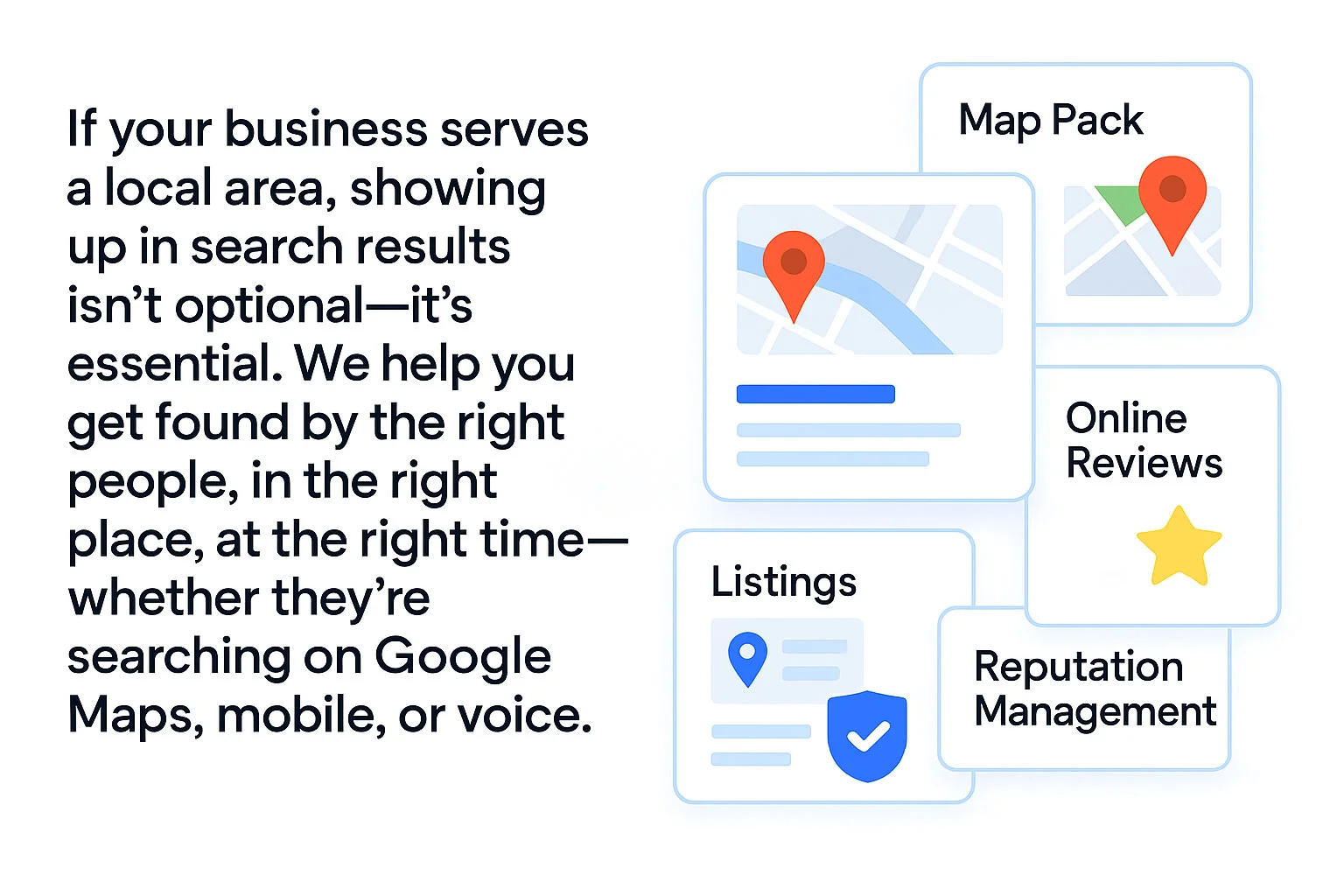
When someone searches “plumber near me” or “best dentist in [city],” Google displays a block of three local business listings at the top of the results — that’s the Maps Pack. It’s prime real estate. According to industry data, it captures as much as 44% of all clicks on local search results pages, and for service businesses, it drives roughly 50% of all inbound calls.
If your business isn’t showing up there, those leads are going somewhere else.
The challenge is that most business owners don’t fully understand how the Maps Pack works, why their competitors outrank them, or what to do about it. This guide breaks all of that down — in plain language, with clear steps you can act on.
I’m Kelly Rossi, founder of Marketing Magnitude and a digital marketing strategist with over 20 years of experience helping local service businesses improve their maps pack ranking and turn search visibility into real, measurable growth. This guide brings together everything I’ve learned across hundreds of local SEO campaigns to help you compete — and win — in local search.
What is the Google Maps Pack and Why It Matters
When we talk about the Google Maps Pack (often referred to as the “Local 3-Pack” or “Google Map Pack”), we are talking about the boxed area that appears at the absolute top of Google’s search results for queries with local intent. Whether you are running a boutique dental practice in Austin, TX, or a plumbing company in Las Vegas, NV, securing a spot in this 3-pack is the holy grail of local search visibility.
(Quick side note: If you happened to stumble upon this guide searching for gaming map packs, you might actually be looking for community resources like the [Beatmap Packs] All ranked maps (Archived + January 2024 – ) · forum | osu! , the osu! Map Pack Curators: Leaderboard | osu! – Hinamizawa.ai , or Map Packs By Popularity – Risk: Global Domination | Duxaris . However, if you are a business owner looking to dominate real-world local maps, you are in the right place!)
Understanding the difference between different types of search results is crucial. While standard organic listings are highly valuable, they require a different approach. You can read more about this in our detailed breakdown of Organic SEO Services vs Local SEO Services: What’s the Difference?.
Simply put, organic SEO focuses on ranking your website globally or regionally, while local SEO is entirely about putting your physical location or service area on the map. Because the Maps Pack sits above the organic results, it captures a massive 44% click-through rate from users. Even better, local searchers usually have high intent; they aren’t just browsing — they are ready to buy. For local service businesses, visibility here accounts for roughly 50% of all inbound calls.
The Anatomy of a Local 3-Pack
To win the local search game, we first have to understand what the user sees. The Maps Pack is designed to give searchers the most important information at a single glance:
- Map Preview: A visual map with pins marking the physical locations of the top three businesses.
- Business Name: The official name of your business (which should never be stuffed with unnecessary keywords!).
- Star Rating & Review Count: A visual representation of your reputation.
- Physical Address: Your street address (or your general location if you are a service-area business).
- Operating Hours: Current status (e.g., “Open now,” “Closes at 5 PM”).
- Click-to-Call Button: A direct link for mobile users to call your office instantly.
- Website Link: A direct path to your local landing page.
How Google Determines Your Maps Pack Ranking
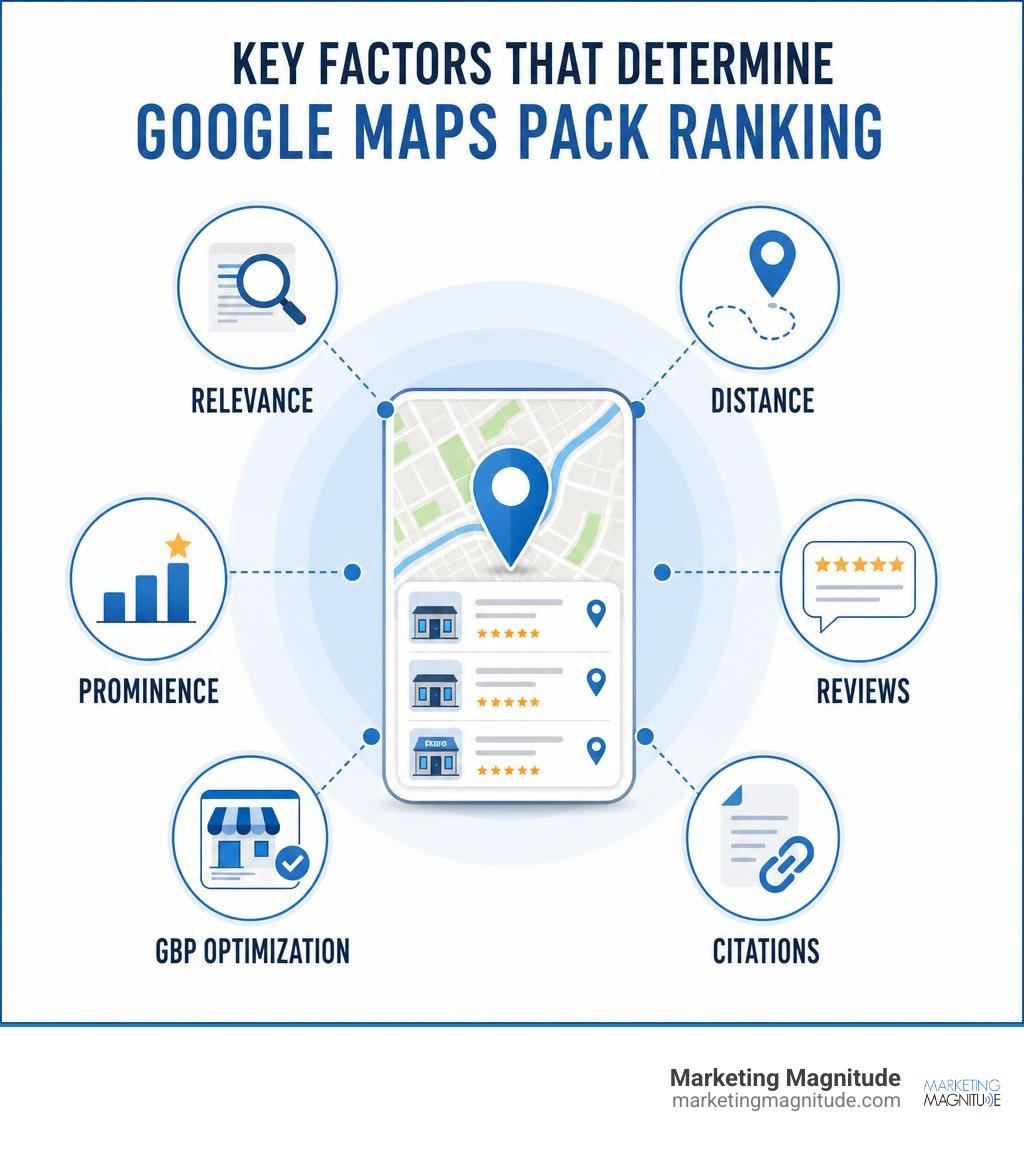
Google’s search engine optimization algorithms can feel like a closely guarded state secret, but when it comes to local search, Google is surprisingly transparent. There are three primary pillars that determine which businesses make it into the top three spots: Relevance, Distance, and Prominence.
| Ranking Pillar | What It Means | Key Signals |
|---|---|---|
| Relevance | How well a business matches the searcher’s query. | GBP categories, service descriptions, website keywords. |
| Distance | How close the business is to the searcher or search location. | Searcher GPS, business address, S2 map cells. |
| Prominence | How authoritative, popular, and well-known the business is. | Reviews, local citations, domain authority, backlinks. |
Relevance: Aligning with Search Intent
Relevance is all about ensuring your business matches what the user is looking for. If someone in Las Vegas searches for “emergency air conditioning repair,” Google isn’t going to show them a general handyman unless it has strong proof that the handyman specializes in AC work.
To establish relevance, you must align your Google Business Profile (GBP) and website content directly with local search queries. This means choosing the exact primary business category, writing detailed service descriptions, and ensuring your website has clear, keyword-matched text.
Distance: The Proximity Factor
Distance (or proximity) is the physical measurement between the searcher’s location and your business. If a user searches for “coffee shop” while walking down Congress Avenue in Austin, TX, Google will prioritize coffee shops within a few blocks.
Google calculates this using the searcher’s real-time GPS coordinates, IP address, or the specific geographic terms used in the search query (like “near Henderson NV” or “Downtown Austin”). While you cannot change your physical location, you can optimize your service area definitions to ensure Google knows exactly which S2 map cells your business serves.
Prominence: Authority and Offline Popularity
Prominence is Google’s way of measuring your brand’s authority and offline reputation. Think of it as a digital popularity contest. Google wants to showcase businesses that are well-established, highly rated, and trusted by the local community.
To determine prominence, Google looks at your web mentions, local citations, the strength of your website’s backlink profile, and your overall review signals. A business with a long history of positive reviews and strong local brand authority will almost always outrank a newer competitor, even if that competitor is slightly closer to the searcher.
Core Optimization Strategies to Boost Local Visibility
Achieving a high maps pack ranking requires a cohesive, multi-layered approach. You can’t just set up a profile and hope for the best. To build a sustainable pipeline of local leads, you must implement proven Local SEO Strategies to Boost Your Business.

Maximizing Google Business Profile (GBP) Performance for Maps Pack Ranking
Your Google Business Profile is the absolute foundation of your local SEO efforts. If you want to rank in competitive markets like Austin or Las Vegas, your profile must be completely optimized and highly active.
- Primary Category Selection: This is the single most important setting on your profile. Your primary category must match Google’s internal classification for your core service. If you are an HVAC company, your primary category should be “HVAC Contractor,” not just a generic “Service Establishment.”
- Complete Business Description: Write a clear, engaging description of your business. Use your primary keywords naturally, and focus on what makes your service unique.
- High-Quality Photos: Profiles with more than 100 photos see a massive lift in clicks. Add new photos weekly — showcase your team, your completed projects, and your office.
- Google Posts: Treat your GBP like a social media platform. Post 2-3 times per week with local updates, special offers, and helpful tips. For a deeper dive into these tactical moves, check out our guide on Map pack optimization.
Review Velocity and Reputation Management
Reviews are the lifeblood of prominence. Google weighs the content, volume, and frequency of your reviews very heavily.
- The Power of Star Ratings: 80% of consumers state that the star ratings they trust the most are between 4.0 and 5.0 stars. Having a perfect 5.0 with only two reviews looks suspicious; a 4.7 with 200 reviews is far more persuasive.
- Review Velocity: Google looks at how consistently you receive reviews. A sudden burst of 20 reviews followed by months of silence looks unnatural. Aim for a steady cadence of 2 to 4 new reviews every week.
- The Response Gap: 53% of consumers expect a business to respond to their review within 7 days. Shockingly, up to 63% of consumers say they have never heard back from a business after leaving a review. At Marketing Magnitude, we believe that ignoring reviews is like ignoring a customer standing in your lobby. Respond to every review — positive or negative — within 24 hours.
- Keyword-Rich Reviews: Gently guide your clients to mention specific services and locations in their reviews. A review that says, “They did an amazing job repairing my water heater in Las Vegas!” carries significantly more ranking weight than a simple “Great service!”
Localized Content and Schema Markup
Your website and your Google Business Profile must speak the same language. If your website is weak, your Maps Pack rankings will suffer.
- LocalBusiness Schema: Implement structured data markup on your website. This code helps search engines understand your exact business name, address, phone number (NAP), and operating hours.
- Neighborhood Landing Pages: If you serve multiple areas across Southern Nevada or Central Texas, build dedicated, high-quality location pages. Avoid duplicate templates; each page should feature unique local content, neighborhood-specific landmarks, and embedded Google Maps.
- Hub-and-Spoke Architecture: Create a main “Service Areas” hub page that links out to individual neighborhood spoke pages. This structure builds strong topical authority and helps Google’s algorithm crawl your site efficiently. For specialized industries, you can explore the Best Local SEO Strategies for HVAC, Plumbing and Roofing Companies to see how this architecture works in action.
Tracking Performance and Measuring Local Reach
You cannot manage what you do not measure. Traditional rank trackers that give you a single “average” ranking position for a city are no longer sufficient. Local search is highly volatile and depends entirely on where the searcher is standing. To get a true picture of your visibility, you need to implement a modern tracking strategy. To learn more about how this fits into a broader digital marketing plan, explore our insights on Local SEO Services: The Sneak Attack to Google Rankings.
Utilizing a Map Pack Rank Tracking Tool for Maps Pack Ranking
To see how your business actually performs across your entire service area, we use advanced geo-grid tracking technology.
Using a dedicated Map Pack Rank Tracking Tool allows us to run multi-point scans across specific ZIP codes and neighborhoods. Instead of checking your rank from just your office, a geo-grid scan prompts search queries at hundreds of individual coordinates surrounding your business.
One of the industry-standard platforms for this is Local Falcon, which serves over 100,000 agencies, enterprise organizations, and multi-location businesses worldwide. This tool visualizes your search presence as a color-coded heatmap (green for top 3, yellow/red for lower positions). It measures your Share of Local Voice (SoLV), giving you a precise look at where your competitors are stealing market share and where you need to strengthen your local signals.
The 90-Day Operating Rhythm for Local SEO
Local SEO is not a one-time project; it is an ongoing operational discipline. To achieve and maintain a top-3 ranking, we recommend a structured 90-day operating rhythm:
- Weekly: Add 2-3 high-quality photos, publish at least one Google Post, and respond to all reviews within 24 hours.
- Monthly: Audit your citations for NAP consistency, build 5-10 high-quality local backlinks (such as local chamber sponsorships), and run fresh geo-grid scans to identify new visibility gaps.
- Quarterly: Conduct a thorough competitor analysis and adjust your primary/secondary GBP categories if seasonal search behavior shifts.
When you partner with us for our comprehensive local growth strategies, most clients see meaningful, sustainable results within 90 to 120 days using our customized optimization packages.
Frequently Asked Questions about Local Search
What are the most common mistakes businesses make in local SEO?
The most common mistake we see is keyword stuffing in the business name (e.g., naming your profile “Las Vegas Plumber Best AC Repair Plumbing Pros” when your actual business name is just “Las Vegas Plumbing Pros”). This is a direct violation of Google’s guidelines and can lead to immediate profile suspension.
Other frequent errors include choosing the wrong primary business category, having inconsistent NAP data across online directories, and creating low-quality, duplicate location pages that Google’s algorithm flags as doorway pages.
How do AI-powered search features impact Maps Pack visibility?
Local search is evolving rapidly. AI-powered search features, such as Google’s AI Overviews and conversational search tools like Gemini and ChatGPT, are shifting how users find local businesses. For instance, Google’s “Ask Maps” feature (launched in April 2026) focuses heavily on single, highly personalized AI recommendations rather than a traditional list of three.
Furthermore, AI platforms use sentiment analysis to calculate a Buyer Persuasion Score (BPS) for your business based on your online reviews. This makes having a complete, active Google Business Profile and highly detailed, keyword-rich customer reviews more critical than ever.
Can a service-area business without a physical storefront rank in the 3-Pack?
Absolutely. If you operate an HVAC, plumbing, or mobile detailing business from your home, you can verify your Google Business Profile using your home address and choose to hide your physical location from the public.
Google allows you to define your service areas by ZIP codes, cities, or counties. As long as you have strong entity trust signals, consistent local reviews, and a highly optimized website, you can easily outrank businesses with physical storefronts.
Conclusion: Partner with Marketing Magnitude for Sustainable Local Growth
Achieving a dominant maps pack ranking is about more than just getting clicks — it is about building a scalable, predictable growth engine for your business. At Marketing Magnitude, we believe that sustainable business growth happens when your digital marketing, customer communication, and operational systems work together as one connected ecosystem.
If you are ready to stop chasing short-term vanity metrics and start building a powerful local search presence that drives real, high-quality inbound calls, we are here to help. Explore our specialized Services: Local SEO Services Boost Visibility in Google Maps and let’s discuss how we can help you dominate your local market.
Whether you are looking to win the Google 3-pack with proven Austin Map Pack Ranking – Win the Google 3-Pack with Proven SEO, dominate the Southern Nevada market with our tailored Las Vegas SEO Services, or implement comprehensive Local SEO Marketing Las Vegas campaigns, we have the technology, strategy, and expertise to help your business scale sustainably. Contact us today to schedule your custom geo-grid performance analysis!