
Why Multi-Location Optimization Is the Growth Challenge Most Businesses Underestimate
Multi-location optimization is the practice of improving how each branch, franchise, or facility in your business network performs — both in local search results and in physical operations like supply chain and inventory placement.
Here’s a quick breakdown of what it covers:
- Local SEO — getting each location found in its own market on Google
- Website structure — organizing your site so every location gets indexed and ranked
- Google Business Profiles — maintaining a verified, complete listing for every branch
- Citation consistency — keeping your name, address, and phone number identical everywhere
- Supply chain placement — positioning warehouses and facilities to reduce costs and delivery times
- Performance tracking — measuring results by location, not just as one blended number
Think about this for a moment. A franchise with forty locations isn’t competing in one search market. It’s competing in forty separate local search environments at the same time — each with its own competitors, customers, and ranking factors.
That’s a fundamentally different challenge than running SEO for a single business.
And yet, most businesses still manage their locations like one big operation. They use the same content across every location page. They look at blended, aggregate marketing data. They run one Google Business Profile — or none at all for newer branches.
The result? Visibility gaps. Some locations thrive. Others are invisible online.
The stakes are real. According to research, 74% of consumers use Google to find local businesses, and 80% of local searches lead to conversions. The local pack — those top three map results — captures 44% of all clicks on a local search page. If your locations aren’t showing up there, you’re leaving a significant share of high-intent customers to your competitors.
Multi-location optimization isn’t just an SEO tactic. It’s an operational strategy that spans your website, your listings, your reviews, and — for product-based businesses — even your warehouse network.
I’m Kelly Rossi, founder of Marketing Magnitude, and over more than 20 years of running digital marketing campaigns across SEO, analytics, and paid media, I’ve helped businesses at every stage navigate the complexity of multi-location optimization — from structuring websites that scale to building local visibility systems that actually drive leads. This guide will walk you through everything you need to know to get it right.
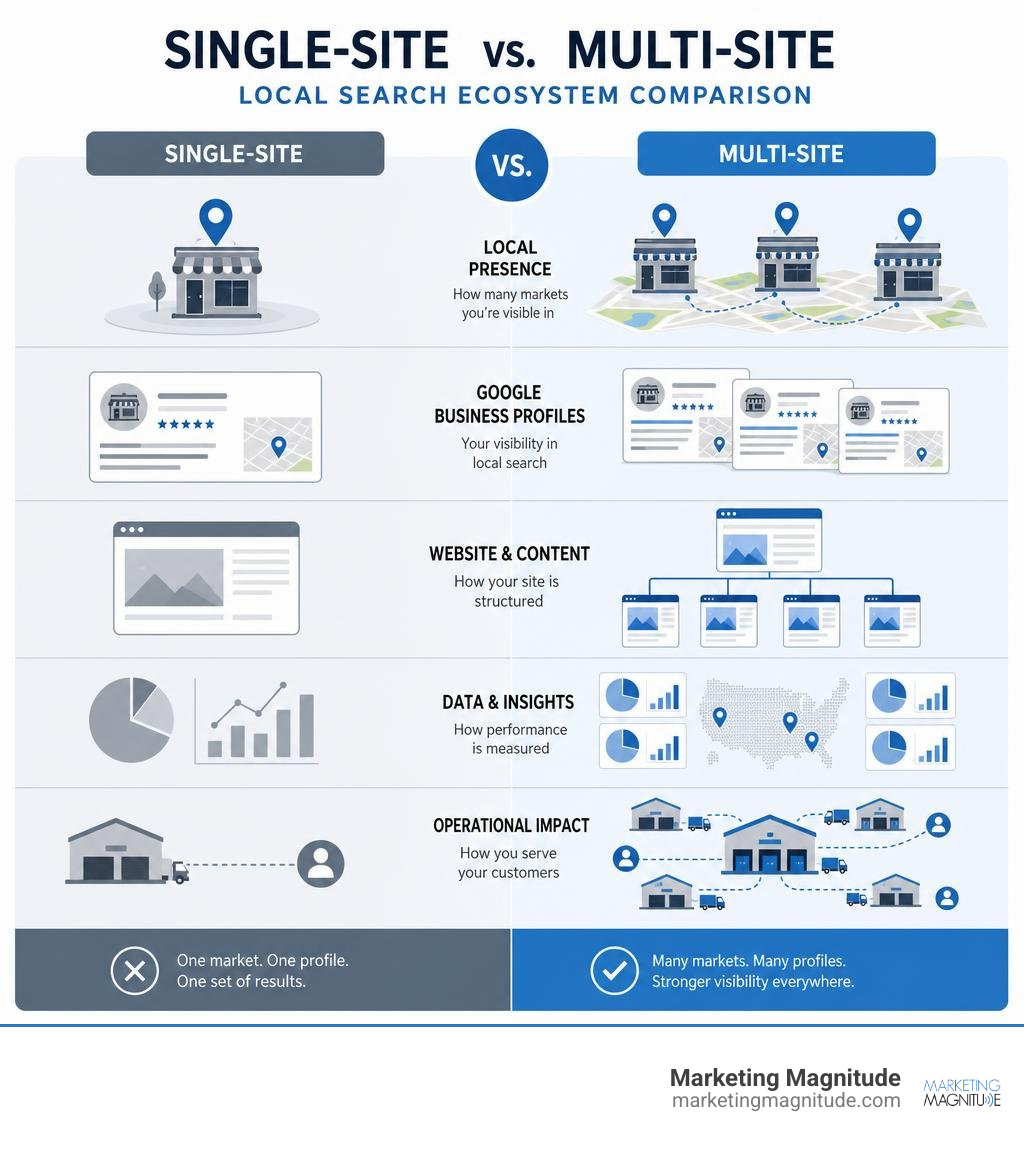
What is Multi-Location Optimization and Why Does It Matter?
At its core, multi-location optimization is the art and science of ensuring every physical footprint of your brand is visible, relevant, and highly operational within its specific geographic market. In the digital space, this means tailoring your digital assets so search engines can easily connect local search intent with your nearest physical branch.
When a consumer searches for a service in Las Vegas, Nevada, or Austin, Texas, search engines prioritize three core pillars: proximity (how close the business is), prominence (how authoritative and well-reviewed the business is), and relevance (how well the business matches the search query). If your brand operates with a single, generic homepage, search engines will struggle to rank you across multiple cities. This is why specialized local SEO strategies are essential to bridge the gap between national brand authority and local market relevance.
Single-Location vs. Multi-Location Optimization
Single-location SEO is relatively straightforward. You have one website, one Google Business Profile (GBP), and one set of local citations to manage. All your optimization efforts—backlinks, content, and reviews—feed into a single online presence.
Multi-location optimization, however, introduces exponential complexity:
- Multiple Search Environments: Instead of competing in one local market, you are competing in dozens or hundreds of distinct search environments simultaneously.
- Internal Competition: Without a clear strategy, your own location pages can end up competing against one another for rankings, a common pitfall highlighted in industry discussions on multi-location SEO strategy.
- Scale and Complexity: Managing NAP (Name, Address, Phone) consistency, localized content, and reviews across multiple profiles requires robust systems. What works for one office in Austin will not automatically scale to ten branches across Nevada without dedicated, systematic execution.
Balancing Centralized Brand Control with Location-Level Relevance
One of the greatest operational tensions in multi-location business management is the push-and-pull between centralized brand consistency and localized optimization.
Corporate marketing teams want to protect brand guidelines, maintain uniform messaging, and control technical website assets. On the other hand, local operators—whether they are branch managers in Las Vegas or franchisees in Austin—understand the unique nuances, customer pain points, and community events of their specific markets.
We believe the most effective solution is a shared responsibility model:
- Centralize the Infrastructure: Keep technical SEO, site architecture, core brand assets, and platform integrations under a centralized marketing team or a specialized growth partner. This ensures technical compliance and brand integrity.
- Decentralize local insights: Empower local branch managers or regional teams to collect localized reviews, capture high-quality photos of local projects, and contribute unique community insights. This decentralized input feeds the local authority signals that search engines crave.
Designing a Scalable Website Structure for Multi-Location SEO
Choosing how to structure your website is one of the most critical decisions you will make. Get it wrong, and you dilute your domain authority, making it incredibly difficult to rank in highly competitive local markets.
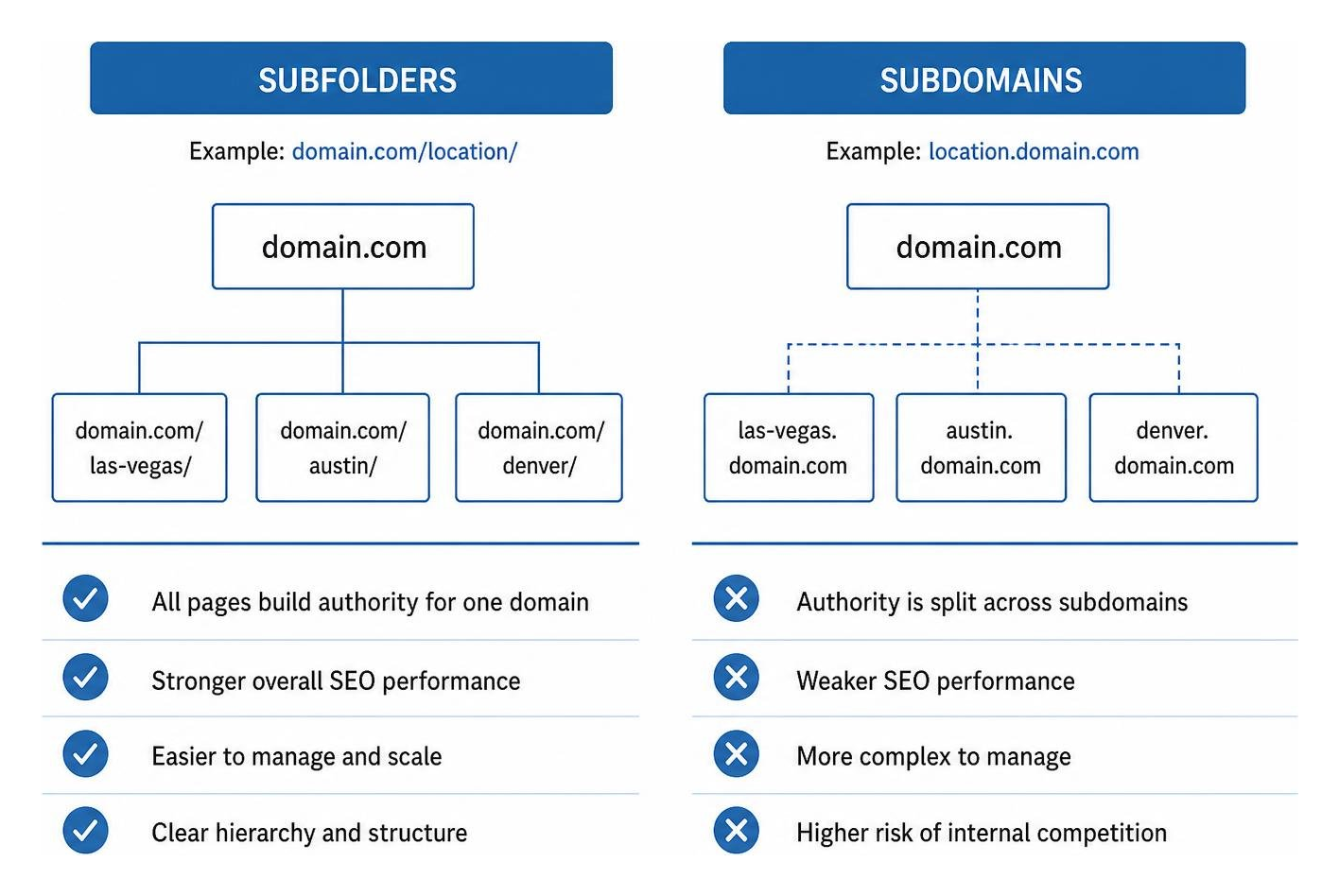
When organizing a multi-location website, businesses generally choose between three structures: separate domains, subdomains, or subfolders.
| Structure Type | URL Example | Domain Authority Impact | Technical Management | Scalability |
|---|---|---|---|---|
| Separate Domains | brandlasvegas.com, brandaustin.com |
Diluted (Each site starts from zero) | High (Multiple sites to maintain, secure, and update) | Poor |
| Subdomains | lasvegas.brand.com, austin.brand.com |
Fragmented (Search engines often treat them as separate sites) | Medium (Requires individual tracking and DNS setups) | Moderate |
| Subfolders | brand.com/locations/las-vegas/ |
Consolidated (All pages share and build parent domain authority) | Low (Centralized management under one CMS) | Excellent |
Why Subfolders Win the Multi Location Optimization Battle
For almost every multi-location business—whether you have 5 locations or 500—subfolders are the superior choice.
When you use a subfolder structure (e.g., yourbrand.com/locations/austin), every backlink, review signal, and authoritative piece of content published on your site benefits the entire domain. This consolidated domain authority gives your individual location pages a massive head start in competitive local search results.
Additionally, subfolders make technical SEO far more manageable. You only have to maintain one SSL certificate, manage a single XML sitemap, and optimize a unified crawl budget. It prevents the operational headache of managing fragmented data across separate web properties.
Essential On-Page Elements for High-Ranking Location Pages
To prevent your location pages from triggering Google’s thin or duplicate content filters, each page must be treated as a unique, high-value local landing page.
Every individual location page should include the following core elements:
- 100% Consistent NAP Data: Display the exact Name, Address, and Phone number that matches your Google Business Profile for that specific branch.
- Local Schema Markup (JSON-LD): Implement structured data to feed search engines machine-readable details about your physical location, operating hours, and services.
- Localized, High-Value Content: Avoid simply swapping out city names on identical templates. Write unique descriptions, highlight local staff bios, list specific services offered at that branch, and mention local landmarks or community partnerships.
- Interactive Embedded Google Map: Embed a customized Google Map pointing directly to your verified GBP listing to reinforce geographical relevance.
- Location-Specific Reviews and Testimonials: Showcase reviews from customers in that specific city to build local trust and prominence.
Building Off-Page Authority and Local Search Prominence
Off-page SEO for multi-location brands focuses heavily on winning the local map pack. Since the local pack captures a massive 44% of all local search clicks, building off-page prominence is non-negotiable.

To build a dominant local presence, businesses must combine aggressive Google Business Profile optimization with systematic citation management and review acquisition. For those operating in competitive Southwestern hubs, partnering with a specialized local SEO marketing Las Vegas team can accelerate this off-page authority building.
Google Business Profile Optimization for Multiple Branches
Your Google Business Profile (GBP) is the single most important off-page asset for driving local visibility. If you manage multiple locations, you should utilize Google’s bulk verification and management tools to maintain control.
Ensure your GBP optimization strategy includes:
- Precise Naming Conventions: Use your exact, real-world business name across all profiles. Avoid keyword stuffing or adding geographic modifiers unless they are part of your legal business name, as this is a primary trigger for profile suspensions.
- Strategic Category Selection: Select the most accurate primary category (e.g., “HVAC Contractor” or “Medical Clinic”) and utilize up to 10 relevant secondary categories.
- High-Quality Local Photos: Regularly upload real, high-resolution photos of your local team, physical storefront, and completed local projects.
- Leverage Localized Services: If you are a service-based business operating in Nevada, ensure you outline your exact service areas to maximize your local reach, utilizing resources like GBP Optimization Services in Nevada – GMB Guru to audit your setups.
Citation Consistency and Review Acquisition Systems
Beyond GBP, your business must establish a strong foundation of local citations across major directories (such as Yelp, Bing Places, and Apple Maps) and primary data aggregators (Data Axle, Neustar Localeze, and Foursquare). Data aggregators are highly efficient because they automatically distribute your consistent NAP data to hundreds of smaller local directories, saving hundreds of hours of manual entry.
Simultaneously, you need a decentralized review acquisition system. Reviews are a primary ranking factor for the local map pack; businesses ranking in the top three map results average 4.2 stars and over 60 reviews.
We recommend implementing automated post-service touchpoints—such as SMS or email follow-ups sent 1 to 2 hours after a service is completed—to systematically capture reviews. To see how these off-page signals translate directly to maps rankings, explore our detailed A-Z Guide to Maps Pack Ranking.
Supply Chain Logistics and Multi Location Optimization
While digital marketers view multi-location optimization through the lens of search rankings, supply chain managers view it as a mathematical equation to minimize costs and maximize delivery speeds.
Interestingly, these two worlds are deeply connected. Where you choose to position your physical facilities determines your local search proximity signals, your geographical targeting capabilities, and your physical cost-to-serve.

Physical facility location decisions drive approximately 80% of total supply chain costs. Making a poor placement decision locks a business into operational inefficiencies for years. For deeper insights into the mathematical modeling of physical site selection, you can explore the Scientific research on facility location optimization or examine developer tools like the ArcGIS Location-Allocation API documentation.
Multi-Location Assortment Optimization and Warehouse Placement
In e-commerce and retail logistics, businesses face the classic p-median problem: determining the optimal number and locations of warehouses to minimize the sum of fixed facility costs and variable transportation expenses.
Consider the real-world financial impact of shipping distance. For every 100-mile increase in the distance of shipping goods worth $30, outbound shipment costs increase between $0.17 and $0.47. When scaled across thousands of transactions, these minor distance variations dictate business profitability.
To combat this, modern enterprises employ multi-location assortment optimization under an “endless aisle” model. This model allows any warehouse in the network to fulfill an order, but uses tiered inventory placement to ensure high-demand products are stocked closest to major demand hubs (like Las Vegas or Austin). This minimizes transshipments, reduces split orders, and meets the rapid delivery speeds that modern consumers expect.
Tracking, Scaling, and Preparing for AI Search
To scale a multi-location business sustainably, you must move away from blended, aggregate reporting. If you look only at account-level averages, you will inevitably starve your most profitable locations while over-allocating budget to low-performing markets.
How to Track and Measure Individual Location Performance
Consider a real-world scenario of a regional home services brand with multiple locations. On paper, a campaign in Phoenix might show a highly efficient Cost Per Lead (CPL) of $40, while a campaign in Tucson shows a much higher CPL of $95.
If you rely solely on aggregate metrics, you might be tempted to shift budget away from Tucson. However, tracking down to the location level reveals that the average job value in Tucson is far higher due to system replacements, yielding a 15.8x return on ad spend (ROAS) compared to Phoenix’s 3.3x return.
To prevent these costly reporting errors, we recommend:
- Dynamic Number Insertion (DNI): Implement location-specific call tracking to attribute phone leads directly to the correct branch.
- Isolate Location Data in GA4: Use customized Google Analytics 4 properties or sub-properties to filter traffic, conversions, and user behavior by specific location subfolders.
- Incorporate CRM Integrations: Link your marketing data directly to your CRM to track leads from initial search query all the way to closed revenue.
Preparing for AI Search in Multi Location Optimization
The search landscape is undergoing a massive shift with the rise of AI-powered search engines, including Google’s AI Overviews, ChatGPT, and Perplexity.
AI search engines do not simply return a list of blue links; they synthesize answers to conversational, highly specific queries (e.g., “Where can I find an emergency plumber near Summerlin, Las Vegas that is open now and has good reviews for water heater repair?”).
To ensure your locations are recommended by AI search models, your digital footprint must be structured for machine readability:
- Robust Schema Markup: Implement advanced LocalBusiness and Product schema across all location pages. This provides the structured, explicit data that AI models rely on to verify facts.
- Nurture Brand Authority and Entity Signals: AI search engines recommend businesses they recognize as trusted “entities.” Building high-volume, high-quality reviews and earning local press mentions strengthens your brand’s digital authority.
- Optimize for Conversational Queries: Create FAQ sections on your location pages that answer long-tail, natural-language questions specific to your local markets.
Frequently Asked Questions about Multi-Location Optimization
How many Google Business Profile listings do I need for a multi-location business?
You need a separate, verified Google Business Profile for every physical location where your business operates and conducts face-to-face customer interactions during stated business hours.
If you operate ten physical offices across Nevada, you need ten distinct listings. Managing these through a single, bulk-verified Google Business Manager account allows you to maintain consistent branding while optimizing each profile for its local market.
Can I use the same content on all my location pages?
No. Copying and pasting the same content across multiple location pages—and simply swapping out the city names—is a critical mistake.
Search engines easily recognize this as duplicate or “thin” content, which can severely suppress your rankings. Each page must feature unique local elements, such as specific service details, local staff bios, unique customer testimonials, and localized copy highlighting community involvement.
How long does it take to see results from multi-location optimization?
While some local search improvements—such as correcting inaccurate GBP data or fixing technical site errors—can yield positive ranking shifts within a few weeks, a comprehensive multi-location optimization strategy typically takes 3 to 6 months to show significant organic results.
Building sustainable local authority requires consistent citation indexing, localized content development, and ongoing review acquisition. If you are a contractor or home services brand looking to scale across multiple territories, you can read more about our tailored support systems by visiting our page on multi-location contractor support.
Conclusion
Scaling a multi-location business requires more than just generating local leads; it requires building a connected growth ecosystem. True operational scalability happens when your digital marketing, local SEO, CRM systems, and physical operations work together as one cohesive system.
At Marketing Magnitude, we specialize in helping service-based and regional businesses eliminate fragmented growth systems. By combining advanced technology with human-centered strategy, we help brands build sustainable, ethical, and measurable systems that scale across every location.
Whether you are looking to dominate local search in Las Vegas, expand your footprint in Austin, or optimize your entire multi-location digital presence, we are here to help you grow smarter.
Partner with Marketing Magnitude for SEO services and let’s build a scalable growth system for your business.
Get Started Now
Fill out this form to start your journey to next-level marketing solutions for your business.