Why Predictive Analytics is Changing Digital Marketing Success
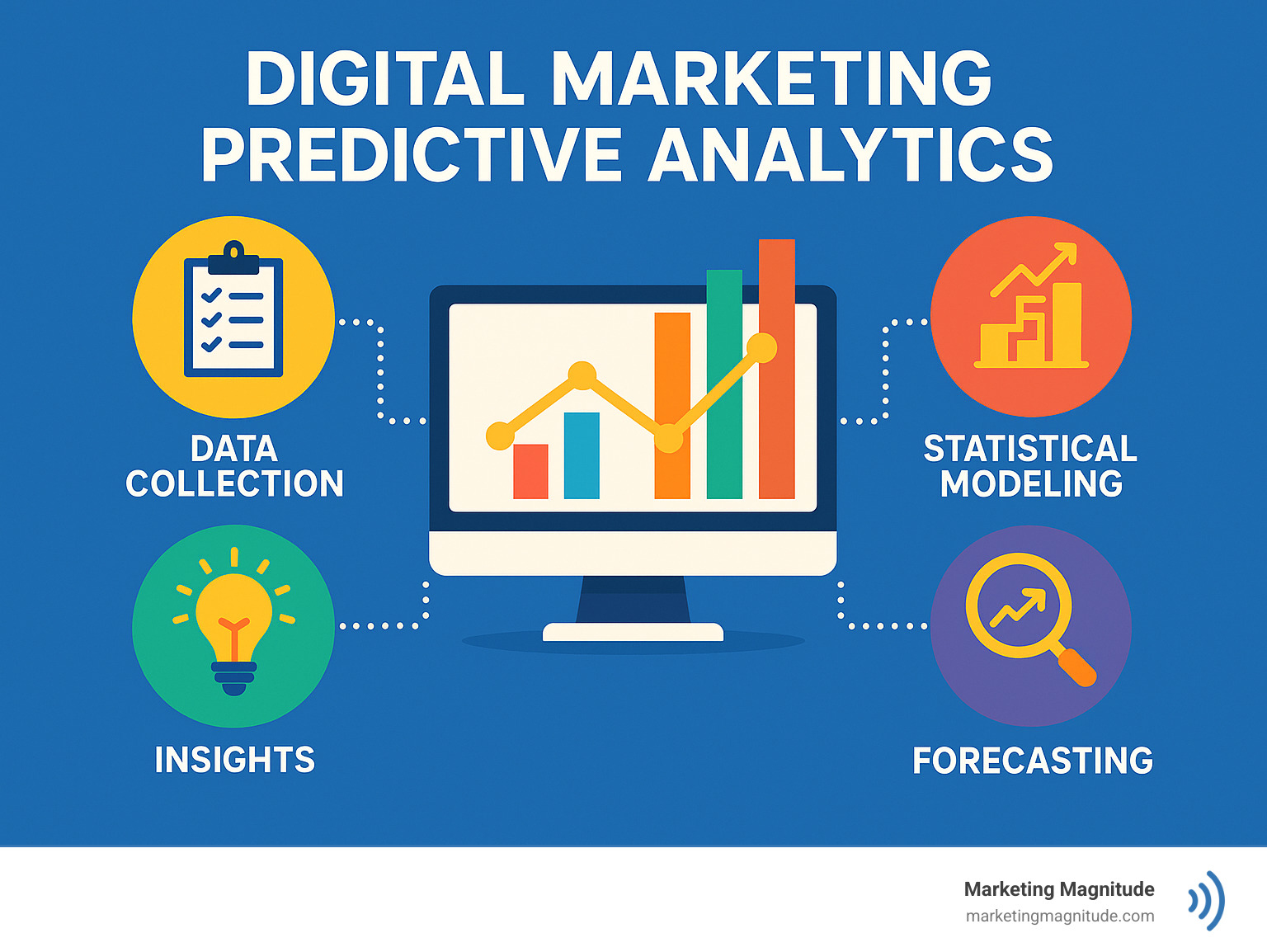
Digital marketing predictive analytics uses historical data, machine learning, and statistical models to forecast customer behavior and campaign outcomes. Instead of guessing what might work, marketers can now predict which strategies will drive the best results.
Key Applications of Digital Marketing Predictive Analytics:
• Customer Segmentation – Group audiences by predicted behavior and value
• Churn Prevention – Identify customers likely to leave before they do
• Campaign Optimization – Forecast which channels and content will perform best
• Lead Scoring – Rank prospects by conversion probability
• Revenue Forecasting – Predict sales outcomes from marketing investments
• Personalization – Deliver the right message to the right person at the right time
The numbers tell the story. Companies using predictive intelligence see 26.34% of total orders influenced by recommendations, growing from 11.47% to 34.71% over 36 months. Meanwhile, over half of marketing leaders admit their ability to predict customer behavior feels like “guesswork” despite major investments in data tools.
This disconnect happens because most marketers collect tons of data but lack the frameworks to turn it into reliable predictions. The good news? Modern predictive analytics tools are more accessible than ever, and the techniques can be learned without a PhD in data science.
I’m Kelly Rossi, and I’ve spent over 20 years helping businesses grow through data-driven digital marketing strategies, including implementing digital marketing predictive analytics solutions that have transformed campaign performance for clients across industries. Throughout this guide, I’ll show you exactly how to harness predictive analytics to stop guessing and start knowing what will drive your marketing success.
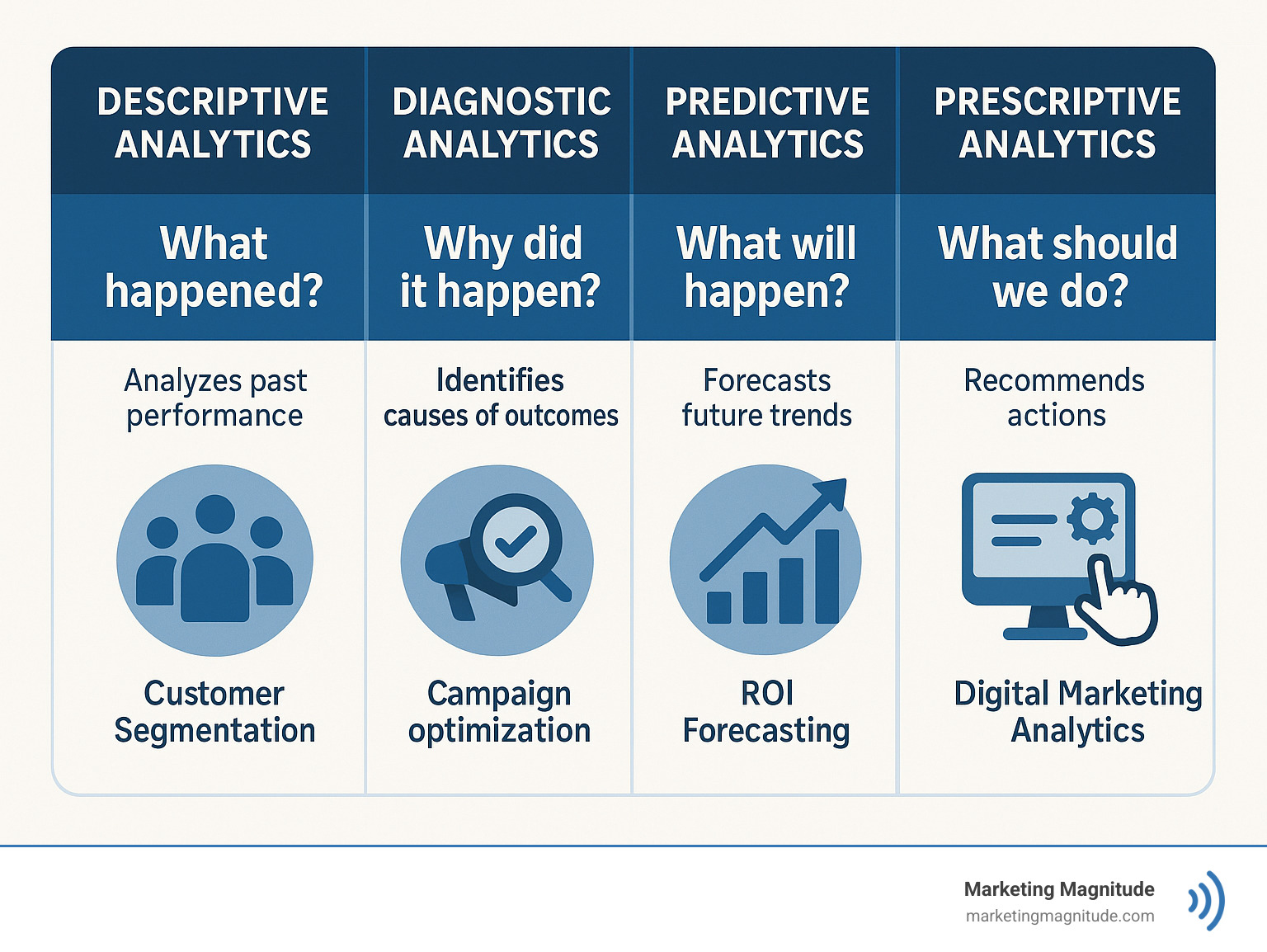
Digital marketing predictive analytics vocab explained:
Why This Guide Matters
We understand the pain points marketers face daily. You’re drowning in data from multiple channels but struggling to connect the dots between your efforts and actual business outcomes. You need to justify every dollar spent while proving ROI to stakeholders who want concrete results, not vanity metrics.
This guide addresses these challenges head-on by showing you how to transform raw marketing data into predictive insights that drive real business growth. Whether you’re managing campaigns for a startup in Austin or scaling enterprise initiatives in Las Vegas, the frameworks we’ll share apply across industries and company sizes.
Predictive Analytics 101: From Data to Foresight
Picture having a crystal ball that actually works. That’s essentially what digital marketing predictive analytics offers—except instead of magic, it relies on scientific research on predictive analytics principles to peek into your marketing future.
The beauty of predictive analytics lies in its simplicity. It takes three ingredients you already have—historical data, statistical algorithms, and machine learning techniques—and blends them into a powerful forecasting tool. This combination transforms marketing from a guessing game into a strategic advantage.
Instead of constantly looking backward at what happened last month, you can finally look forward and make decisions based on what’s likely to happen next. It’s like upgrading from driving with only a rearview mirror to having a full windshield view of the road ahead.
What Is Predictive Analytics in Digital Marketing?
Digital marketing predictive analytics turns your customer data into a roadmap for future success. While traditional analytics tells you that 500 people visited your website yesterday, predictive analytics tells you which of today’s visitors are most likely to become customers tomorrow.
The real magic happens when we dig into the patterns hiding in your customer interactions. Every website click, email open, social media like, and purchase creates a digital breadcrumb trail. When we analyze these trails across thousands of customers, clear patterns emerge.
Here’s a simple example: Imagine you notice that customers who download three specific whitepapers typically make a purchase within 30 days. Armed with this insight, you can immediately flag new prospects who download those same resources and fast-track them to your sales team.
Companies that master this approach see remarkable results. Research shows that fast-growing businesses derive 40% more revenue from personalization than their slower competitors. The secret isn’t just having good data—it’s knowing how to predict what each customer wants before they even realize it themselves.
How Predictive Models Work
Building a predictive model is like teaching a computer to recognize patterns the same way you might learn to predict the weather by watching clouds. The process follows a logical sequence that transforms messy data into reliable forecasts.
First comes data collection, where we gather information from your CRM, website analytics, social platforms, and transaction records. Think of this as collecting all the puzzle pieces you’ll need to see the bigger picture.
Next is data cleaning—arguably the most important step, though it’s about as exciting as organizing your sock drawer. We remove duplicates, fill in missing information, and make sure everything speaks the same language. Research shows that 45-90% of analysis time gets spent on this crucial step, but it’s what separates accurate predictions from expensive guesses.
Then comes model training, where algorithms scan your cleaned data looking for hidden relationships. The computer might find that customers who visit your pricing page twice in one week are 3x more likely to purchase, or that email subscribers who click on Tuesday morning campaigns convert at higher rates.
Validation ensures our model actually works by testing its predictions against known outcomes. If the model says 100 leads should convert and only 20 actually do, we know something needs fixing.
Finally, deployment puts the model to work generating real-time predictions for new data. The beauty of this approach is that larger datasets make predictions more accurate—so the longer you use predictive analytics, the better it gets.
Types of Marketing Data You Need
Successful digital marketing predictive analytics thrives on data diversity. Think of different data types as ingredients in a recipe—each one adds its own flavor to create richer insights.
First-party data is your gold mine because it comes directly from your customers. This includes website behavior patterns, email engagement metrics, purchase histories, customer service interactions, and survey responses. Since you own this data completely, it’s both reliable and privacy-compliant.
CRM data provides relationship intelligence that reveals how customers move through your sales process. Lead sources, sales cycle duration, customer lifetime value, and interaction frequency all paint a picture of what successful customer relationships look like.
Social media data offers behavioral signals that traditional analytics might miss. Engagement rates, audience demographics, sharing patterns, and sentiment analysis help predict which customers are genuinely interested versus just browsing.
Transactional data keeps everything grounded in revenue reality. Purchase frequency, product preferences, seasonal patterns, and payment methods reveal the actual buying behaviors that drive your business forward.
The real insights emerge when you combine these data streams. A customer who engages heavily with your educational content on social media, downloads multiple resources, maintains high email open rates, and browses your pricing page multiple times is practically waving a flag that says “I’m ready to buy”—even if they haven’t contacted sales yet.
The Core Models Powering Marketing Predictions
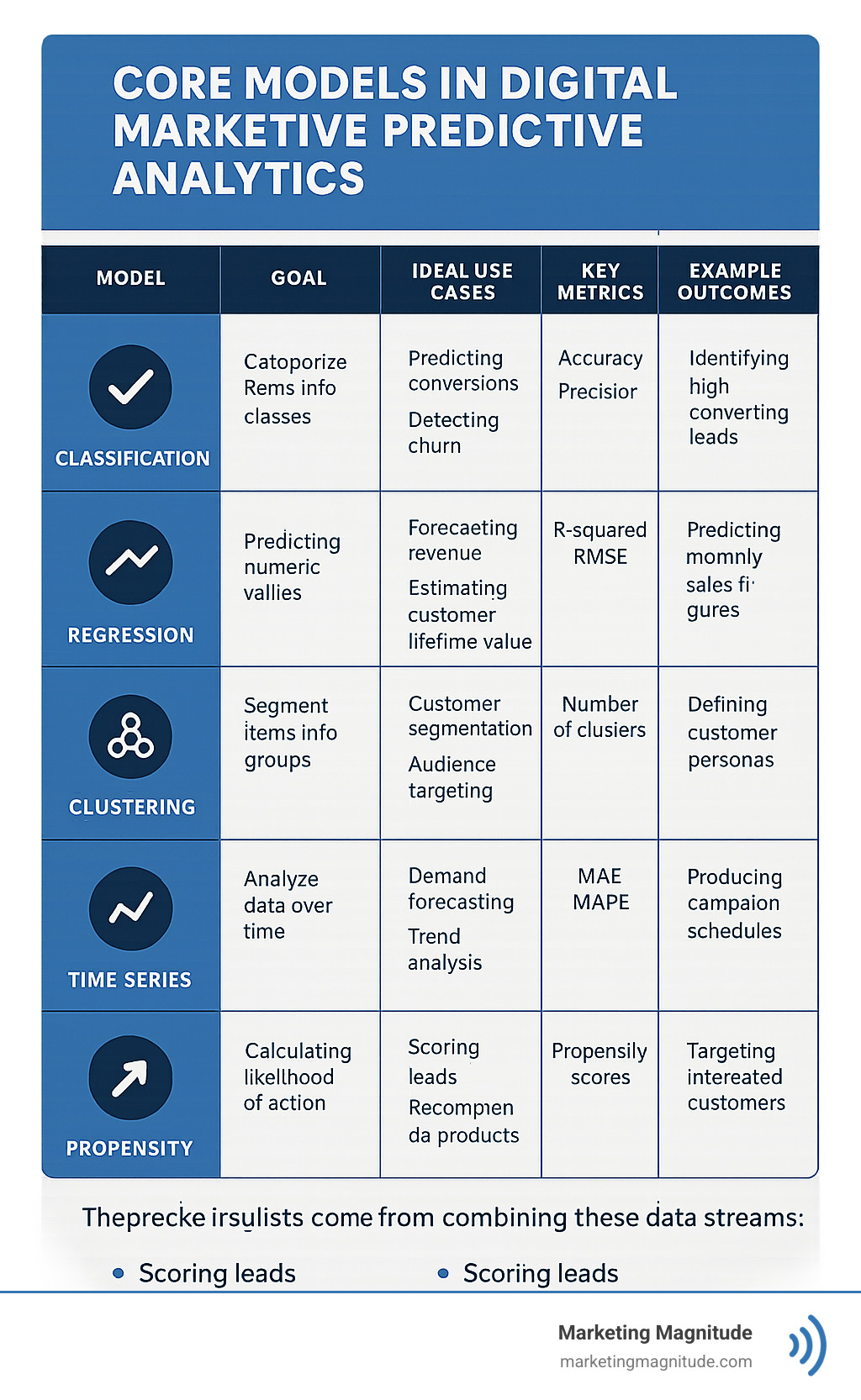
When it comes to digital marketing predictive analytics, think of predictive models as your specialized team of data detectives. Each model type has its own superpower for solving different marketing mysteries. Let me walk you through the five core models that will transform how you understand and predict customer behavior.
The beauty of these models lies in their variety. Some excel at answering simple yes-or-no questions, while others tackle complex numerical forecasts. Understanding which model to use for each situation is like having the right tool for every job in your marketing toolkit.
Model #1–2: Classification & Regression
Classification models are your binary decision makers. They love answering questions like “Will this customer buy?” or “Is this lead worth pursuing?” These models shine when you need clear yes-or-no predictions about customer behavior.
Here’s where it gets interesting. One of our clients finded that email recipients who opened messages within two hours had an 85% chance of clicking through. Those who waited 24 hours or more? Only a 12% chance. This insight completely changed their follow-up strategy.
Regression models tackle the numbers game. Instead of yes-or-no answers, they predict actual values like revenue amounts, customer lifetime value, or campaign ROI. Research reveals fascinating patterns here—$1,000 in social media spend typically generates $3,500 in revenue, while the same investment in email marketing produces $2,800.
The real magic happens when you combine these insights. We’ve watched clients increase lead conversion rates by 38% simply by implementing predictive lead scoring. They focused their energy on prospects most likely to purchase within 30 days, rather than spreading efforts equally across all leads.
Model #3–4: Clustering & Time Series
Clustering models are like having a brilliant market researcher who never sleeps. These models automatically group your customers based on actual behavior patterns, not assumptions about demographics. The results often surprise even seasoned marketers.
Instead of traditional age-based segments, clustering might reveal groups like “weekend browsers who buy on Tuesdays” or “mobile researchers who only convert on desktop.” One retail client finded four distinct clusters: high-value infrequent buyers, frequent low-value shoppers, seasonal bulk buyers, and new customers exploring options.
This wasn’t just interesting data—it was actionable gold. By creating targeted campaigns for each cluster, they increased overall revenue by 25% within 90 days. The weekend browsers received Monday evening emails, while the mobile researchers got desktop retargeting ads.
Time series models predict the “when” of customer behavior. These models excel at seasonal planning and demand forecasting. They can tell you when sales typically spike, the optimal time to send emails, or when customers are most likely to upgrade services.
The timing insights from these models often reveal patterns that human analysis misses. Customers might consistently upgrade on the third Tuesday of each quarter, or email engagement might peak at 2:47 PM on Wednesdays. These precise timing predictions give you a significant competitive edge.
Model #5: Propensity Scoring for Churn & Upsell
Propensity models assign likelihood scores that help you prioritize your efforts intelligently. Customer A might have an 85% upgrade probability, Customer B 67%, and Customer C 32%. This scoring transforms how you allocate resources across your customer base.
The strategic impact is enormous. Focus your high-touch sales efforts on the 85% prospect while nurturing the 32% prospect through automated campaigns. This approach maximizes both conversion rates and team efficiency.
Churn prediction becomes particularly powerful when you consider the economics. Research consistently shows that acquiring new customers costs five times more than retaining existing ones. By identifying at-risk customers early, you can implement targeted retention campaigns that dramatically improve customer lifetime value.
We’ve seen companies reduce churn by 40% simply by reaching out to customers before they decided to leave. The key is timing—contact them when they’re considering alternatives, not after they’ve already made the decision.
Turning Insights into Impact: Planning, Execution & Optimization
The real magic of digital marketing predictive analytics happens when those insights actually change how you work. It’s one thing to know that Customer A has an 85% chance of buying—it’s another thing entirely to use that knowledge to create campaigns that consistently outperform your expectations.
Think of predictive analytics as your marketing GPS. It doesn’t just tell you where you are or where you’ve been. It shows you the fastest route to your destination and warns you about traffic jams before you hit them.
Smarter Campaign Planning
Remember the old days of setting budgets based on “what worked last year” or worse, gut feelings? Media Mix Modeling (MMM) powered by predictive analytics puts those days behind you for good. Advanced machine learning-driven MMM can improve marketing ROI by 14-38% by showing you exactly where every dollar will have the biggest impact.
Here’s how it works in the real world. Let’s say you’re planning next quarter’s budget. Instead of splitting it evenly across channels, predictive models run thousands of scenarios. They might find that shifting 20% of your display advertising budget to email marketing could increase overall conversions by 15% while actually reducing your cost per customer.
A/B test prediction takes the guesswork out of experimentation too. Rather than throwing random variations at the wall to see what sticks, predictive models analyze your audience characteristics and historical patterns to forecast which variations will likely win. This means fewer failed tests and faster wins.
The beauty of resource allocation guided by predictive insights is how surgical it becomes. When models reveal that customers acquired through organic search have 3x higher lifetime value than social media leads, you can adjust your content strategy and ad spend with confidence. No more wondering if you’re focusing on the right channels.
Precision Targeting & Personalization
Behavioral triggers powered by predictive analytics work like having a crystal ball for each customer. When someone’s browsing behavior matches patterns that historically lead to purchases, your systems can automatically send a personalized email, show dynamic website content, or adjust ad targeting in real-time.
Recommendation engines go far beyond the basic “customers who bought this also bought that” approach. They analyze purchasing patterns, browsing behavior, and preferences from similar customers to deliver suggestions that feel almost mind-reading accurate. Companies using predictive recommendation engines see conversion rates increase by 8% on average—and that’s just the beginning.
Hyper-custom content represents the next evolution of personalization. Predictive models don’t just determine what content to show someone—they predict when to show it, through which channel, and even what tone will resonate best. A B2B prospect in the awareness stage might get educational content via LinkedIn, while someone in the consideration stage receives detailed case studies through email.
For more insights on optimizing your digital marketing approach, explore our online marketing resources.
Measuring Success & Maximizing ROI
Real-time dashboards powered by predictive analytics completely change how you monitor campaign performance. Instead of just seeing yesterday’s conversion rate, you’re looking at predicted conversion probability for today’s traffic. This means you can spot problems and opportunities while there’s still time to act on them.
KPI alignment becomes crucial when working with predictive models. Vanity metrics like page views or social media followers take a backseat to predictive indicators that actually drive business outcomes—things like revenue probability, predicted customer lifetime value, and retention likelihood.
Integrated reporting pulls together data from every touchpoint to create a complete picture of how customers actually move through your marketing funnel. This holistic view enables attribution modeling that accurately shows which channels deserve credit for conversions, not just which ones happened to be last in line.
At Marketing Magnitude, our real-time tracking and reporting capabilities integrate seamlessly with predictive analytics platforms. This gives our clients transparent insights into both current performance and future opportunities—no more flying blind or waiting weeks for campaign results.
The change from reactive to predictive marketing doesn’t happen overnight, but when it does, the competitive advantage is unmistakable. You’ll find yourself confidently making decisions that your competitors are still guessing about.
Implementation Roadmap & Must-Have Tools
Getting started with digital marketing predictive analytics doesn’t have to feel overwhelming. Think of it like learning to drive—you start with the basics, practice in safe environments, and gradually build confidence before tackling busy highways.
The beauty of modern predictive analytics is that you don’t need a team of data scientists to see real results. With the right roadmap and tools, even small marketing teams can harness the power of prediction to make smarter decisions.
Step-by-Step Launch Blueprint
Starting with solid foundations makes everything else easier. During your first two weeks, focus on defining what success looks like. Instead of saying “we want better marketing results,” get specific: “we want to increase our email conversion rate by 20% in the next quarter using predictive lead scoring.”
Next, take inventory of what you already have. Look at your current data sources—your website analytics, email platform, CRM system, and social media insights. You might be surprised by how much valuable information you’re already collecting. The challenge isn’t usually getting more data; it’s making sense of what you have.
Data preparation is where the magic really begins, even though it’s not the most exciting part. Think of it like organizing your kitchen before cooking a big meal—the prep work isn’t glamorous, but it makes everything else possible. Research shows that 27% of revenue is lost due to poor data quality, so this step is worth doing right.
Clean up duplicate records, fill in missing information where possible, and make sure all your data sources speak the same language. Set up automated connections between your different platforms so data flows smoothly without manual work.
Building your first models should feel like solving puzzles, not rocket science. Start with your biggest pain point. If customers are leaving faster than you’d like, begin with a simple churn prediction model. If you’re struggling to prioritize leads, focus on conversion probability scoring.
Follow the 70-20-10 rule for testing your models: use 70% of your historical data to train the model, 20% to validate it’s working correctly, and save 10% for final testing. This approach helps ensure your predictions will be accurate when applied to new customers.
Going live with your predictions is when things get exciting. Connect your models to your existing workflows. Your CRM might automatically flag high-probability leads, or your email platform could send personalized messages based on predicted interests.
Models need ongoing attention, just like plants need watering. Market conditions change, customer behavior evolves, and your models need fresh data to stay accurate. Plan to review and refresh your models regularly.
Popular Platforms & Toolkits
Choosing the right tools depends on your team’s technical comfort level and budget. Enterprise solutions like Salesforce Einstein integrate seamlessly with existing CRM workflows, making predictive lead scoring feel natural for sales teams. Adobe Analytics offers sophisticated audience prediction capabilities that work beautifully with other Adobe marketing tools.
Cloud-based platforms provide powerful capabilities without requiring massive infrastructure investments. Snowflake combines data storage with built-in machine learning, making it easier to manage large datasets. Google Analytics Intelligence automatically spots trends and anomalies, giving you insights without manual analysis.
For teams with technical expertise, open-source options like Python and R offer maximum flexibility for custom solutions. These tools require more learning upfront but provide unlimited customization possibilities.
The key is starting where your team feels comfortable and growing from there. Many successful companies begin with user-friendly platforms that offer pre-built models, then gradually move to more sophisticated tools as their skills develop.
Navigating Privacy & Cookie-Less Challenges
The changing privacy landscape might seem like a roadblock, but it’s actually creating opportunities for smarter marketers. With third-party cookies disappearing and regulations like GDPR getting stricter, digital marketing predictive analytics is shifting toward more sustainable approaches.
First-party data is becoming your most valuable asset. This includes information customers willingly share through website interactions, email subscriptions, surveys, and loyalty programs. The good news? First-party data is often more accurate and predictive than third-party alternatives because it reflects actual customer relationships.
Building trust through transparent consent management helps customers feel comfortable sharing information. When people understand how their data improves their experience—like getting more relevant product recommendations or timely offers—they’re often happy to participate. For detailed guidance on privacy-compliant analytics, review scientific research on data privacy.
Contextual analytics opens new possibilities for prediction without individual tracking. Models can analyze patterns based on device type, time of day, content preferences, and browsing behavior while respecting privacy boundaries. These approaches maintain effectiveness while building customer trust.
At Marketing Magnitude, our real-time tracking and reporting capabilities help clients steer these privacy challenges while maintaining transparent insights into campaign performance and future opportunities.
Future Trends Shaping Digital Marketing Predictive Analytics
The world of digital marketing predictive analytics is changing at breakneck speed. New technologies are emerging that will reshape how we understand customers, create campaigns, and measure success. Let’s explore what’s coming next and how you can prepare your marketing team for these exciting changes.
Real-Time & Streaming Predictions
Remember when we had to wait until Monday morning to see how weekend campaigns performed? Those days are quickly becoming ancient history. Real-time analytics now process customer interactions as they happen, updating predictions and triggering responses in milliseconds rather than hours or days.
Edge analytics is bringing this processing power even closer to where customers interact with your brand. Instead of sending data to distant servers for analysis, predictions happen right at the source. Picture this: a customer browsing your website sees product recommendations that update instantly based on their current session, local weather, and real-time inventory levels.
This isn’t science fiction—it’s happening now. Companies using instant personalization powered by streaming predictions are seeing conversion rates jump significantly. When someone’s browsing behavior screams “I’m ready to buy,” the system can immediately surface the perfect offer or trigger a well-timed chat invitation.
The beauty of real-time predictions lies in their responsiveness. Your website becomes less like a static brochure and more like a smart sales assistant who learns and adapts with every interaction.
AI-Driven Creativity & Automation
Here’s where things get really exciting. Generative AI is revolutionizing how we create and optimize marketing content. Predictive models can now forecast which headlines, images, and calls-to-action will resonate with specific audience segments—then automatically generate variations for testing.
Think about the creative bottlenecks your team faces. How long does it take to develop multiple ad variations for different audience segments? AI-driven creativity can generate dozens of personalized versions in minutes, each optimized for different customer types based on predictive insights.
Adaptive campaigns take this concept even further. Instead of launching static campaigns that run unchanged for weeks, you can deploy dynamic campaigns that evolve continuously. Machine learning algorithms adjust messaging, timing, and channel selection based on real-time performance data and predictive forecasts.
The most impressive advancement might be automated A/B testing that runs hundreds of micro-experiments simultaneously. Traditional testing approaches require weeks to reach statistical significance. Predictive-powered testing can identify winning variations in days, dramatically accelerating optimization cycles.
This doesn’t mean creativity becomes obsolete—quite the opposite. Human creativity guides strategy and brand voice while AI handles the heavy lifting of variation generation and optimization.
Preparing for What’s Next
The future belongs to marketing teams that blend human insight with analytical power. This shift requires thoughtful preparation across three key areas.
Skills development tops the priority list. The most successful marketers will understand predictive analytics principles without needing PhD-level technical knowledge. Invest in training that helps your team interpret model outputs, ask the right questions, and translate insights into actionable strategies.
Cultural change often proves more challenging than technical implementation. Moving from gut-feeling decisions to data-driven choices requires organizational commitment. Foster a culture that celebrates experimentation, treats failures as learning opportunities, and prioritizes measurable outcomes over creative preferences.
Continuous learning becomes non-negotiable as digital marketing predictive analytics evolves rapidly. Establish regular processes for staying current with new techniques and tools. Industry publications, conferences, and professional development programs help teams maintain their competitive edge.
The integration of IoT data streams, voice analytics, and augmented reality interactions will create new prediction opportunities. Ethical considerations around AI transparency and sustainability metrics will shape how we implement these technologies responsibly.
At Marketing Magnitude, we’re already helping clients steer these changes through our real-time tracking and reporting capabilities. The future of predictive analytics isn’t just about better technology—it’s about using that technology to create more meaningful customer relationships and drive genuine business growth.
Frequently Asked Questions about Predictive Analytics for Marketers
How much historical data is “enough” to start?
You don’t need years of perfect data to begin your digital marketing predictive analytics journey. The truth is, most marketers overthink this requirement and delay getting started.
For basic classification models like conversion prediction or churn detection, six to twelve months of data usually provides enough patterns to build useful models. If you’re looking at seasonal trends or want robust time series forecasting, aim for two to three years of historical information.
Here’s what really matters: you need about 1,000 records per category you’re trying to predict. So if you’re building a model to predict which leads will convert, having 1,000 converted leads and 1,000 non-converted leads in your dataset gives you a solid foundation.
But here’s the secret that surprises many marketers—quality beats quantity every time. Clean, consistent data from six months often produces better predictions than three years of messy, incomplete records. Start with whatever data you have, build your first model, and improve it as you collect more information.
Research consistently shows that even smaller datasets can yield valuable insights when analyzed properly. The key is beginning with realistic expectations and growing your capabilities over time.
Can predictive analytics replace A/B testing?
This question comes up constantly, and the answer might surprise you. Digital marketing predictive analytics doesn’t replace A/B testing—it makes testing smarter and more effective.
Think of predictive models as your testing strategy advisor. They excel at prioritizing which tests to run first based on predicted impact, forecasting optimal test duration and sample sizes to reach statistical significance faster, and identifying audience segments most likely to respond to different variations.
A/B testing remains absolutely crucial for validating your predictive model accuracy, finding unexpected customer behaviors that models might miss, and building confidence in significant strategic changes before full implementation.
The magic happens when you combine both approaches. Use predictive analytics to design smarter experiments that focus on high-impact variations, then use your test results to train better predictive models. This creates a virtuous cycle where each approach strengthens the other.
We’ve seen clients reduce their testing time by 40% while finding more winning variations by using this combined approach. Instead of testing random ideas, they focus on variations their models predict will succeed.
What’s the quickest win for small teams using digital marketing predictive analytics?
Email send-time optimization delivers the fastest, most measurable results for small marketing teams. This application requires minimal technical setup but consistently improves open rates by 15-20% within weeks.
The beauty of this approach lies in its simplicity. Start by analyzing your historical email data to identify when each subscriber typically opens and clicks. Most email platforms already collect this information—you just need to look at it differently.
Use simple algorithms to predict optimal send times for individual subscribers rather than sending everything at the same time. Then implement automated sending based on these predicted engagement windows. The results are usually visible within the first few campaigns.
Beyond email optimization, lead scoring using existing CRM data provides another quick win. By analyzing which leads actually converted in the past, you can identify patterns that help your sales team prioritize follow-up activities more effectively.
Customer segmentation based on purchase history and behavior data also delivers fast results. Instead of broad demographic categories, you can identify behavioral segments like “weekend browsers who buy on mobile” or “research-heavy customers who convert after multiple touchpoints.”
For subscription or repeat-purchase businesses, basic churn prediction can identify at-risk customers early enough to implement retention campaigns.
The key is starting with one focused application, measuring results carefully, and expanding to additional use cases as you build confidence and capabilities. Digital marketing predictive analytics success comes from consistent application of simple techniques rather than complex models that nobody understands.
Conclusion
The journey from guessing to knowing starts with digital marketing predictive analytics. What once felt like throwing darts in the dark can now be transformed into precise, data-driven decisions that consistently drive real business growth.
Think about where we started. Over half of marketing leaders admit their customer behavior predictions feel like “guesswork” despite massive investments in data tools. But the companies that have cracked the code are seeing remarkable results. 26.34% of their total orders come from predictive recommendations, and their marketing ROI improves by 14-38% through advanced modeling.
The gap between winners and everyone else isn’t access to better data—it’s knowing how to turn that data into reliable predictions.
Throughout this guide, we’ve walked through the complete roadmap. Start with clear objectives and clean data. Choose the right predictive models for your specific challenges. Implement systematically, measure carefully, and scale gradually as your confidence grows.
The beauty of digital marketing predictive analytics lies in its accessibility. You don’t need a PhD in data science or a massive budget to begin. Start with email send-time optimization or basic lead scoring. Get some wins under your belt. Then expand to more sophisticated applications like customer lifetime value prediction and real-time personalization.
But remember—technology alone won’t transform your marketing. The magic happens when you combine predictive insights with human creativity and strategic thinking. The models tell you what’s likely to happen. Your expertise determines what to do about it.
At Marketing Magnitude, we’ve seen how challenging it can feel to bridge the gap between data and actionable insights. That’s exactly why our real-time tracking and reporting capabilities integrate seamlessly with predictive analytics platforms. We believe in transparent insights that help you make confident decisions about every marketing dollar you spend.
Whether you’re growing a startup in Austin, scaling operations in Las Vegas, or serving clients across Nevada, these predictive principles work. The frameworks adapt to your industry, your audience, and your unique business challenges.
The future is already here for marketers who can predict customer behavior, optimize campaigns in real-time, and demonstrate crystal-clear ROI. The tools exist today. The question isn’t whether predictive analytics will transform marketing—it’s whether you’ll be leading that change or playing catch-up.
Ready to stop guessing and start knowing? Our comprehensive services can help you implement these powerful predictive capabilities and achieve the breakthrough results your business deserves.
Get Started Now
Fill out this form to start your journey to next-level marketing solutions for your business.