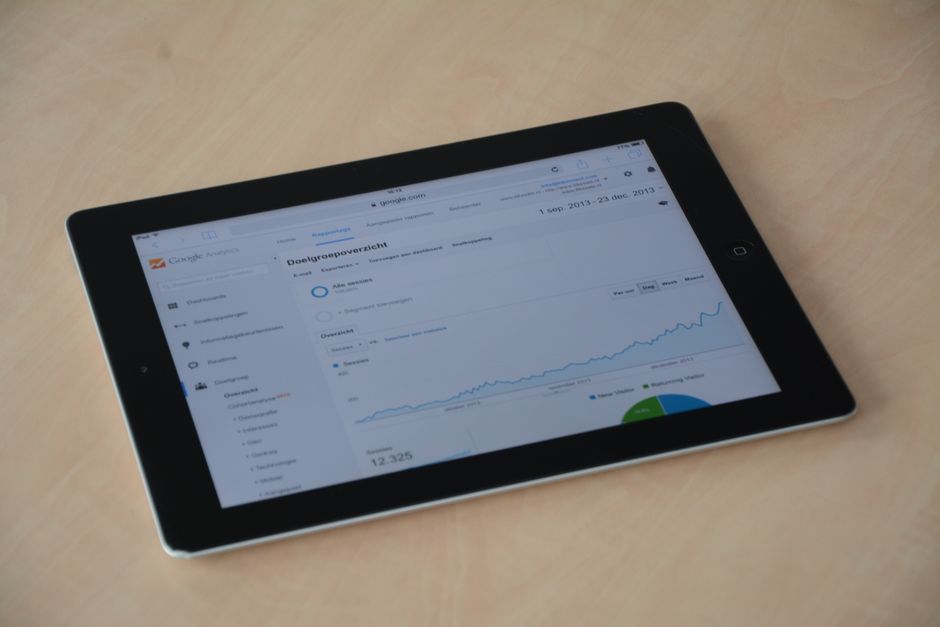
Your Marketing Is Either Making You Money or It Isn’t — Here’s How to Tell
If you’ve ever wondered how to know if your marketing is actually working (even if you’re not a marketer), here’s the short answer:
Track only these 5 numbers:
| Metric | What It Tells You |
|---|---|
| Revenue | Is marketing putting money in the bank? |
| Customer Acquisition Cost (CAC) | What does it cost to win one customer? |
| Conversion Rate | Are leads turning into paying customers? |
| Traffic | Are enough people finding you? |
| Repeat Rate | Are customers coming back? |
Ignore: likes, impressions, follower counts, bounce rate, and email open rates. These don’t pay bills.
That’s the core of it. Everything else in this article shows you exactly how to set it all up — in about 10 minutes, with a free spreadsheet.
Picture this: your marketing agency sends over a glossy report. Impressions are up. Engagement is climbing. The graphs look great. Then you ask the only question that actually matters — “Did we make more money this month?” — and suddenly the room gets very quiet.
You’re not alone. Most small business owners are drowning in data that looks impressive but tells them nothing about whether their marketing is actually working. The problem isn’t that you’re not a marketer. The problem is that 80% of what gets reported is noise — vanity metrics designed to look good rather than reveal the truth.
The good news? You only need five numbers to know if your marketing is healthy. No analytics degree required.
I’m Kelly Rossi, founder of Marketing Magnitude and a digital marketing strategist with over 20 years of experience helping businesses cut through the noise and build measurement systems that tie directly to revenue. Knowing how to know if your marketing is actually working (even if you’re not a marketer) is something I’ve helped hundreds of business owners figure out — and I’ll show you exactly how to do it here.
The Only 5 Metrics That Actually Matter for Your Bottom Line
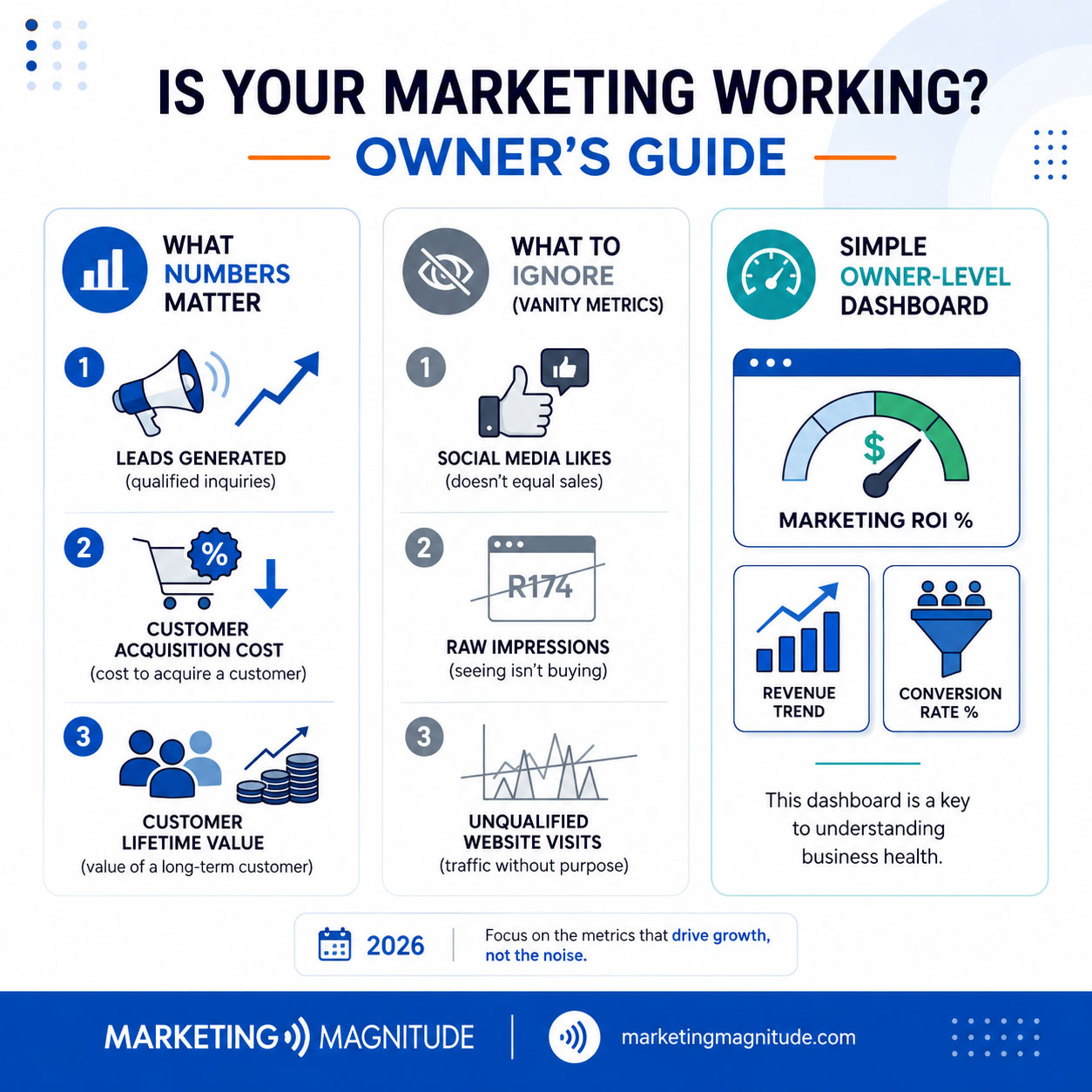
When we talk to business owners in Las Vegas or Austin, they often feel like they need a NASA-style control room to understand their performance. They don’t. In fact, tracking too much often leads to understanding nothing. To find clarity, you must distinguish between “vanity metrics” (which make you feel good) and “actionable metrics” (which help you make money).
| Vanity Metrics (The Noise) | Actionable Metrics (The Truth) |
|---|---|
| Social Media Likes / Reach | Total Revenue Generated |
| Website Impressions | Customer Acquisition Cost (CAC) |
| Email Open Rates | Sales Conversion Rate |
| Follower Growth | Repeat Purchase Rate |
| Time on Site | Qualified Lead Volume |
To truly understand your Digital Marketing Goals, you need to focus on these five pillars:
- Revenue: This is the ultimate “North Star.” If your marketing isn’t eventually leading to more money in the bank than you started with, it’s a hobby, not a strategy.
- Customer Acquisition Cost (CAC): How much do you have to spend in ads and fees to get one person to swipe their card? If it costs you $500 to acquire a customer who only spends $200, you’re effectively paying people to use your service.
- Conversion Rate: This is the efficiency of your sales funnel. If 1,000 people visit your site and only 2 buy, you have a 0.2% conversion rate. Improving this is often cheaper than buying more traffic. You can Find Out The Value Of Your Website by seeing how well it turns strangers into prospects.
- Repeat Rate: Scaling a business is exhausting if you only ever sell to new people. A healthy repeat rate (20% is decent, 40%+ is excellent) means your marketing is attracting the right people who stick around.
- Traffic Volume: While traffic is a “secondary” metric, it’s the fuel. You need to know if the total number of people seeing your offers is growing or shrinking.
What Numbers Matter: How to Know if Your Marketing Is Actually Working (Even If You’re Not a Marketer)
If you are a service-based business owner, the “Traffic” and “Impressions” numbers can be particularly deceptive. What matters most is Qualified Lead Volume. A lead is only a lead if they take an action indicating buying intent—like filling out a quote form or calling your office.
A deep Online Marketing Analysis should also look at your Sales Close Rate. If your marketing is generating 100 leads but your team only closes 2, you don’t necessarily have a marketing problem; you might have a sales process or lead quality problem.
Finally, keep the 3:1 LTV-to-CAC ratio in mind. Your Customer Lifetime Value (LTV) should be at least three times what it cost to acquire them. If it’s 1:1, you’re breaking even on the marketing but losing money on overhead.
Calculating Your Marketing ROI and Spend Efficiency
Calculating your Return on Investment (ROI) is the fastest way to know if you should keep spending or cut your losses. The basic formula is: ((Revenue – Marketing Cost) / Marketing Cost) x 100.
Recent Scientific research on small business ad spend trends suggests that small businesses are spending more than ever, but many struggle to prove the return. At Marketing Magnitude, we suggest a 200% ROI threshold as your “yellow light.”
- Below 100%: You are losing money. Stop and fix the offer.
- 100% – 200%: You are likely breaking even after you account for labor and overhead.
- 300% – 500%: This is the “sweet spot” for most healthy small businesses.
Always perform a break-even analysis before launching a new campaign. If your profit margin is 25%, you need a 4:1 ROAS (Return on Ad Spend) just to break even on the transaction.
How to Know if Your Marketing Is Actually Working (Even If You’re Not a Marketer)
The biggest mistake we see owners make is trusting automated reports blindly. To know if your marketing is working, you need to verify the path from “click” to “cash.”
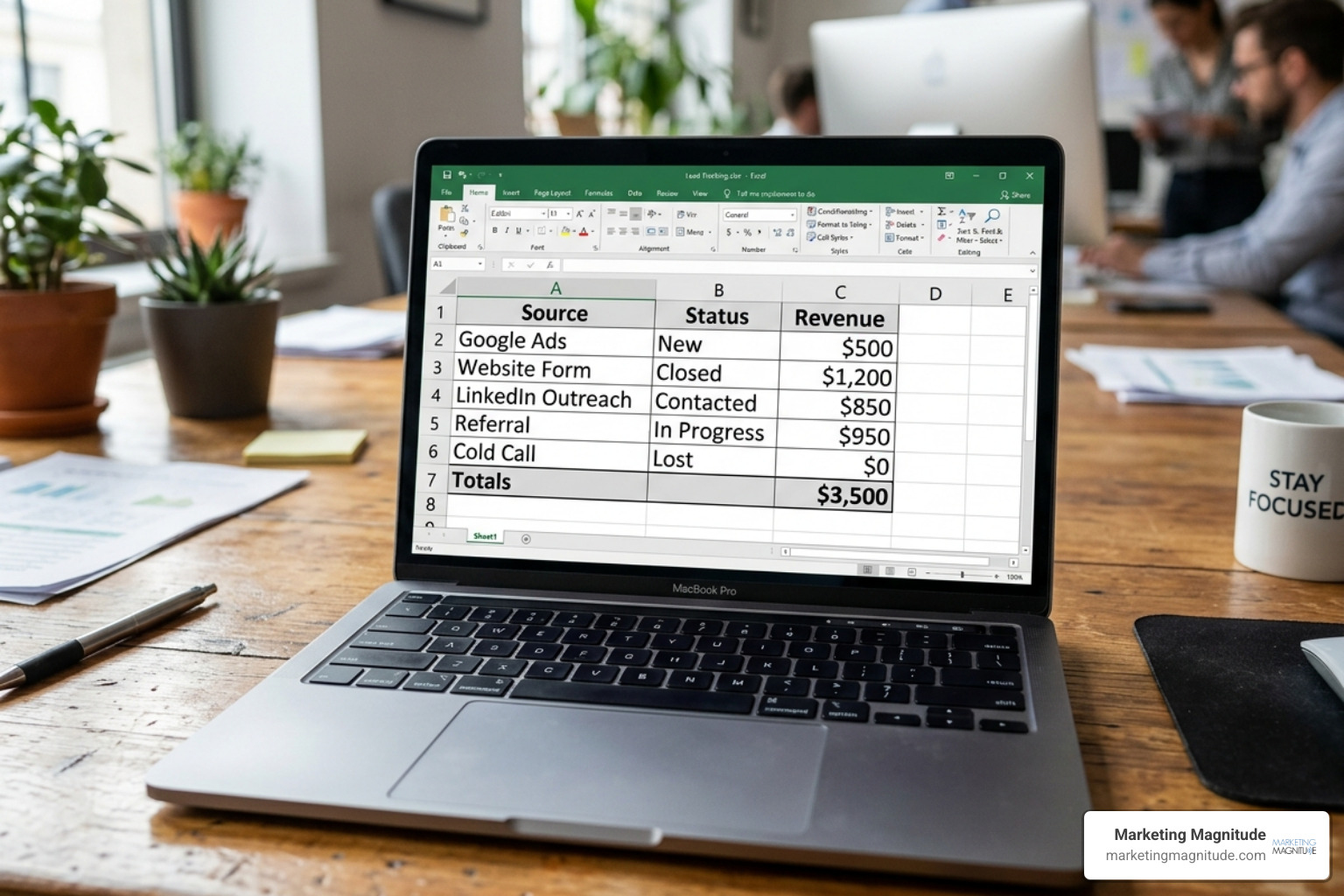
Understanding Website Marketing Analytics doesn’t mean you need to live inside Google Analytics 4 (GA4). It means you need to understand Lead Attribution—knowing exactly which door the customer walked through.
A proper Guide To Online Marketing Analysis will tell you to look for Buying Intent. Someone searching “how to fix a leaky pipe” has less intent than someone searching “plumber in Las Vegas open now.” Your marketing is working if it captures the latter.
Tracking Lead Sources Without Fancy Tools
You don’t need expensive software to start. The most powerful tool in your arsenal is the simple question: “How did you find us?”
While manual logs are great, they can be human-error prone. This is where Call Tracking For Marketing Campaigns Why Is It Important comes into play. By using unique phone numbers for different ads, you can see exactly which campaign triggered the call without having to ask.
For digital leads, ensure your team is using UTM parameters. These are small bits of code added to the end of a URL that tell your analytics exactly which Facebook post or email link the user clicked. This is the foundation of Website Conversion Tracking.
Simple Owner-Level Dashboard: How to Know if Your Marketing Is Actually Working (Even If You’re Not a Marketer)
You can set up a dashboard in 10 minutes using Google Sheets. Create columns for:
- Week/Month
- Total Spend (Ads + Agency Fees)
- Total Leads (Calls + Forms)
- New Customers
- Total Revenue
Review this weekly for 15 minutes. Don’t obsess over daily fluctuations; look for Monthly Trends. If your spend is steady but leads are dropping for three weeks straight, that’s a red flag. This simple habit is How Do You Measure Success without getting bogged down in jargon.
Vanity Metrics: What to Ignore to Avoid Overwhelm
If a metric doesn’t help you make a decision, it’s a vanity metric. Agencies often use these to “hide” a lack of results.

- Impressions and Reach: These tell you how many people could have seen your ad. It’s like counting how many people drove past your billboard while they were texting. It doesn’t mean they looked at it, and it certainly doesn’t mean they bought anything.
- Follower Counts: You can’t pay your mortgage with “likes.” We’ve seen accounts with 50,000 followers generate zero sales, while accounts with 500 followers generate six figures.
- Email Open Rates: Thanks to Research on how Apple Mail Privacy Protection affects open rates, these numbers are now highly inflated and unreliable. Focus on “Click-Through Rate” or “Replies” instead.
- Bounce Rate and Time on Site: These are diagnostic tools for web designers, not business owners. If your phone is ringing, it doesn’t matter if people only stayed on your site for 30 seconds.
Red Flags: When to Change Your Approach or Fire Your Agency
How do you know when to pull the plug? The biggest red flag is Shifting Goalposts. If your agency starts the year talking about “Leads” but switches to talking about “Brand Awareness” or “Engagement” when the leads dry up, they are trying to distract you.
Another red flag is a Lack of Transparency. You should always know exactly how much of your money is going to “Ad Spend” (Google/Meta) versus “Management Fees.” If these are lumped together, you can’t calculate your true ROI.
Effective Ppc 101 Basics Of Pay Per Click Management requires constant testing. If your agency isn’t mentioning What Is A B Testing For Landing Pages or showing you different versions of ads they are trying, they are likely “setting it and forgetting it” while collecting your fee.
Realistic Timelines for Marketing Results
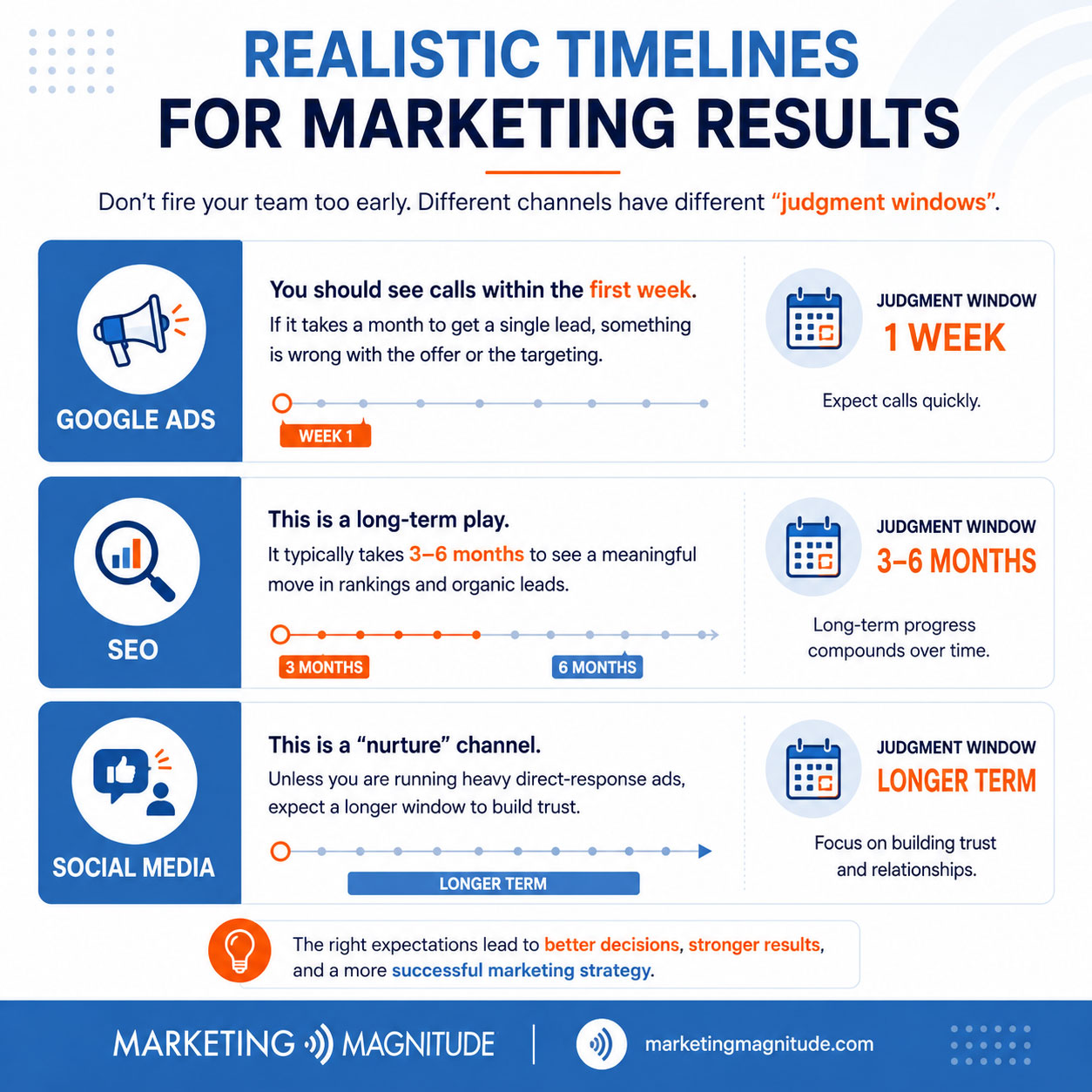
Don’t fire your team too early. Different channels have different “judgment windows”:
- Google Ads: You should see calls within the first week. If it takes a month to get a single lead, something is wrong with the offer or the targeting.
- SEO: This is a long-term play. It typically takes 3–6 months to see a meaningful move in rankings and organic leads.
- Social Media: This is a “nurture” channel. Unless you are running heavy direct-response ads, expect a longer window to build trust.
Identifying the “Right” Kind of Customers
Marketing is working when it attracts your Ideal Customer Profile, not just anyone with a pulse. Use “Lead Scoring” to evaluate quality.
- Are you getting “Price Shoppers” who want the cheapest deal?
- Or are you getting “Value Buyers” who need your specific expertise?
If you are a local business in Nevada, check your Geographic Targeting. If you’re a plumber in Las Vegas but getting calls from Reno, your marketing is “working” but it’s not “effective.” High refund rates or low service-match scores are signs that your messaging is attracting the wrong audience.
Frequently Asked Questions about Marketing Success
What is a “good” ROI for a small business in 2026?
A “good” ROI is generally between 300% and 500%. However, this depends on your margins. A high-margin software company can survive on a lower ROI, while a low-margin retail shop might need a 700% ROI to stay profitable. In 2026, with rising ad costs, efficiency is more important than raw volume.
How soon should I see leads from new SEO efforts?
SEO is a compounding asset. While you might see some “quick wins” in the first 60 days by fixing technical errors, the real “hockey stick” growth usually happens between months 6 and 12. If you need leads today, use PPC. If you want to lower your lead cost next year, use SEO.
Why are my leads up but my revenue is down?
This usually points to one of three things:
- Lead Quality: You’re attracting “junk” leads or spam.
- Sales Friction: Your team isn’t following up fast enough. (Leads called within 5 minutes are 10x more likely to convert).
- Pricing: You’ve raised prices beyond what your current marketing message supports, or you’re attracting people who can’t afford you.
Conclusion
At Marketing Magnitude, we believe that you shouldn’t need a degree in data science to run your business. Our mission is to provide real-time tracking and transparent reporting so that you never have to guess if your investment is paying off.
By implementing a 15-minute monthly routine to review your core 5 metrics—Revenue, CAC, Conversion Rate, Traffic, and Repeat Rate—you take back control of your growth. Stop settling for reports full of smoke and mirrors. If you’re ready for a no-BS approach to growth, it’s time to Start your journey with a professional advertising agency that prioritizes your bottom line over vanity stats.
Whether you are in Las Vegas, Austin, or anywhere in between, the goal remains the same: marketing that actually makes you money.
Get Started Now
Fill out this form to start your journey to next-level marketing solutions for your business.