What Is an Integrated Dental Practice Growth System?
A modern dental practice growth system is not a collection of disconnected software tools or one-off marketing tactics. It is an operational ecosystem where patient acquisition, AI-driven scheduling, automated hygiene recall, multi-channel marketing, and CRM infrastructure function together as a unified engine.
In 2026, isolated marketing efforts consistently fail dental practices. Running paid search ads without an automated booking funnel wastes advertising spend on abandoned clicks. Similarly, generating website traffic without a responsive communication layer leaves prospective patients waiting hours for a callback—by which time they have already booked with a competing local clinic.
The most damaging inefficiency inside most practices is not poor lead generation; it is dormant patient retention. Industry benchmarks reveal that the average dental practice has 30% to 40% of its active patient roster overdue for routine hygiene recall. For a practice maintaining 2,000 active charts, that equates to roughly 700 overdue patients. This gap represents between $140,000 and $280,000 in dormant annual production sitting uncollected in the practice management database.
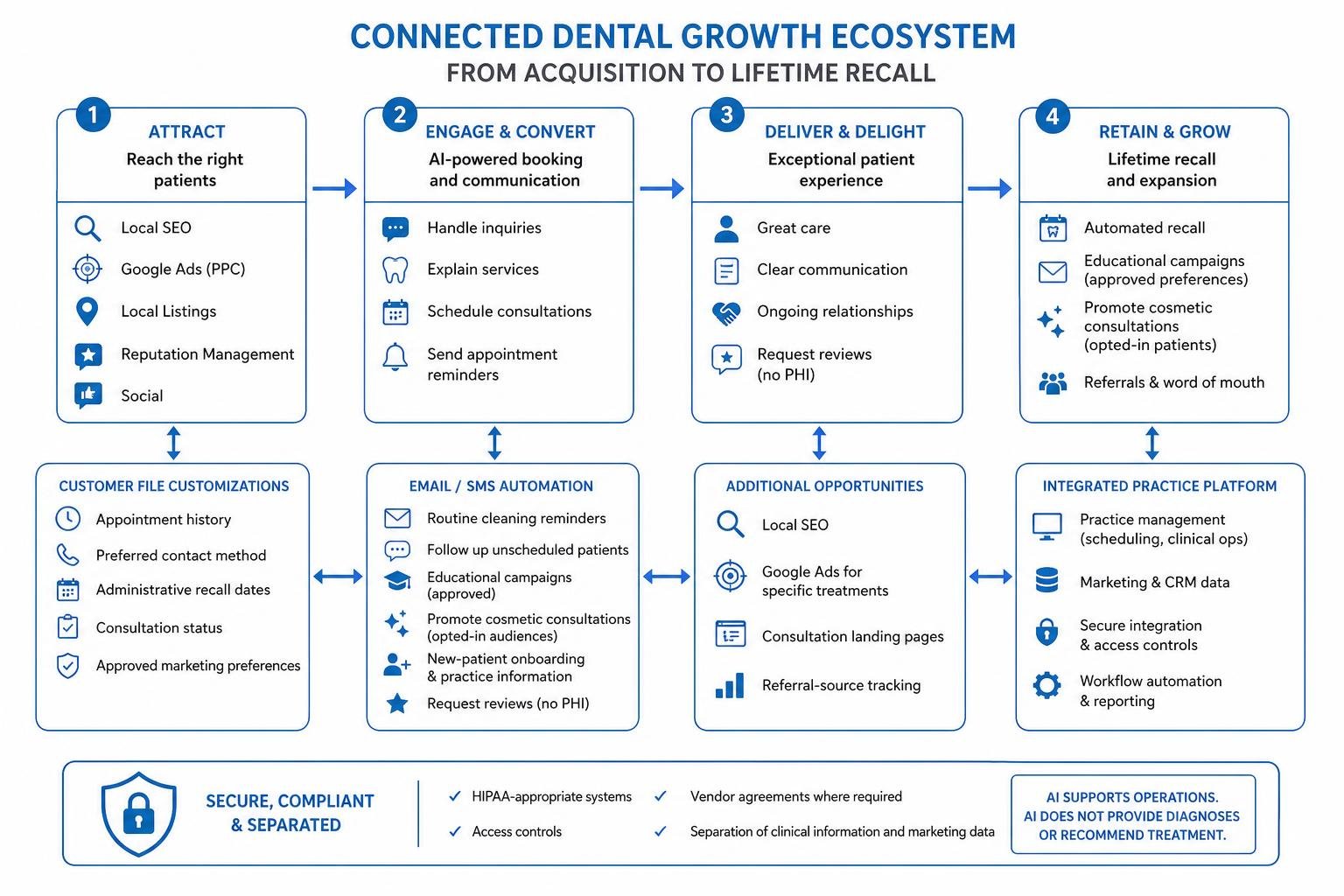
Sustainable practice expansion requires shifting away from transactional patient acquisition toward connected, lifetime operational growth. When marketing systems communicate directly with your scheduling pipelines and recall workflows, patient value compounds predictably over time.
How Does HIPAA-Compliant AI Scheduling and Communication Automate Front-Desk Operations?
AI Conversational Booking and Patient Inquiries
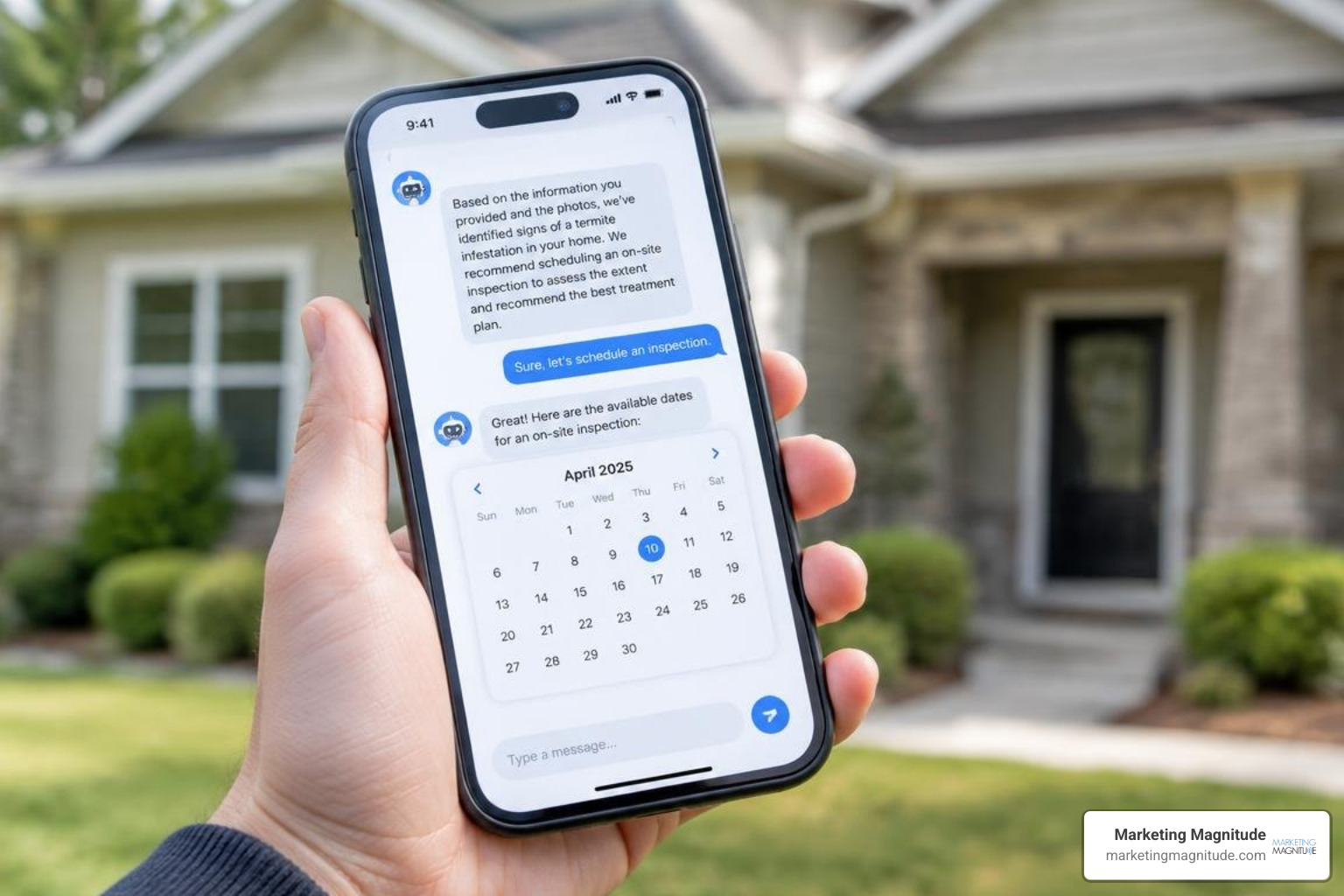
Front-desk staff face constant interruptions between greeting in-office patients, managing checkout, verifying insurance, and answering ringing phones. Deploying intelligent AI phone answering and chatbot solutions ensures your practice captures high-intent patient inquiries 24 hours a day, 7 days a week.
These conversational AI assistants handle routine non-clinical tasks effortlessly:
- Explaining available practice services, office hours, and accepted insurance networks
- Qualifying patient needs for general checkups, cosmetic consultations, or emergency visits
- Directing patients to real-time scheduling links based on provider availability
- Collecting initial intake details and dispatching administrative appointment confirmations
Automated front-desk triage allows clinics to scale patient communication without increasing administrative overhead.
However, boundary enforcement is essential: AI assistants must be strictly limited to administrative and informational workflows. Conversational systems must never offer clinical diagnoses, interpret symptoms, or independently recommend specific dental treatments. If a patient describes acute pain, trauma, or complex clinical symptoms, the system must immediately route the inquiry to your clinical team or direct the patient to emergency care.
HIPAA Safeguards, BAA Agreements, and Clinical Data Isolation
Healthcare workflows demand rigorous data governance. Marketing and operational tools that touch patient data must comply fully with HIPAA privacy and security standards.
Key compliance requirements include:
- Business Associate Agreements (BAAs): You must execute a signed BAA with every technology vendor, software platform, and marketing CRM that processes, transmits, or stores patient contact details.
- Separation of Clinical Data: Electronic Protected Health Information (ePHI)—including detailed diagnostic records, radiographic images, clinical notes, and treatment histories—must remain securely housed inside your certified Practice Management Software (PMS). Marketing CRMs should store only administrative fields (such as name, contact details, appointment dates, and marketing opt-in preferences).
- Access Controls and Encryption: Maintain end-to-end data encryption in transit and at rest, role-based user permissions, and mandatory two-factor authentication (2FA) across all administrative accounts.
When designing workflows, practices should review established HIPAA-conscious marketing guidance to ensure outreach protocols satisfy federal and state privacy statutes.
Multi-Touch Appointment Reminders and Show-Rate Optimization
Patient no-shows and last-minute cancellations directly erode practice profitability. The dental industry average no-show rate ranges between 8% and 15% when offices rely on manual reminder calls. Implementing an automated, 3-touch reminder sequence reduces no-show rates to 3% to 7%.
The optimal communication cadence includes:
- Touch 1 (48 Hours Prior): Email reminder detailing appointment date, time, location, and parking directions.
- Touch 2 (24 Hours Prior): SMS confirmation asking the patient to reply “C” to confirm or call to reschedule.
- Touch 3 (2 Hours Prior): Short SMS notification with arrival instructions and check-in details.
Studies indicate that SMS appointment reminders are preferred by 60% to 70% of patients under 55 and 40% to 50% of patients over 55. Adopting a structured approach for improving appointment show rates with compliant reminders protects your chair capacity and front-desk bandwidth.
| Operational Metric | Manual Front-Desk Reminders | Automated 3-Touch System | Practice Impact |
|---|---|---|---|
| Average No-Show Rate | 12% – 15% | 3% – 7% | 40% – 60% relative reduction |
| Staff Time per 100 Appts | 8 – 12 hours (phone tag) | 0.5 hours (monitoring exceptions) | 90%+ administrative time savings |
| Annual Lost Production (2k pts) | $35,000 – $55,000 | $8,000 – $15,000 | +$25,000 to +$40,000 recovered |
| Patient Confirmation Rate | 45% – 55% | 80% – 92% | Significant schedule predictability |
How Can Dental Practices Maximize Patient Retention Through Continuous Recall and Custom CRM Data?
Custom Customer File Architecture for Dental CRMs
Effective patient retention depends on clean, structured data. To automate outreach without sacrificing personalization, practice customer files within your CRM software and marketing automation platform should track key administrative data points:

- Administrative Recall Due Date: The exact calendar date the patient is due for their next preventative hygiene visit.
- Appointment History: Last visit date, attended status, and upcoming scheduled slots.
- Preferred Communication Method: Documented patient preference (SMS, email, or voice call).
- Consultation Pipeline Stage: Lead, scheduled consultation, treatment proposed, or treatment accepted.
- Marketing Consent Flags: Explicit opt-in timestamps for promotional campaigns, educational newsletters, and cosmetic service announcements.
Maintaining strict separation between clinical charts and CRM records ensures that marketing workflows remain personalized while adhering to data privacy standards.
Always-On Automated Hygiene Recall Sequences
Many practices run hygiene recall as an occasional, batch-and-blast marketing effort once or twice a year. This approach floods front-desk phone lines for three days and leaves chairs empty for the next three months.
Continuous, trigger-based recall workflows outperform one-off blasts by engaging patients based on their specific due dates. Always-on automation steadily reactivates overdue charts while keeping daily schedule capacity balanced.
Practices should implement a multi-tiered segmentation model powered by email marketing automation for dental practices:
- Due in 30 Days (Upcoming Due Date): Friendly check-in encouraging early booking before schedules fill.
- Overdue 1–30 Days (Grace Period): Direct notification that their 6-month cleaning window has arrived, complete with a one-click scheduling link.
- Overdue 60–90 Days (Active Lapsed): Multi-channel SMS and email sequence highlighting preventative oral health benefits and insurance benefit utilization.
- Overdue 6–12 Months (Dormant): Re-engagement message emphasizing gentle care, updated office amenities, or easy online booking.
- Overdue 12–24+ Months (Reactivation): Win-back campaign addressing dental anxiety, highlighting new technology, and offering an administrative consultation.
For a clinic with 2,000 active patients and a standard 65% recall rate, systematic recall automation reliably reactivates 15% to 25% of lapsed patients, unlocking between $140,000 and $280,000 in untapped hygiene and restorative production.
Segmented Educational Nurturing and High-Value Treatment Promotions
Beyond routine hygiene, automated nurturing establishes patient trust and drives interest in high-value elective care. Practices should deliver approved educational campaigns addressing periodontal wellness, pediatric habits, and seasonal oral care.
For elective treatments such as Invisalign, dental implants, sleep apnea appliances, and cosmetic whitening, outreach must be strictly targeted. Only deliver promotional broadcasts to patients who have explicitly opted into cosmetic and elective marketing channels.
Following best practices for setting up SMS drip campaigns ensures your elective messages remain conversational, valuable, and compliant with telecommunications regulations.
What Is the Most Effective Multi-Channel Patient Acquisition Funnel in 2026?
Local SEO and Google Maps Visibility
When local residents experience dental discomfort or search for a new family dentist, their journey begins on Google. Dominating the Google Map 3-Pack and localized organic search results is the foundation of sustainable patient acquisition.
High-performing practices focus on several core organic visibility pillars:
- Google Business Profile (GBP) Optimization: Selecting primary and secondary categories accurately (e.g., “Dentist,” “Cosmetic Dentist,” “Dental Clinic”), maintaining accurate practice hours, uploading weekly clinic photos, and publishing informative GBP updates.
- Local Citations and Directory Consistency: Ensuring Name, Address, and Phone number (NAP) data matches identically across healthcare directories, local business indexes, and mapping platforms.
- Location-Specific Treatment Pages: Building dedicated landing pages for specific high-intent services combined with geographic identifiers (e.g., “Invisalign Provider in Northwest Las Vegas”).
Partnering with professional local SEO services to boost Google Maps visibility helps practices capture high-intent local search demand organically without relying solely on paid ad auctions.
High-Intent PPC Campaigns and Treatment Landing Pages
While SEO builds compounding organic visibility, paid search delivers immediate patient volume for high-margin procedures. Running dedicated Google Ads campaigns targeting emergency dentistry, single-tooth implants, full-arch restorations, and clear aligners captures prospective patients at the exact moment of commercial intent.
Managing patient acquisition costs requires specialized paid advertising and PPC management to avoid broad, expensive keyword waste.
To convert paid clicks into scheduled consultations, campaigns must route traffic to procedure-specific landing pages rather than a generic homepage. High-converting dental landing pages incorporate:
- Clear value proposition and practice differentiators (e.g., sedation options, modern 3D imaging, flexible financing)
- Doctor biographies, authentic staff photography, and patient video testimonials
- Simple digital intake forms and live scheduling widgets
- Prominent click-to-call buttons for mobile visitors
Dental Acquisition Funnel Conversion Benchmarks:
- Landing Page Opt-In Rate: 25% – 40% (Top performers: 40% – 55%)
- Opt-In to Scheduled Consultation: 40% – 60% (Top performers: 60% – 75%)
- Scheduled to Attended Appointment: 70% – 85% (Top performers: 85% – 92%)
- New Patient to Long-Term Active Patient: 65% – 80% (Top performers: 80% – 90%)
Referral-Source Tracking and Marketing Attribution
To allocate marketing budgets effectively, practice owners must know precisely which channels produce scheduled appointments and completed treatments.
Implementing dynamic number insertion (DNI), unique campaign tracking parameters, and CRM attribution tracking links revenue directly back to individual marketing sources:
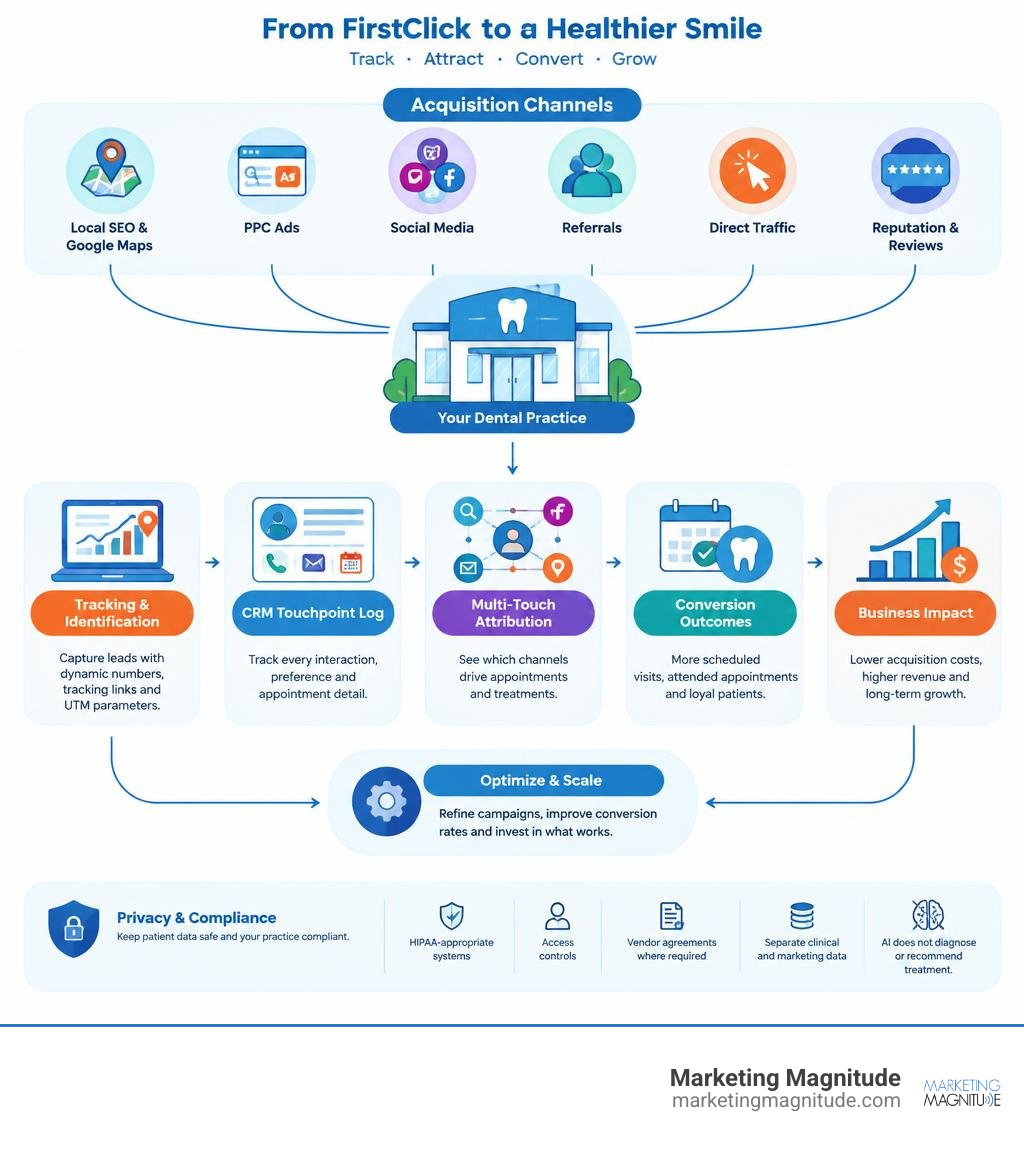
Connecting lead tracking to your practice management pipeline reveals your true Customer Acquisition Cost (CAC) and Return on Ad Spend (ROAS). In general dental practices, the average lifetime value of a new patient ranges between $1,500 and $3,500 over their first 24 months. Understanding this metric allows practices to invest confidently in predictable patient acquisition channels.
How Do You Scale Reputation Management and Review Generation Without Compromising Privacy?
Automated Post-Appointment Review Workflows
Online patient reviews are the single most influential factor in local conversion rates and Google Maps ranking algorithms. However, asking front-desk team members to verbally request reviews produces inconsistent outcomes.
Automating review generation via SMS post-appointment produces up to 10× more authentic Google reviews than manual requests. Timing is critical to campaign success:
- Routine Hygiene & Preventative Visits: Dispatch review requests via SMS 2 to 3 hours after checkout while the positive experience is fresh.
- Complex Restorative & Surgical Visits: Delay review requests by 24 to 48 hours, allowing local anesthesia to wear off and following up first with a personal post-op comfort call.
Generating a steady stream of 5 or more new 4.8-star reviews each month delivers compounding visibility gains: practices routinely see a 20% to 40% increase in Google Maps profile views and a 10% to 20% lift in inbound patient calls.
Privacy-Preserving Review Request Best Practices
When automating patient feedback requests, protecting patient privacy is mandatory. Under HIPAA, confirming that an individual received specific medical or dental treatment can constitute an unauthorized disclosure if handled improperly.
Best practices for compliant dental review collection include:
- Omit Clinical Terminology: Never mention specific procedures, diagnostic terms, or doctor notes in SMS or email invitations.
- Use Neutral Prompts: Keep invitation copy simple and service-oriented (e.g., “Thank you for visiting our office today! We value your feedback. Would you take 30 seconds to share your experience with our team?”).
- Direct Link to Public Profiles: Provide a direct link to your public Google Business Profile review interface.
- Never Gate Reviews: Avoid using conditional logic forms that filter negative ratings away from public review sites, as this violates search engine terms of service.
- De-escalate Negative Feedback Privately: Train front-desk leadership to respond to critical reviews publicly with neutral, HIPAA-compliant language while moving the clinical resolution to a private phone conversation.
What Financial ROI Can Dental Practices Expect from an Integrated Growth Platform?
Building an integrated growth infrastructure delivers measurable compounding returns across every stage of the patient lifecycle. Rather than relying on a single marketing channel, an integrated system captures efficiency gains from multiple operational improvements simultaneously.
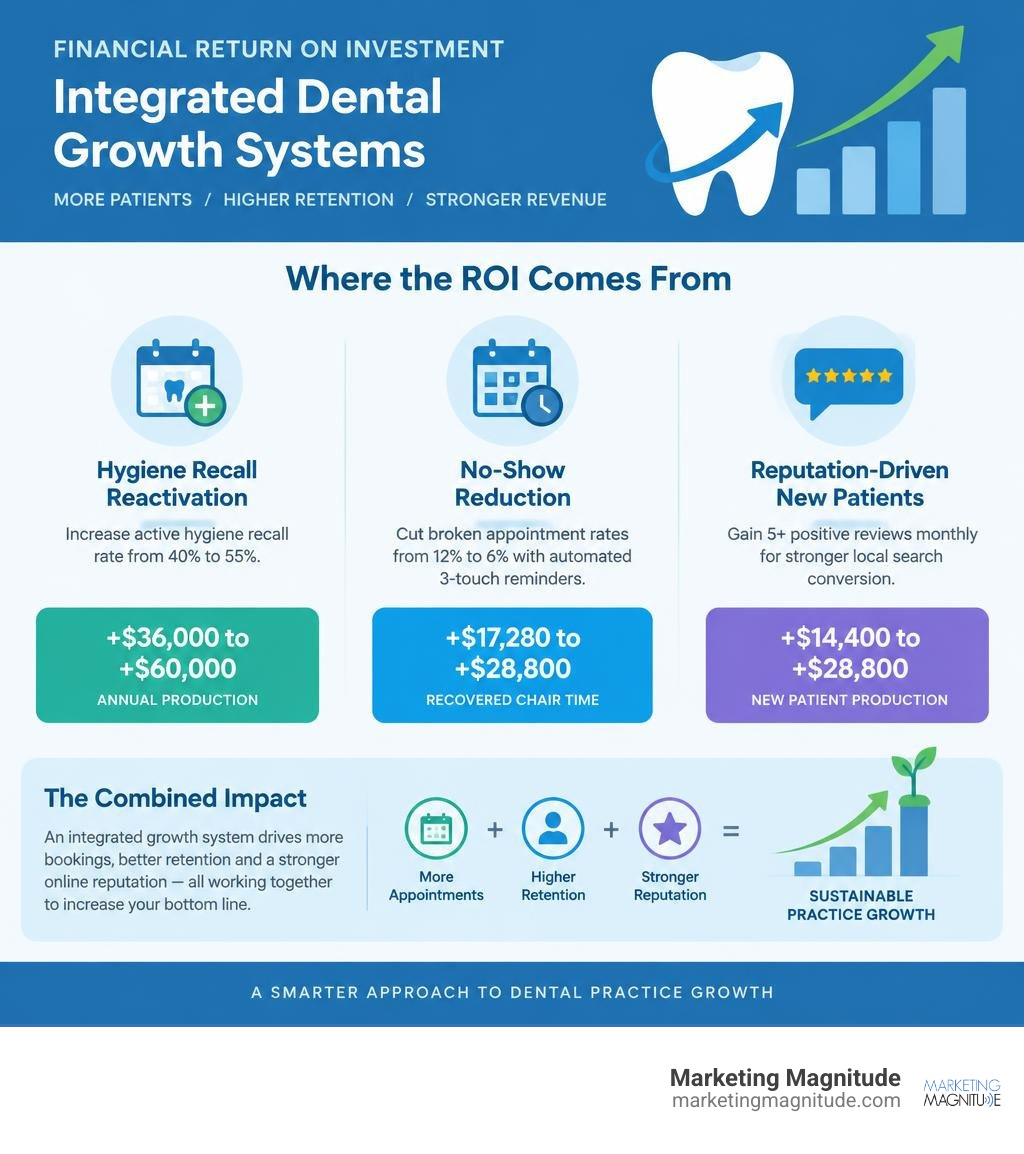
Consider the annual financial impact on a typical general dental practice with 2,000 active patient charts:
- Hygiene Recall Reactivation: Increasing the active hygiene recall rate from 40% to 55% returns an estimated +$36,000 to +$60,000 in annual production.
- No-Show Reduction: Cutting broken appointment rates from 12% to 6% via automated 3-touch reminders recaptures +$17,280 to +$28,800 in lost provider chair time.
- Reputation-Driven New Patients: Gaining 5+ positive reviews monthly lifts local search conversion, generating an estimated +$14,400 to +$28,800 in new patient production.
- Acquisition Conversion Optimization: Improving paid ad landing page and intake response conversions by 10% contributes +$9,000 to +$18,000 in incremental new patient revenue.
In total, a fully integrated growth platform generates +$76,680 to +$135,600 in additional annual gross production, delivering an estimated net first-year ROI multiple of 12.8× to 14.2×.
| Practice Performance Metric | Traditional / Disconnected Practice | Integrated Modern Growth Platform |
|---|---|---|
| Active Patient Recall Rate | 40% – 50% | 70% – 85% |
| Average Appointment No-Show Rate | 12% – 15% | 3% – 7% |
| New 5-Star Reviews Generated / Month | 1 – 2 reviews | 8 – 15 reviews |
| Lead Response Time (Inbound Inquiries) | 2 – 6 hours (or next morning) | Under 60 seconds (24/7 AI response) |
| Landing Page Conversion Rate | 8% – 12% | 25% – 40% |
| Marketing Attribution Visibility | Unclear / Anecdotal | Exact revenue tracked per campaign |
At Marketing Magnitude, we engineer unified systems that connect marketing, CRM architecture, and front-desk automation into a single growth engine.
Frequently Asked Questions About Dental Practice Growth Systems
Can AI chatbots provide diagnoses or recommend dental treatments?
No. AI communication tools must never provide clinical diagnoses, recommend specific treatment plans, or interpret patient symptoms.
In healthcare environments, artificial intelligence functions strictly as an administrative coordination tool. Its role is limited to answering general practice inquiries, explaining standard office procedures, assisting with scheduling, and routing complex patient requests to licensed dental practitioners. Practices must ensure their AI prompts contain explicit guardrails redirecting clinical questions to professional medical staff.
How does practice management software integrate with external marketing CRMs?
Integration between Practice Management Software (PMS)—such as Dentrix, Eaglesoft, or Open Dental—and external marketing CRMs is managed through secure APIs, certified middleware connectors, or encrypted webhooks.
These integrations sync administrative appointment milestones, recall due dates, and contact records into the marketing CRM to trigger automated workflows. High-grade systems implement strict firewalls: clinical charts, treatment notes, and diagnostic imaging remain secured inside the PMS, while the CRM processes only the administrative data necessary for patient communication.
Why does continuous recall automation outperform seasonal email blasts?
Seasonal email blasts send a single message to hundreds of patients at once, regardless of when their last appointment occurred. This approach produces low engagement, increases email unsubscribe rates, and creates unmanageable spikes in front-desk call volume followed by long periods of low chair utilization.
Continuous, trigger-based recall tracks every patient’s individual 6-month preventive milestone. By delivering timely, personalized reminders exactly when each patient is due for care, continuous automation maintains smooth hygiene schedule capacity throughout the year while boosting reactivation rates.
How Can Your Practice Implement a Sustainable Growth System Today?
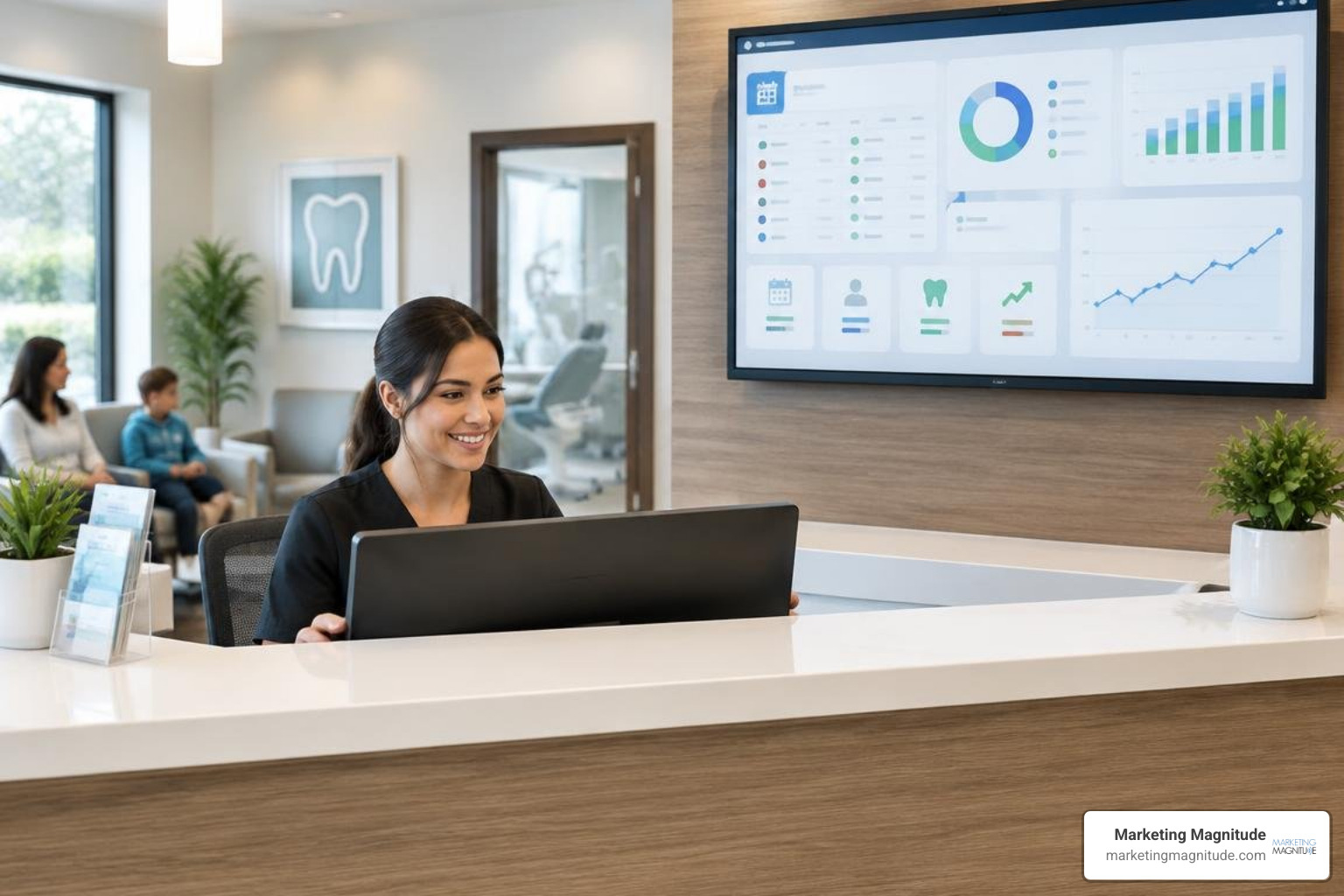
Scaling a modern dental practice requires moving past fragmented marketing tactics and establishing an integrated operational engine.
To build a predictable growth system:
- Audit Your Recall Pipeline: Identify the exact percentage of your patient roster currently overdue for hygiene visits to quantify your dormant production potential.
- Secure Your Compliance Foundation: Ensure all communication software, messaging vendors, and CRM databases operate under signed Business Associate Agreements with strict ePHI data isolation.
- Activate Automated Multi-Touch Reminders: Replace manual reminder phone calls with a proven 48-hour email, 24-hour SMS, and 2-hour SMS reminder sequence to reduce no-shows.
- Deploy Always-On Hygiene Sequences: Build automated, tiered re-engagement workflows tied to individual patient due dates rather than periodic batch broadcasts.
- Align Organic SEO with Targeted PPC: Optimize your Google Business Profile for local 3-pack visibility while running targeted paid search campaigns for high-margin elective services.
- Implement Privacy-Preserving Review Workflows: Automate post-visit SMS review invitations to build local authority on Google Maps.
We specialize in designing and deploying unified growth systems that help dental practices operate efficiently, engage patients effectively, and scale revenue predictably.
Schedule a strategic consultation to discover how an integrated growth platform and CRM marketing system can transform your practice operations and long-term production.
Get Started Now
Fill out this form to start your journey to next-level marketing solutions for your business.