
Why Is the Choice Between Hiring a Marketing Agency and Using AI Tools So Critical in 2026?
When comparing hiring a marketing agency to using multiple AI tools in 2026, the decisive difference is that an agency provides strategic oversight, revenue accountability, and integrated execution that a fragmented AI tool stack cannot deliver. AI platforms generate content, spin up variations of ad copy, and output raw analytics, but they do not build cohesive business growth strategies. Software execution without strategic direction merely creates high-speed noise.
For many founders and business leaders across Las Vegas, Austin, and throughout the United States, the sales pitch sounds enticing: cancel your agency retainer, subscribe to five or six specialized AI software tools, and let algorithms run your revenue engine. However, business leaders quickly encounter a sobering reality check.
When evaluating a dedicated growth partner versus assembling a self-managed, DIY software stack, the core issue comes down to revenue accountability. Automated tools do not understand your balance sheet, your operational capacity, or your local market reputation. They cannot discern whether an influx of form fills consists of high-value prospects or spam bots seeking free downloads.
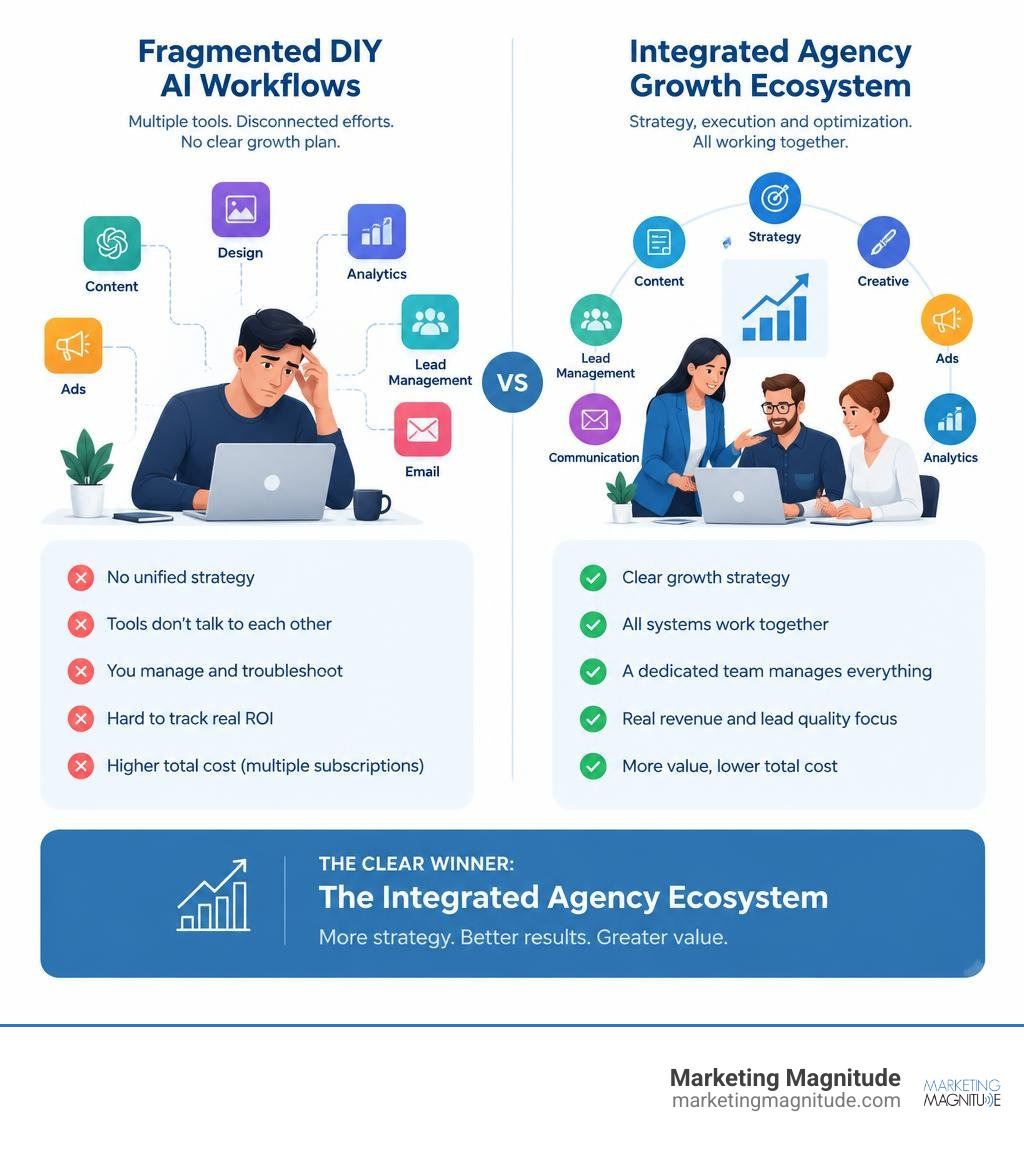
Speed of execution means nothing if your campaigns move rapidly in the wrong direction. Sustainable business growth requires integrated systems where marketing, lead management, communication, and analytics operate in unison.
Why Does a Professional Marketing Agency Outperform a Disconnected AI Tool Stack?
To understand why a dedicated agency consistently outperforms a collection of standalone software apps, we must separate raw asset generation from holistic business growth. AI software is inherently compartmentalized: an AI copywriter writes paragraphs, an automated creative tool churns out graphic banners, and an algorithmic bidding script adjusts ad keywords. None of these individual tools understands what happens after a prospect clicks.
Industry data confirms this shift: 73% of agency leaders emphasize that AI has permanently altered content discovery, moving the true value of marketing from high-volume production to taste, context, domain authority, and strategic positioning. When anyone can generate fifty generic blog posts in ten minutes, search algorithms and prospective buyers quickly discount surface-level content.
A full-service growth partner aligns advanced search engine optimization strategies with paid acquisition, CRM pipelines, and customer lifecycle retention. When these channels operate in silos, data fragmentation and strategic drift inevitably follow. As highlighted in recent industry analyses of AI Marketing Consultant vs Agency vs In-House 2026, software alone cannot replace executive-level orchestration.
When weighing the trade-offs of hiring an agency vs in-house staff to operate standalone tools, many businesses discover that managing software internally consumes far more leadership bandwidth than anticipated.
The Value of Cross-Channel Synthesis Over Single-Point Execution
Standalone AI tools cannot communicate the nuances between channels. For example, your paid search tool does not automatically inform your content generation platform that high-intent buyers are searching for specific localized solutions. Nor does your automated email tool adjust its nurture cadence when your CRM shows a bottleneck in sales consultations.
An integrated growth partner solves this by creating cross-channel synthesis:
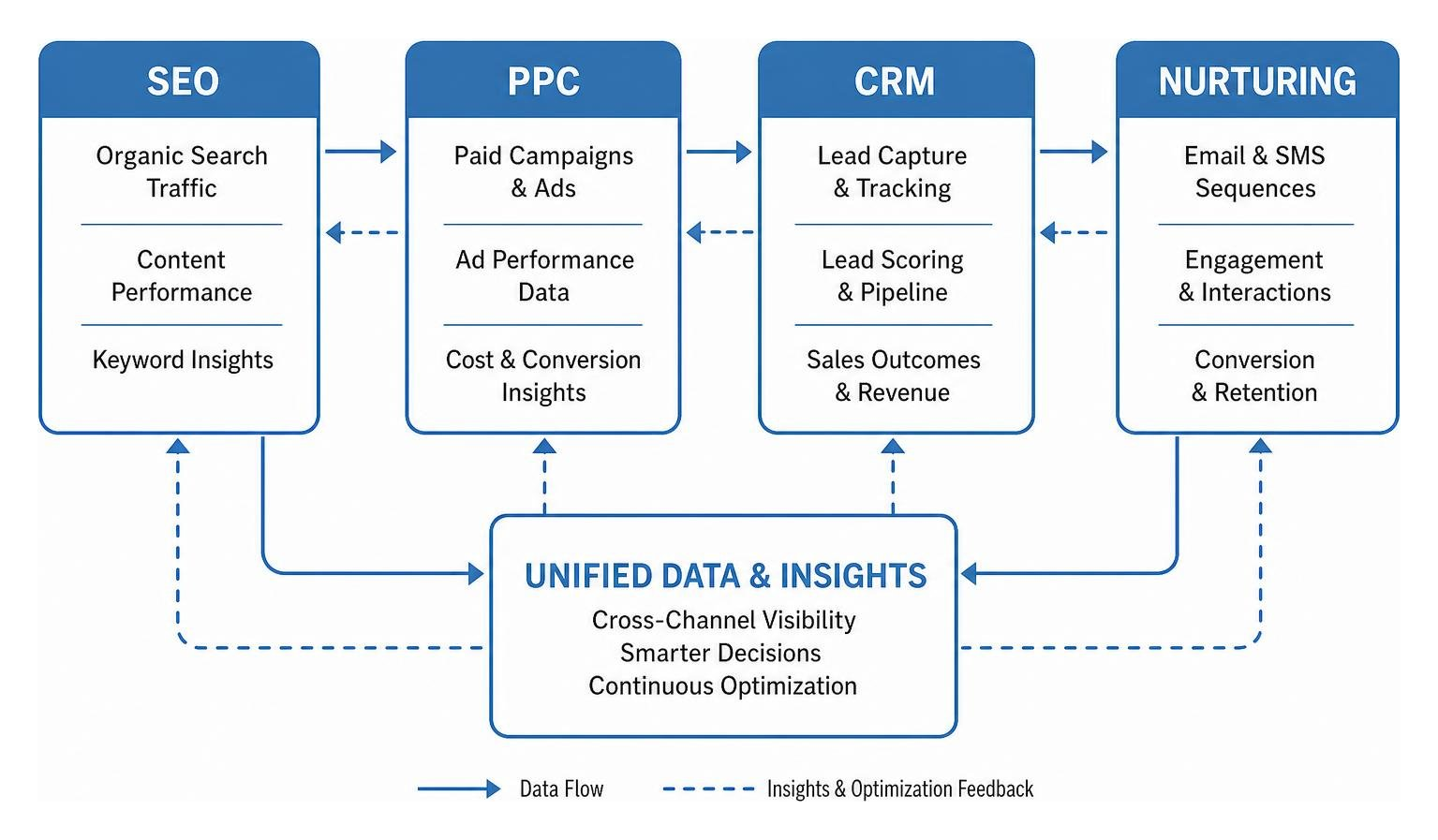
Human strategists identify non-linear customer journeys that machine algorithms miss. We connect conversion architecture directly across your website development, targeted acquisition campaigns, and automated follow-up sequences, ensuring every touchpoint reinforces your brand positioning.
Strategic Accountability vs. Software Subscriptions
A software vendor sells you a login license. Their revenue model succeeds whether your business grows by 40% or loses ground over the next quarter. If an AI platform generates low-converting leads or misinterprets your buyer persona, the software provider still charges your credit card on the first of the month.
A true marketing agency carries contractual, strategic, and professional accountability for your pipeline results. We evaluate success based on qualified consultations, customer acquisition costs, and pipeline velocity rather than vanity engagement metrics.
Who Actually Manages the AI Tools, and What Are the Hidden Operational Costs?
One of the most persistent myths of modern software is the concept of “set-it-and-forget-it” marketing. In practice, automated marketing platforms require relentless human management, including continuous prompt crafting, workflow maintenance, context calibration, and weekly quality audits.

Research shows that client communication, quality assurance, and review cycles eat up 20% to 60% of total project time. When you choose the DIY route, that operational burden does not disappear; it transfers directly onto you and your internal team.
Before deciding to run point on software tools internally, asking should you make your own changes to your digital marketing reveals the hidden productivity trap: every hour your leadership spends configuring software prompts or troubleshooting broken webhooks is an hour stolen from serving clients, training staff, and closing deals.
The Bottleneck of Prompt Engineering and Daily Administration
Managing a modern AI marketing stack requires specialized technical literacy. Internal staff must navigate rapid platform updates, changing interface layouts, and shifting API connections between point solutions.
When a third-party automation fails or an API token expires, your entire lead capture sequence can stall silently for days. As we explore in the complete guide to replacing 6 marketing tools, the administrative overhead of juggling disconnected software subscriptions frequently overwhelms internal teams, transforming strategic marketers into frustrated software administrators.
The High Cost of Unmonitored Algorithmic Drift
Without continuous human calibration, automated marketing systems experience algorithmic drift. When automated bidding platforms run without strategic oversight, their machine-learning models optimize for the easiest possible metric to achieve—often cheap clicks, accidental form submissions, or non-converting bot traffic.
The data behind this phenomenon is telling: businesses using AI copywriting and ad optimization tools in-house without strategic oversight saw a 22% drop in cost per lead in month one, followed by a 40% rise by month four. Why? Because nobody was auditing what the algorithm was actually optimizing toward. The tool hit its short-term volume targets by chasing low-quality prospects, ultimately polluting the sales pipeline and wasting valuable ad spend.
Is a Multi-Tool AI Stack Actually More Expensive Than Marketing Magnitude’s Entry Package?
Many founders adopt DIY AI tools assuming they are taking the frugal route. However, looking at the cumulative financial reality in 2026 tells a very different story.
SaaS prices have climbed 11.4% year-over-year, far outpacing general market inflation. When you assemble a functional, high-performing AI marketing stack, the individual software subscriptions add up rapidly:
- Enterprise AI copywriting and research platform
- AI ad creative and banner generator
- Advanced SEO content intelligence and auditing software
- Automated video editing and captioning tool
- AI-driven social media scheduling and analytics platform
- CRM, pipeline management, and email automation engine
- Middleware integration software to connect the tools
Combining these specialized tools easily pushes your software licensing costs to $1,500–$3,000+ per month before accounting for a single hour of human labor. As detailed in AI Campaign Tools vs Hiring an Agency: The Honest Math, the software subscription costs alone match or exceed professional services, without delivering any strategic oversight.
By contrast, Marketing Magnitude’s lowest-tier package delivers a fully managed, integrated growth ecosystem—including custom strategy, campaign execution, reporting, and technical maintenance—at an overall investment lower than purchasing and assembling that premium software stack on your own.
The Real Math: Software Subscriptions + Labor vs. Managed Services
When evaluating your true cost of ownership, you must calculate both software licensing fees and the market value of internal labor hours spent managing those platforms.
| Evaluation Metric | Fragmented DIY AI Tool Stack | Marketing Magnitude Managed Growth Tier |
|---|---|---|
| Direct Software Overhead | $1,500 – $3,000+ / month across 6–8 separate vendors | Included within unified ecosystem; zero extra tool fees |
| Internal Management Hours | 25–40+ hours / month spent prompting, editing, and fixing | Near zero; our team manages execution and calibration |
| Strategic Leadership | None; founder/staff must formulate all campaign strategy | Experienced marketing directors guide every initiative |
| System Integrations | Fragile third-party webhooks prone to silent breaks | Native end-to-end architecture built for reliability |
| Quality Control & Auditing | Internal team must catch hallucinations and formatting errors | Rigorous multi-stage human review and brand alignment |
| Accountability for ROI | Zero; software vendors bill regardless of revenue impact | Direct alignment with qualified pipeline growth |
Discovering why most businesses use 10 tools secrets exposed reinforces a fundamental operational truth: consolidating your marketing, CRM, and automation under one unified agency framework eliminates tool sprawl while dramatically reducing your total cost of customer acquisition.
What Marketing Magnitude Delivers at the Base Tier
Rather than handing you complicated software dashboards and expecting you to build your own workflows, our entry-level growth tier provides end-to-end infrastructure.
We connect robust CRM software and marketing automation directly with targeted client acquisition campaigns. You receive:
- Strategic Growth Roadmaps: Clear campaign planning built around your target revenue, unit economics, and local market competition.
- Turnkey Multi-Channel Execution: Coordinated search visibility, paid campaigns, and content assets that reflect your authentic brand voice.
- Automated Pipeline Nurturing: Intelligent lead capture, automated SMS/email follow-ups, and calendar booking workflows that ensure zero prospect leakage.
- Transparent Business Analytics: Unified reporting dashboards that show exactly where your revenue originates, eliminating guesswork.
What Critical Mistakes Do Businesses Make When Attempting DIY AI Marketing?
When organizations try to replace experienced strategic guidance with self-serve AI platforms, specific operational and brand-level failures consistently emerge:
- Brand Hallucinations and Factual Errors: Automated models frequently invent service details, misquote pricing terms, or generate regulatory claims that damage client trust.
- Homogenized, Uninspired Content: Because AI models train on existing web data, their unedited output tends toward bland, repetitive generalities that prospective buyers ignore.
- Search Engine Visibility Penalties: Rushing out unedited, automated text runs afoul of search quality guidelines. Reviewing how to know your SEO person is faking it illustrates how automated spinning destroys domain trust instead of building sustainable organic rankings.
- Leaky Conversion Funnels: Tools generate raw traffic to landing pages that lack proper conversion architecture, tracking pixels, or automated lead capture mechanisms.
Algorithmic Optimization Toward the Wrong Conversion Metrics
A major flaw in DIY automation is the disconnect between platform metrics and actual business revenue. Ad networks rely on algorithmic optimization to deliver whatever action you define as a conversion. If your conversion pixel registers every contact form fill as a success, the AI will naturally seek out users who submit forms with minimal friction.
In many cases, those submissions come from job seekers, vendors selling services, or automated spam bots. The ad platform reports phenomenal campaign performance and lower costs per lead, yet your sales calendar remains empty. Uncovering the 3 dirty little secrets of marketing systems shows why automated optimization requires human verification to ensure you pay for genuine buyer intent rather than empty database entries.
Reputation Risks and Generic Brand Positioning
In trust-centered industries—such as healthcare practices, wellness centers, therapy clinics, and professional consulting firms—client acquisition depends entirely on credibility, empathy, and professional authority.
Generic, robotic copywriting erodes that hard-earned reputation instantly. High-value clients can sense impersonal, template-driven messaging from the first sentence. When every competitor in your city utilizes the exact same AI prompts, your marketing blends into background noise. Standout positioning requires human storytelling, nuanced clinical understanding, and authentic relationship-building.
How Does Strategic Human Judgment Bridge the Gap Between AI Automation and Sustainable ROI?

At Marketing Magnitude, we do not view AI as a replacement for human intellect; we leverage it as an operational accelerant. When guided by seasoned marketing consultants, intelligent automation streamlines repetitive administrative workflows, accelerates data synthesis, and expands production capacity.
The critical difference lies in the human judgment directing those systems. Technology provides execution speed, but human strategy provides direction, empathy, and taste. We combine proprietary automated workflows with senior-level consulting across our full suite of digital marketing services to build growth engines that scale reliably.
The Agency as an Integrated Growth Ecosystem
Sustainable business expansion does not happen through isolated marketing tactics. It happens when your marketing, communication, lead management, and operational systems function as a single connected platform.
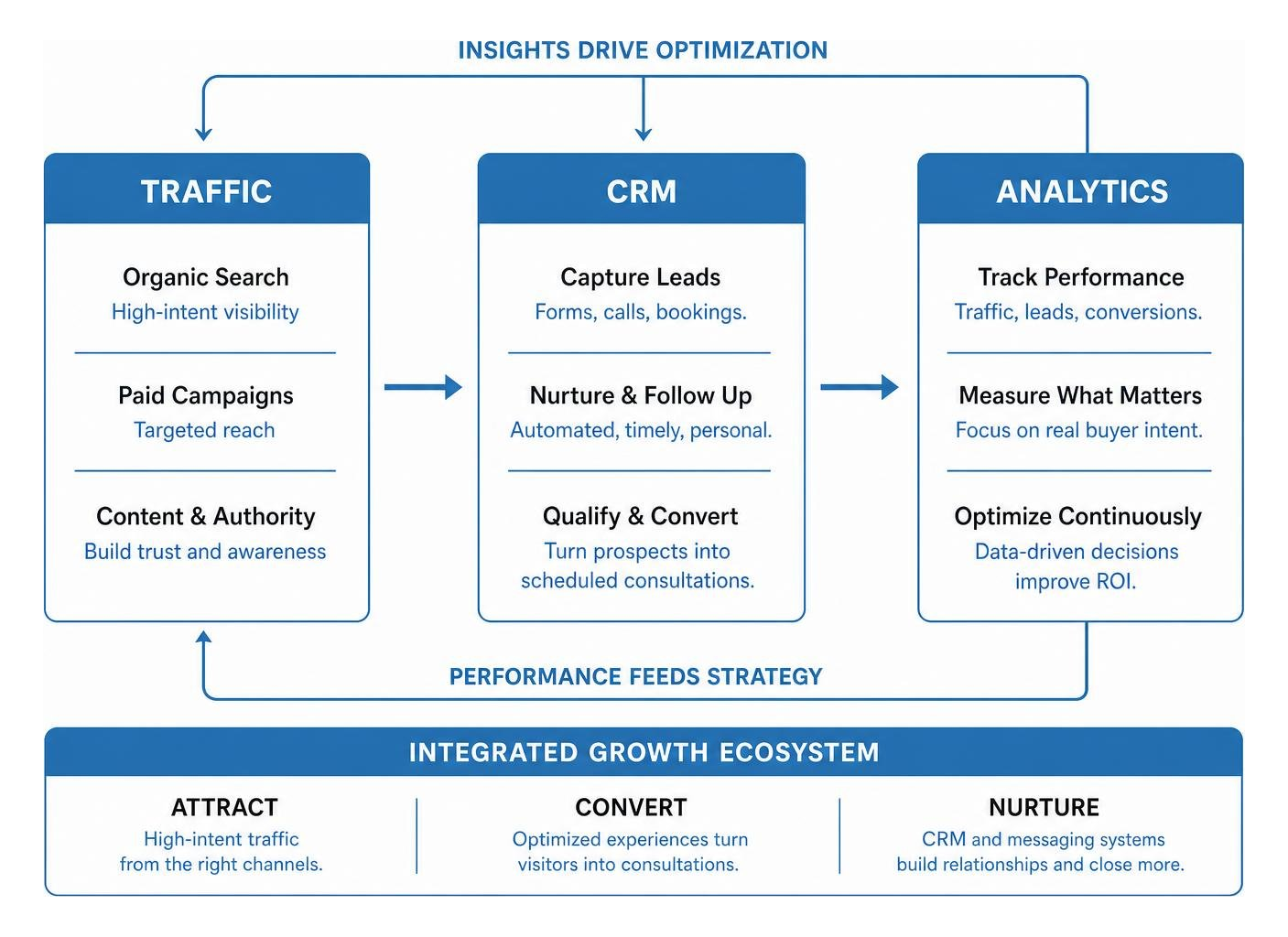
Instead of delivering isolated deliverables—like a standalone blog post or an unmonitored ad campaign—we construct a closed-loop growth architecture:
- Attract: High-intent search visibility and targeted paid campaigns capture qualified attention.
- Convert: Optimized website design and conversion-focused landing pages turn visitors into scheduled consultations.
- Nurture: CRM workflows and intelligent messaging systems follow up with prospects instantly.
- Retain: Automated communication workflows foster long-term loyalty and repeat business.
Sustainable Scaling for Trust-Centered and Service-Based Businesses
For organizations that rely heavily on reputation and long-term client relationships, growth strategies must protect brand equity. Whether supporting private healthcare practices in Nevada or scaling specialized service providers in Texas, we tailor growth systems to maintain human warmth while achieving operational scale.
We balance intelligent automation with authentic customer care, ensuring your marketing communicates genuine authority at every stage of the buyer journey.
Frequently Asked Questions About Agency Marketing vs. AI Tools
Can AI tools completely replace a digital marketing agency in 2026?
No. While AI tools accelerate content drafting, image generation, and data processing, they lack strategic judgment, brand context, multi-channel orchestration, and the ability to audit their own errors. Without experienced marketing directors setting campaign architecture, aligning messaging with unit economics, and calibrating conversion paths, unmanaged AI tools produce generic messaging and unmonitored ad spend drift.
Why is assembling multiple AI marketing tools often more expensive than hiring an agency?
A functional stack of premium AI tools covering copywriting, ad optimization, design, technical SEO, CRM, and API automation costs $1,500 to $3,000+ per month in software subscriptions alone. When you add the internal labor hours required to prompt, troubleshoot, connect, and audit those systems, the total cost of ownership significantly exceeds Marketing Magnitude’s fully managed lowest-tier growth package, which includes complete strategy and execution.
What should a business do if they already invested in several AI marketing subscriptions?
Conduct a comprehensive audit of your software utilization and actual cost-per-outcome. Most businesses find they are paying for redundant, underutilized features that drain revenue without moving the pipeline. Consolidating your growth systems under an integrated agency partner allows you to eliminate tool sprawl, lower your monthly operational overhead, and place strategic execution in the hands of seasoned professionals.
What Is the Final Verdict on Choosing Between an Agency and AI Software?
The debate between hiring a marketing agency and subscribing to a DIY stack of AI tools is not about choosing between human talent and technology. It is about understanding that technology delivers maximum ROI only when guided by experienced human strategy.
Relying entirely on fragmented AI tools creates operational bottlenecks, exposes your brand to algorithmic errors, and quietly drains your budget through compounding SaaS fees. Real, sustainable business growth requires a unified ecosystem where strategy, traffic acquisition, customer relationship management, and automated workflows operate seamlessly together.
As a business leader, your highest-value role is running your company, leading your team, and serving your clients. You should not have to spend your evenings debugging software integrations, rewriting generic AI copy, or auditing ad platform algorithms.
If you are ready to eliminate fragmented tools and deploy a predictable, connected growth infrastructure, we are here to help. Contact Marketing Magnitude today to schedule your complimentary growth audit and discover how our integrated platform drives measurable, scalable revenue for your business.
Get Started Now
Fill out this form to start your journey to next-level marketing solutions for your business.