What Is the Core Difference Between Google Marketing and Social Media Marketing?
When we evaluate digital marketing channels for service providers, healthcare clinics, and scaling enterprises, the central debate frequently boils down to two heavyweights: Google and social media. While both channels sit at the center of modern customer acquisition, treating them as interchangeable ad networks is one of the costliest mistakes a business can make.
At its core, the distinction is structural:
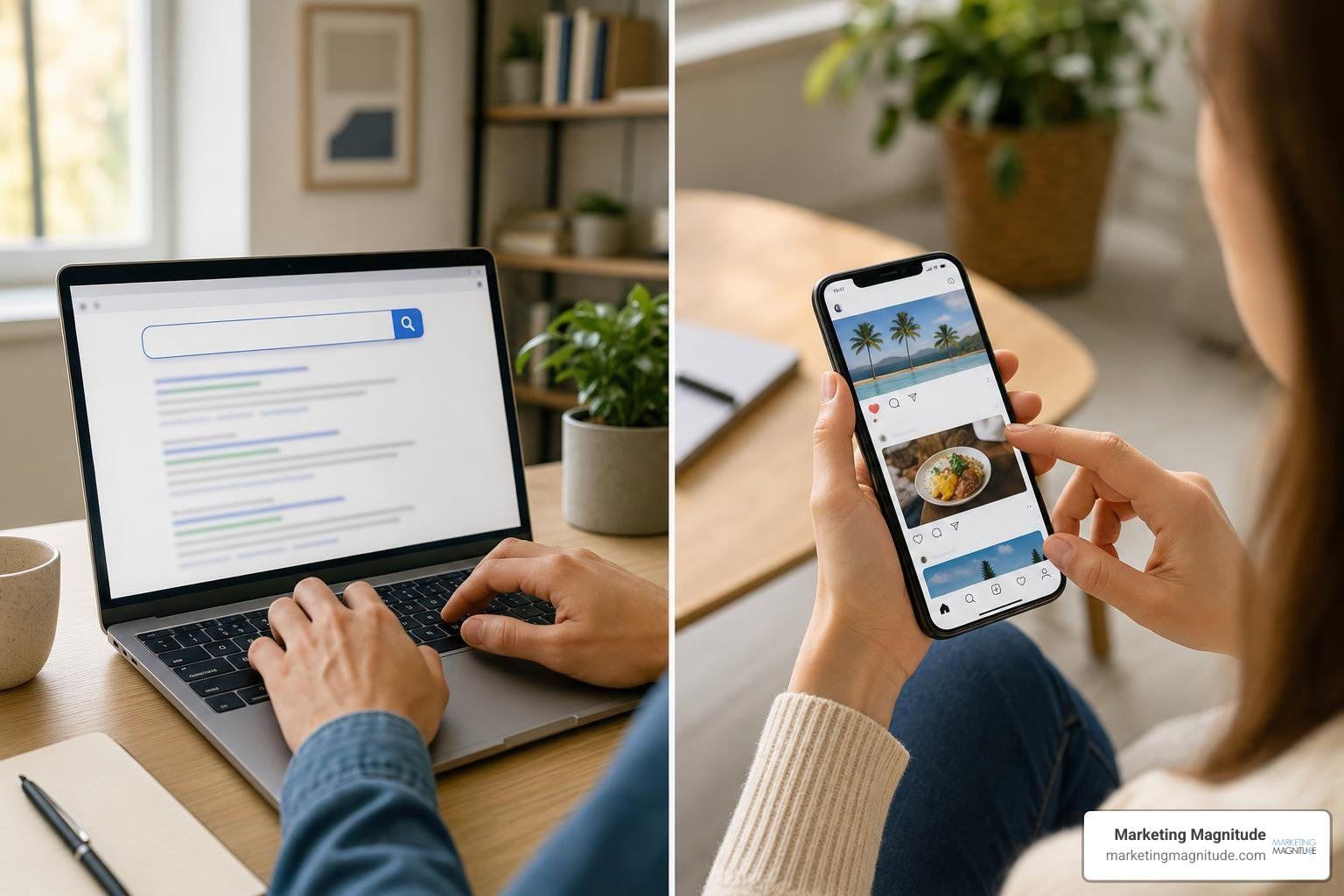
- Google Marketing is a Demand Capture Engine. When someone searches on Google, they have already identified a problem or need. They are actively seeking a solution, evaluating vendors, or looking for immediate service. Your role on Google is to be visible at the exact second that declared intent manifests.
- Social Media Marketing is a Demand Generation Engine. Users do not open Instagram, Facebook, TikTok, or LinkedIn to buy emergency plumbing or sign up for corporate compliance software. They log in to be entertained, connect with peers, or explore industry trends. Your role on social platforms is to interrupt that passive browsing experience with relevant, compelling messaging that creates interest where none existed moments earlier.
In 2026, the modern buyer journey rarely moves in a straight line. Prospective buyers constantly oscillate between these two states. A prospect might see an educational video on LinkedIn or Meta while relaxing in the evening, remember your brand name three days later, and then execute a Google search when their pain point flares up.
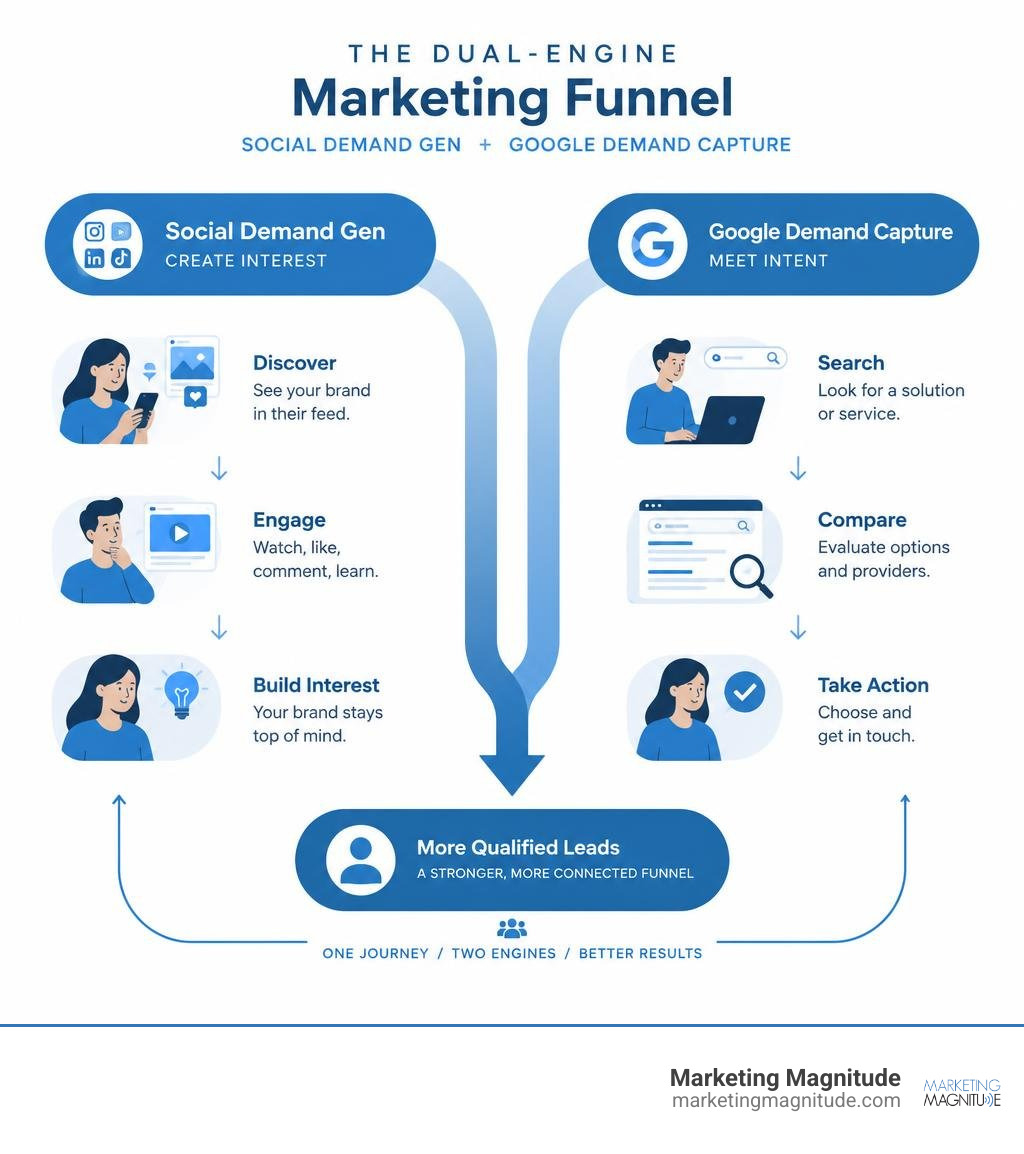
When businesses experience poor performance on either platform, the root cause is rarely the platform itself. Instead, it stems from treating these channels as isolated silos rather than parts of an integrated ecosystem. When top-of-funnel social discovery is not connected to bottom-of-funnel search capture and unified CRM workflows, prospective leads leak out of the pipeline before a sales conversation ever occurs.
How Do User Intent and Audience Targeting Differ Between Google and Social Media?
The fundamental difference between Google and social media marketing lies in how audience intent is identified and targeted:
- Google targets declared intent. The user explicitly states what they want through search keywords (e.g., “urgent HVAC repair Las Vegas” or “HIPAA-compliant CRM software”).
- Social media targets predicted interest. Algorithms analyze historical engagement, behavioral footprints, and psychographic profiles to deliver ads to users who match the persona of someone likely to care about your offering.
This psychological divide directly dictates your sales velocity and conversion probability. An active searcher has high purchase readiness; their decision window may be hours or days. A passive social media scroller requires nurturing, education, and social proof before they are ready to transact.
Targeting mechanics reflect this reality. In Google Ads, campaigns leverage keyword match types, semantic search intent, and Google AI Max bidding models designed to identify commercial queries. Conversely, platforms like Meta, TikTok, and LinkedIn rely on demographic data, lookalike modeling, interest graphs, and job titles.
Creative requirements differ just as starkly:
- Google Search requires precision, clarity, and relevance. Your text copy, structured snippets, and landing page headlines must immediately answer the search query and remove friction.
- Social Media demands high-velocity visual creative. If your short-form video, dynamic carousel, or image asset does not halt the user’s scroll within the first two seconds, targeting precision becomes irrelevant.
Capturing high-intent searchers demands experienced execution through our paid advertising and PPC management services, ensuring every dollar spent on high-intent terms yields measurable pipeline impact. Simultaneously, building enduring market authority requires strategic social media management services that cultivate trust and nurture relationships over time.
Capturing Active Demand Through Google Search Intent
Declared intent queries represent the highest-converting traffic in digital marketing. When a homeowner searches for “emergency pipe burst repair” or an operations director searches for “medical practice management software,” they are not looking to be entertained—they are looking for a qualified solution provider.
Modern search engines leverage advanced large language models to interpret the underlying context of these queries, distinguishing informational intent (e.g., “how to fix a leaking pipe”) from explicit commercial intent (e.g., “licensed plumber near me”).
Because these users are actively seeking an answer, Google Search traffic delivers average conversion rates between 6% and 8% on commercial and lead-generation queries. However, Google Search has one immutable constraint: you cannot capture search volume that does not exist. If you offer a novel, category-defining service or an innovative product that prospects do not yet know how to name, search query volume will be minimal.
Cultivating Discovered Demand Through Social Feed Receptivity
Social platforms solve the limitation of search volume by distributing content based on behavioral signals, interests, and engagement history. When your ideal customer is scrolling their feed, an impactful video ad can highlight an unrecognized problem, present a compelling case study, or demonstrate a transformative result.
Because these users are interrupted during leisure or networking time, click-through rates (CTR) on social feeds average between 0.9% and 1.6%. The conversion process is rarely instantaneous. Instead, it fulfills the core principles outlined in the AMA’s definition of marketing—creating, communicating, and delivering value to build relationships and establish category preference long before the buyer enters an active procurement cycle.
What Are the Key Cost and Conversion Benchmarks for Google Ads vs Social Media Ads?
Evaluating campaign performance across channels requires looking past surface-level vanity metrics to understand the full economics of customer acquisition. A low cost per click does not equal an affordable customer if the conversion rate is negligible.
Here is how cost structures compare across major performance benchmarks:
- Cost Per Click (CPC): Google Search commands a median CPC of $4.66 across industries (with competitive legal, medical, and B2B keywords regularly ranging from $3.50 to over $9.00). Meta platforms (Facebook and Instagram) average between $0.70 and $1.00 for traffic and awareness campaigns.
- Cost Per Mille (CPM): Meta blended CPMs hover around $14 to $15 for targeted audience segments, whereas Google Display and Video network placements often range from $3.50 to $5.50.
- Click-Through Rate (CTR): Google Search ads achieve strong engagement with average CTRs between 6.0% and 6.6%, driven by high keyword relevance. Social media feed ads average between 0.9% and 1.5%.
- Cost Per Lead (CPL): Google Ads generates a median CPL of $66.69 across service categories, while Meta campaigns produce CPLs between $20 and $60 for top-of-funnel lead forms.
When evaluating social media ads vs google ads, looking only at click costs creates a distorted picture. Social media clicks are cheaper because you are buying passive attention. Google clicks carry a premium because you are purchasing active, high-intent consideration.
Cost and Performance Metric Comparison
| Performance Metric | Google Search Ads | Meta / Social Media Ads | Strategic Impact on Business ROI |
|---|---|---|---|
| Median Cost Per Click (CPC) | $4.66 ($3.50 – $9.00+) | $0.70 – $1.00 ($0.80 – $2.50) | Social delivers higher click volume; Google delivers higher buyer readiness per click. |
| Average Click-Through Rate (CTR) | 6.0% – 6.6% (Median 6.42%) | 0.9% – 1.5% (Median ~1.1%) | Search ads achieve 4x–6x higher CTR due to immediate keyword relevance. |
| Conversion Rate (Lead-Gen) | 6.0% – 8.0% (~7.0% median) | 1.0% – 3.0% (cold feed traffic) | Google offsets higher CPCs with significantly higher immediate conversion rates. |
| Blended CPM (Cost Per 1,000 Impressions) | $3.50 – $5.50 (Display/Video) | $14.00 – $15.00 (Targeted Feed) | Social CPM reflects premium demographic and psychographic behavioral data. |
| Typical Cost Per Lead (CPL) | $25.00 – $150.00+ ($66.69 median) | $20.00 – $60.00 (B2B / Local Lead Ads) | Social yields lower upfront CPL, but lead qualification and sales velocity require backend automation. |
Understanding the True Price of Customer Acquisition
The metric that dictates business scalability is not CPC or CPM—it is the Cost Per Converted Outcome (CAC) and the subsequent Customer Lifetime Value (LTV).
Consider a practical example:
- On Google Search: You pay $4.50 per click. With a 7% lead conversion rate, you generate a lead for approximately $64.28. Because the prospect had urgent intent, your sales closing rate is 25%, resulting in a final customer acquisition cost of $257.12.
- On Social Media: You pay $0.90 per click. With a cold feed conversion rate of 1.8%, your front-end cost per lead is $50.00. However, because the prospect was passively browsing and needs additional education, your initial close rate is 10%, yielding a customer acquisition cost of $500.00.
Lower front-end ad costs do not guarantee higher profitability. To make social media customer acquisition economics viable, businesses must deploy automated email nurturing, retargeting sequences, and robust CRM follow-up systems that systematically warm up leads over time.
Which Marketing Channel Best Suits Your Industry and Budget Constraints?
Choosing where to invest depends on three operational variables: your purchase urgency, the visual nature of your offering, and your monthly budget.
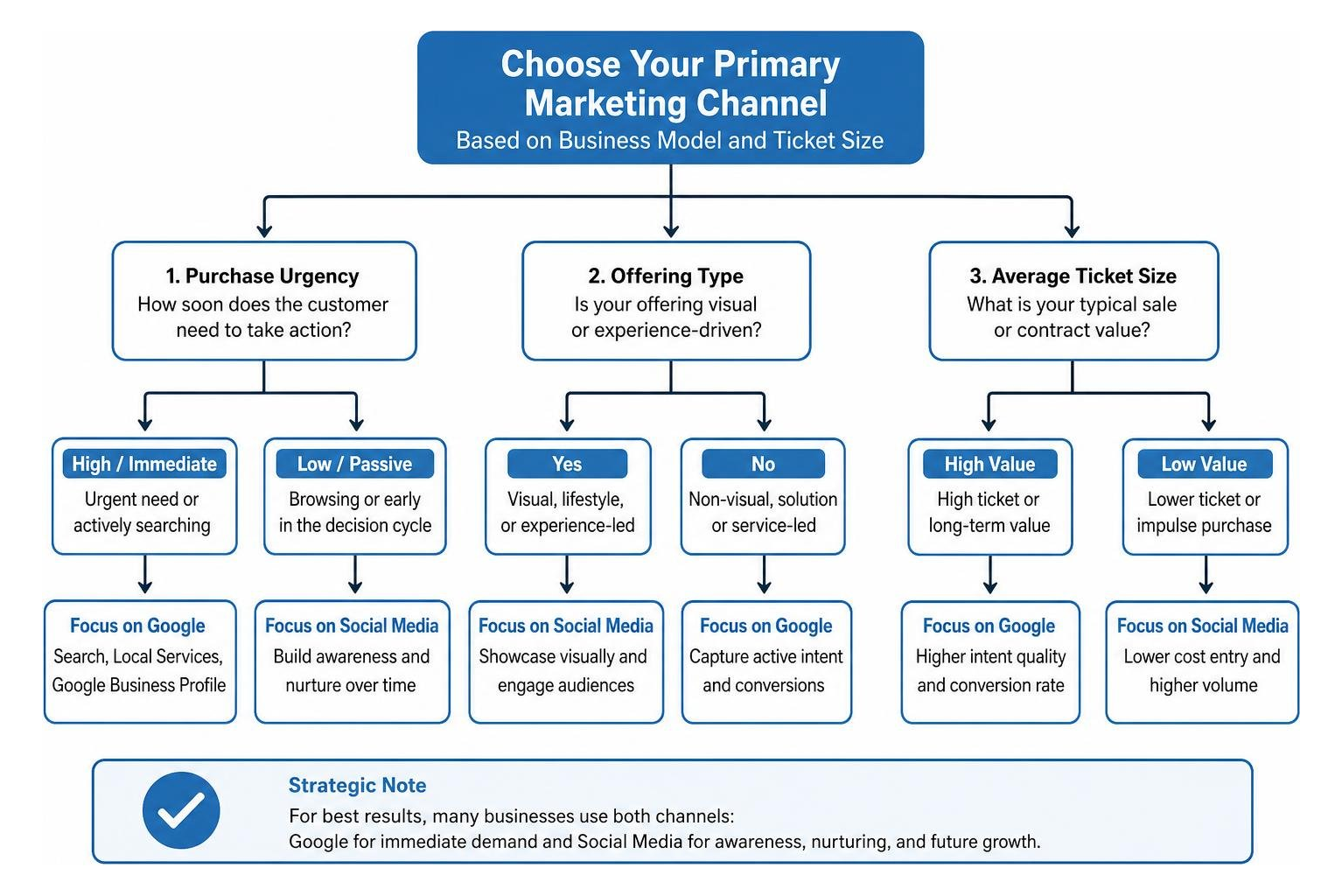
For organizations managing disciplined budgets, we recommend reviewing our guide to $5k monthly marketing allocation to balance channel spend against operational capacity. When resources are focused, prioritizing an expertly managed campaign to manage paid search ensures you capture immediate revenue opportunities before expanding into broader brand awareness campaigns.
High-Intent Local Services, Healthcare, and Urgent Providers
Service businesses—such as emergency HVAC technicians, commercial roofing contractors, physical therapy practices, specialized medical clinics, and legal practices—depend heavily on Google Search, Google Business Profile optimization, and Local Services Ads.
When a homeowner faces a malfunctioning furnace or a patient experiences acute back pain, their decision window is brief. They do not browse social media looking for lifestyle content; they search Google for verified, local providers with strong reviews and immediate availability.
For these industries, Google Search should capture 60% to 80% of paid ad allocations. Social media in these sectors functions best not as a cold lead generation channel, but as a reputation asset—showcasing patient testimonials, team expertise, and community involvement to build credibility when prospects research your brand.
E-Commerce, Lifestyle Products, and Visually Driven DTC Brands
Direct-to-consumer e-commerce brands, innovative wellness products, fashion, and aesthetic services require visual storytelling to thrive. An innovative kitchen gadget, a high-end skincare formula, or custom interior decor cannot communicate its full value through text search ads alone.
These brands excel on Meta (Instagram/Facebook) and TikTok by utilizing short-form video assets, creator collaborations, and interactive carousels that visually demonstrate transformations. Once social campaigns spark desire, Google Shopping and branded search campaigns act as the net that captures buyers when they search for product reviews, brand names, or specific model numbers.
B2B Solutions and Professional Services
B2B enterprises, corporate consulting firms, and SaaS platforms operate within extended, multi-stakeholder buying cycles. A B2B decision-maker rarely converts on a high-ticket contract from a single ad encounter.
The most effective B2B strategy combines channels:
- LinkedIn and Meta Video Ads introduce thought leadership, proprietary frameworks, and industry research to target accounts and executives.
- Google Search Ads target high-intent evaluation terms (e.g., “enterprise CRM integrations” or “fractional CFO services”), capturing buyers actively researching market alternatives.
- Connected Lead Management automatically syncs inquiries into a central CRM to trigger automated email sequences, calendar booking workflows, and sales team alerts.
How Can Businesses Integrate Google and Social Media into a Cohesive Growth System?
Running Google Ads and social media marketing as isolated initiatives creates operational blind spots and inflates customer acquisition costs. Sustainable business growth happens when both channels operate as synchronized components of a unified marketing ecosystem.
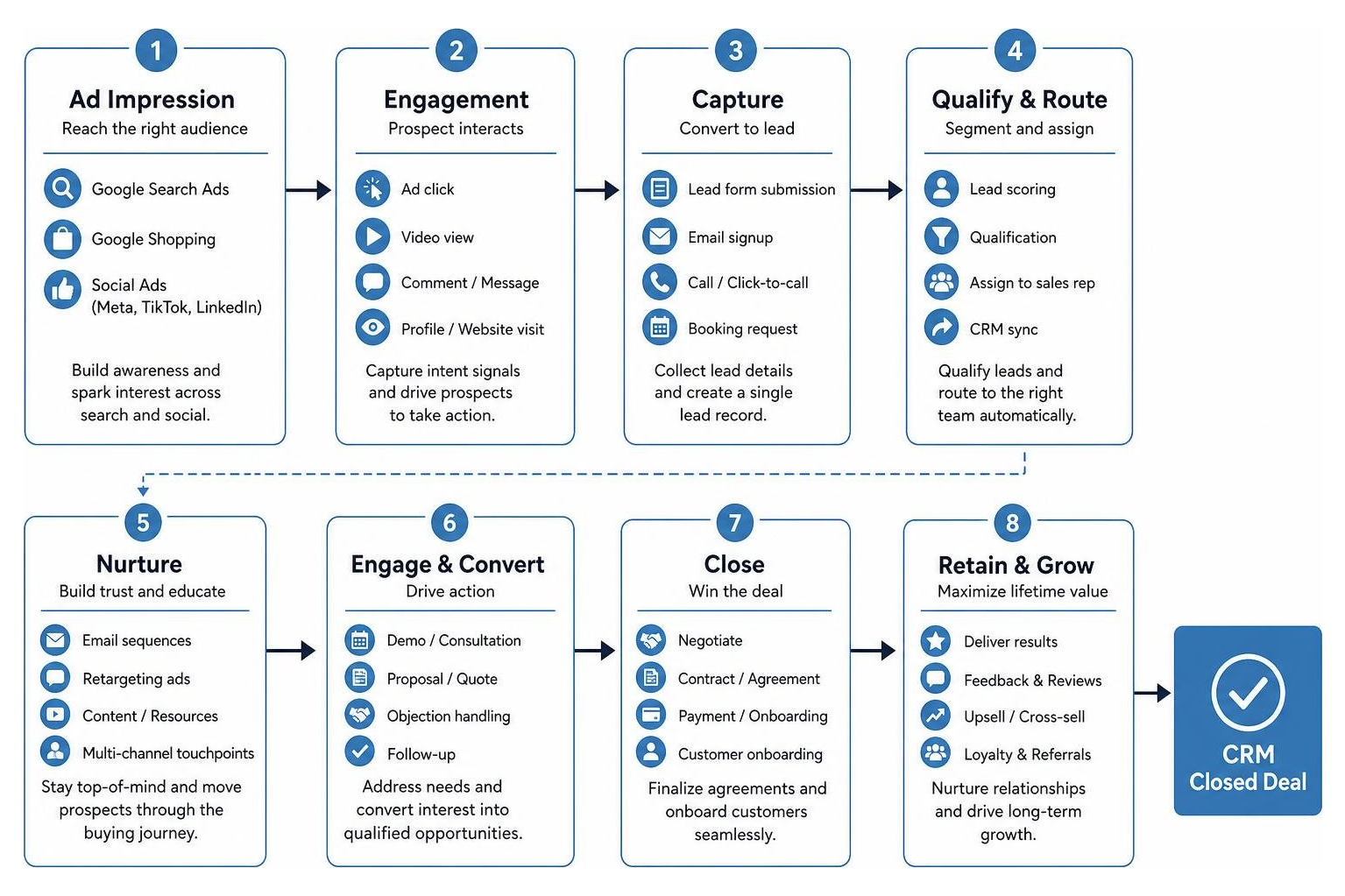
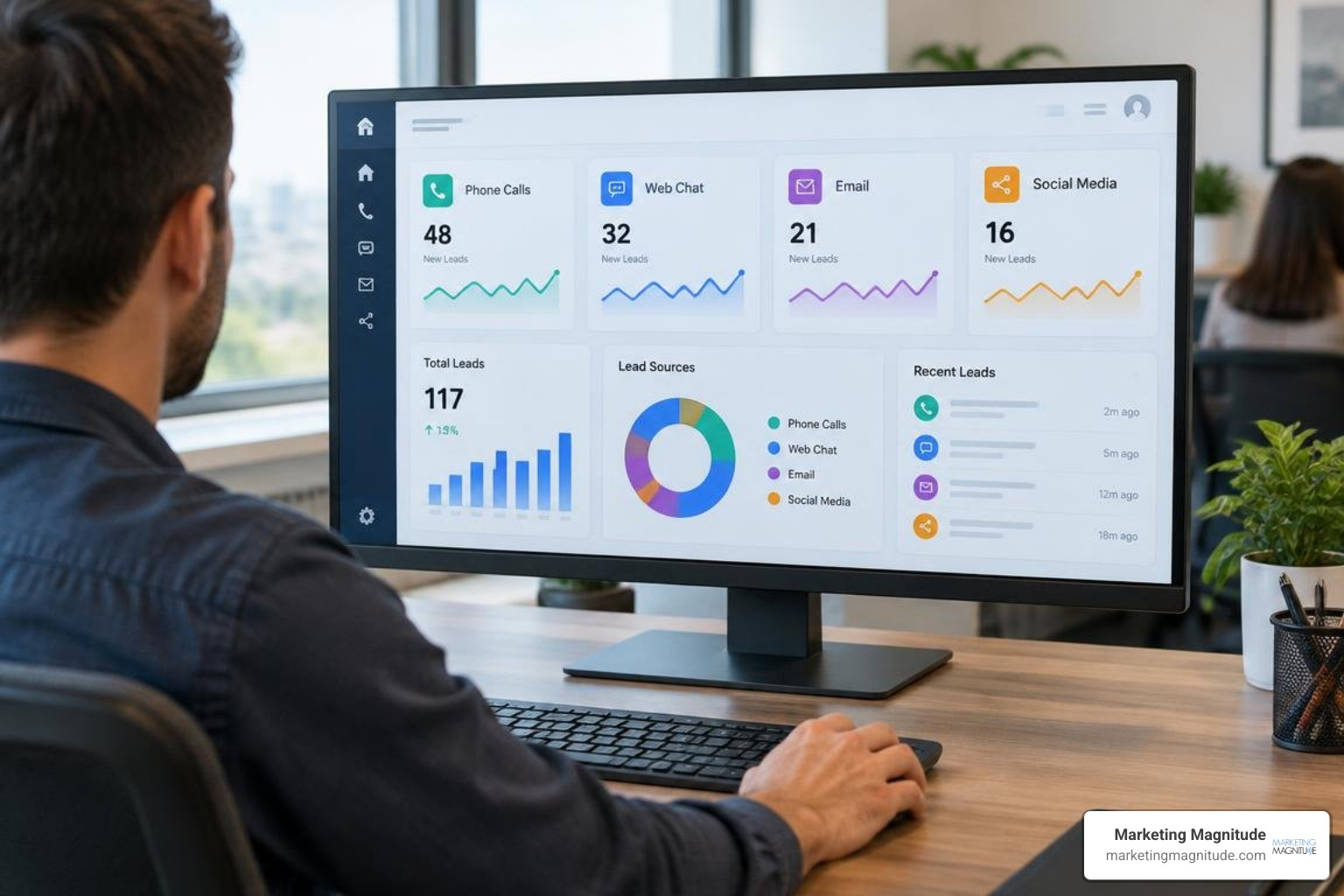
By deploying modern CRM software and marketing automation, every interaction across search and social connects to an automated workflow. When prospects engage with an ad, their activity is tracked, leads are instantly routed for follow-up, and automated nurturing sequences ensure no prospect slips through the cracks.
Accurately evaluating this integrated flow requires calculating conversion rates in Google Analytics properly to see how touchpoints across multiple channels contribute to bottom-line sales.
The Awareness-to-Conversion Strategy
To orchestrate search and social campaigns into a high-converting loop, follow these proven integration steps:
- Step 1: Spark Category Discovery with Social Video. Deploy top-of-funnel short-form video ads on Meta or TikTok highlighting a core problem, proprietary methodology, or customer case study.
- Step 2: Capture Search Lift with Google Ads. As social ad impressions increase, brand search volume rises. Ensure exact-match branded search campaigns and high-intent category search ads are running to capture users who search for your company after seeing your social creative.
- Step 3: Re-Engage Bounced Search Traffic on Social Feeds. Website visitors who arrive via Google Search but do not immediately convert are added to dynamic retargeting audiences across Meta and LinkedIn, serving them client video testimonials and detailed case studies.
- Step 4: Sync CRM Data to Ad Platforms. Feed qualified lead and customer lists back into Google and Meta audience managers to build high-value Lookalike Audiences and power Customer Match targeting.
Cross-Channel Attribution and Multi-Touch ROI Tracking
One of the most persistent measurement challenges in digital marketing is attribution bias:
- Google Ads frequently claims outsized credit under standard last-click models because it captures the final search before a transaction.
- Social Media Ads often report inflated return on ad spend (ROAS) inside native dashboards due to generous 1-day or 7-day view-through attribution windows.
To establish true financial clarity, businesses should transition away from single-channel platform reporting and adopt two unified metrics:
- Marketing Efficiency Ratio (MER): Total Revenue divided by Total Marketing Spend across all channels. MER provides a reliable macro-level benchmark of overall marketing profitability.
- Data-Driven Attribution in GA4: Utilizing algorithmic attribution models that assign fractional credit to every touchpoint along the customer journey, from initial social discovery to final Google search conversion.
At Marketing Magnitude, we integrate paid media execution directly with backend CRM infrastructure. This gives business leaders complete visibility into where leads originate, which touchpoints accelerated their buying decision, and which channels generate the highest long-term customer value.
2026 Emerging Trends: AI Automation, Privacy, and Social Search
As digital advertising matures in 2026, three major shifts are redefining performance across Google and social channels:
- AI-Driven Campaign Operations: Automated campaign engines—including Google Performance Max, AI Max for Search, and Meta Advantage+ suites—now handle bidding, audience matching, and creative asset assembly in real time. Marketers using Google AI Max frequently experience up to 14% to 27% conversion uplifts by allowing algorithms to optimize across broad match queries with strong automated bidding constraints.
- The Shift Toward Social Search: User search habits have fragmented. Industry data shows that 45% of Gen Z and 35% of Millennials prefer TikTok or Instagram over traditional search engines when discovering local businesses, products, and how-to guides. Furthermore, 24% of all Americans now turn to social media first for initial product discovery.
- The “Search Everywhere” Paradigm: Consumers no longer view search as a single Google text box. With YouTube standing as the world’s second-largest search engine and platforms like Facebook ranking among the top global discovery hubs, businesses must optimize their organic authority, structured video content, and paid advertising across every surface where their audience seeks answers.
Frequently Asked Questions About Google Marketing vs Social Media Marketing?
Which platform is more cost-effective for a business with a limited budget?
If your monthly ad budget is under $2,000, start where active demand already exists: Google Search.
When capital is constrained, capturing users who are actively searching for your service yields the shortest path to cash flow and positive ROI. Building brand awareness on social media requires consistent ad spend and creative velocity over several weeks or months before yielding mature returns. Capture your existing high-intent search market first; then reinvest those profits into social media demand generation.
Can you run Google Ads and social media ads simultaneously on a small budget?
Yes, provided you implement a structured budget split rather than spreading funds evenly across multiple cold campaigns.
A proven framework for smaller budgets is a 70/30 allocation:
- 70% of spend is dedicated to high-intent Google Search campaigns targeting exact-match commercial keywords and local service terms.
- 30% of spend is allocated to Meta or LinkedIn purely for retargeting website visitors who did not convert on their first visit.
This structure ensures your cold acquisition budget focuses on high-intent prospects while leveraging social media’s cost-effective CPMs to nurture interested visitors toward conversion.
Why does Google Ads show higher conversion rates than social media campaigns?
The difference in conversion rate is driven by buyer psychology:
- Google Searchers are in an active problem-solving state. They navigated to a search bar, typed a query, and clicked an ad seeking an immediate solution. Their intent to purchase or contact a provider is high.
- Social media users are in a passive consumption state. They are scrolling through feeds for entertainment or social connection. Your ad interrupts their experience, requiring you to guide them from passive interest to active consideration.
While social media conversion rates are lower on direct cold traffic (1% to 3% compared to Google’s 6% to 8%), social media remains crucial for building brand familiarity, driving organic search volume, and filling the top of your marketing funnel.
How Can You Build a Unified Marketing System for Sustainable Growth?
Choosing between Google marketing and social media marketing is not an either-or decision. Winning companies do not pick a single channel; they build connected growth systems that align each platform’s unique strengths with the appropriate stage of the customer journey.
- Use Social Media to spark interest, educate your market, showcase social proof, and build lasting brand authority.
- Use Google Marketing to capture high-intent search demand at the exact moment prospects are ready to hire, buy, or schedule.
- Use CRM and Automation to tie every ad dollar to automated follow-up sequences, clear pipeline tracking, and measurable revenue outcomes.
When your marketing channels, customer communication, and operational workflows function as one connected ecosystem, growth becomes predictable, scalable, and sustainable.
Ready to Build an Integrated Growth System for Your Business?
At Marketing Magnitude, we help service businesses, healthcare providers, and growing organizations eliminate fragmented marketing and build complete, predictable growth engines.
Whether you need to scale high-intent search campaigns, launch brand-building social strategies, or connect your marketing directly into automated CRM pipelines, our team provides the strategic consulting and technology integration you need to grow sustainably.
Contact Marketing Magnitude Today to schedule your comprehensive growth strategy consultation. Explore our complete range of growth services or discover how our SEO services and local SEO solutions can position your business at the top of your market.
Get Started Now
Fill out this form to start your journey to next-level marketing solutions for your business.