What a Smart $5,000/Month Marketing Budget Actually Looks Like
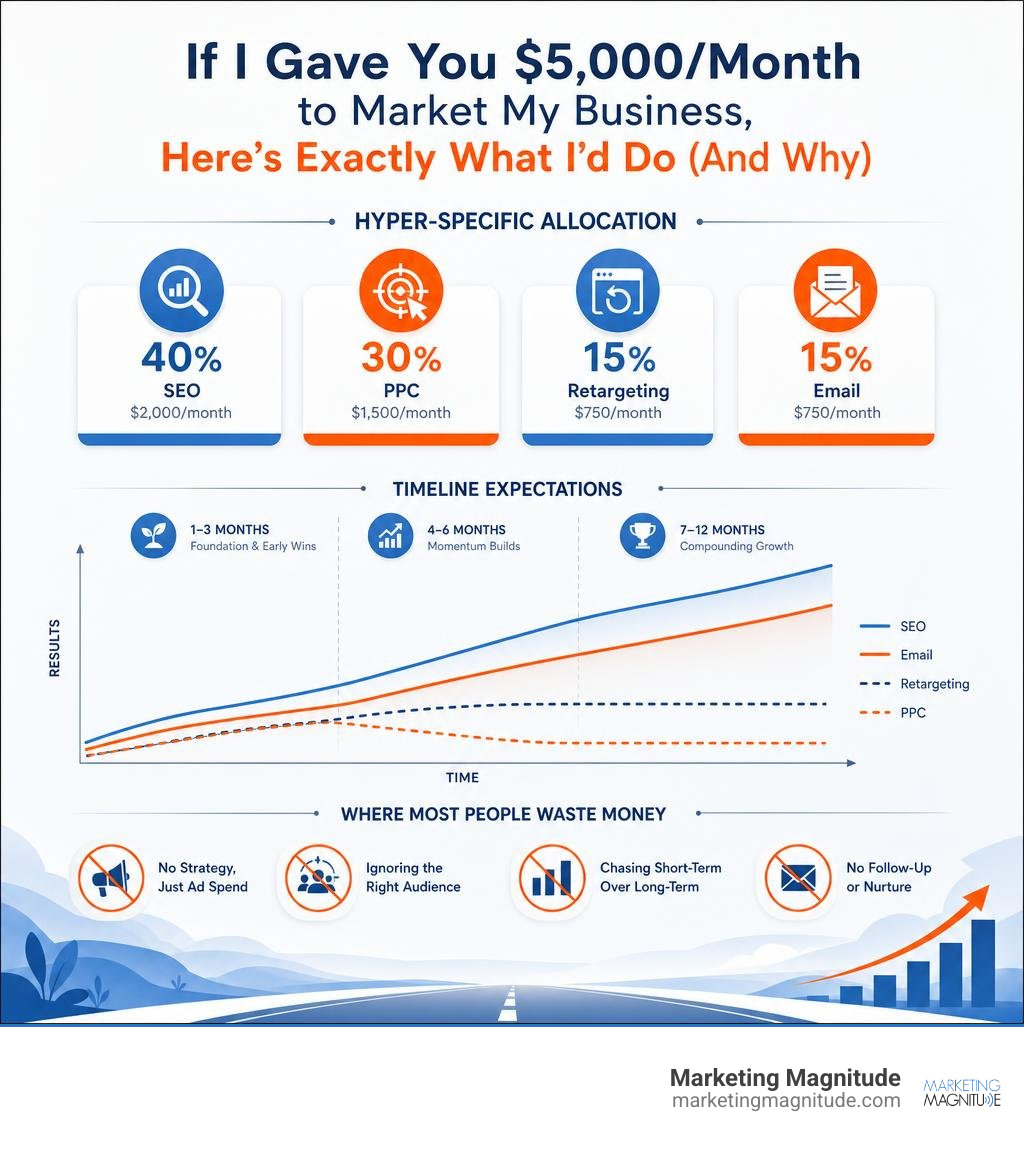
If I gave you $5,000/month to market my business, here’s exactly what I’d do (and why) — and the answer isn’t what most agencies will tell you.
Here’s the short version, optimized for your decision-making right now:
| Channel | Monthly Allocation | Why |
|---|---|---|
| SEO & Content | $1,500 (30%) | Compounds over time; 748% average ROI |
| PPC / Google Ads | $1,500 (30%) | Immediate traffic; targets high-intent buyers |
| Email Marketing | $500 (10%) | Highest ROI channel at $36-$42 per $1 spent |
| Retargeting Ads | $750 (15%) | Converts warm audiences at lower cost |
| Tools & Analytics | $250 (5%) | Attribution, tracking, and reporting |
| Contingency / Testing | $500 (10%) | New channels, creative testing, opportunities |
The core principle: prioritize channels that compound (SEO, email) over channels that expire the moment you stop paying (paid ads alone).
Timeline expectations at a glance:
- Days 1-30: Foundation setup, data collection, no meaningful ROI yet
- Days 31-60: PPC begins converting; email sequences go live
- Days 61-90: Optimization kicks in; SEO starts gaining traction
- Months 6-12: SEO compounds; overall CAC drops significantly
Where most people waste money:
- Paying a full agency retainer ($3,000+) before a single ad runs
- Sending paid traffic to a homepage instead of a dedicated landing page
- Ignoring email entirely despite its industry-leading ROI
- Broad targeting on social ads with no retargeting layer
Nearly half of all small businesses spend less than $500 per month on marketing. At $5,000, you have a real opportunity — but only if you allocate it strategically. Most of that money disappears into agency overhead, unfocused ad spend, and channels that never had a chance to work together.
This guide cuts through the noise. It gives you a dollar-by-dollar plan built on data, not guesswork.
I’m Kelly Rossi, founder of Marketing Magnitude and a digital marketing strategist with over 20 years of hands-on experience running SEO, PPC, and email campaigns across dozens of industries — the exact channels at the heart of this $5,000/month allocation guide. I’ve seen what works, what wastes money, and how to build a marketing system that compounds rather than expires.
The Paid-Organic Decision Matrix: SEO vs PPC vs Email
When we look at a $5,000 budget, we have to decide between “buying” customers and “earning” them. This is the fundamental difference between Search Engine Marketing (SEM) and Search Engine Optimization (SEO). SEM is the broad umbrella that includes both, but in common parlance, it usually refers to Pay-Per-Click (PPC) advertising.
PPC is like renting a house; you have a place to stay as long as you pay the landlord. SEO is like buying a house; it takes a large down payment and maintenance, but eventually, you own the equity. In 2026, the cost of “renting” (PPC) has skyrocketed. Google Ads cost per lead averaged $70.11 in 2025 according to Google Ads industry benchmarks, and customer acquisition costs (CAC) have increased 40% to 60% since 2023. This is why we don’t put all our eggs in the PPC basket.
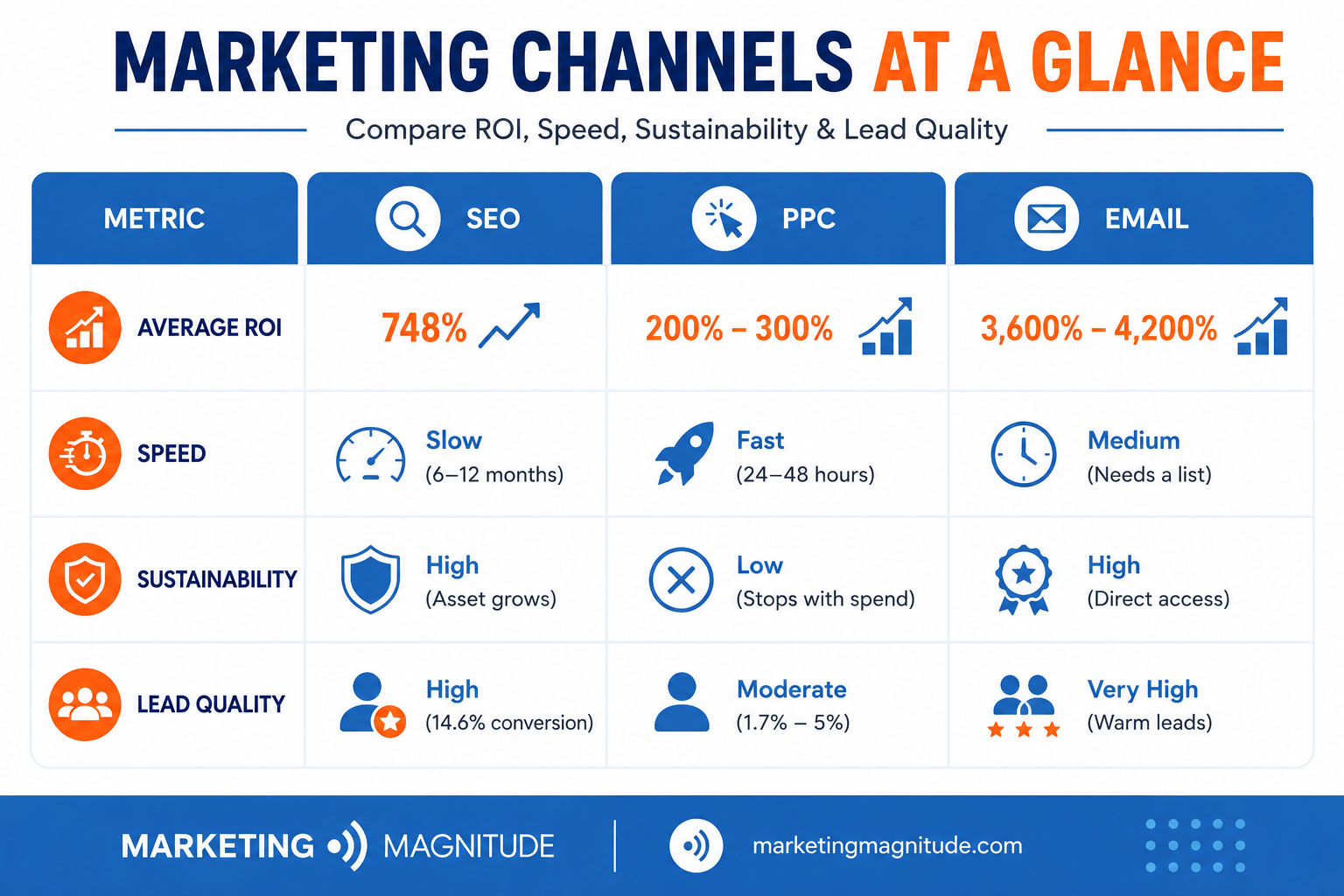
| Metric | SEO | PPC | |
|---|---|---|---|
| Average ROI | 748% | 200% – 300% | 3,600% – 4,200% |
| Speed | Slow (6-12 months) | Fast (24-48 hours) | Medium (Needs a list) |
| Sustainability | High (Asset grows) | Low (Stops with spend) | High (Direct access) |
| Lead Quality | High (14.6% conversion) | Moderate (1.7% – 5%) | Very High (Warm leads) |
To make these work together, we use Paid Search Management Services to capture immediate demand while simultaneously investing in Search Engine Optimization (SEO Services) to build long-term authority.
Building a Keyword Matrix for Maximum Efficiency
We don’t just guess which keywords to target. We build a matrix based on two axes: Intent and Cost-Per-Click (CPC).
- High Intent / High CPC: These are “Buy Now” keywords (e.g., “Las Vegas HVAC repair”). We use PPC for these because the competition is too high to wait for SEO, and the immediate revenue justifies the cost.
- High Intent / Low CPC: These are the “Gold Mine” keywords. We attack these with both PPC and SEO to dominate the first page.
- Low Intent / Low CPC: These are “Educational” keywords (e.g., “how to fix a leaky faucet”). We use SEO and content marketing here. It’s too expensive to pay for these clicks, but they are great for building an email list.
Understanding PPC 101: Basics of Pay-Per-Click Management helps you realize that the goal isn’t just “clicks”—it’s profitable conversions. When you manage PPC campaigns effectively, you use the data from your paid ads to tell your SEO team exactly which keywords actually result in sales, not just traffic.
Why Compounding Channels Win in 2026
If you spend $1,500 on PPC this month, you get a set number of leads. Next month, if you spend $0, you get zero leads. However, if you spend that $1,500 on Las Vegas SEO Services, that content stays on the web, ranking and pulling in traffic for years. B2B companies, for instance, generate twice as much revenue from organic search compared to any other channel.
The same applies to Email Marketing Automation. Automated emails generate 320% more revenue than non-automated ones. By building an email list, you are creating a distribution channel you own. When ad platforms change their algorithms daily, owning your audience is the ultimate hedge against risk.
“If I Gave You $5,000/Month to Market My Business, Here’s Exactly What I’d Do (And Why)” Hyper-specific allocation: SEO vs PPC vs retargeting vs email Timeline expectations Where most people waste money
We follow the 70/30/10 Rule: 70% of the budget goes to proven, high-intent channels; 30% goes to “safe bets” that are scaling; and 10% is reserved for experimental testing.

When deciding how much to spend on digital marketing, we have to account for the “Foundation Layer.” You cannot run successful ads if your website is broken or your tracking isn’t set up. Part of your initial $5,000 must go toward high-quality landing pages.
Many founders ask how much it should cost to manage a PPC campaign. Typically, management fees range from 15% to 25% of ad spend, or a flat retainer. At a $5,000 level, we focus on “Expert Activation”—paying for specialized output (like 4-6 high-quality SEO blog posts) rather than just “availability.”
The 90-Day Rollout
You cannot judge a marketing plan by its first 30 days. Here is what we expect:
- Days 1-30 (The Foundation): We set up PPC Las Vegas campaigns and implement Local SEO Services to boost visibility in Google Maps. This is the “Paying to Learn” phase. We are gathering data on which hooks and keywords convert.
- Days 31-60 (The Optimization): We cut the keywords that aren’t working. We start seeing the first real leads. We implement the “Winner Scaling Reserve,” moving budget from failing ads to the ones showing a positive ROI.
- Days 61-90 (The Scaling): We now have enough data to pivot. SEO starts to show early ranking improvements. The email automation sequences are fully populated and starting to “catch” the leads that didn’t buy on the first visit.
Avoiding the Money Pit
Where does the money go to die? Usually, it’s in PPC mistakes that harm your strategy.
- Broad Targeting: Showing your ad to everyone in Texas when you only serve Austin.
- The Agency Trap: Paying a $3,000 retainer to an agency that only leaves you $2,000 for actual ads.
- Ignoring Attribution: If you don’t know which ad led to a phone call, you are gambling, not marketing.
If you see three red flags your PPC strategy needs a makeover—like high CPC with zero conversions—you must pivot immediately. Research shows that email marketing is often the most neglected high-performing channel; businesses will spend thousands on cold traffic while ignoring the 3,600% ROI sitting in their existing customer list, as noted in research on email marketing ROI.
Execution and Measurement: AI Tools, Team Structure, and ROI Benchmarks
In 2026, you don’t need a 10-person team to execute a $5,000 plan. AI-assisted marketing delivers 44% higher productivity and saves an average of 11 hours per week. We use AI for research synthesis, first drafts of content, and ad copy variations.
However, AI cannot replace strategy. You still need to decide if you should hire someone to manage your PPC campaign. A single specialist can typically manage multiple PPC campaigns efficiently, but the “Freelancer Lottery” is real—traditional platforms have a 70% project failure rate. We recommend a “Fractional” model: hiring an expert for 5-10 hours a month to steer the ship while using AI tools for the heavy lifting.
Key Metrics: CPL, CAC, and LTV
Vanity metrics like “Impressions” or “Likes” won’t pay your mortgage. We focus on:
- Cost Per Lead (CPL): How much does it cost to get a name and email?
- Customer Acquisition Cost (CAC): How much does it cost to get a paying customer?
- LTV:CAC Ratio: A healthy business has a 3:1 ratio. If a customer is worth $3,000 (Lifetime Value), you can afford to spend $1,000 to acquire them.

Whether you are working with an SEO Consultant in Austin, Texas or an Email Marketing Agency in Las Vegas, you should demand real-time tracking. At Marketing Magnitude, we provide transparent performance insights so you can see your “Quotable Leads” (leads that actually result in a quote) in real-time.
Adjusting for Business Type: B2B vs E-commerce
- B2B SaaS/Services: Focus 40% on PPC Management for high-ticket keywords and 40% on SEO/Content to build authority. The sales cycle is long, so email retargeting is non-negotiable.
- E-commerce: Focus 60% on PPC and Retargeting. You need volume and immediate sales. Email should focus on “Abandoned Cart” sequences, which can recover up to 15-30% of lost revenue.
- Local Services: Focus heavily on Local SEO and Google Maps. Use a smaller PPC budget to “snipe” high-intent local searches like “emergency plumber near me.”
Frequently Asked Questions about $5,000 Marketing Allocations
How long until I see a positive ROI from a $5,000/month spend?
You should see “signals of intent” (calls, emails, form fills) within the first 30 days of PPC. However, true profitability usually stabilizes between months 3 and 4. SEO is a longer play; positive ROI typically appears within 6 to 12 months, with peak performance in years 2-3. This is why we balance the two—PPC pays the bills today, while SEO builds the wealth of tomorrow.
Should I hire an agency or use AI tools for execution?
The answer is usually “both.” Using AI alone often leads to generic, low-quality content that Google’s 2026 algorithms can easily detect and devalue. Hiring a full-service agency with a $10,000 retainer is overkill for a $5,000 budget. The sweet spot is an “Expert Activation” partner who uses AI to keep costs down but provides the strategic oversight to ensure you aren’t making common PPC mistakes.
What is the biggest risk at the $5,000/month budget level?
The biggest risk is the “Founder Bottleneck.” If you try to manage the SEO, write the emails, and tweak the Google Ads yourself, you will burn out, and the quality will suffer. Another risk is “Client Concentration”—relying on one single channel for all your leads. If Google changes its algorithm and you don’t have an email list or a retargeting pixel, your lead flow could vanish overnight.
Conclusion
A $5,000 monthly budget is a powerful tool, but only if it’s treated as a cohesive system rather than a series of disconnected experiments. By balancing the immediate reach of Paid Advertising (PPC Management) with the compounding growth of SEO and the high-efficiency ROI of email, you create a marketing engine that gets cheaper and more effective over time.
At Marketing Magnitude, we believe in total transparency. You shouldn’t have to wonder if your marketing is working. We provide real-time reporting and performance insights so you know exactly where every dollar of your $5,000 is going and exactly what it’s bringing back.
Ready to stop guessing and start scaling? Let’s build your custom allocation plan today.
Get Started Now
Fill out this form to start your journey to next-level marketing solutions for your business.