
What “Digital Marketing SEO Meaning” Actually Is (In Plain English)
Understanding the digital marketing seo meaning starts with a simple idea: when people search for something online, you want your business to show up — without paying for every click.
SEO (Search Engine Optimization) is the process of improving your website so it appears higher in search engine results like Google — organically, meaning without paid ads.
Here is a quick breakdown:
| Term | What It Means |
|---|---|
| SEO | Search Engine Optimization |
| Digital Marketing | All online marketing efforts combined |
| Organic Traffic | Visitors who find you through unpaid search results |
| SERP | Search Engine Results Page — where rankings appear |
| Ranking | Your position on that results page for a given search |
In one sentence: SEO is how you earn free, ongoing visibility on Google by making your website more relevant, trustworthy, and easy to find.
Google processes over 8.5 billion searches every day. The first organic result gets 27.6% of all clicks. If your business is not showing up, those clicks are going to someone else.
SEO is not a quick fix. It is a long-term investment. But it compounds — and the numbers back it up. For every dollar spent on SEO, businesses earn an average return of over $22.
For service-based businesses — therapists, healthcare providers, home service companies, consultants — SEO is often the difference between a full calendar and an empty one.
I’m Kelly Rossi, founder of Marketing Magnitude and a digital marketing strategist with over 20 years of experience helping businesses grow through SEO and integrated digital strategy. Understanding the digital marketing seo meaning is where every successful organic growth plan begins, and in this guide I will walk you through everything you need to know to build one that actually works.
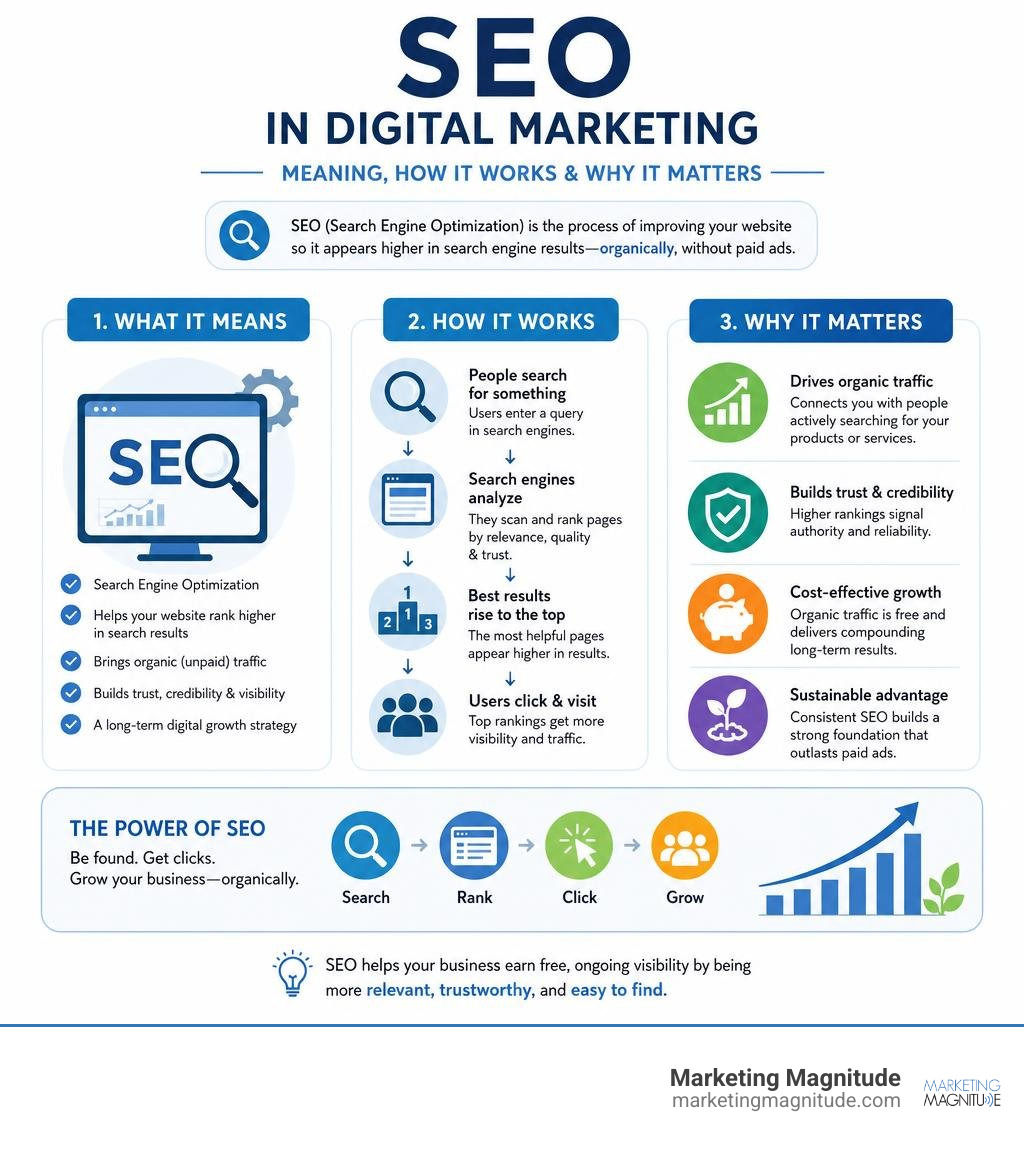
Defining the Digital Marketing SEO Meaning and How It Works
To grasp the true digital marketing seo meaning, we have to look at how websites earn their spot at the top of organic search results. It is not about tricking an algorithm or finding a temporary “hack.” At its core, search engine optimization is a democratic business tool that levels the playing field, allowing smaller, trust-based organizations to compete directly with massive corporations.
When we talk about digital marketing, we are looking at an interconnected ecosystem where channels like social media, email, and paid advertising work alongside organic search. However, while other channels require constant direct spend or daily posting to stay visible, SEO acts as a permanent digital asset. By understanding What Is SEO and How Does it Work?, you can begin to transform your website from a passive digital brochure into an active lead-generation engine.
Demystifying the Digital Marketing SEO Meaning for Beginners
For those just starting out, the sheer volume of acronyms can make your head spin. Let’s break down the basic digital marketing seo meaning by looking at what search engines actually look for: relevance, authority, and structure.
To help you navigate this landscape, we have compiled A Brief Glossary of 12 Essential SEO Terms that every business owner should know. When you optimize a page, you are telling search engine crawlers exactly what your content is about so they can match it with the right user queries. If you want to dive deeper into the core concepts, check out our guide on What is Search Engine Optimization? to see how these elements fit together.
Why SEO Marketing Matters for Modern Businesses
Why should your business care about organic search? Because that is where your customers are. In fact, 39% of global traffic to eCommerce websites originates from search engines, and over 58% of all online searches come from mobile devices.
If you run a trust-based service business — like a therapy practice, a wellness brand, or a professional consultancy — your reputation is everything. When a prospective client searches for a solution to their problem and finds your educational article at the top of Google, you instantly build brand credibility.
Furthermore, the financial impact is massive. Improving your site’s organic search traffic can reduce your customer acquisition costs by up to 87%. To learn more about how search visibility drives sustainable business growth, explore these Need to Know Search Engine Optimization Facts.
SEO vs. SEM: Understanding the Key Differences
It is common to hear the terms SEO and SEM used interchangeably, but they are fundamentally different strategies:
- SEO (Search Engine Optimization) focuses entirely on earning organic, unpaid visibility. It takes time to build, but once established, it offers incredible longevity and a compounding return on investment.
- SEM (Search Engine Marketing), often referred to as paid search or PPC (Pay-Per-Click), involves buying ad space at the top of the search results. While it offers instant visibility, the traffic stops the moment you stop paying.
To help you decide which avenue is right for your current business goals, read our detailed comparison on SEO vs SEM: What’s the Difference?. At Marketing Magnitude, we believe the most successful growth strategies do not choose between the two; instead, they combine them to capture maximum search engine real estate.
How Search Engines Work: Crawling, Indexing, and Ranking
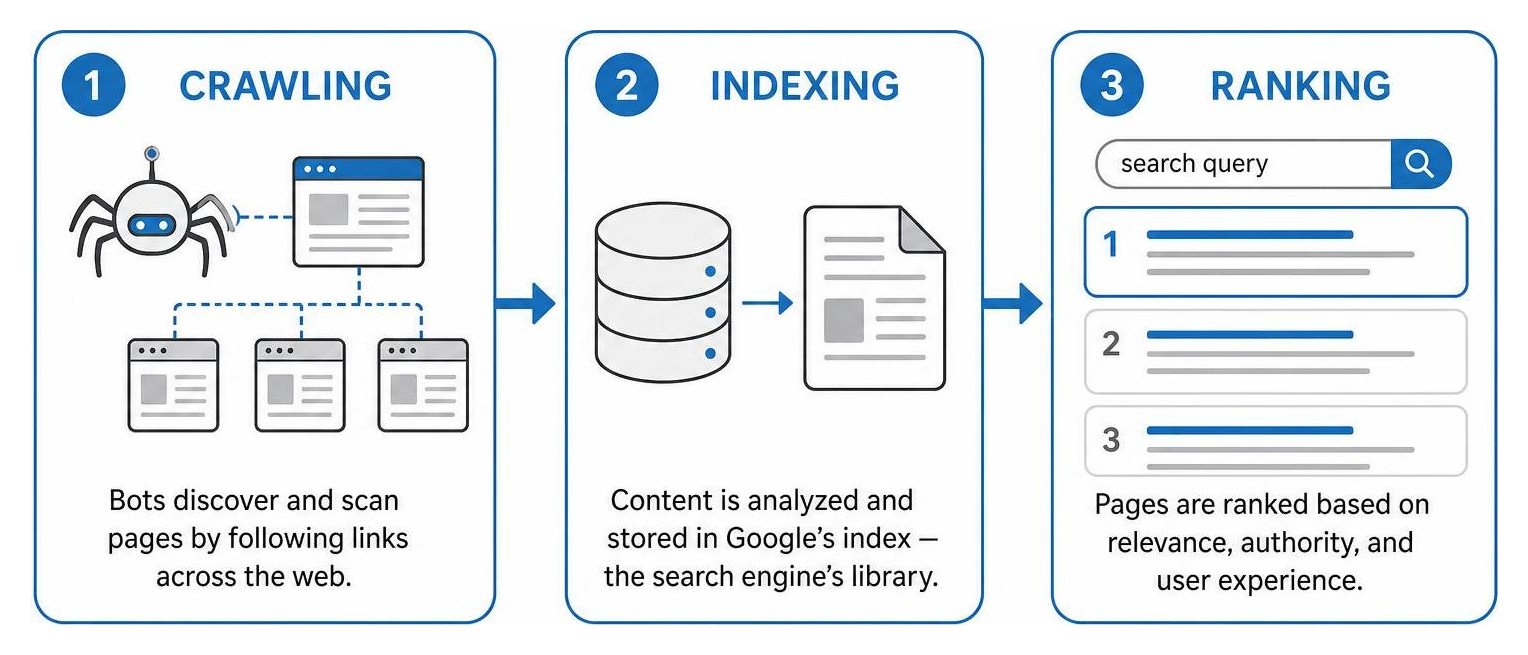
Before we can optimize our websites, we must understand how search systems like Google actually process information. Google is a fully automated search engine that constantly explores the web using crawler programs.
The Mechanics of Crawling and Indexing
The search journey begins with crawling. Automated bots, such as Googlebot, scan the vast network of the internet by following links from already discovered pages to find new and updated content.
To make this process as efficient as possible, we use technical tools:
- XML Sitemaps: A roadmap of your website that you submit to Google Search Console to ensure no page is overlooked.
- Robots.txt: A file that tells web crawlers which parts of your site they should or shouldn’t crawl, helping you preserve your crawl budget.
Once a page is crawled, it goes through indexing. This is where Google analyzes the content, images, and structure of the page, storing it in a massive digital database (the search index) so it can be retrieved in a fraction of a second when a user searches. For a deeper look into the history and technical standards of this process, check out Wikipedia’s Search Engine Optimization Guide.
How Search Algorithms Rank Web Pages
After indexing comes ranking. When a user types a query, search algorithms weigh hundreds of ranking signals to determine which pages deserve to sit at the top. These factors include:
- Relevance: How well your content matches the user’s search query.
- Authority: The trustworthiness of your website, often measured by the quality of external links pointing to it.
- User Experience (UX): Factors like page load speed, mobile-friendliness, and secure connections (HTTPS).
Google’s algorithms are incredibly dynamic, undergoing thousands of updates every year to prioritize helpful, user-first content over manipulative tactics.
The Three Pillars of Search Engine Optimization
To build a balanced, high-performing organic presence, you must address the three main pillars of search engine optimization: on-page, off-page, and technical SEO. If you want to ensure your website excels in all three areas, our Search Engine Optimization Services are designed to build a solid foundation for your business.
On-Page SEO: Optimizing Content and HTML Elements
On-page SEO is all about optimizing the visible content and underlying HTML code on your website. Key on-page elements include:
- Title Tags: The clickable headlines that appear on search results pages. Keep them under 60 characters and place your primary keyword near the front.
- Meta Descriptions: Brief summaries (up to 160 characters) that encourage users to click your link.
- Headings (H1, H2, H3): Structural elements that make your content easy to read for both humans and search engines.
- URL Structure: Clean, descriptive URLs that use hyphens to separate words (e.g.,
yoursite.com/blog/digital-marketing-seo-meaning).
To master these elements and boost your click-through rates, check out The Secret Sauce of On Page Optimization.
How Search Intent Shapes the Digital Marketing SEO Meaning
You can write the most beautifully optimized content in the world, but if it does not match what the user is actually looking for, it will not rank. This is known as search intent. Google categorizes search queries into four primary buckets:
- Informational (52.65% of searches): The user is looking for an answer to a question (e.g., “how does SEO work”).
- Navigational (32.15% of searches): The user wants to find a specific website or brand (e.g., “Marketing Magnitude login”).
- Commercial (14.51% of searches): The user is researching options before buying (e.g., “best SEO services in Austin”).
- Transactional (0.69% of searches): The user is ready to make a purchase or sign up right now (e.g., “hire Las Vegas SEO agency”).
Understanding this breakdown allows us to map our keyword research to the exact stage of the customer journey, ensuring we provide the right content at the right time.
Off-Page SEO: Building Authority and Trust
Off-page SEO focuses on activities outside of your own website that impact your rankings. The most critical factor here is earning high-quality backlinks from authoritative, trusted websites.
Think of a backlink as a digital vote of confidence. However, not all votes are equal; one link from a highly respected industry publication is worth far more than a hundred low-quality links from spammy directories. To learn how to build a clean, authoritative link profile, read our guide on What is a Backlink?.
Technical SEO: Optimizing the Foundation of Your Website
Technical SEO is the behind-the-scenes work that ensures search engine crawlers can access, index, and render your site without any issues. If your technical foundation is broken, even the best content will struggle to rank.
Critical technical factors include:
- Site Speed & Core Web Vitals: Users (and Google) hate slow websites. Compressing images and using modern formats like WebP can dramatically improve load times.
- Mobile-Friendliness: With the majority of searches happening on mobile devices, Google uses mobile-first indexing to rank your pages.
- HTTPS Security: Secure your site with an SSL certificate to protect user data and earn Google’s trust.
How to Build an Effective SEO Strategy: A Step-by-Step Guide
Now that you understand the core mechanics, it is time to put them into action. Building an effective SEO strategy requires a systematic approach that aligns your business goals with user needs.

Step 1: Audience Research and Keyword Strategy
The first step in any successful strategy is understanding who your target audience is and what they are searching for.
- Identify Pain Points: What questions do your clients ask during consultations? Use these as the basis for your content.
- Analyze Search Volume & Difficulty: Look for keywords with a healthy search volume but a manageable keyword difficulty score to build early momentum.
- Spy on Competitors: See what keywords your competitors are ranking for and identify gaps in their content.
To explore how these pieces fit into a broader marketing strategy, check out Search Engine Optimization SEO Strategies for Improved Online Visibility. For a foundational look at keyword research, What Is SEO? Search Engine Optimization Best Practices – Moz is an excellent resource.
Step 2: Content Quality and the Role of E-E-A-T
In 2026, search engines are smarter than ever. They can easily distinguish between generic, AI-generated filler content and deep, valuable insights. To rank well, your content must satisfy Google’s E-E-A-T guidelines:
- Experience: Demonstrate first-hand, real-world experience with the topic.
- Expertise: Showcase professional credentials, deep knowledge, and clear explanations.
- Authoritativeness: Build a reputation as a go-to source in your industry.
- Trustworthiness: Ensure your content is accurate, transparent, secure, and honest.
While E-E-A-T is not a direct ranking factor, it is the conceptual framework Google uses to evaluate content quality. Write for humans first, and the search engines will follow.
Step 3: Advanced SEO in 2026: AI, Local SEO, and Voice Search
The search landscape is evolving rapidly. To stay ahead of the curve, your strategy should incorporate these advanced trends:
- Generative AI Search: Platforms like ChatGPT, Perplexity, and Google’s AI Overviews are changing how users find information. Optimize for these systems by using clear content structures, structured data, and authoritative citations.
- Local SEO: If you are a service business in Nevada or Texas, local visibility is everything. Claiming and optimizing your Google Business Profile, maintaining consistent Name, Address, and Phone Number (NAP) citations, and earning positive reviews are critical steps. If you are looking for local expertise, partnering with a Las Vegas SEO Agency or a trusted Las Vegas SEO Company – Digital Dynasty can help you dominate your local map pack. Similarly, if you are based in Texas, exploring the Best SEO Companies in Austin 2026 or working with an established Austin SEO Company can give you a massive competitive edge.
- Voice Search: With the rise of smart speakers and mobile assistants, more people are searching using conversational, long-tail questions. Write content that directly answers these natural-language queries.
Common SEO Myths and Outdated Practices to Avoid
As the industry has matured, many early optimization tactics have become obsolete — or worse, actively harmful. Avoid these common pitfalls:
- Keyword Stuffing: Repeating your target keyword over and over in hopes of ranking. This makes your content unreadable and can trigger a Google penalty.
- Meta Keywords Tag: Google has completely ignored this tag for years.
- Chasing Word Count: There is no “perfect” length for an article. Focus on answering the user’s query thoroughly rather than hitting an arbitrary word count.
- Black Hat SEO: Deceptive link-building schemes or hidden text might offer a temporary boost, but they will eventually get your site banned from search results.
Measuring and Tracking SEO Success
SEO is a long-term strategy, but that does not mean it cannot be measured. By tracking the right metrics, you can see exactly how your organic traffic translates into real business growth.
| Metric | What It Measures | Why It Matters for Your Business |
|---|---|---|
| Organic Traffic | Unpaid visitors from search engines | Shows the overall growth of your online visibility |
| Click-Through Rate (CTR) | Percent of searchers who click your link | Indicates how compelling your titles and descriptions are |
| Bounce Rate | Visitors who leave after viewing one page | Highlights whether your content matches user intent |
| Average Session Duration | How long users stay on your site | Measures engagement and content quality |
| Conversion Rate | Percent of visitors who take a desired action | Directly links your SEO efforts to revenue and leads |
Key SEO Metrics to Monitor
To get a clear picture of your performance, you should regularly monitor your analytics using free tools like Google Analytics and Google Search Console. Look beyond vanity metrics like keyword rankings and focus on user engagement:
- Dwell Time: If a user clicks your link and immediately hits the back button (a “bad click”), it tells Google your page did not answer their question.
- CRM Integration: At Marketing Magnitude, we believe the ultimate measure of SEO success is closed revenue. By connecting your search data to your CRM and automation systems, you can track exactly which blog posts and search terms are driving your most valuable clients.
Frequently Asked Questions about Digital Marketing SEO
What is the difference between SEO and SEM?
SEO (Search Engine Optimization) focuses on earning free, organic traffic through long-term content and technical optimization. SEM (Search Engine Marketing) uses paid advertising (PPC) to buy immediate visibility at the top of search results. While SEM stops working when your budget runs out, SEO builds a lasting digital asset that continues to drive traffic over time.
How long does it take to see results from SEO?
While minor technical fixes can sometimes show results in a few days, a comprehensive SEO strategy typically takes three to six months to show significant organic growth. This timeline can vary depending on your industry’s competitiveness, your website’s history, and the quality of your content. However, this patience pays off with a highly compounding return on investment.
Is E-E-A-T a direct ranking factor for Google?
No, Google’s search algorithms do not assign a direct “E-E-A-T score” to your website. Instead, E-E-A-T (Experience, Expertise, Authoritativeness, and Trustworthiness) is a conceptual framework that Google’s human Search Quality Evaluators use to assess the helpfulness of search results. Optimizing for E-E-A-T simply means creating high-quality, trustworthy content that serves your users.
Conclusion
Understanding the digital marketing seo meaning is the first step toward unlocking sustainable, predictable business growth. But as we have explored throughout this guide, organic search does not live in a vacuum. True operational scalability happens when your marketing, communication, website design, and CRM systems work together as one connected ecosystem.
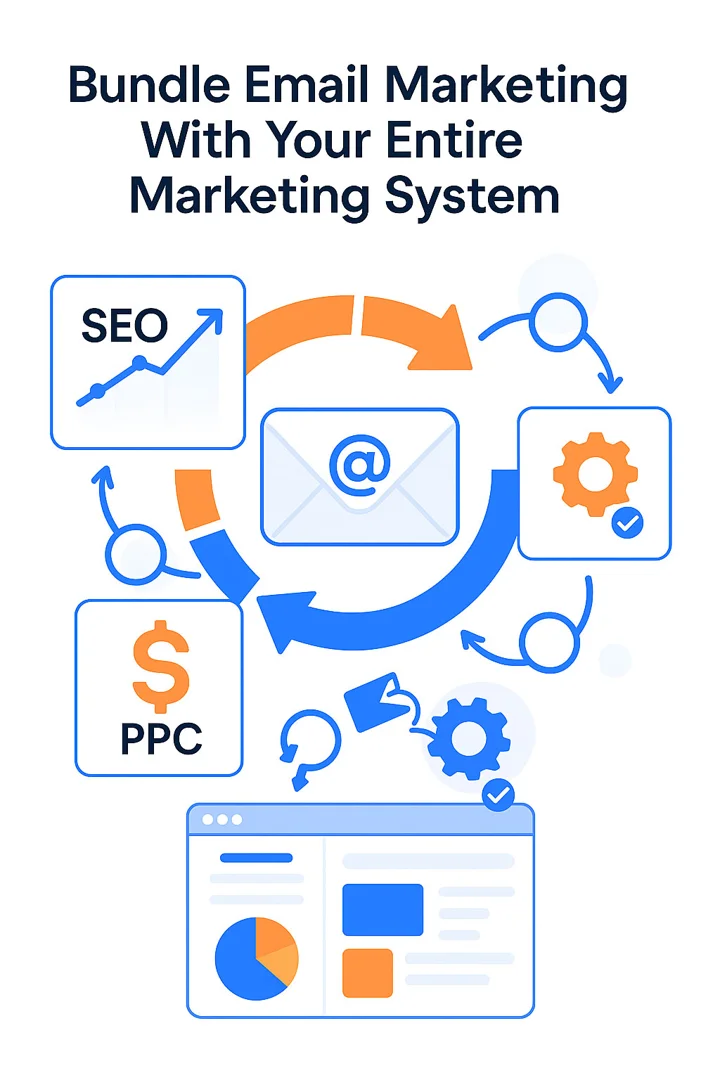
At Marketing Magnitude, we build more than just traffic; we build complete growth infrastructures. Whether you are a therapist looking to fill your practice, a healthcare provider expanding your reach, or a local service business striving to dominate your region, we are here to help you scale ethically and sustainably.
If you are ready to stop chasing short-term marketing hacks and start building a lasting digital asset, explore our Digital Marketing SEO Services today. Let’s connect your systems and grow your business together.
Get Started Now
Fill out this form to start your journey to next-level marketing solutions for your business.