
Why Too Many Marketing Tools Are Quietly Killing Your Efficiency
“We replaced 6 marketing tools with one system—here’s what happened” is a story more small business owners need to hear, because the results come down to three things: efficiency, cost savings, and better tracking.
Here’s the short version:
| What Changed | Before | After |
|---|---|---|
| Monthly tool cost | ~$1,800+ across 6+ tools | ~$297 for one system |
| Time lost to data reconciliation | 21 hrs/week | Near zero |
| Data accuracy | Fragmented, siloed | Single source of truth |
| Team focus | 40% on maintenance | 90% on strategy |
| Onboarding new hires | 2 weeks | 2 days |
The average marketing team runs 12 or more separate tools at once. Each one has its own login, billing date, and data export process. Every time you switch between them, you lose 9 to 23 minutes of focused work time — and that adds up fast.
For a five-person team, that “tool tax” can cost $82,000 a year in lost productivity alone — before you even count the subscription fees.
Most small business owners don’t realize how much this fragmentation is costing them until they finally consolidate.
I’m Kelly Rossi, founder of Marketing Magnitude and a digital marketing strategist with over 20 years of experience helping businesses cut waste and grow smarter — and consolidating bloated tool stacks is one of the highest-ROI moves I’ve seen deliver real, measurable results in efficiency, cost savings, and better tracking. Let’s break down exactly what happens when you make the switch.
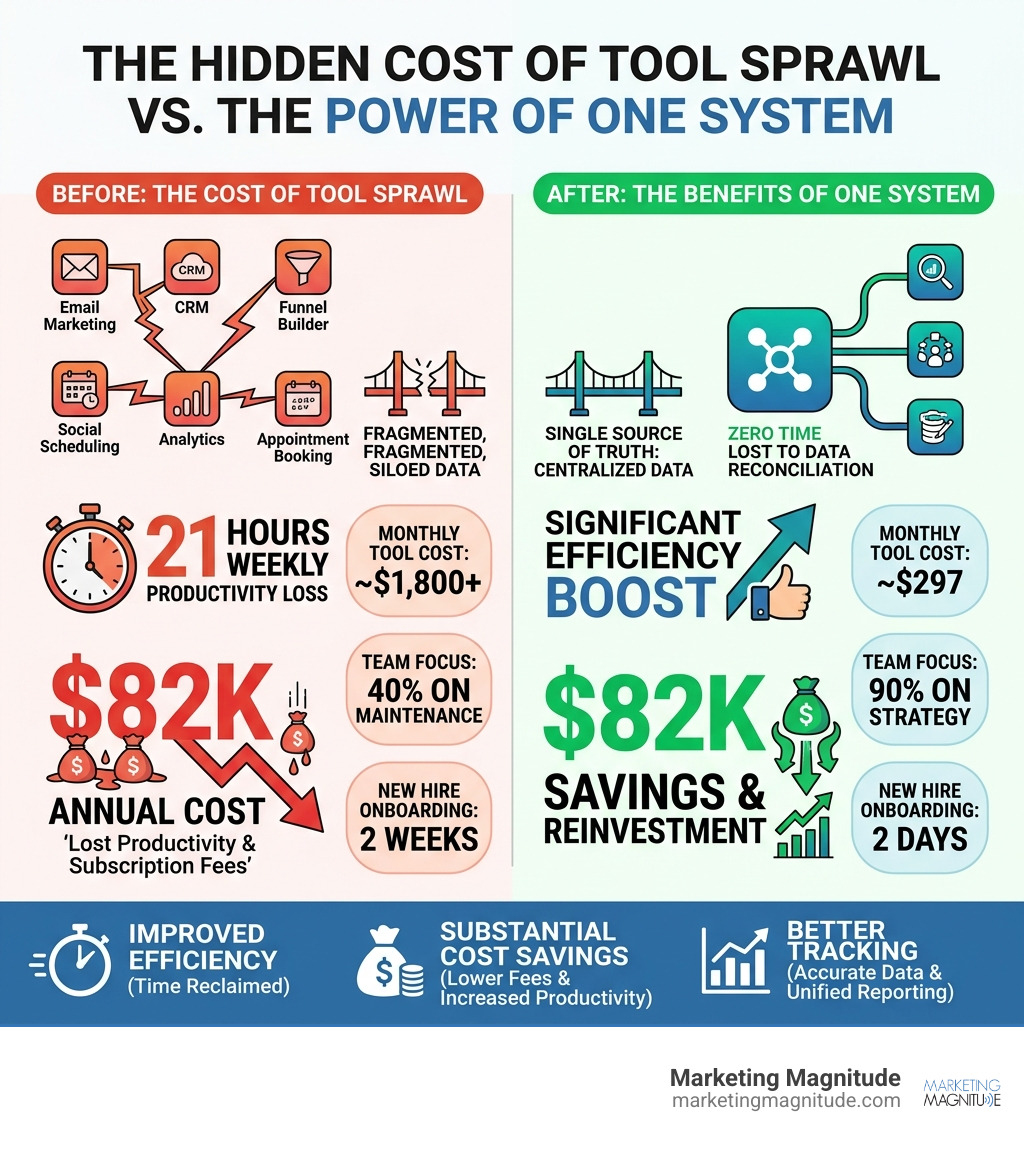
The Hidden Cost of Tool Sprawl: Why “We Replaced 6 Marketing Tools With One System—Here’s What Happened” Tie into: Efficiency Cost savings Better tracking
When we talk about “tool sprawl,” we aren’t just complaining about having too many icons on a desktop. We are talking about a fundamental breakdown in how a business operates. In our experience at Marketing Magnitude, we’ve seen teams in Las Vegas and Austin struggling to keep their heads above water because their data is trapped in six different “best-in-class” silos.
The reality is that the shift toward all-in-one platforms isn’t just about saving a few bucks on subscriptions. It’s about reclaiming your brainpower. When your CRM doesn’t talk to your email automation, and your funnel builder is a stranger to your appointment scheduler, your team becomes the “manual API.” They spend their days exporting CSV files and praying the data matches.
By moving to a unified system, we replaced the following six core functions:
- CRM & Pipeline Management: No more lost leads in spreadsheets.
- Email Marketing & Automation: Automated sequences that actually know when a lead has called.
- Funnel & Website Building: Landing pages that load fast and track conversions natively.
- Appointment Scheduling: Eliminating the back-and-forth of “does Tuesday work for you?”
- Social Media Management: One place to schedule and track engagement.
- Reputation Management: Automated review requests that boost local SEO.
Using 5 Business and Marketing Automation Tools for 2020 as a baseline, it’s clear that the industry has moved toward deep integration. The “Frankenstein stack” held together by duct tape and expensive third-party integration subscriptions is officially a liability.

“We Replaced 6 Marketing Tools With One System—Here’s What Happened” to Our Monthly Overhead
Let’s talk about the “Death by a Thousand Subscriptions.” When you audit a typical fragmented stack, the numbers are eye-opening. We’ve seen businesses paying $299 for a CRM, $150 for email marketing, $97 for a funnel builder, $30 for a calendar tool, $200 for reputation management, and $50 for social scheduling. That’s over $800 before you even get to the “hidden” costs.
In more complex scenarios, a $1,800 monthly stack is common for growing agencies. By consolidating into one system for approximately $297, the direct savings are massive. But the real financial win comes from avoiding Ppc Mistakes That Harm Your Digital Marketing Strategy—like overspending on ads because your tracking is broken.
When you ask, How Much Should I Spend On Digital Marketing?, you have to factor in the “Integration Tax.” If you are spending $500 a month on tools but your team spends 10 hours a week fixing them, you aren’t really saving money. You’re burning it.
“We Replaced 6 Marketing Tools With One System—Here’s What Happened” to Our Data Integrity
The biggest nightmare of a fragmented stack is the “Data Silo.” If your Facebook Ads tool says you had 20 conversions, but your CRM only shows 10 leads, who is lying?
Consolidation creates a “Single Source of Truth.” When a lead fills out a form on your website, that action is immediately recorded in the CRM, triggers an email sequence, and notifies your sales team in one fluid motion. This level of Website Conversion Tracking ensures that no lead falls through the cracks.
By housing everything under one roof, you gain a level of category/analytics that was previously impossible without a dedicated data scientist. You can see the entire customer journey from the first click to the final invoice without ever leaving your dashboard.
Breaking Down the Math: Efficiency, Cost Savings, and Better Tracking
The numbers don’t lie. When we look at the operational ROI, the shift is dramatic. According to industry research, teams using 6+ disconnected tools lose an average of 21 hours per week to manual data transfer. At a modest $75/hour for a professional marketer’s time, that is $82,000 annually for a five-person team.
Consider this real-world comparison:
- Old Stack: $847/mo subscriptions + $1,440/mo labor = $2,287 total.
- New Stack: $99/mo subscription + $300/mo labor = $399 total.
That is a 69% cost reduction and an annual saving of over $22,000 for a small operation. As noted in the case of how some Replaced 6 Ecommerce Tools With 1, inventory accuracy can jump from 87% to 99% simply by removing the lag between disconnected systems. This is the essence of a professional Online Marketing Analysis.
Eliminating the Integration Tax
Every time you add a “middleman” tool to connect two apps, you create a potential failure point. Webhooks break, API permissions expire, and data gets mangled in translation. This is the “Integration Tax.”
Beyond the technical failures, there is the psychological cost. The University of California found that every tool switch costs 9-23 minutes of refocus time. If your team checks four different platforms before lunch, they’ve effectively lost two hours of deep work. A unified system removes this friction, allowing for a more thorough Guide To Online Marketing Analysis.
Achieving a Unified View of the Customer Journey
Better tracking isn’t just a “nice to have”—it’s a competitive necessity in 2026. With a consolidated system, lead attribution becomes native. You don’t have to guess which ad campaign drove the phone call that turned into a $10,000 contract.
Our approach at Marketing Magnitude emphasizes real-time reporting. By unifying Website Marketing Analytics, we can see exactly how a prospect moved from a blog post to an email click to a booked appointment. This “Marketing-to-Sales Handoff” is where most businesses lose money; consolidation makes that handoff invisible and instantaneous.
From Fragmented to Fluid: Streamlining Workflows and Automation

When your tools live in the same ecosystem, “automation” actually means automation. In a fragmented stack, you spend your time building “bridges” between tools. In a unified system, you spend your time building “customer experiences.”
We’ve seen teams achieve a 4x increase in output by moving to sequential workflows. For example, instead of manually exporting leads from a landing page tool to an email tool, the system does it natively. This allows for advanced Services/Crm Software Marketing Automation where the system can send a specific SMS if a lead hasn’t opened an email within two hours.
The same applies to Services/Email Marketing Automation. When your email tool knows exactly what your CRM knows, your “personalization” goes beyond just using a first name. You can reference the specific service they looked at or the last time they spoke to a sales rep.
Shifting Focus from Maintenance to Strategy
One of the most profound changes we see is the “Maintenance-to-Strategy Shift.” In a fragmented environment, marketing managers often spend 40% of their week acting as “tech stack therapists”—fixing broken links, reconciling spreadsheets, and troubleshooting logins.
After consolidation, that maintenance time drops to about 10%. This frees up 90% of their time to focus on what actually moves the needle: strategy, creative, and optimization. For businesses looking for Digital Marketing Automation Las Vegas, this shift is the difference between staying stagnant and scaling rapidly.
Overcoming the Migration Hurdle: Challenges and Best Practices
We won’t sugarcoat it: moving from six tools to one is a project. It’s not something that happens overnight. We typically recommend a 60-90 day migration window to ensure everything is handled correctly.
The biggest challenges usually involve:
- Data Mapping: Ensuring your “Custom Fields” in the old CRM match the new one.
- Parallel Testing: Running both systems for 30-60 days to ensure no leads are lost during the transition.
- Change Management: Helping your team break old habits and learn the new interface.
The “Build vs. Buy” matrix is also relevant here. While custom-coded AI tools are becoming popular for specific tasks, most small-to-mid businesses in Nevada and Texas are better off “buying” a unified platform that has already solved the core integration challenges.
When Consolidation Works Best
Consolidation is a “slam dunk” for:
- Small-to-Mid Agencies: Managing multiple clients becomes 10x easier with unified sub-accounts.
- High-Output Teams: Teams of 2-10 people who need to move fast without a dedicated IT department.
- SaaS Spend Thresholds: If you are spending more than $500/month on disconnected tools, the ROI of switching is usually immediate.
However, if you are an enterprise-level e-commerce brand with highly specialized needs (like deep manufacturing logic), you might still need a few “best-of-breed” specialist tools. For most service-based businesses, however, the “All-In-One” approach wins every time.
Frequently Asked Questions about Marketing Tool Consolidation
What are the most common tools replaced during consolidation?
Most businesses successfully replace their legacy CRM, standalone email marketing platforms, separate funnel builders, external appointment schedulers, social media management tools, and reputation management software.
How long does it take to see a return on investment after switching?
The subscription-based ROI is usually felt in the first 30 days. The “Efficiency ROI”—the time your team saves—usually kicks in by month three, once the learning curve has flattened.
Will I lose specialized features by moving to an all-in-one system?
You might lose the “top 5%” of niche features that a specialist tool offers. However, we find that most businesses only use about 20% of a tool’s features anyway. The gain in workflow speed and data accuracy far outweighs the loss of a niche “power user” feature.
Conclusion
At Marketing Magnitude, we believe that transparency and clarity are the foundations of successful marketing. Our unique selling proposition is providing real-time tracking and reporting, which is significantly easier—and more accurate—when your tools are unified.
“We replaced 6 marketing tools with one system—here’s what happened” isn’t just a headline; it’s a roadmap to a more profitable, less stressful business. By focusing on efficiency, cost savings, and better tracking, you stop being a “systems administrator” and start being a marketer again.
If you’re ready to stop the “Death by a Thousand Subscriptions” and see what a unified system can do for your ROI, explore our Services/Content Marketing Services or reach out for a stack audit. Whether you’re in Las Vegas, Austin, or anywhere in between, it’s time to trade tool sprawl for operational excellence.