Why Every Service Business Should Be Running a Drip SMS Campaign Right Now
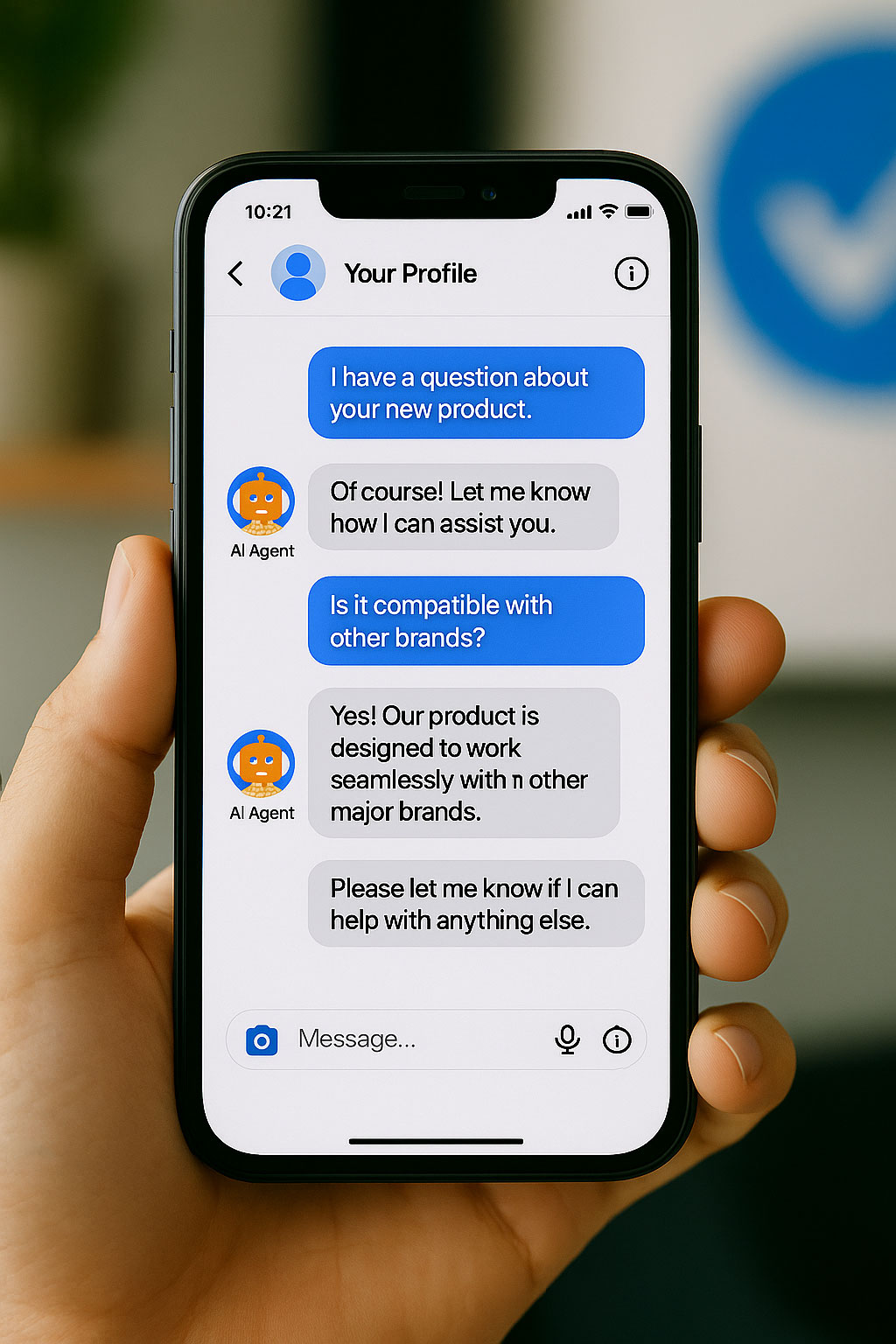
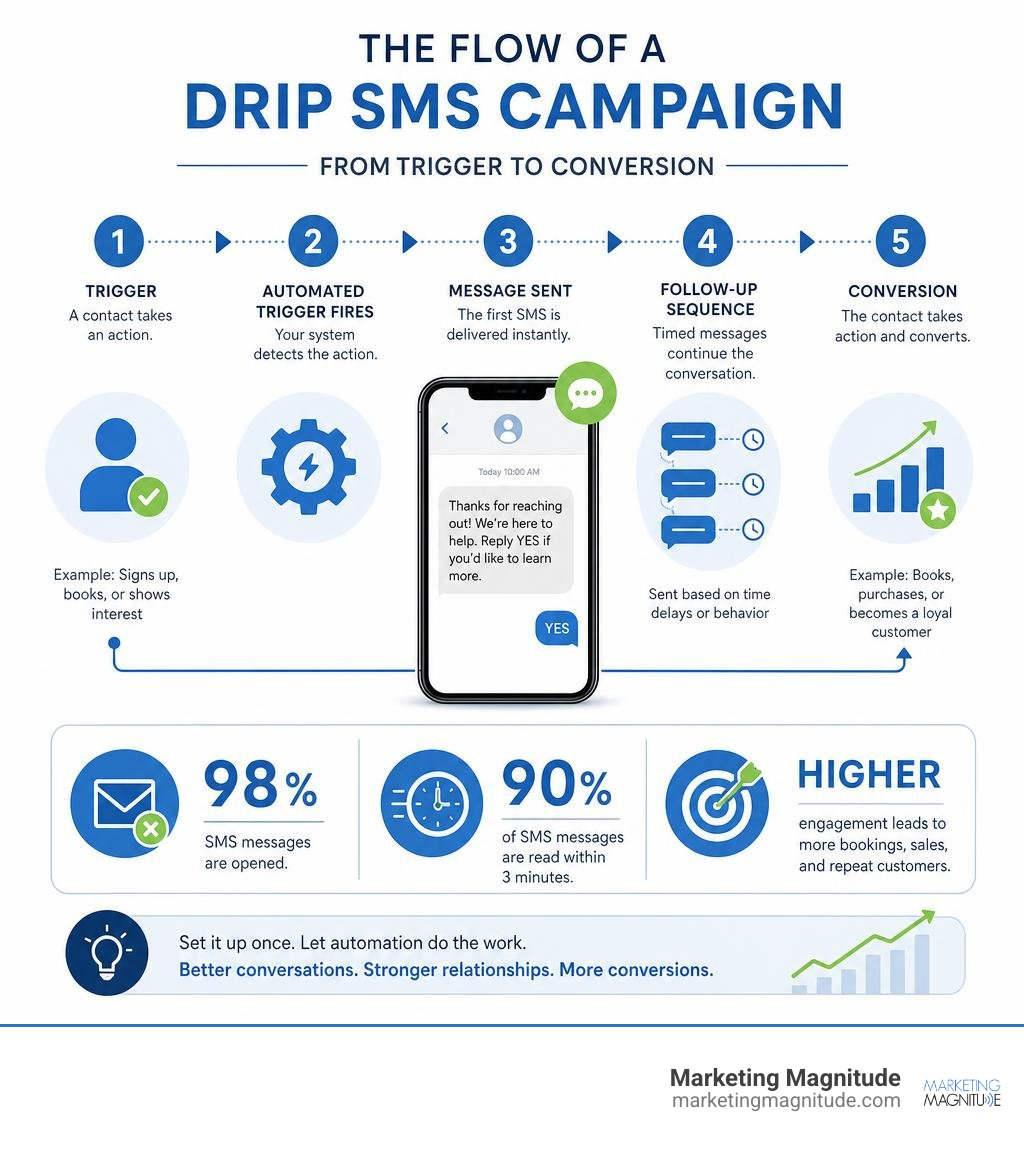
A drip SMS campaign is one of the most powerful — and underused — tools available to small and mid-sized service businesses today. While most business owners are still relying on email follow-ups that go unread, SMS messages are opened 98% of the time, with 90% read within three minutes of delivery.
Here is a quick answer to what a drip SMS campaign is and how it works:
What is a drip SMS campaign?
A drip SMS campaign is a series of automated text messages sent to contacts based on specific triggers or time delays. Instead of sending one manual text, you build a sequence once, and it runs automatically — guiding leads and customers through a defined journey.
How it works at a glance:
- A contact takes an action (signs up, abandons a cart, books an appointment)
- A trigger fires automatically in your SMS platform
- A pre-written text message is sent at the right time
- Follow-up messages are delivered in sequence based on delays or behavior
- The contact converts — or exits the sequence automatically
The difference between businesses that grow predictably and those that stay stuck often comes down to how consistently they follow up. Manual follow-up is slow, inconsistent, and easy to forget. An automated SMS drip sequence fixes all three problems — without adding work to your plate.
For service businesses like healthcare practices, home services, or wellness clinics, this kind of automation can reduce no-shows, recover lost leads, and keep customers engaged long after the first appointment.
I’m Kelly Rossi, founder of Marketing Magnitude and a digital marketing strategist with over 20 years of experience building automated systems that drive measurable growth. I’ve helped service businesses across multiple industries design and launch drip SMS campaigns that turn cold contacts into loyal, returning customers.
Understanding the Power of a Drip SMS Campaign
To understand why a drip SMS campaign is so effective, we must look at how modern consumers interact with their mobile devices. In July 2026, the average person is constantly bombarded with emails, social media notifications, and digital ads. Most marketing channels have become overcrowded, resulting in low organic reach and diminishing returns.
Automated text messaging, however, cuts through the digital noise. Because text messages are highly personal and land directly in a recipient’s native messaging app, they feel more like a digital “firm handshake and warm smile” than a cold corporate broadcast.
The secret to a successful SMS drip lies in its structure. Unlike a one-off broadcast, a drip sequence delivers value incrementally. It gives your audience room to breathe and digest your message, guiding them down the sales funnel step-by-step rather than forcing a quick conversion.
| Feature | SMS Blast | SMS Drip Campaign |
|---|---|---|
| Audience | Broad, often the entire subscriber list | Highly segmented, based on user behavior |
| Timing | Sent all at once at a scheduled time | Trigger-based, spaced out over days or weeks |
| Personalization | Low (usually just first names) | High (dynamic custom fields, behavior, history) |
| Primary Goal | Immediate sales spikes, flash promotions | Long-term relationship building, customer retention |
| Maintenance | Requires manual setup for each send | Runs automatically in the background |
How SMS Drips Differ from SMS Blasts
Many business owners confuse SMS blasts with drip campaigns, but they serve completely different purposes.
An SMS blast is like grabbing a megaphone. It is a single, identical message sent to a broad list of subscribers at the exact same time. While blasts are highly effective for time-sensitive announcements — like a quick holiday promotion or a flash sale — they do not build long-term relationships. Relying solely on blasts can lead to high opt-out rates and subscriber fatigue.
A drip SMS campaign, on the other hand, is a series of automated, behavior-triggered messages. It is highly targeted and sent to individual subscribers based on their unique actions. For example, if a user signs up for a consultation on your website, they enter a automated sequence designed specifically to guide them toward booking.
Drips rely on timing and context rather than sheer volume. Because the messages are triggered by the recipient’s behavior, they arrive exactly when the lead is most interested, making them feel incredibly natural and helpful.
Key Benefits of a Drip SMS Campaign for Retention
Acquiring a new customer is significantly more expensive than keeping an existing one. That is why smart businesses prioritize retention. When integrated with a professional Email Marketing & Automation Services ecosystem, SMS drip campaigns become the ultimate retention tool.
Here are the primary benefits of using SMS drips to keep your customers engaged:
- Unmatched Open and Response Rates: With a 98% open rate and response rates as high as 45%, SMS ensures your retention messages are actually seen and acted upon.
- Proactive Churn Prevention: Proactive SMS outreach can reduce involuntary customer churn by up to 34%. By automatically texting clients about failed credit cards, upcoming subscription renewals, or account updates, you resolve issues before they lead to cancellations.
- Automated Customer Nurturing: Once mapped and scripted, a drip campaign acts as a quiet relationship-builder that runs in the background. It maintains consistent contact with your audience without requiring daily manual oversight from your staff.
- High Return on Investment: Because text messages are highly targeted, they are incredibly cost-effective. Industry benchmarks show that SMS marketing can deliver returns as high as $8.11 per message, with standard sending costs running only pennies per text.
By implementing structured, automated text sequences, you ensure no customer falls through the cracks. To explore how to build these sequences safely and effectively, you can read more in this guide on SMS Drip Campaigns: The Complete Guide for 2026.
Common Types of SMS Drip Sequences
To design a high-converting automated text strategy, you must align your sequences with specific stages of the customer journey. Let’s look at the most common and effective types of SMS drip sequences used by successful service businesses.
Welcome and Onboarding Series
The welcome series is your chance to make a stellar first impression. When a new lead signs up for your list, registers for a free trial, or joins your community, their interest is at an all-time high.
A standard Welcome SMS drip usually consists of 3 to 4 messages sent over a week. For example, a SaaS platform or service provider might use a 4-message activation drip to guide trial users through setting up their accounts. This simple sequence typically converts 25% to 40% of dormant signups into active users.
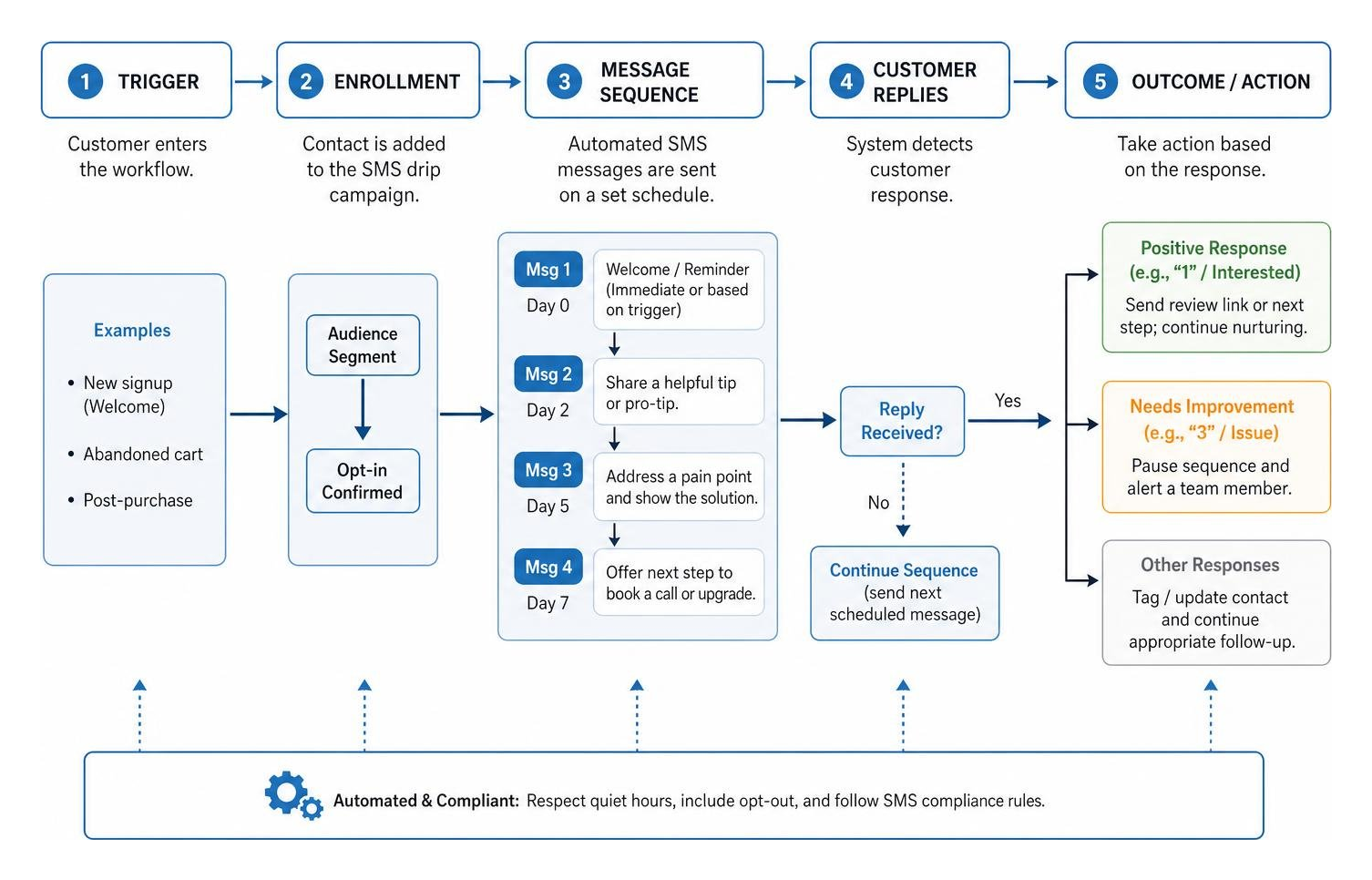
- Message 1 (Immediate): Welcome the subscriber, deliver any promised lead magnet, and introduce your brand.
- Message 2 (Day 2): Share a helpful tip or a “pro-tip” video to help them get value from your service.
- Message 3 (Day 5): Address a common pain point and show how your team solves it.
- Message 4 (Day 7): Offer a direct path to book a call or upgrade their account.
Abandoned Cart Recovery
For e-commerce and online booking systems, cart abandonment is a major revenue drain. While email cart recovery is standard, it typically only recovers 8% to 10% of lost sales.
An abandoned cart SMS drip campaign is far more effective, recovering 20% to 35% of abandoned carts. Because 28% of recipients click on links in cart recovery texts, reaching out via SMS is the fastest way to win back lost revenue.
- Message 1 (1 Hour After): Send a gentle, helpful reminder. “Hi {{First Name}}, did life get in the way? We saved your spot/items here: {{Link}}.”
- Message 2 (24 Hours After): Offer assistance or answer common questions. “Still thinking about it, {{First Name}}? Reply to this text if you have any questions, or secure your booking here: {{Link}}.”
- Message 3 (48 Hours After): Introduce a small, time-limited incentive or discount code to create urgency.
Post-Purchase and Customer Feedback
The customer journey does not end when a purchase is made. In fact, the post-purchase phase is where brand loyalty is built.
Using a post-purchase SMS sequence allows you to check in on customer satisfaction, deliver helpful tutorials, and request reviews. One of the most effective strategies we recommend is a Day 7 check-in using a simple “1, 2, or 3” response mechanic:
“Hi {{First Name}}, Kelly here from Marketing Magnitude. How has your experience been so far? Reply with 1 (Amazing!), 2 (Okay), or 3 (Needs Improvement) so we can make sure you’re taken care of!”
If the customer replies with a “1,” your automated platform can instantly send a link to your Google Business Profile to collect a 5-star review. If they reply with a “3,” the sequence auto-pauses and routes the text to a live team member, allowing you to resolve the issue privately before they leave a negative review online.
How to Set Up a Drip SMS Campaign in 5 Steps
Building an automated text campaign does not have to be complicated. By following a structured process, you can launch a compliant, high-converting campaign that runs entirely on autopilot.
Step 1: Define Your Goal and Segment Your Audience
Before writing a single word of copy, you must define exactly what you want your drip SMS campaign to achieve. Are you trying to convert free trial users? Reactivate cold leads? Or prompt past clients to book their annual maintenance? Each campaign should have exactly one clear goal.
Once your goal is set, you must segment your audience. Sending a generic text message to your entire database is a fast track to high unsubscribe rates. Instead, use your CRM to segment contacts based on behavioral data, purchase history, and signup sources.
To understand how to organize your customer data for maximum impact, consult our In-Depth Guide to CRM Meaning for Sales. By organizing your leads into clean, structured categories, you can deliver highly targeted text messages that feel personally relevant to every recipient.
Step 2: Map the Sequence and Exit Conditions
Next, you need to map out your customer journey. Decide how many messages will be in your sequence and the exact timing delays between them. For most marketing and lead nurturing workflows, a sequence of 3 to 5 messages spaced 2 to 5 days apart is the sweet spot.
Crucially, you must build exit conditions into your campaign logic. An exit condition is a rule that automatically removes a contact from the sequence once they take the desired action.
For example, if a lead is in an abandoned booking sequence and they finally book an appointment, they must be removed immediately. Continuing to send automated “Don’t forget to book!” texts to someone who just purchased ruins the customer experience and makes your business look disorganized.
Your automation platform should also support auto-pause on reply. If a lead texts back with a question, the automated drip should pause instantly, allowing a human team member to jump in and have a real-time, 1:1 conversation.
Step 3: Write High-Converting, Personalized Copy
SMS copywriting requires a different approach than email. Because standard SMS messages are limited to 160 characters per segment, you must be incredibly concise. Every word must earn its place.
Here are our top rules for writing high-performing SMS copy:
- Focus on a Single Idea: Do not try to explain your entire business in one text. Stick to one key point and one clear call to action (CTA).
- Use Personalization Tokens: Go beyond just using the recipient’s first name. Dynamically insert custom fields like their last purchase, appointment time, or local branch location.
- Keep It Conversational: Write in a warm, approachable tone. Use natural contractions and casual language, as if you were texting a friend.
- Identify Yourself Immediately: Always start your message by identifying your name or company so the recipient knows exactly who is texting them.
- Include shortened links: Use a link shortener (like your platform’s native tracking URLs) to keep character counts low and enable click-through tracking.
Step 4: Set Compliant Timing and Send Windows
Timing is everything in SMS marketing. While an unread email sitting in an inbox at 2:00 AM is harmless, a text message buzzing on a bedside table at midnight is incredibly invasive.
To protect your brand reputation and remain legally compliant with the Telephone Consumer Protection Act (TCPA), you must restrict your sending to compliant local hours. Promotional and automated SMS messages should only land on phones between 8:00 AM and 9:00 PM in the recipient’s local time zone.
Your SMS platform must have quiet-hour safeguards built-in. If a user triggers a drip sequence outside of these hours (for example, by abandoning a cart at 11:30 PM), the system must hold the message in a queue and deliver it the following morning when the compliant window reopens.
Step 5: Validate Your List and Launch
Before you activate your sequence and send messages to live contacts, you must perform list validation. Sending automated texts to inactive landlines, disconnected numbers, or invalid VoIP lines wastes your marketing budget and triggers carrier spam filters.
Using a phone validation tool can reduce wasted messaging costs by up to 40% while ensuring your campaign accuracy remains high.
Additionally, if you are sending messages to United States phone numbers, you must ensure your business is registered for A2P 10DLC (Application-to-Person 10-Digit Long Code). This registration verifies your business identity with mobile carriers, preventing your messages from being blocked or filtered.
Once your list is clean and your compliance is verified, you are ready to launch! Start with a small segment, monitor the initial responses, and optimize your sequence based on real-world data. For a complete look at pre-written templates and setup playbooks, refer to SMS Drip Campaigns: The Complete 2026 Playbook With Templates — ReadySMS.
Best Practices for Timing, Compliance, and Measurement
Maintaining a successful SMS strategy requires ongoing optimization. To maximize your return on investment while keeping your subscribers happy, you must balance timing, legal compliance, and performance tracking.
Navigating TCPA and A2P 10DLC Compliance
SMS is a highly regulated channel. Unlike email, where you can often send cold outreach under certain guidelines, SMS marketing requires explicit, written opt-in consent.
To protect your business from heavy carrier penalties and TCPA fines (which can reach up to $1,500 per non-compliant text), always adhere to these rules:
- Secure Express Written Consent: Contacts must check an unchecked box on your forms explicitly agreeing to receive automated marketing text messages.
- Provide Clear Disclosures: State clearly that message and data rates may apply, and outline how often they should expect to hear from you.
- Include Opt-Out Language in Every Message: Always give your subscribers an easy, obvious way to unsubscribe. Appending “Reply STOP to opt-out” or “STOP to end” to your messages is not just a best practice — it is a carrier requirement.
- Honor Opt-Outs Instantly: Your SMS tool must automatically process STOP replies and instantly suppress those contacts from all future campaigns without requiring manual intervention.
To learn more about setting up automated compliance guardrails, you can review this guide on Managing SMS Compliance In Drip – Help Center.
Measuring the Success of Your Drip SMS Campaign
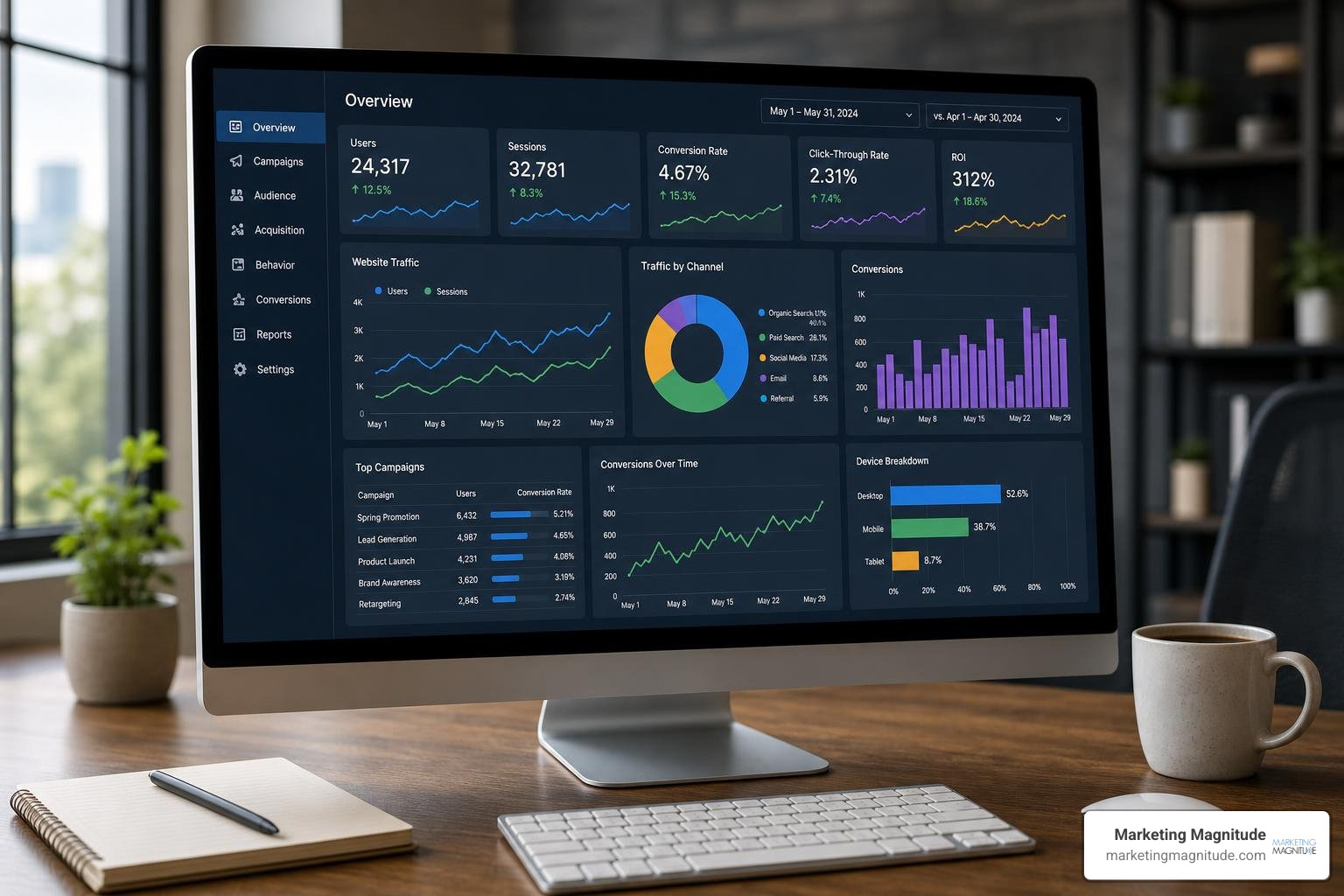
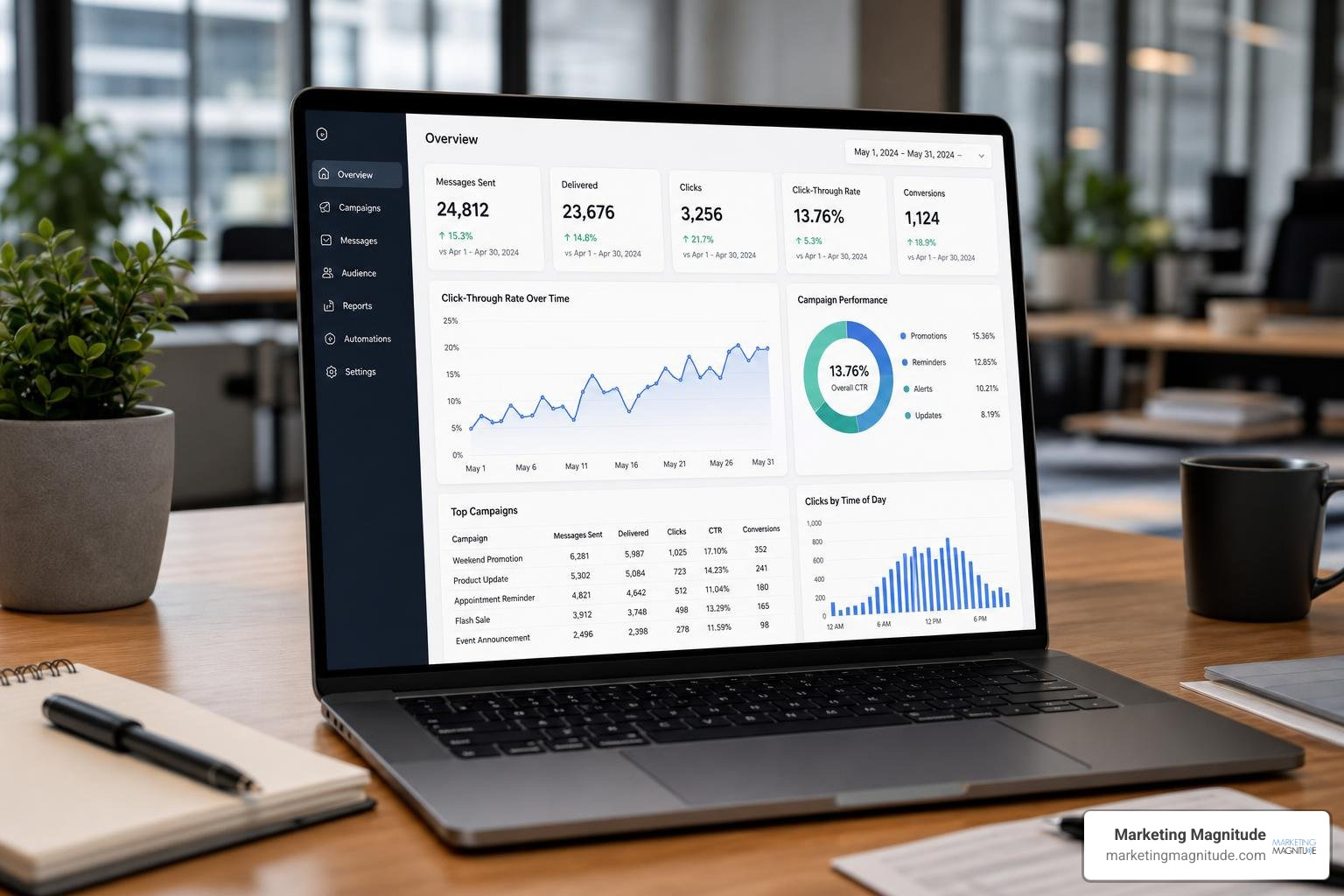
You cannot improve what you do not measure. Because SMS open rates cannot be tracked directly (as mobile carriers do not share that data), you must rely on other critical metrics to evaluate your campaign performance.
When evaluating your campaigns, focus on these core metrics:
- Click-Through Rate (CTR): This is the percentage of recipients who clicked a link in your text. A CTR of 6% to 12% is considered good, while anything above 15% is excellent.
- Conversion Rate: The percentage of recipients who took the final desired action (such as booking an appointment or making a purchase) after clicking your link. Typical SMS conversion rates range from 2% to 5%.
- Opt-Out Rate: The percentage of subscribers who reply STOP. Keep a close eye on this metric at the individual message level. If a specific message in your sequence has a high opt-out rate, it is a clear sign that the copy is too aggressive, sent too frequently, or lacks value.
- Revenue Attribution: Track purchases and bookings back to specific text messages. Many platforms use a strict 5-day attribution window for SMS clicks to measure exact ROI.
For local businesses looking to scale, integrating these metrics with your central CRM is key to maintaining clear visibility over your sales pipeline. Discover how our CRM Software & Marketing Automation Services can help you connect your SMS campaigns directly to your revenue tracking.
Frequently Asked Questions about SMS Drips
What is the ideal frequency for a drip SMS campaign?
To avoid message fatigue, we recommend keeping your sequences limited to 3 to 6 messages in total, spaced 2 to 5 days apart. For active nurture sequences, never send more than one message per day. For long-term customer retention or educational drips, a cadence of 2 to 3 messages per week is ideal. Always prioritize delivering genuine value over high message volume.
Can you track open rates for SMS drip campaigns?
No, SMS open rates cannot be tracked technically. Instead, you must measure engagement through link click-through rates. By using shortened, trackable URLs unique to each recipient, you can accurately track clicks, site behavior, and conversion attribution. For detailed documentation on how automated platforms track clicks and attribute revenue, refer to Send an SMS Campaign – Drip Help Center.
How do you personalize a drip SMS campaign beyond using a name?
True personalization relies on behavioral and situational data. You can personalize your texts by referencing specific products they viewed, their last service date, their local account manager’s name, or upcoming appointment details.
For example, instead of a generic greeting, you can send: “Hi {{First Name}}, it’s been 6 months since your last HVAC service in Austin. Book your summer tune-up here: {{Link}}.” To explore more advanced lead nurturing use cases, read How an SMS Drip Campaign Can Turn Interest Into Real ….
Conclusion

At Marketing Magnitude, we believe that sustainable business growth does not happen through isolated marketing tactics. True, scalable success occurs when your marketing, communication, and operational systems work together as one connected ecosystem.
A drip SMS campaign is not just a tool for sending text messages — it is a vital growth infrastructure asset. When integrated seamlessly with your CRM and broader marketing automation workflows, automated text sequences allow you to nurture relationships, recover lost revenue, and retain clients on autopilot, all while maintaining an authentic, human-centered connection.
Whether you are a healthcare provider in Las Vegas looking to reduce appointment no-shows, or a professional service business in Austin TX aiming to scale your lead follow-up, we are here to help you build a smarter, more efficient growth system.
Ready to eliminate fragmented systems and scale your customer communication sustainably? Explore our CRM Software & Marketing Automation Services today, and let’s build an automated system designed for your long-term success.