
Why Is Your Existing Customer Database the Most Profitable Marketing Asset for Landscaping in 2026?
To turn your landscaping customer database into a predictable, year-round revenue engine, businesses must segment customer property records (including turf species, square footage, and irrigation setups), automate seasonal email and SMS upsell campaigns, and deploy AI booking assistants to capture estimate requests instantly. Structuring client files into dynamic route clusters allows you to pre-book seasonal aeration, weed control, and irrigation services with minimal manual outreach.
While fresh lead acquisition will always play an important role in growing your business, acquiring a brand-new customer typically costs five to seven times more than retaining or expanding an existing account. In an industry where seasonal shifts, equipment overhead, and labor costs tighten profit margins, relying strictly on top-of-funnel acquisition creates an unpredictable revenue rollercoaster.
When we look at the financial fundamentals of lawn care and landscape operations, recurring maintenance accounts represent the true baseline of equity and operational stability. Consider the numbers: a single residential client enrolled in a bi-weekly or weekly maintenance program at an average of $200 per month generates $2,400 per year. Over a five-year relationship, that client contributes $12,000 in baseline recurring revenue. When you systematically nurture that relationship through structured, automated seasonal upsells—such as core aeration, mulch replenishment, seasonal color rotations, shrub pruning, and low-voltage lighting maintenance—that client’s total lifetime value easily climbs to $18,700 or more.
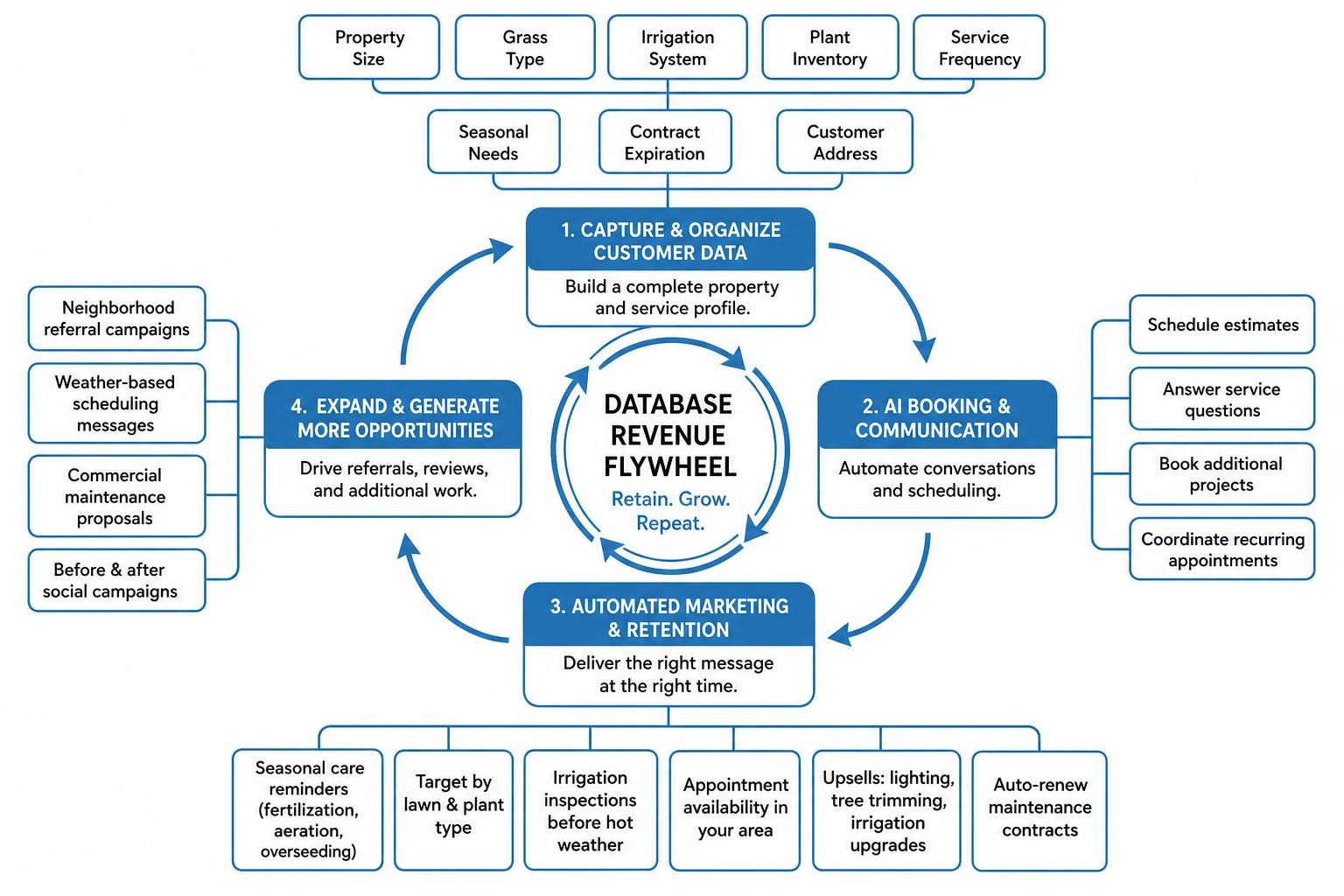
The primary reason many landscaping businesses struggle with winter cash flow dry-ups or mid-summer lulls is not a lack of local demand; it is an over-reliance on reactive, manual outreach. When customer records sit scattered across paper clipboards, disconnected spreadsheets, or basic billing software, office managers must spend days calling hundreds of property owners to book seasonal cleanups or irrigation blowouts.
By shifting from manual calling to an integrated, data-driven revenue engine, we turn your historical customer records into predictable, automated work orders that maintain steady cash flow throughout every month of the year.
How Do You Structure and Segment Landscaping Customer Files for Maximum Revenue?
To generate high-margin upsells and maximize route efficiency, your customer database must capture property-specific intelligence beyond standard contact details. A generic email blast offering aeration to every client on your list wastes marketing spend and annoys customers whose lawns do not require it. True database-driven marketing relies on dynamic segmentation.
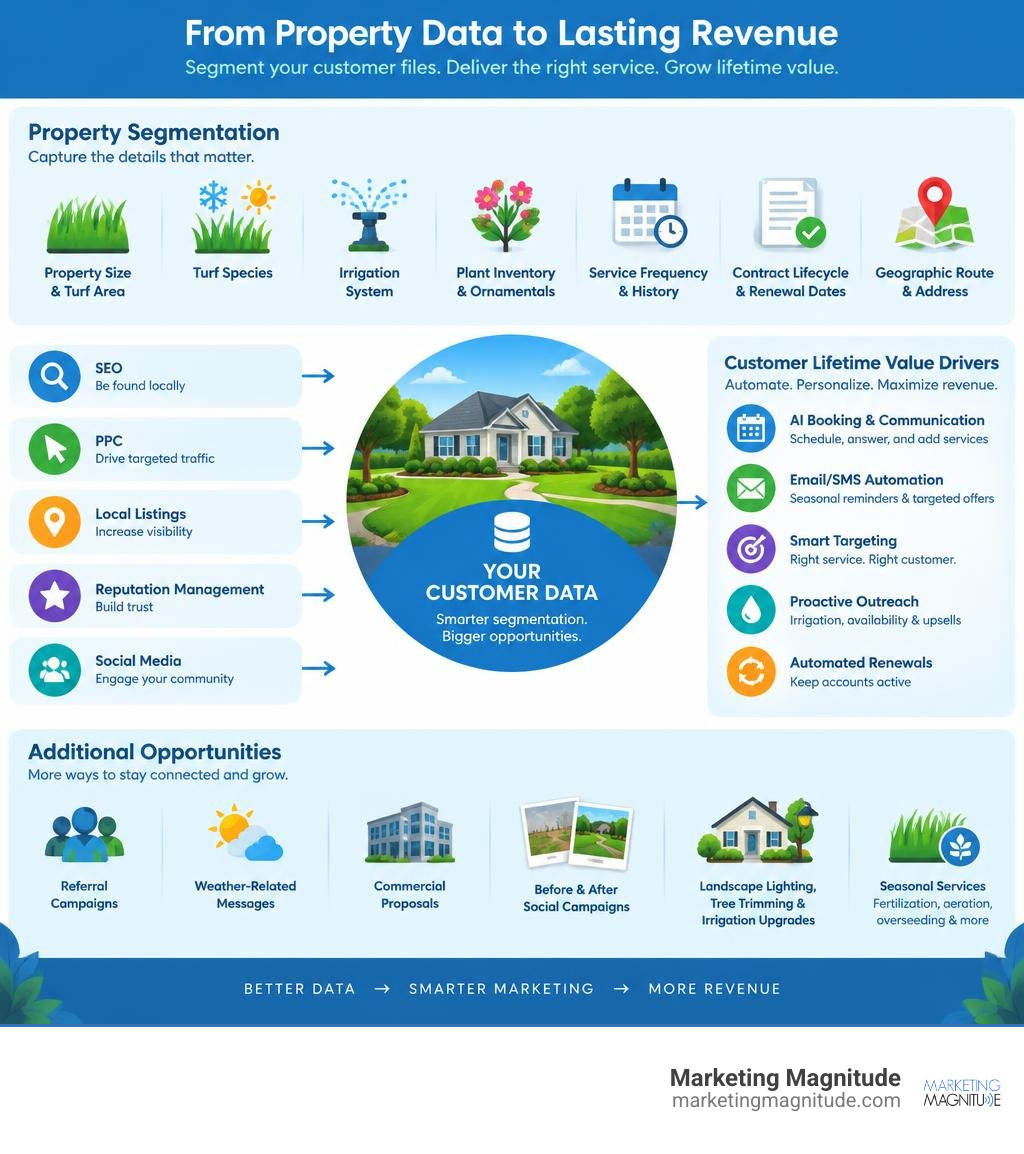
Every high-performing landscaping database should track the following core data attributes for each property:
- Property Size & Turf Square Footage: Enables accurate automated quoting for liquid fertilization, pre-emergent treatments, aeration, and overseeding without requiring a truck roll for an on-site measurement.
- Turf Species: Segments cool-season grasses (Tall Fescue, Kentucky Bluegrass) from warm-season varieties (Bermuda, St. Augustine, Zoysia) to ensure fertilization and seeding schedules align with specific agronomic windows.
- Irrigation System Specifications: Tracks controller brand, number of active zones, backflow preventer type, and date of last inspection to trigger proactive spring activation and fall winterization workflows.
- Plant Inventory & Specialty Ornamentals: Identifies properties with ornamental flowering trees, boxwood hedges, or native desert shrubs that require structured pruning schedules, pest treatments, or dormant oil applications.
- Service Frequency & Maintenance History: Differentiates full-service weekly maintenance accounts from seasonal project-only clients.
- Contract Lifecycle & Renewal Dates: Flags upcoming 30-, 60-, and 90-day maintenance contract expirations for automated renewal workflows.
- Geographic Route & Street Address: Groups accounts by neighborhood subdivisions, streets, and postal corridors to optimize crew routing.
| Property Record Field | Traditional Flat List Approach | Segmented Custom Property Profile | Revenue & Operational Impact |
|---|---|---|---|
| Turf Variety | Not tracked or generic “lawn” tag | Specific species recorded (e.g., Bermuda vs. Tall Fescue) | Eliminates mismatched fertilizer applications and boosts campaign click-to-book rates |
| Turf Area | Unknown | Exact square footage recorded | Enables instant programmatic pricing on aeration, overseeding, and topdressing |
| Irrigation Specs | “Sprinklers: Yes” | Zone count, controller model, backflow type | Yields 70–85% seasonal rebooking rates on start-ups and winterization blowouts |
| Shrub & Tree Profile | Unrecorded | Inventory of palms, ornamental hedges, fruit trees | Powers high-margin pruning and deep-root feeding service upsells |
| Geographic Cluster | Random ZIP codes | Street-level and neighborhood subdivision grouping | Cuts route drive time and crew fuel consumption by 25–30% |
Managing these data fields efficiently requires centralized operational software. Deploying a dedicated Contractor Marketing CRM Platform allows field technicians and office staff to log property attributes directly from mobile devices during routine visits. Understanding how to increase revenues from current customers begins with organizing your customer data so that every follow-up message offers a service the homeowner genuinely needs.
Segmenting by Turf Species and Plant Material
Agronomic needs vary dramatically across turf species. Applying nitrogen fertilizer or broadleaf weed control at the wrong time of year will damage the lawn and erode customer trust. In transition zones and warm-season regions such as Las Vegas or Austin, TX, Bermuda grass enters winter dormancy and may benefit from fall ryegrass overseeding, whereas cool-season turf requires deep aeration and fertilization during late summer and autumn.
When your customer database automatically categorizes turf species, your marketing platform can dispatch tailored educational guides and service offers directly matching the customer’s property profile. Furthermore, maintaining notes on mature canopy trees and specialty ornamentals allows you to promote hazard assessments and preventive tree care. For an in-depth look at marketing high-margin arboreal services, explore The Complete Guide to Next-Level Digital Marketing for Tree Services.
Geographic and Route-Based Clustering
Non-billable windshield time is one of the largest drains on landscaping profitability. When your crews spend 45 minutes driving between isolated jobs across town, labor costs rise while total completed stops drop.
Geographic segmentation allows us to cluster our marketing campaigns around high-density service pockets. When your customer files are organized by subdivision and street, you can automate radius-specific promotions to adjacent homeowners whenever a crew is scheduled in that neighborhood. Establishing route clusters can cut route drive time and fuel consumption by 25–30%, allowing your crews to complete one to two additional stops per day without increasing overhead.
How Can AI Booking and Automated Communication Streamline Lawn Care Operations?
During peak seasonal surges, such as the initial spring cleanup rush or the post-monsoon cleanup period, office phones ring continuously. Inbound inquiries from homeowners wanting property estimates often slip through the cracks when staff are overwhelmed. Studies show that responding to an inbound service inquiry within five minutes dramatically increases lead conversion rates, while waiting even thirty minutes drops qualification odds substantially.
Integrating AI Phone Answering & Chatbot Services into your web properties and phone lines solves this bottleneck. An AI-powered communication assistant answers calls 24/7, responds instantly to website inquiries, captures property measurements, pre-qualifies job requirements, and books estimates directly into your team’s calendar.
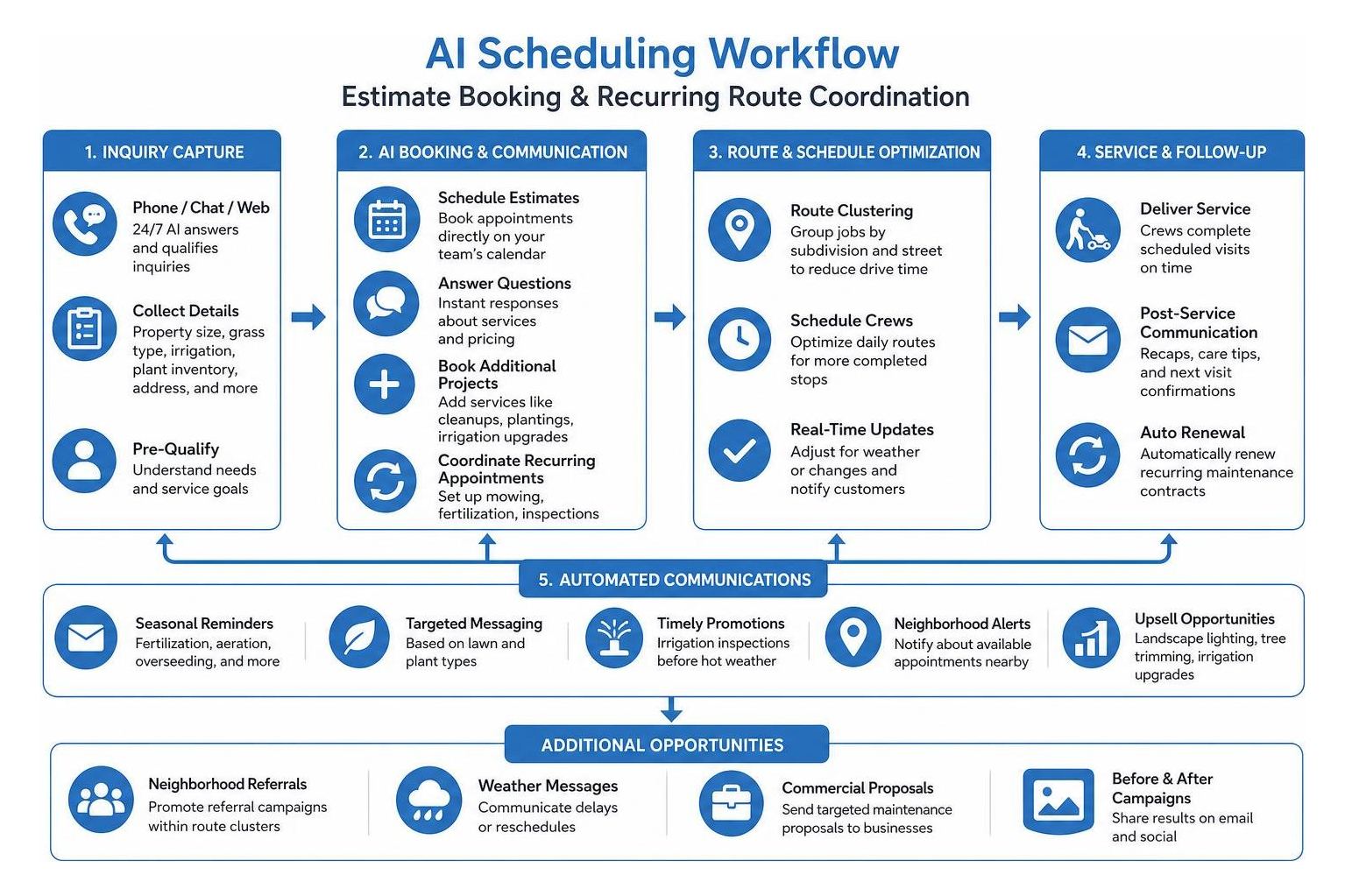
Connecting an AI booking engine with your CRM eliminates the lag between customer inquiry and estimate delivery. For standard recurring services like weekly lawn mowing or seasonal sprinkler checks, AI assistants can present immediate quotes based on database property size formulas, collect credit card details to store on file, and confirm recurring service days without human intervention.
Automated Project Upsells and Add-On Booking
Interactive conversational AI can automatically recommend logical service additions when a customer schedules routine maintenance. For instance, when a client opens an SMS reminder confirming their upcoming seasonal cleanup, the AI assistant can prompt:
“Hi David, your spring yard cleanup is scheduled for Tuesday. Our crew has room on the truck to deliver and install 3 yards of fresh dark mulch while on site. Would you like us to add this to your visit for an automated one-click confirmation?”
When the homeowner taps “Yes,” the work order updates in your scheduling system automatically, maximizing crew revenue per stop.
Weather-Triggered Scheduling and Notifications
Inclement weather—whether extreme heat advisories, high winds, heavy rain, or early freezes—inevitably impacts field operations. Traditionally, bad weather triggers an influx of frantic customer calls asking why crews have not arrived.
Connecting your database with weather-triggered automation tools turns a customer service headache into an operational asset:
- Proactive Weather Delay Alerts: Dispatches an automated text alert 12 hours prior to severe weather notifying clients that routes are shifted by 24 hours to protect their turf from tire rutting.
- Post-Storm Recovery Campaigns: Triggers instant SMS alerts to properties in storm-affected ZIP codes offering prompt fallen branch removal, palm frond cleanups, and drainage clearance.
Which Email and SMS Automation Campaigns Drive the Highest Seasonal Upsells?
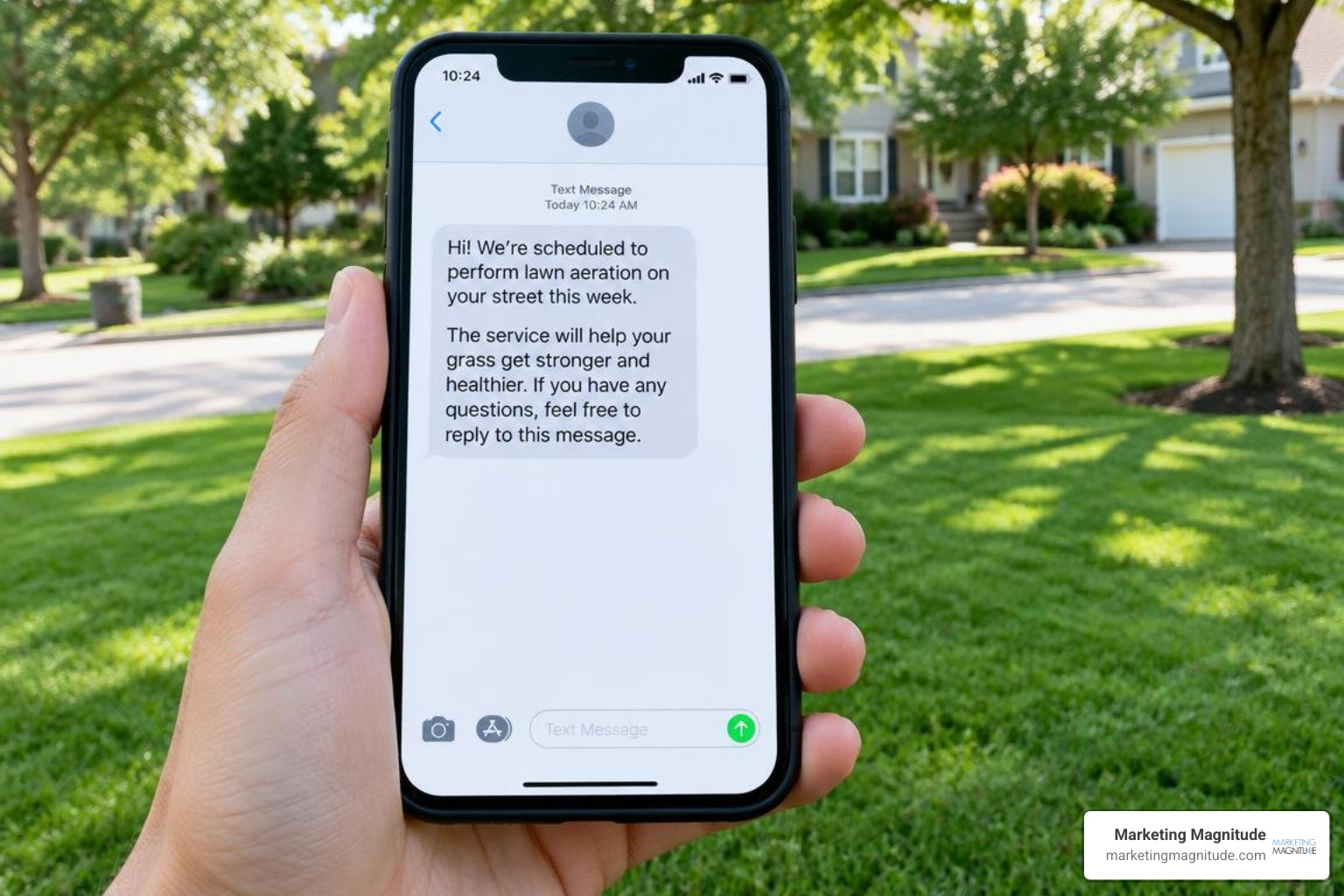
Email and text messaging remain the most cost-effective channels for generating revenue from your existing customer database. Industry data shows that email marketing delivers an average return of $36 to $40 for every $1 invested. When combined with SMS, which consistently sees open rates above 90%, you can deploy automated campaigns that systematically fill your schedule ahead of each season.
Implementing end-to-end Email Marketing Automation ensures your clients receive relevant service recommendations precisely when their landscapes require them. To launch text-based outreach quickly, review our step-by-step walkthrough on how to set up a drip SMS campaign in 5 easy steps.
Here are the highest-margin seasonal automated campaigns every landscaping business should run:
- Pre-Emergent Weed Control Waves (Late Winter / Early Spring): Alerts homeowners to schedule soil barrier applications before soil temperatures trigger weed germination.
- Core Aeration, Dethatching & Overseeding (Early Autumn / Spring): Programmatically calculates square-footage pricing and offers one-click booking to established turf owners.
- Low-Voltage Landscape Lighting Audits: Offers fixture cleaning, lens replacement, timer adjustments, and LED upgrades ahead of darker winter months.
- Smart Irrigation Upgrades: Promotes weather-sensing smart controllers, drip conversions, and high-efficiency rotary nozzles before water restriction periods begin.
The Multi-Wave Irrigation Activation and Winterization Sequence
Irrigation maintenance is one of the highest-margin services in the green industry. Sprinkler systems require date-driven service rather than subjective aesthetic maintenance. However, running manual call lists often results in low booking conversion because office staff reach voicemail or miss the narrow seasonal window.
Businesses deploying multi-wave automated SMS and email reminders achieve 70–85% rebooking rates among system-owning customers, compared to just 35–50% for companies relying on manual phone outreach.
- Wave 1 (4 Weeks Prior to First Freeze or Thaw): Dispatches an early-bird booking notification with a direct calendar link to reserve startup or blowout dates.
- Wave 2 (2 Weeks Prior): Sends an urgency-focused reminder warning of limited seasonal route capacity and the risk of freeze damage to backflow valves.
- Wave 3 (Missed-Response Recovery, 10–14 Days Later): Targets unbooked system owners with an automated text offer bundling system startup with a seasonal backflow test or drip-zone inspection.
Frictionless Contract Renewals and Retention Sequences
Client turnover undermines long-term business valuation. Churn often occurs simply because a one-year agreement lapses and neither party proactively initiates a renewal.
Automating maintenance contract renewals eliminates friction:
- 60-Day Satisfaction Check: Sends an automated feedback survey to resolve any service discrepancies before contract discussions begin.
- 45-Day Early-Renewal Incentive: Offers a fixed credit applied toward seasonal enhancements (such as seasonal color or aeration) for renewing the annual maintenance plan early.
- Auto-Pay Integration: Enrolling clients on automatic card-on-file payment schedules increases client retention and smooths month-to-month cash flow.
- Post-Project Maintenance Conversion: When an installation or hardscaping project wraps up, trigger an automated sequence over the following 14 days offering an ongoing maintenance agreement to preserve the new installation. Industry data demonstrates that presenting a maintenance agreement upon project completion converts 15–25% of one-off installation clients into long-term recurring revenue.
How Do Local SEO, PPC, and Reputation Management Feed Your Recurring Revenue Engine?

Your customer database does not exist in isolation. To keep your database filled with high-value accounts, you need a steady stream of local inbound inquiries. When search marketing, pay-per-click advertising, and reputation management work together with your CRM, they form a cohesive growth engine.
Building strong organic visibility using Local SEO Services: Boost Visibility in Google Maps ensures that when property owners search for landscaping services, your company appears in the Google Local Map Pack. Proven local optimization tactics—such as maintaining accurate business citations, earning backlinks, and structuring location-specific service pages—are detailed in our A-Z Guide to Maps Pack Ranking.
Reputation management is equally critical: according to BrightLocal’s Local Consumer Review Survey, the vast majority of consumers read online reviews before selecting a local home service company, and many will refuse to hire a contractor with too few reviews. Furthermore, Google Business Profiles featuring 100+ authentic project photos generate three times more inbound phone calls than profiles with fewer than 20 images.
To drive high-ticket installations without wasting marketing budget on unqualified leads, contractors must refine their paid advertising. High-end design-build projects require very different targeting than basic mowing inquiries. Managing search campaigns through dedicated Paid Search Management Services prevents search term contamination, ensuring your ad spend reaches high-intent homeowners seeking comprehensive landscape overhauls. For a broader overview of search channel synergy, explore our guide on SEO vs SEM: What’s the Difference?.
Dominating Neighborhood Clusters with Targeted Local Ads and Referrals
Once you secure a recurring maintenance client on a specific street, your acquisition costs for neighboring homes drop significantly. You can dominate that micro-market through coordinated neighborhood campaigns:
- Hyper-Local Google Ads: Run radius-targeted search campaigns covering high-value subdivisions, supported by call tracking for marketing campaigns to measure lead attribution accurately.
- Neighbor Referral Sequences: When a crew completes work on a property, automated software prompts the homeowner with a referral link offering both them and their neighbor a credit on their next monthly invoice.
- Automated Radius Postcards: Automatically dispatch “We’re working on your street” direct mailers to the 20 nearest homes surrounding a major design-build installation.
Visual Proof and Before-and-After Social Campaigns
Landscaping is inherently visual. Homeowners want to see transformative curb appeal before committing to extensive yard redesigns or ongoing turf programs.
Using professional Social Media Management, we can turn routine crew photos into compelling visual proof across Facebook and Instagram. Documenting the step-by-step restoration of drought-damaged turf, outdoor kitchen builds, or nighttime landscape lighting installations establishes local authority and captures homeowner interest. Including direct estimate links in your social posts channels interested prospects straight into your automated CRM database.
Frequently Asked Questions About Landscaping Database Marketing
How often should a landscaping company send automated marketing emails and text messages to its customer list?
Communication frequency should follow regional landscaping seasons. During major seasonal transition windows (early spring prep, mid-summer irrigation checks, and late autumn winterization), sending two to three touches per month via combined email and SMS is effective and welcomed by homeowners who need seasonal services.
During quieter maintenance months, scale back outreach to once a month, focusing on educational lawn tips, equipment safety, or property enhancement ideas. Always ensure your text messaging complies with standard carrier opt-out guidelines by including clear unsubscribe instructions, and maintain message logging through your CRM Software & Marketing Automation suite.
What customer data points are most critical for setting up personalized landscaping campaigns?
The five most foundational property data points are:
- Turf Square Footage & Grass Variety: Determines exact fertilizer application windows, mowing heights, and overseeding rates.
- Irrigation System Infrastructure: Tracks zone counts, backflow assembly type, and controller functionality.
- Landscape Bed & Shrub Footprint: Helps estimate mulch requirements, weed fabric needs, and seasonal trimming labor.
- Service History & Active Contract Status: Identifies which properties are prime candidates for recurring maintenance conversions.
- Geographic Route Cluster: Identifies the neighborhood or subdivision to ensure marketing supports efficient crew routing.
If your database is missing these details, train field technicians to capture measurements and plant notes on their mobile devices during initial property evaluations and routine maintenance visits.
How does an automated customer database help acquire commercial maintenance contracts?
Commercial property managers, HOA board directors, and facility operators prioritize reliability, prompt communication, and risk mitigation over low-bid pricing. Maintaining a structured customer database allows you to automatically send commercial maintenance proposals 60 to 90 days before fiscal budgeting cycles close.
Your database can store key commercial details—such as parking lot square footage for snow clearing, irrigation backflow test dates for municipal compliance, and commercial turf acreage—allowing you to generate comprehensive multi-season proposals tailored to commercial property needs.
How Can Landscaping Companies Build a Sustainable Growth Ecosystem?
Scaling a landscaping business sustainably requires connecting every element of your business into a single operational engine. When marketing, customer management, communication, and field operations operate in silos, leads get lost, routes become inefficient, and off-season revenues drop.
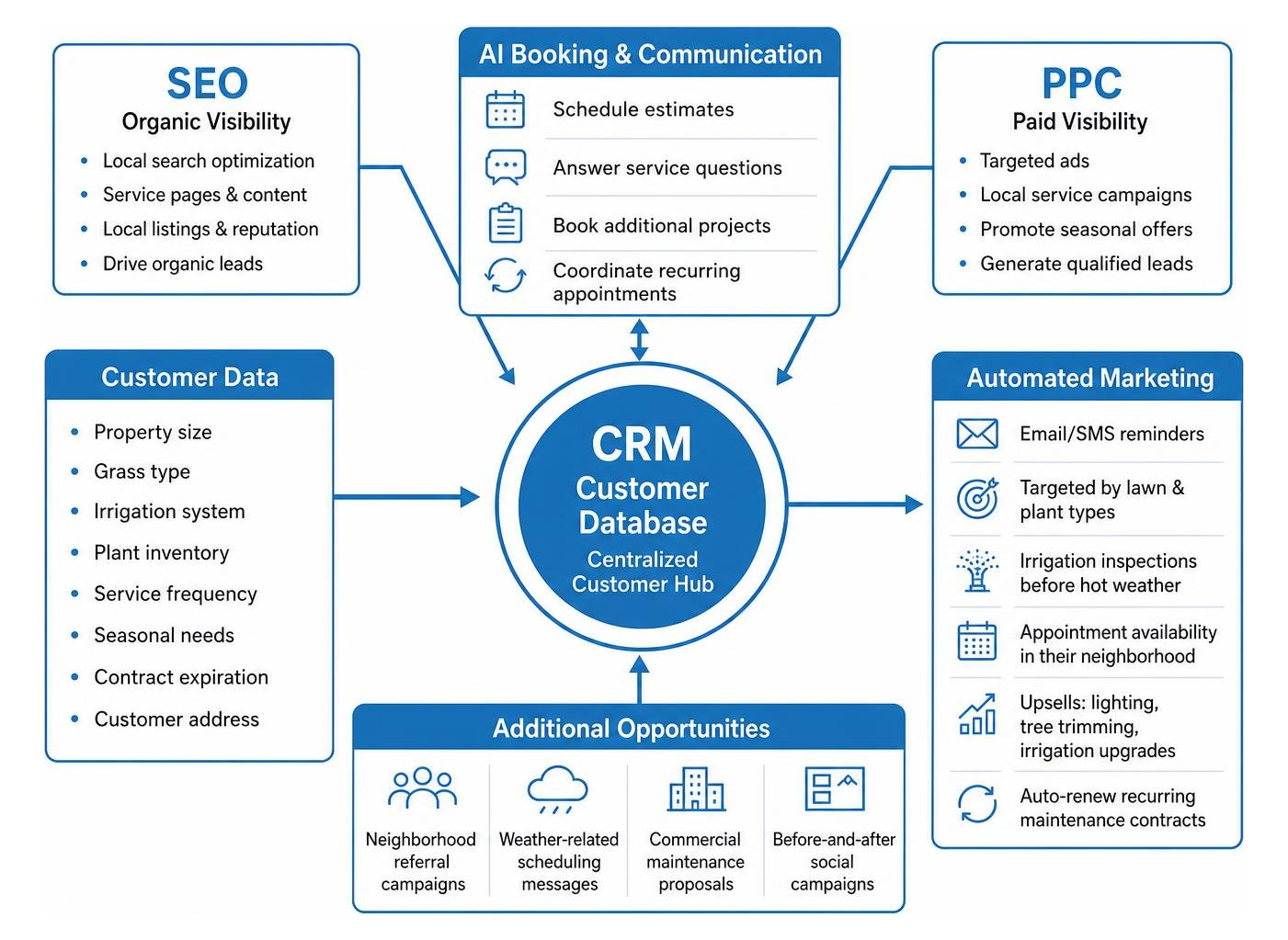
At Marketing Magnitude, we partner with home service contractors to build integrated growth platforms. Rather than offering disconnected marketing tactics, we connect custom Website Design & Development, advanced Search Engine Optimization Services, focused paid search management, and intelligent CRM automation into one unified system.
By structuring your customer database, automating AI booking and seasonal follow-ups, and building local search visibility across your primary service territories, we help you eliminate seasonal cash flow slumps and build a predictable, year-round revenue engine.
Ready to turn your customer database into your most profitable business asset? Contact us today to design your customized landscaping growth platform.
Get Started Now
Fill out this form to start your journey to next-level marketing solutions for your business.