Why Is an Integrated Digital Marketing and CRM System Essential for Roofing Contractors?
An integrated digital marketing and CRM system is essential for roofing contractors because it connects every lead source, intake channel, and follow-up workflow into one automated growth engine. This unified approach ensures that when a homeowner searches, calls, or submits a form, the inquiry is captured instantly, qualified systematically, and nurtured through project completion—preventing the lead leakage, slow response times, and lost sales that plague fragmented marketing setups.
The roofing industry in 2026 represents a massive $92.2 billion market across roughly 105,000 contractors in the United States. Yet despite high demand, most roofing companies struggle with unpredictable revenue cycles, volatile lead volumes, and lost sales opportunities.
The primary cause is fragmentation. Traditional marketing setups treat search engine optimization, pay-per-click advertising, social media, and customer communication as completely separate silos. A homeowner sees an ad after a hail event, submits a form, and waits hours—or even days—for someone to call back. Meanwhile, field estimators write paper quotes that get buried in spreadsheets, and past customers are forgotten until the next severe weather event hits.
With severe weather generating over $58 billion in annual insured losses, storm restoration and residential retail replacements represent high-stakes revenue opportunities. When hail strikes or high winds damage a neighborhood, thousands of property owners seek inspections simultaneously. In this high-pressure environment, disconnected marketing channels collapse:
- Lead leakage occurs at intake: An estimated 25% of inbound calls to home-service businesses go unanswered, a number that spikes during storm surges.
- Response delays destroy win rates: While the average company takes 42 hours to respond to an inquiry, reaching a homeowner within the first hour makes a contractor nearly seven times more likely to hold a meaningful conversation with a decision-maker.
- Estimates stall in limbo: Without automated follow-ups, up to 60% of delivered proposals go unanswered simply because nobody followed up consistently.
Winning in today’s roofing market requires moving away from disjointed tactics and establishing a connected growth ecosystem. When your acquisition channels (SEO, PPC, local maps) feed directly into intelligent intake tools (AI voice receptionists, chatbots) and an automated CRM, every lead is captured instantly, qualified systematically, and nurtured through project completion.
How Can Roofing Contractors Combine SEO, PPC, Local Listings, and Reputation Management?

A resilient digital marketing strategy relies on multiple acquisition pillars working together. When we look at how homeowners find and choose a roofer, over 55% conduct extensive research online before calling, and 70% of local service inquiries originate through organic local search.
To dominate local service areas such as Las Vegas, Nevada or Austin, Texas, roofing contractors must build a multi-layered search engine presence that captures homeowners at every stage of their search intent.
Organic Local Search & Google Business Profile Optimization
Long-term organic visibility starts with foundational technical architecture and dedicated service pages. By following our detailed guide to SEO basics for home service contractors, roofing businesses can build search authority that generates steady retail replacements year-round.
Capturing top search positions requires:
- Hyperlocal Keyword Clustering: Creating dedicated landing pages for specific neighborhoods and suburbs targeting terms like “tile roof replacement in Summerlin” or “emergency roof repair in South Congress”.
- Google Map Pack Dominance: Implementing our best local SEO strategies for HVAC, plumbing, and roofing companies to rank in the top three map positions where the vast majority of local clicks occur.
- Specialized Local Signals: Leveraging professional local SEO services that boost visibility in Google Maps by maintaining consistent Name, Address, and Phone (NAP) citations across industry directories, embedding local schema markup (Contractor, FAQ, and Review schemas), and regularly uploading geotagged job-site photos directly to Google Business Profile.
High-Intent Paid Advertising & Bid Optimization
While SEO builds long-term equity, Pay-Per-Click (PPC) advertising through Google Search and Local Services Ads (LSAs) delivers immediate visibility when severe storms hit or homeowners face emergency leaks.
However, standard cost-per-lead (CPL) benchmarks can be misleading. Industry data indicates that an aggregate CPL of $350 often masks the massive difference in revenue potential between a $400 minor pipe boot repair and a $25,000 full roof replacement.
We structure high-return PPC campaigns around lead intent:
- Intent-Driven Bidding: Bidding aggressively on high-intent keywords (“hail damage roof inspection”, “complete roof replacement contractor”) while routing minor leak queries to lower-cost ad groups.
- Multi-Platform Retargeting: Retargeting unclosed website visitors across social and display networks. Because retargeted prospects are 70% more likely to convert than first-time visitors, remarketing keeps your brand top-of-mind while homeowners collect competitive bids.
- Negative Keyword Filtering: Continually scrubbing search query reports for terms like “how to patch a roof DIY”, “shingle prices per bundle”, or “roofing jobs hiring” to protect ad budgets from non-revenue clicks.
Systematic Review Generation and Brand Proof
Over 90% of consumers read online reviews before hiring a local service business. In roofing, where contracts average tens of thousands of dollars, trust and social proof dictate whether an estimate is signed or rejected.
An integrated marketing system automates the reputation management process:
- Triggered Review Requests: As soon as a job status shifts to “Completed” in the CRM, automated SMS and email prompts request reviews on Google Business Profile, the Better Business Bureau, and industry-specific portals.
- Keyword-Rich Responses: Responding to all reviews promptly, naturally incorporating geographic markers and specific service terms (“Thank you for trusting our crew with your stone-coated steel roof installation in Northwest Austin”).
- Video Testimonials: Embedding homeowner video case studies directly on high-intent PPC landing pages, lifting conversion rates by demonstrating authentic community trust.
How Do Customer File Customizations Drive Higher Conversion Rates?
Most roofing CRMs operate as static digital address books. To unlock true marketing leverage, contact records must be enriched with property-specific metadata. Using a dedicated contractor marketing & CRM platform, contractors can segment their database into targeted audiences rather than sending blanket promotions.
Predictive models that combine verified weather severity data with property age improve lead conversion rates by 40% compared to random neighborhood canvassing. By structuring custom fields inside the CRM, every communication speaks directly to the homeowner’s exact situation.
| Custom Data Field | Core Trigger Rules & Criteria | Targeted Marketing Campaign Activated |
|---|---|---|
| Roof Age | Reaches 15, 20, or 25-year milestones | Proactive replacement consultations, architectural upgrade guides |
| Roofing Material | Architectural, 3-tab shingle, tile, metal, flat TPO | Lifespan warnings, material-specific maintenance checklists |
| Warranty Status | 11 months post-install, 5-yr, 10-yr, 20-yr milestones | Workmanship warranty inspections, extended protection renewals |
| Inspection History | 12+ months since last on-site inspection | Annual complimentary roof health check-up invitations |
| Storm Damage History | Address located within verified hail/wind swath | Weather-alert follow-up, complimentary damage verification |
| Estimate Status | Proposal delivered > 72 hours without signature | Automated 14-day estimate re-engagement & financing offers |
| Property Type | Single-family, multi-family, HOA, commercial | Tailored B2B asset management vs. residential retail copy |
| Insurance Claim Status | Claim filed, adjuster meeting pending, scope approved | Adjuster meeting preparation checklists, supplement support |
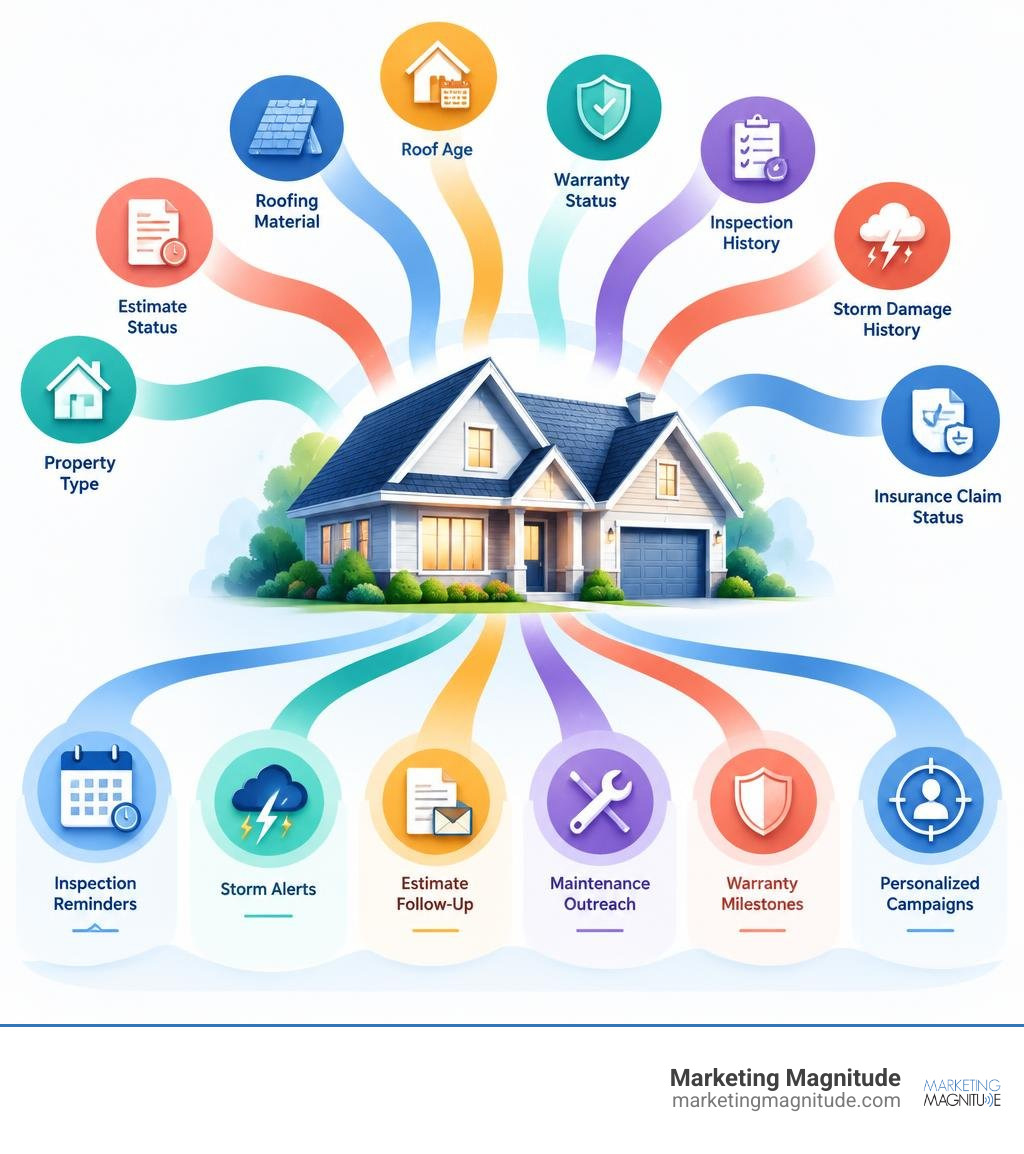
Essential Data Customizations for Roofing Contact Records
- Roof Age: Filtering database records by installation year allows you to target roofs approaching the end of their design life (e.g., 15–20-year-old asphalt shingles) before catastrophic leaks occur.
- Roofing Material: Concrete tile, standing seam metal, flat membrane, and asphalt shingles degrade differently. Material segmentation ensures homeowners receive relevant care instructions rather than irrelevant service offers.
- Warranty Status & Expiration Dates: Tracking workmanship and manufacturer warranties allows you to schedule a proactive 11-month inspection before the initial one-year workmanship period expires, reinforcing customer satisfaction.
- Inspection & Service History: Keeping detailed digital records of past gutter cleanings, minor flashing repairs, and attic ventilation checks helps estimators build credibility during repeat consultations.
- Storm Damage History: Recording historical weather events tied to the property creates a defensible audit trail when working with insurance adjusters on delayed damage claims.
- Estimate Status: Categorizing pipeline stages (Estimate Sent, Insurance Scope Review, Verbal Approval, On Hold) ensures prospects receive stage-appropriate nurturing.
- Property Type: Separating single-family homeowners from HOA board members and commercial facility managers ensures commercial leads receive formal capability statements and commercial references.
- Insurance Claim Status: Tracking open insurance claims allows the sales team to provide timely assistance with carrier scopes of loss, deductible verification, and supplement documentation.
How Does AI Booking and Real-Time Communication Streamline Storm Lead Intake?
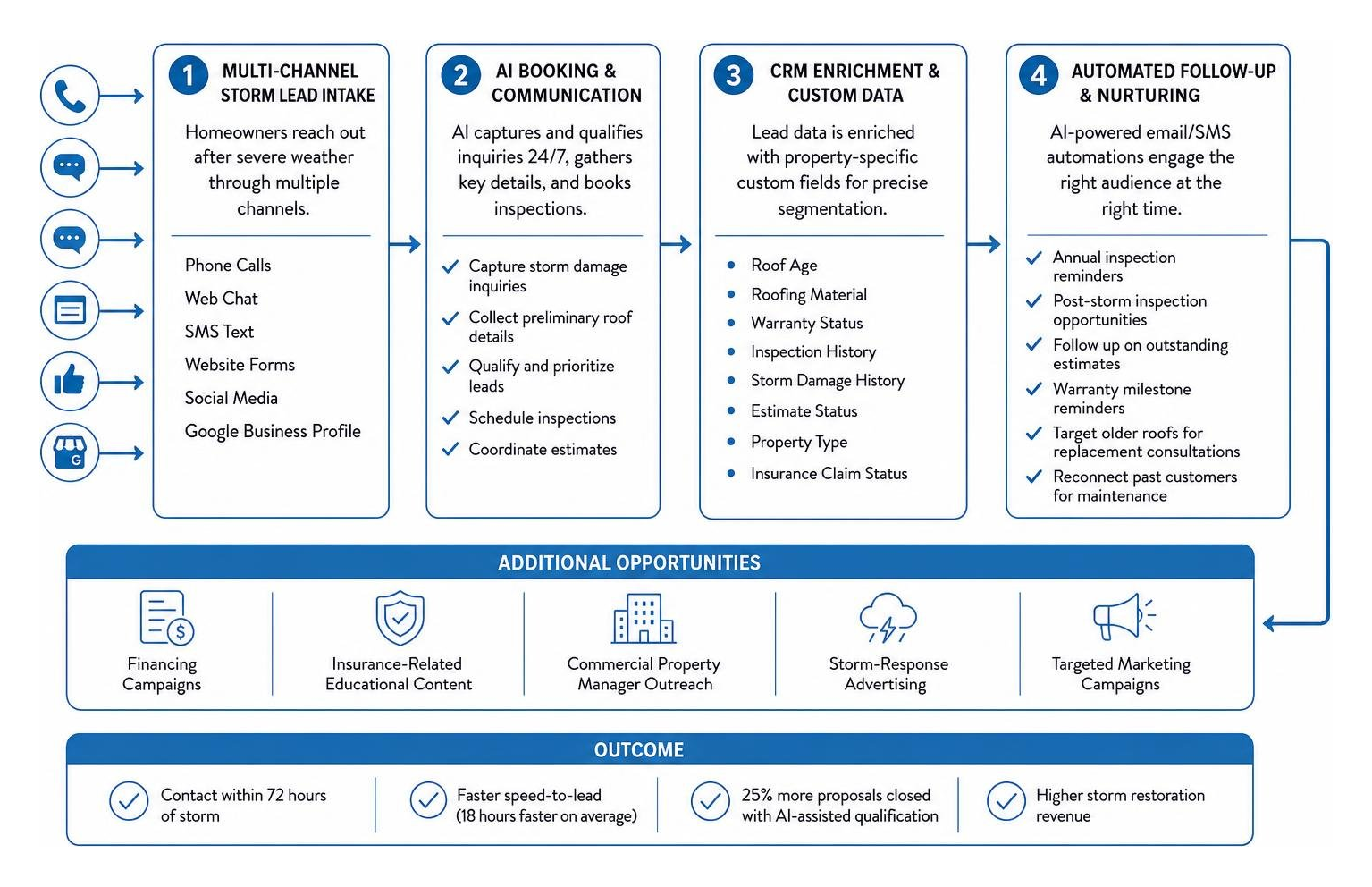
Speed-to-lead is the single most decisive factor in storm restoration revenue. Research confirms that homeowners who receive outreach within 72 hours of a storm event are three times more likely to schedule an inspection than those contacted later. Furthermore, 80% of storm-related insurance claims are filed within the first two weeks following severe weather.
When a storm hits, manual phone systems break down immediately. Estimators are in the field, office staff are overwhelmed, and prospective customers call the next contractor on Google Maps when their call goes to voicemail.
Deploying 24/7 AI phone answering & chatbot services solves this operational bottleneck. Automated storm-response workflows allow contractors to contact incoming prospects an average of 18 hours faster than manual operations. With AI-assisted qualification filtering out non-viable inquiries, sales estimators close 25% more proposals because their time is reserved for ready, qualified buyers.
Automated Multi-Channel Lead Capture & Deduplication
Inquiries flood in simultaneously across phone calls, web forms, Google Business messages, Facebook Messenger, and SMS during a weather event.
An automated intake engine captures every channel instantly and applies deduplication logic based on caller ID and property address. This prevents multiple sales representatives from calling the same household, eliminating internal confusion and protecting the company’s professional reputation.
Conversational Qualification & Preliminary Detail Gathering
AI voice agents and website chat tools do not merely take messages; they qualify leads using natural conversational logic:
- Capturing Damage Indicators: Asking whether there are active interior ceiling leaks, missing shingles, or visible denting on gutters and air conditioning units.
- Gathering Property Details: Confirming homeownership status, roof material, and insurance carrier name.
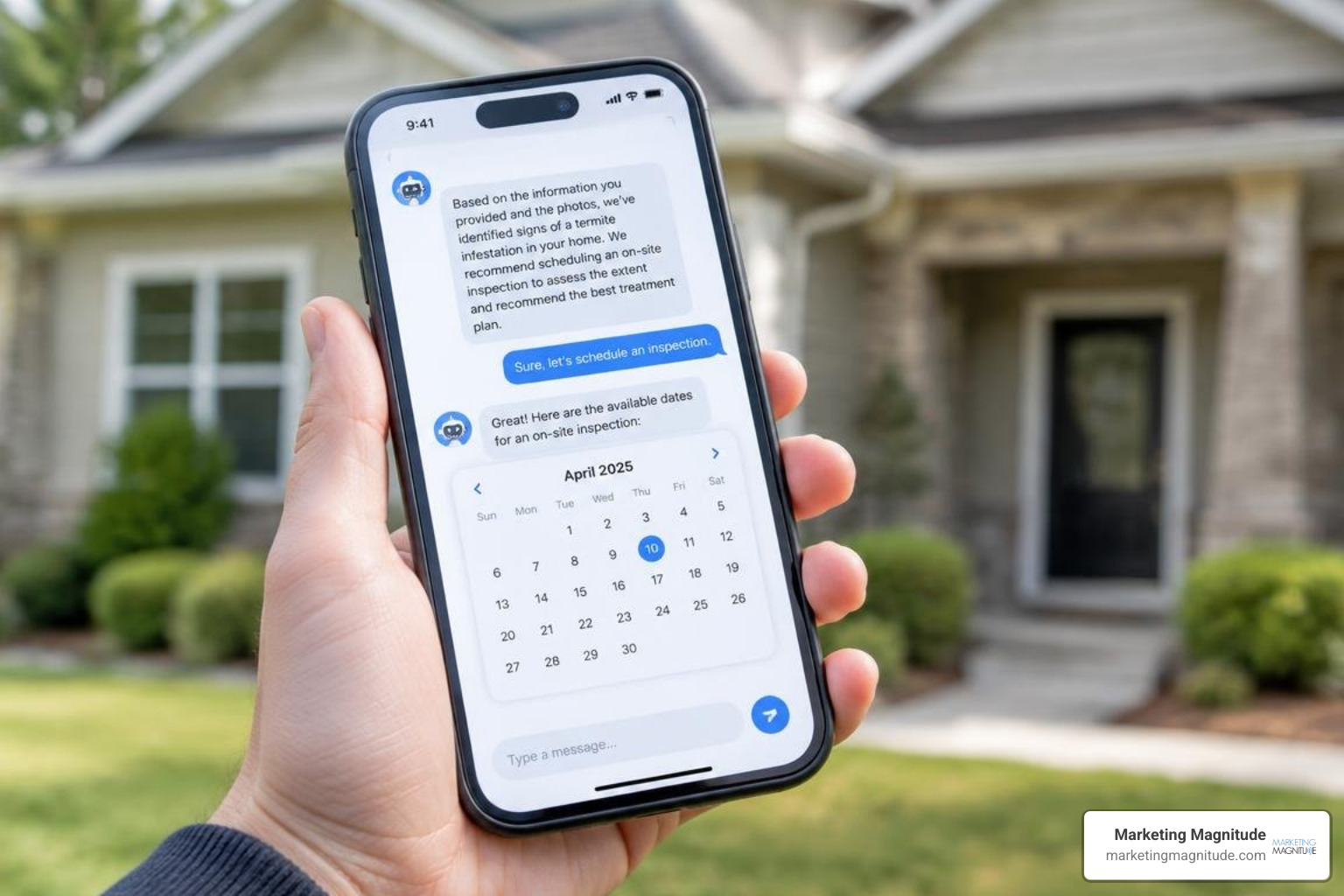
- Automated Photo Uploads: Sending an automated SMS link enabling the homeowner to upload photos of visible roof or gutter damage from their smartphone, allowing estimators to triage urgency before leaving the office.
- Intelligent Lead Scoring: Automatically routing high-value, full-replacement candidates to senior project managers while queuing minor repair inquiries for dedicated repair technicians.
Direct Calendar Booking & Self-Scheduling
Once qualified, the AI system presents real-time calendar availability based on geographic dispatch zones. By clustering inspections within specific ZIP codes, contractors minimize drive time and fuel costs. The system immediately dispatches booking confirmations via SMS and email, accompanied by a digital checklist explaining what the homeowner should prepare before the estimator arrives.
What Are the Most Effective Email and SMS Automation Sequences for Roofing Follow-Ups?
SMS communication achieves near-98% open rates compared to roughly 22% for email. However, email excels at delivering in-depth educational material, project portfolios, and insurance claim walkthroughs. Combining both channels through behavioral CRM software & marketing automation allows contractors to capture the 58% of revenue generated by segmented, automated workflows.
When building SMS sequences, following our guide on how to set up a drip SMS campaign in 5 easy steps ensures strict compliance with TCPA and CAN-SPAM regulations, including explicit consent records and instant STOP opt-out processing.
90-Day Post-Storm Automated Campaign Sequence
A structured 90-day sequence matches communication to the homeowner’s evolving decision timeline:
- Days 1–3 (Calm Triage & Safety Alert): Focus on safety and leak prevention.
- SMS: “Hi Maria, severe hail was verified in your neighborhood last night. If you notice leaks or displaced shingles, our crew is staging complimentary safety inspections nearby. Reply INSPECT to hold a spot.”
- Days 4–14 (Inspection Follow-Up & Carrier Timelines): Highlight the importance of timely filing before carrier deadlines approach.
- Email: Send an educational guide: “Why 80% of storm damage claims are filed within 14 days — and what adjusters look for during their initial walk.”
- Days 15–45 (Claim Scope & Proposal Decision Nurture): Address insurance paperwork and material options.
- SMS/Email: Provide scope-of-loss reviews, explain how supplement documentation works, and outline Class 4 impact-resistant shingle options.
- Days 46–90 (Slow Nurture & Season Closeout): Re-engage unclosed inquiries.
- Email Track: Highlight carrier filing deadlines (many policies require claims within 12 months) and share before-and-after photos of completed neighborhood restorations.
Annual Roof Inspection & Maintenance Reminders
Past customers represent predictable repeat and referral revenue.
Eleven months after an installation or repair, an automated workflow triggers an annual check-up notification. In regions with intense sun exposure, such as Nevada, or severe seasonal thunderstorm patterns, such as Texas, seasonal reminders (spring hail prep and autumn weatherproofing) keep your brand top-of-mind while generating consistent service work.
Outstanding Estimate & Proposal Re-Engagement
When a roofing quote is delivered, momentum fades quickly without structured follow-up. An automated 14-day estimate sequence systematically addresses decision hesitation:
- Day 2: Send a personal video link explaining the estimate breakdown and scope inclusions.
- Day 5: Highlight flexible monthly financing options with estimated monthly payments.
- Day 9: Outline warranty protections (manufacturer material warranties vs. contractor workmanship coverage).
- Day 14: Offer a final consultation call before material pricing locks expire.
Aging Roof & Warranty Milestone Campaigns
Segmenting records by property age allows you to run database reactivation campaigns to homes built 15+ years ago. Remind homeowners that aging shingles become brittle, lose granule adhesion, and are increasingly vulnerable to high winds.
Similarly, checking in at 5-, 10-, and 20-year warranty milestones reinforces customer loyalty and generates word-of-mouth referrals.
What Additional Marketing Strategies Drive Year-Round Revenue and High-Value Contracts?

Relying exclusively on hail or wind events creates volatile “feast or famine” revenue cycles. To build a sustainable, scalable enterprise, roofing contractors must diversify their lead generation across commercial sectors, financing promotions, and proactive weather-triggered advertising.
Integrated Financing Campaigns
Cost is the single largest objection in retail roof replacements. Integrating consumer financing options directly into PPC landing pages, email signatures, and digital estimate proposals lowers the barrier to entry.
Promoting low monthly payment plans or seasonal “No Interest, No Payments for 12 Months” programs during slower winter months converts budget-conscious homeowners who would otherwise delay replacing an aging roof.
Educational Content on Insurance Claims & Regulatory Compliance
Homeowners often feel overwhelmed by insurance claim jargon. Publishing authoritative, educational guides on Actual Cash Value (ACV) versus Replacement Cost Value (RCV), insurance deductibles, and navigating adjuster meetings positions your company as a trusted consumer advocate.
From a regulatory standpoint, all marketing copy must strictly comply with state insurance statutes. Contractors must never claim to “negotiate” claims or act as public adjusters without appropriate licensing. Clear, educational content with FAQ schema markup also positions your brand to earn citations across AI search engines and voice assistants.
Commercial Property Manager & HOA Outreach
Commercial and multi-family projects yield substantial contract values and recurring maintenance revenue. Reaching property decision-makers requires an Account-Based Marketing (ABM) approach:
- Targeted Identification: Building targeted lists of commercial property managers, industrial facility directors, and HOA board members.
- Value-Focused Offers: Offering complimentary infrared moisture surveys and commercial roof asset management plans rather than generic sales pitches.
- Omnichannel B2B Sequences: Combining professional LinkedIn outreach, personalized direct mail packets, and educational email sequences outlining life-cycle cost reduction.
Weather-Triggered Geo-Targeted Advertising
Modern advertising platforms can integrate directly with National Oceanic and Atmospheric Administration (NOAA) weather radar APIs.
When hail measuring 1 inch or greater or wind gusts exceeding 58 mph strike specific ZIP codes, the system automatically launches geo-targeted search and social media campaigns within 1 to 3 hours. Landing pages dynamically display local storm radar swaths and verified hail sizes, delivering immediate relevance to affected property owners.
What Are the Key Metrics to Track for a Roofing Marketing and Automation System?
A growth system is only as effective as the data guiding it. By tracking end-to-end performance metrics, roofing contractors can eliminate marketing waste and scale high-performing channels with clarity.
Using conversation intelligence and multi-touch attribution software allows contractors to connect initial ad clicks directly to signed contracts, lifting overall marketing ROI by 25% and improving sales close rates by 15% to 20% within six months.
Lead Intake & Speed Metrics
- Speed-to-First-Contact: Tracking the exact time between a lead submission and the first outbound touchpoint (targeting single-digit minutes).
- Call Capture Rate: The percentage of total inbound calls answered by human staff or AI receptionists (aiming for 98%+ coverage).
- Cost Per Qualified Lead (CPQL): Measuring cost per lead segmented by intent (retail replacement vs. storm claim vs. repair) rather than aggregate CPL.
Sales Pipeline & Conversion Benchmarks
- Inquiry-to-Inspection Booking Rate: The percentage of raw inquiries that result in a confirmed on-site inspection (top-performing automated systems achieve 40%+).
- Inspection-to-Estimate Presentation Rate: Ensuring estimators deliver formal scopes for every qualified inspection performed.
- Estimate-to-Contract Close Rate: Measuring close rates by lead source, service category, and individual sales representative.
- Average Job Value (AJV) & Gross Margin: Tracking profitability by marketing channel to allocate budget toward the most lucrative project types.
Customer Lifetime Value & Database Reactivation
- Database Reactivation Rate: Percentage of revenue generated from dormant past customer records through automated maintenance and aging roof campaigns.
- Review Conversion Rate: Percentage of completed jobs that yield a verified 5-star Google review.
- Referral Pipeline Value: Revenue driven through structured post-warranty check-ins and referral incentive workflows.
Frequently Asked Questions About Roofing Digital Marketing and Automation
How quickly should a roofing contractor respond to storm leads to maximize conversion?
Speed-to-lead is vital during storm events because 80% of insurance claims are initiated within the first two weeks. Reaching an inbound lead within the first hour makes your company nearly seven times more likely to have a meaningful conversation with a decision-maker than waiting another hour. Automated AI intake workflows allow roofers to engage prospects within seconds across SMS and voice, securing inspection slots before competitors respond.
Can automated marketing workflows remain compliant with insurance regulations and TCPA laws?
Yes. Automated communication remains fully compliant when structured around customer education and transparency. Under FCC TCPA rules, businesses must collect prior express written consent before sending automated marketing texts or calls, provide immediate opt-out instructions, and process STOP requests instantly. Furthermore, all insurance-related content should educate homeowners on their policy rights without unlawfully claiming to negotiate policy terms like an unlicensed public adjuster.
How does integrating CRM data with marketing campaigns improve roofing profitability?
Connecting marketing channels with CRM property data—such as roof age, shingle material, and past estimate history—enables targeted behavioral messaging rather than generic mass blasts. This integration allows ad platforms to optimize for high-value replacements over low-margin repairs, lifting overall return on marketing spend by 25% or more while keeping sales pipelines filled throughout the year.
How Can Roofing Contractors Implement a Scalable Growth Platform Today?
Growing a sustainable roofing business requires more than generating sporadic leads or relying on unpredictable weather events. Long-term profitability happens when marketing, lead intake, CRM data, AI communication, and sales operations function as one unified ecosystem.
At Marketing Magnitude, we help roofing contractors eliminate fragmented tools and missed opportunities. We don’t just run ads or build websites; we install complete business growth systems. By integrating hyper-local search visibility, high-intent paid advertising, 24/7 AI lead capture, and automated follow-up workflows, we help contractors scale sustainably with complete visibility into their revenue pipeline.
To evaluate your existing lead response times, audit your local search visibility, and implement an automated growth engine built for your market, explore our comprehensive services or speak with our team at Marketing Magnitude to build your connected growth platform today.
Get Started Now
Fill out this form to start your journey to next-level marketing solutions for your business.