Why Every Home Service Contractor Needs to Understand SEO Basics
The ultimate guide to SEO basics for home service contractors starts with one simple fact: 97% of consumers search online before hiring a local service provider — and if you’re not showing up, your competitor is getting that call.
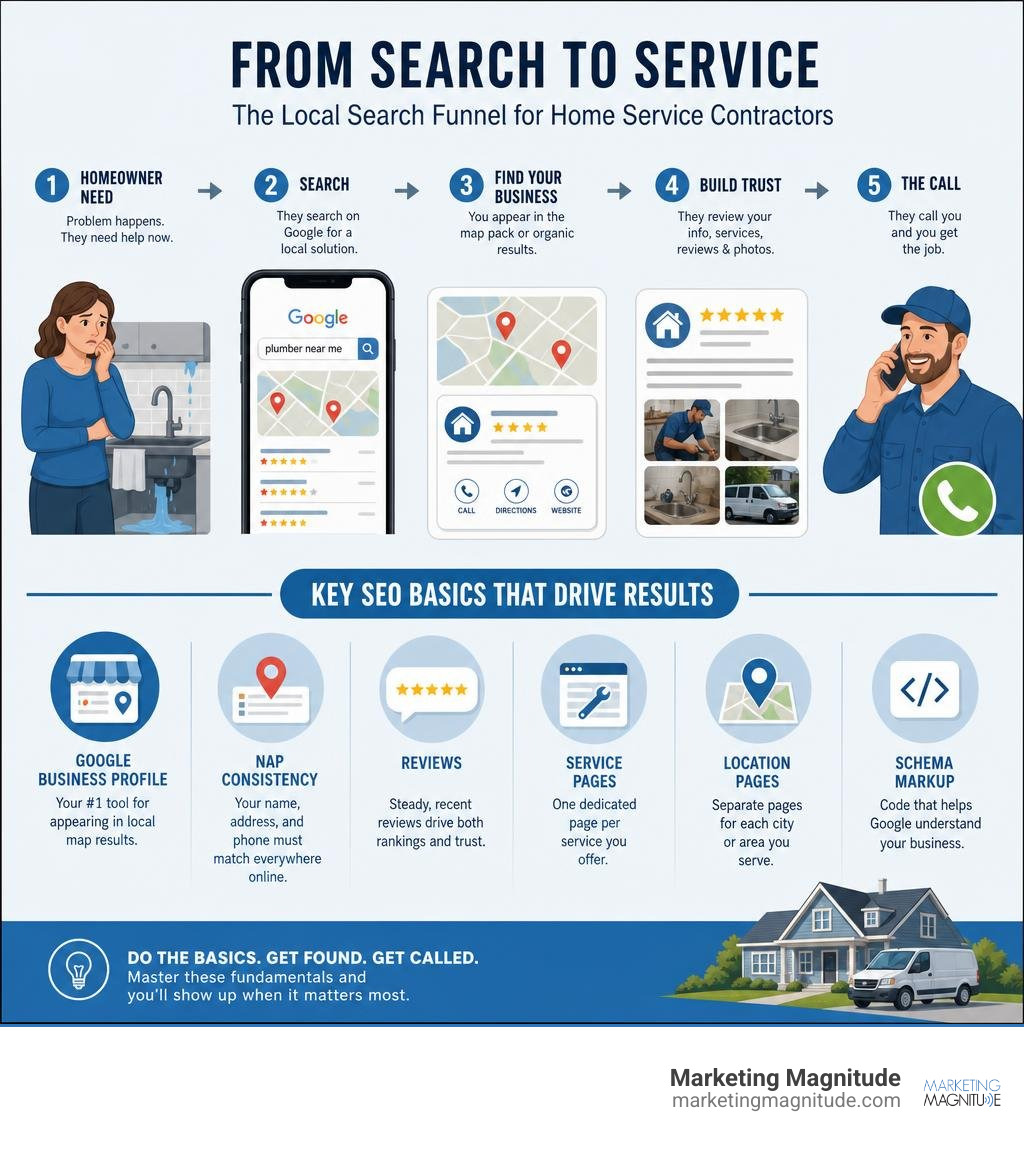
Here’s a quick overview of the core SEO basics every contractor needs:
| SEO Basic | What It Means for You |
|---|---|
| Google Business Profile | Your #1 tool for appearing in local map results |
| NAP Consistency | Your name, address, and phone must match everywhere online |
| Reviews | Steady, recent reviews drive both rankings and trust |
| Service Pages | One dedicated page per service you offer |
| Location Pages | Separate pages for each city or area you serve |
| Schema Markup | Code that helps Google understand your business |
Think about this: a homeowner wakes up to a flooded kitchen. She grabs her phone, searches “plumber near me,” and calls the first business that looks legitimate. That moment — high urgency, mobile search, instant decision — happens thousands of times a day in your market.
Over 60% of home service searches happen on mobile. More than 46% of all Google searches have local intent. The contractors winning those searches aren’t doing anything exotic. They’re doing the fundamentals really well.
This guide breaks down exactly what those fundamentals are, why they work, and how to put them in place — whether you’re starting from scratch or cleaning up what you already have.
I’m Kelly Rossi, founder of Marketing Magnitude, and with more than 20 years of experience helping home service businesses build connected marketing systems, I’ve seen how mastering the ultimate guide to SEO basics for home service contractors separates businesses that grow predictably from those that stay stuck chasing leads. Let’s walk through everything you need to know.
Simple The Ultimate Guide to SEO Basics for Home Service Contractors glossary:
Local SEO vs. Organic SEO: The Ultimate Guide to SEO Basics for Home Service Contractors
To build a reliable digital marketing engine, we first must understand that search engines look at local queries differently than general informational searches. When a homeowner in Las Vegas or Austin, TX searches for a contractor, Google splits the results page into distinct sections.

When we talk about What is Search Engine Optimization, we are looking at the overall practice of making your website and online listings visible to search engines. However, home service contractors have to run two distinct plays simultaneously: Local SEO and Organic SEO.
- Local SEO focuses entirely on geographic search intent. It is what drives your business into the “Google Map Pack” (the local 3-pack of map results that appears at the top of the search engine results page). This is heavily driven by your Google Business Profile, local reviews, and proximity to the searcher.
- Organic SEO deals with the traditional “blue links” below the Map Pack. This is driven by your actual website content, site structure, technical performance, and domain authority.
To help visualize how these two components work together in The Ultimate Guide to Digital Marketing SEO Basics, let’s look at how they compare side-by-side:
| Feature | Local SEO (Google Map Pack) | Organic SEO (Website Listings) |
|---|---|---|
| Primary Goal | Rank in the Local 3-Pack on Google Maps | Rank in the standard organic search results |
| Primary Asset | Google Business Profile (GBP) | Your website, service pages, and blog |
| Key Ranking Factors | Proximity, reviews, category selection, NAP consistency | Content depth, page speed, backlinks, site structure |
| Searcher Intent | Immediate commercial/emergency intent | Commercial and informational research |
| Main Call-to-Action | Click-to-call, request a quote, driving directions | Read a guide, fill out a form, explore services |
Both play a massive role in capturing high-quality organic traffic. While Local SEO captures the immediate “I need an electrician in Henderson, NV right now” calls, Organic SEO captures the homeowners who are researching options, comparing costs, or looking for specific specialized installations.
To dive deeper into the overarching strategy of balancing maps and organic listings, you can check out this comprehensive resource on Home Service SEO: Complete Contractor Guide [2026] | BaaDigi .
Why Traditional Search Differs from Local Search
Traditional SEO was built for e-commerce and national brands where physical location doesn’t matter. But for a roofing company in Austin, TX or an HVAC technician in Las Vegas, NV, traditional broad tactics simply won’t cut it.
First, we must look at emergency intent. When a homeowner’s air conditioning unit breaks down in the middle of a 110-degree July afternoon in Las Vegas, they aren’t looking to read a 3,000-word blog post about thermodynamic cooling cycles. They have immediate transactional intent. They want a reliable, highly rated contractor who is close by and can show up fast.
Second, the service radius adds complexity. As a service-area business (SAB), you do not serve customers at your physical office address; you go to them. Managing how Google understands your physical service boundaries requires a highly localized approach. To get a better handle on these concepts, familiarize yourself with the foundational language in our guide on SEO Terms You Need to Know and explore our quick index of A Brief Glossary of 12 Essential SEO Terms.
Core Ranking Factors: Relevance, Distance, and Prominence
Google uses three core pillars to decide which home service businesses deserve to rank in the coveted Local 3-Pack:
- Relevance: How well does your business profile match what the user is looking for? If someone searches for “tankless water heater installation,” Google will prioritize profiles that explicitly list that service, feature reviews mentioning water heaters, and have dedicated content on their website covering that topic.
- Distance: How far is your business from the searcher? Proximity is a massive ranking factor. However, because contractors operate as service-area businesses, we must carefully define our service areas in Google Business Profile to avoid diluting our proximity signals.
- Prominence: How well-known or authoritative is your business? This is determined by your overall digital footprint. Google looks at your website’s organic authority, your review count, review velocity (how consistently you get new reviews), and how many times your business is mentioned across authoritative local directories.
By understanding how these three factors interact, we can craft highly effective Local SEO Strategies to Boost Your Business that align perfectly with Google’s algorithms.
Optimizing Your Google Business Profile and Review Strategy
Your Google Business Profile (GBP) is the absolute command center of your local search presence. For many contractors, their GBP actually drives more phone calls and booked jobs than their actual website.
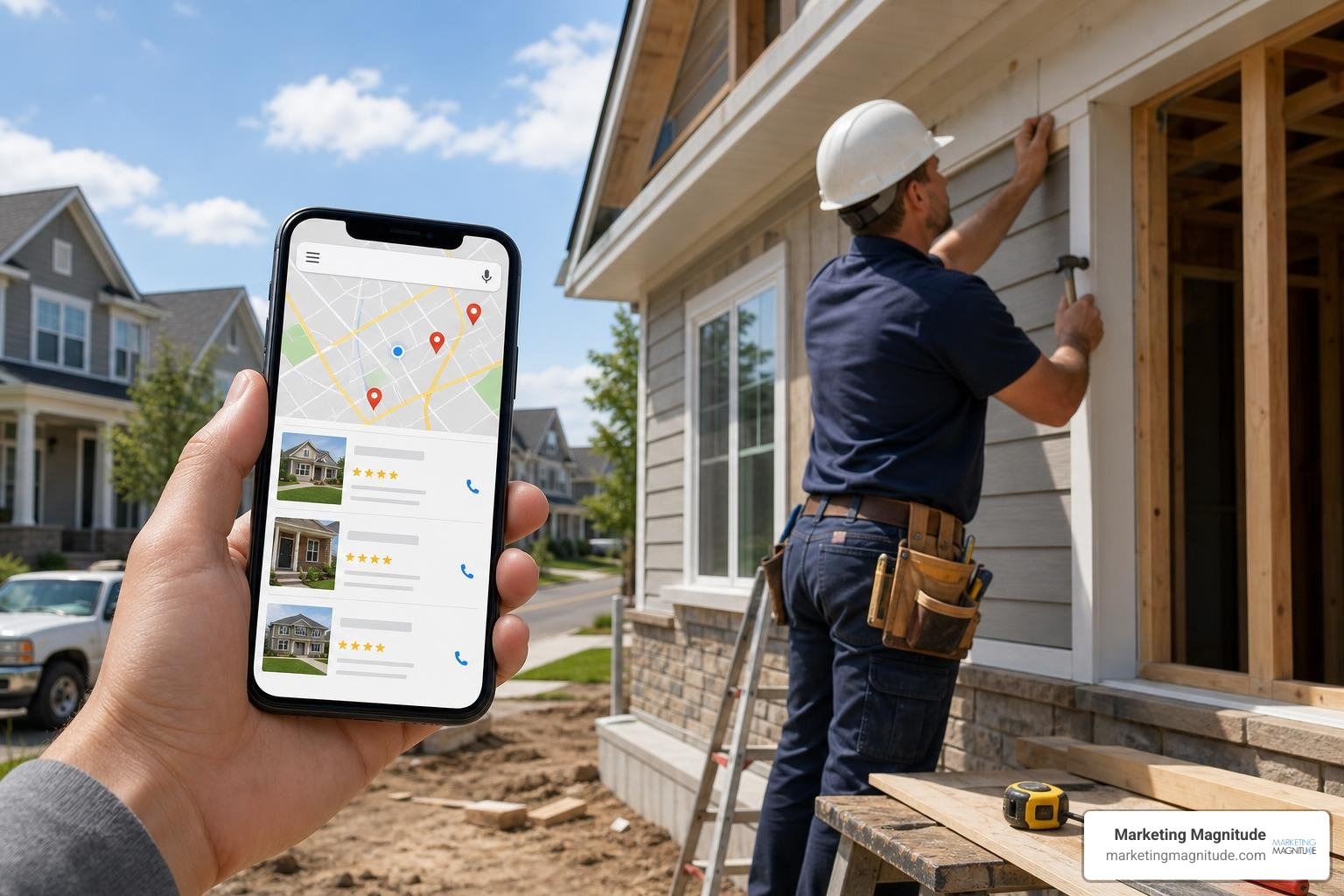
Because the local 3-pack takes up the entire first screen on mobile devices, optimizing this profile is the single highest-leverage move you can make. It is the ultimate “sneak attack” to bypass highly competitive organic listings and get right in front of ready-to-hire homeowners. To understand the mechanics of this, read about our Local SEO Services The Sneak Attack to Google Rankings and see how we implement these systems through Services Local SEO Services Boost Visibility in Google Maps.
Google Business Profile Setup in The Ultimate Guide to SEO Basics for Home Service Contractors
Setting up your profile correctly is critical. A single mistake in your categories or service area can completely tank your visibility. Here is how to optimize your profile step-by-step:
- Select the Perfect Primary Category: This is the single most important setting on your GBP. If you are an HVAC company, your primary category should be “HVAC Contractor” or “Air Conditioning Contractor,” not a broad category like “Service Establishment.” You can add secondary categories (like “Heating Contractor” or “Plumber”) to cover your other services, but your primary category must align with your most profitable, high-volume service.
- Define Your Service Area Tightly: Do not try to game the system by selecting five entire counties. Google penalizes profiles that claim implausibly large service areas. Keep your service area focused on the primary metro areas you actually serve (such as Las Vegas, NV or Austin, TX). Google allows you to list up to 20 specific cities or counties.
- Upload Real, High-Quality Photos: This is a massive trust-builder. Statistics show that businesses with more than 100 photos on their Google Business Profile receive 520% more calls than those with fewer than 10. Avoid stock imagery. Upload real photos of your branded trucks, your team in uniform, completed jobs, and before-and-after transformations. This proves you are a real local business.
- Utilize Advanced GBP Features: Do not treat your profile like a static billboard. Use Google Business Posts to share seasonal promotions, project updates, and maintenance tips. Turn on the messaging and booking features so late-night searchers can contact you directly without having to call.
For a deeper dive into mastering these map rankings, check out our A Z Guide to Maps Pack Ranking and review the practical tactics outlined in SEO for Contractors — Plain-English 2026 Guide .
Review Acquisition and NAP Consistency
Once your profile is set up, you need to feed Google the signals it needs to rank you above your competitors. This comes down to two things: reviews and NAP consistency.
NAP stands for Name, Address, and Phone number. Your NAP must be identical across every single platform on the web—your website, your GBP, Yelp, the Better Business Bureau, Facebook, and local directories. If your website lists your business as “Las Vegas Plumbing Experts, LLC” but your GBP says “Las Vegas Plumbing Experts” and your Yelp profile lists an old phone number, Google’s trust in your business’s legitimacy drops, dragging down your rankings.
When it comes to reviews, volume and recency are incredibly important. Studies show reviews can boost conversions by up to 270%. However, Google has cracked down heavily on review manipulation. In 2025, Google removed 292 million fake reviews, and in April 2026, Google officially banned review gating (the practice of pre-screening customers and only sending review links to happy clients).
The best review strategy is simple: ask every single customer for a review immediately after completing a job. Send a direct text link within an hour of finishing the work while their satisfaction is at its peak. Ensure you respond to every single review—both positive and negative—within 48 hours to signal to Google that you are highly active and engaged.
To build a robust foundation for your online reputation, check out our strategies on developing an Online Visibility Strategy and learn How to Keep Your Business Visible During Crisis.
Building a Penalty-Proof Website Architecture and Schema Stack
While your Google Business Profile drives immediate map calls, your website acts as the long-term compounding asset that establishes your brand authority. To prevent ranking collapses and algorithmic penalties, your website must be built on a clean, logical, and technically sound architecture.
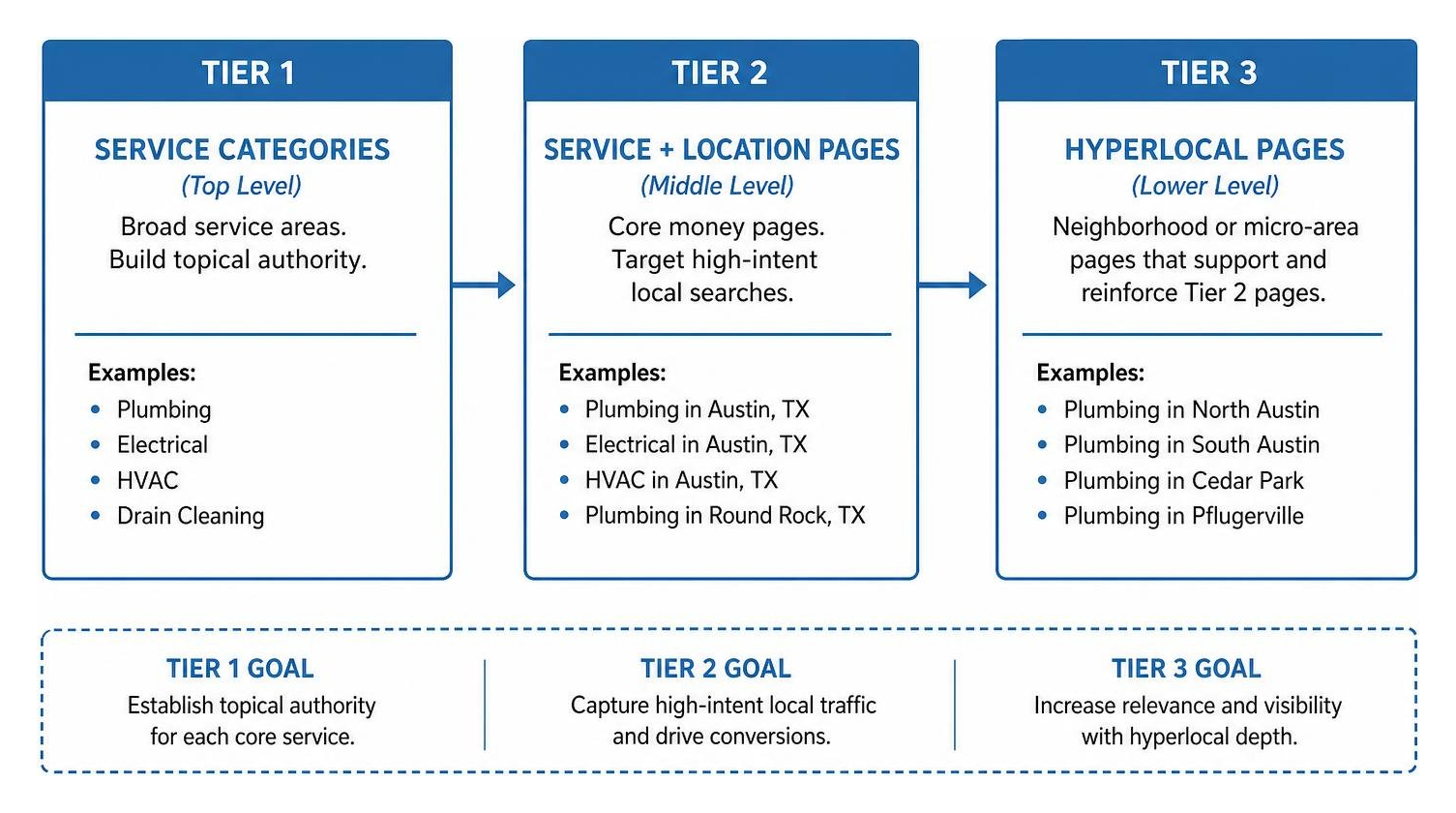
Many contractors make the mistake of using automated tools to spin up hundreds of identical city pages. This is a massive SEO mistake. Google’s search algorithms are incredibly smart, and thin, duplicate “doorway pages” will result in site-wide algorithmic damping or search penalties.
To ensure your site is built to rank and convert, explore our insights on Search Engine Optimization SEO Strategies for Improved Online Visibility and master The Secret Sauce of On Page Optimization. For an advanced architectural blueprint, you can also read the SEO for Contractor Leads: The 2026 Blueprint .
Technical On-Page Tactics in The Ultimate Guide to SEO Basics for Home Service Contractors
To help search engines understand exactly what services you offer and where you offer them, we must implement structured data, also known as schema markup. Schema is a specialized code that you add to your website that translates your content into a language search engines can easily digest.
For home service contractors, we recommend a robust schema stack:
- LocalBusiness Schema (or specific subtypes like HVACBusiness, Plumber, or Electrician): This tells Google your exact NAP, business hours, accepted payment methods, and geographic coordinates.
- Service Schema: This defines the specific services you offer, linking them directly to your main service pages.
- AggregateRating Schema: This displays your review stars directly in the organic search results, significantly boosting your click-through rates.
By implementing this technical code, you give search engines the exact context they need to confidently recommend your business. You can learn more about how modern technology and AI can help you implement these technical elements in our guide on How to Rank Your Website with ChatGPT.
Structuring Service Pages and Location Pages
Your website should follow a strict, logical hierarchy. Instead of putting all your services on a single page, you must create a dedicated page for every core service you offer.
For example, if you run a plumbing company in Austin, TX, you should not have a single “Services” page. Instead, you need individual, deep-dive pages (typically 800 to 1,500 words) for:
/services/drain-cleaning//services/water-heater-repair//services/emergency-plumbing/
Additionally, you need to structure your geographic location pages using a clean “3-Tier Model”:
- Tier 1 (Core City / HQ): This is your main homepage, optimized for your primary physical location (e.g., Las Vegas, NV or Austin, TX).
- Tier 2 (Satellite Cities): These are dedicated landing pages for major surrounding suburbs (e.g., Henderson or Summerlin for a Las Vegas contractor; West Lake Hills or Round Rock for an Austin contractor). These pages must feature completely unique content, including local project photos, local reviews, and specific local service details.
- Tier 3 (Coverage Area Page): A single page listing your entire service area map and zip codes to tie everything together.
To see how to structure these pages specifically for your trade, read our guide on the Best Local SEO Strategies for HVAC Plumbing and Roofing Companies. For additional inspiration on high-converting layouts, check out SEO for Home Services: The Complete Guide to Growing Your Business With Search – Marketing By Kevin .
Frequently Asked Questions About Contractor SEO
Navigating search engine optimization can feel overwhelming. To help you gain complete clarity, we have compiled and answered the most common questions contractors ask us about building their online presence.
To understand the core concepts behind these answers, it helps to know What is a Backlink and read A Beginners Guide to Promoting a New Website.
Can I rank in multiple cities without a physical office?
Yes, you can absolutely rank in multiple cities without having a physical office in each one, but your strategy must be highly intentional.
Because you are a Service Area Business (SAB), Google understands that you travel to your customers. To rank in surrounding satellite cities (like Henderson, NV or Round Rock, TX), you must build highly localized, unique location pages on your website.
Avoid using duplicate, templated text where you only swap out the city name. Instead, make each page genuinely unique by including:
- Real photos of jobs completed in that specific city.
- Reviews from customers living in that specific neighborhood.
- Details about local building permits, weather patterns, or local community events.
- A custom service-area map embed.
By building these high-quality, localized pages, you signal geographic relevance to Google without needing physical storefronts everywhere. To plan this out, explore our guide on How to Build Your First Content Marketing Strategy.
How many reviews do I need to rank in the Map Pack?
There is no magic number of reviews that will automatically guarantee a spot in the Local 3-Pack. Instead of focusing on a static target, Google’s algorithm looks at three main review metrics:
- Review Velocity: How consistently are you getting reviews? A business that gets 5 to 10 reviews every month looks much more active and trustworthy to Google than a business that got 50 reviews two years ago and none since.
- Review Sentiment and Keywords: Are your customers using natural keywords in their reviews? When a client writes, “They did a fantastic job with our furnace replacement in Austin,” Google reads those natural keywords and uses them to boost your relevance for those specific search terms.
- Overall Rating: While a perfect 5.0 rating is great, having a 4.7 or 4.8 rating with hundreds of reviews actually looks more authentic and trustworthy to both Google and homeowners than a perfect 5.0 with only three reviews.
To learn more about how ongoing content and customer engagement support your rankings, check out our thoughts on Should My Company Still Be Blogging.
What is the difference between Local SEO and Organic SEO?
The easiest way to understand the difference is to look at where the traffic goes and what assets are driving it:
- Local SEO is all about visibility in Google Maps and the Local 3-Pack. It is highly dependent on your physical location, your Google Business Profile optimization, local citations, and customer reviews. The primary call-to-action is usually a direct phone call or driving directions.
- Organic SEO is about ranking your actual website pages in the traditional search results below the maps. It is driven by the depth of your content, your technical website optimization, and the quality of your backlinks.
While they are different systems, they work together. A strong, highly optimized website with great organic rankings actually boosts the prominence of your Google Business Profile, helping you rank higher in the maps. To see how to write compelling, clickable titles for your organic content, check out our guide on How to Write Stunning Blog Post Titles.
Conclusion
Mastering the ultimate guide to SEO basics for home service contractors is not about chasing the latest marketing trends or trying to exploit temporary loopholes in Google’s algorithm. It is about executing the boring, fundamental basics exceptionally well.
At Marketing Magnitude, we believe that sustainable business growth does not happen through isolated marketing tactics. Real, predictable growth happens when your marketing, communication, CRM technology, and operational systems work together as one single, connected ecosystem.
When you connect a fast, highly optimized website to a fully completed Google Business Profile, back it up with an automated review generation system, and track your leads through a robust CRM, you build a compounding marketing asset that keeps your phone ringing month after month without holding your budget hostage to paid ads.
If you are ready to stop guessing, eliminate fragmented marketing systems, and build a predictable engine for your home service business, we are here to help. Explore our complete suite of Search Engine Optimization Services and let’s build a sustainable growth system for your business today.
Get Started Now
Fill out this form to start your journey to next-level marketing solutions for your business.