
The Real Answer to “How Much Should You Really Spend on Marketing?” (2026 Guide)
How much should you really spend on marketing? Break down by industry, revenue stage, and growth goals — here’s the short answer:
| Business Situation | Recommended Marketing Spend |
|---|---|
| Startup / New Business (under $1M revenue) | 12–25% of projected revenue |
| Growing SME ($1M–$5M revenue) | 10–20% of gross revenue |
| Established Business ($5M–$25M revenue) | 7–12% of gross revenue |
| Large Established Business ($25M+) | 5–8% of gross revenue |
| Maintaining market position | 2–7% of revenue |
| Steady / moderate growth goal | 7–12% of revenue |
| Aggressive growth goal | 15–30% of revenue |
| B2B companies (general) | 2–8% of revenue |
| B2C companies (general) | 5–15% of revenue |
| SaaS / Software | 15–25% of revenue |
| E-commerce / DTC | 10–15% of revenue |
| Professional services | 5–8% of revenue |
| Manufacturing | 5–7% of revenue |
| Healthcare | 6–10% of revenue |
The widely cited rule of thumb is 7–10% of gross revenue, and the U.S. Small Business Administration backs this up for businesses under $5M. But that number is really just a starting point — your ideal budget shifts based on your industry, how big your business is, and how fast you want to grow.
Most small business owners either spend too little and wonder why growth stalls, or spend without a clear plan and watch dollars disappear with nothing to show for it. Getting this number right matters more than most people realize.
I’m Kelly Rossi, founder of Marketing Magnitude and a digital marketing strategist with over 20 years of experience helping businesses across dozens of industries set smart, ROI-driven budgets — so I know how critical it is to answer “how much should you really spend on marketing, broken down by industry, revenue stage, and growth goals” with real numbers, not vague advice. Read on for a complete breakdown of exactly where your budget should land.
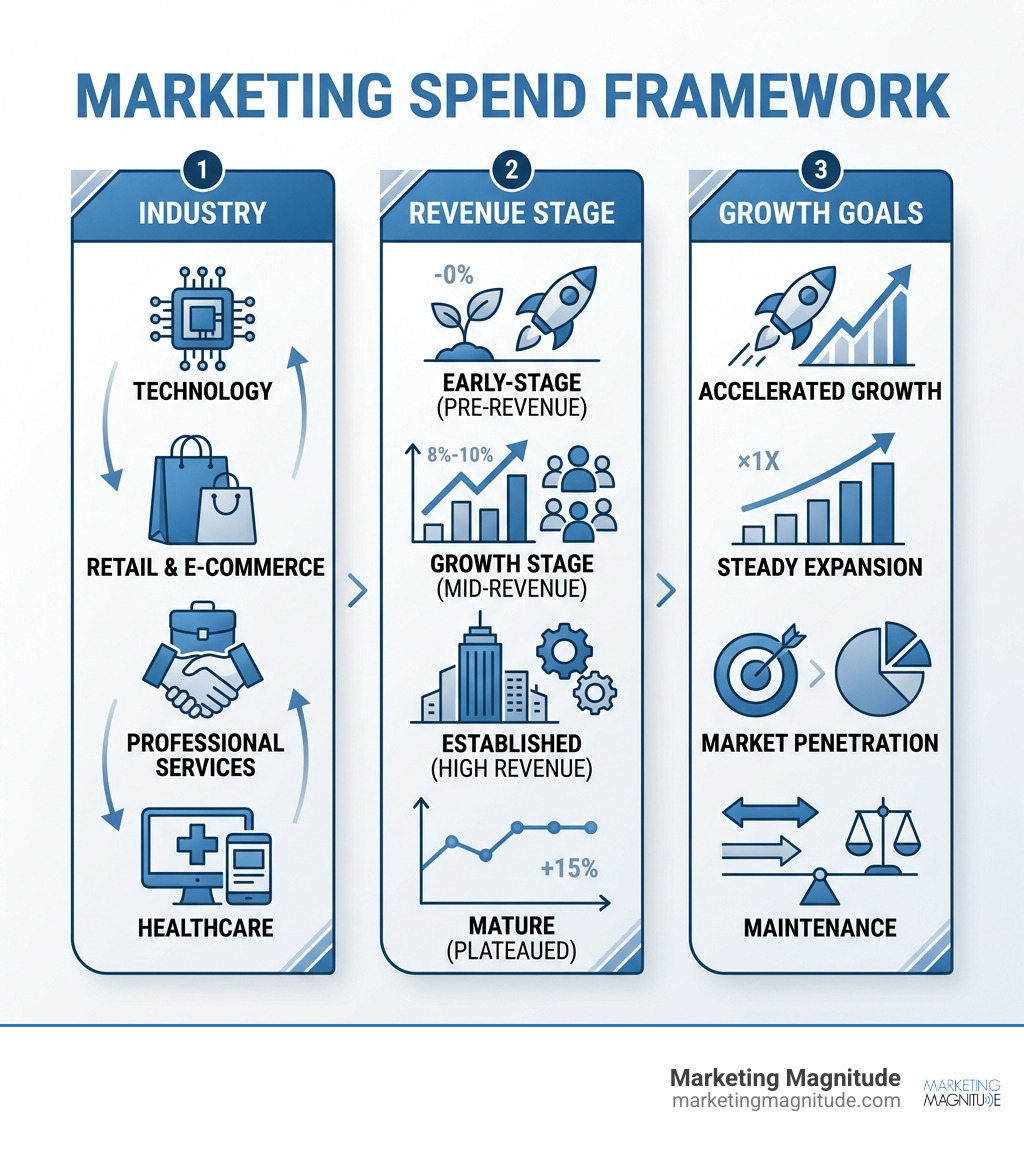
“How Much Should You Really Spend on Marketing?” Break down by: Industry Revenue stage Growth goals helpful reading:
“How Much Should You Really Spend on Marketing?” Break down by: Industry Revenue stage Growth goals
Setting a marketing budget is often the most stressful part of a business owner’s quarterly planning. We’ve all been there, staring at a spreadsheet and wondering if that logo redesign or PPC campaign is actually going to pay for itself. In 2026, the stakes are higher than ever because digital competition has never been more intense.
The fundamental question — “How Much Should You Really Spend on Marketing?” Break down by: Industry Revenue stage Growth goals — requires looking at your business through three specific lenses.
The 7-10% Baseline and SBA Guidelines
For established small businesses with annual revenues under $5 million, the U.S. Small Business Administration (SBA) traditionally recommends spending 7–8% of gross revenue on marketing. This assumes you have net profit margins in the 10–12% range after all expenses. However, our internal data for 2026 shows that most successful businesses in competitive markets like Austin and Las Vegas are pushing closer to 10% just to maintain their current visibility.

Revenue-Based Budgeting: Current vs. Projected
One of the biggest mistakes we see is businesses budgeting based solely on last year’s revenue. If you want to grow, you must budget based on projected revenue. For example, if you earned $1M last year but want to hit $1.5M this year, a 10% budget should be $150,000, not $100,000. This “growth-first” mindset is what separates stagnant companies from market leaders.
As noted in How Much Should I Spend on Marketing?, your budget is an investment in your company’s future value, not just a line-item expense to be minimized.
| Business Size (Revenue) | Maintenance Budget | Growth Budget | Aggressive Expansion |
|---|---|---|---|
| Under $1M | 10% | 15-20% | 25%+ |
| $1M – $5M | 7-8% | 10-15% | 20% |
| $5M – $25M | 5-7% | 8-12% | 15% |
| $25M+ | 3-5% | 6-10% | 12% |
Understanding your digital marketing goals is the first step in deciding which of these tiers you fall into. If your goal is simply to keep the lights on and the phones ringing at current levels, the maintenance column is your home. If you want to steal market share from a local competitor, you need to look at the aggressive expansion column.
Strategic Benchmarks by Industry and Revenue Stage
Not all industries are created equal. A manufacturing plant in Nevada doesn’t need the same marketing muscle as a high-growth SaaS startup or a luxury retail brand in Austin. Your industry’s typical profit margins and customer lifetime value (LTV) dictate how much you can afford to pay to acquire a customer.
According to recent 2025-2026 CMO surveys, industry averages vary wildly:
- Consumer Packaged Goods (CPG): 18.09% (High competition, low loyalty)
- Education: 14.59%
- Media & Communications: 13.82%
- Finance/Insurance: 11.18%
- Healthcare: 9.31%
- Tech / Software: 9.16% (Established)
- Manufacturing: 6.67%
- Energy: 3.21%
The SaaS and Tech Multiplier
In software, the rules change. SaaS companies often spend 15–25% of their revenue on marketing because they are playing a long-game of recurring revenue. Some venture-backed startups in hyper-growth mode will even spend 50-100% of their revenue on marketing to achieve “escape velocity.” For a deeper dive into these specifics, check out our FAQ on what industries we specialize in.
Professional Services and Healthcare
For doctors, lawyers, and accountants, the focus is on trust and local authority. These businesses typically spend between 5-10%. As discussed in How much should you, really, spend on marketing?, these industries rely heavily on the “B2B buying cycle,” which can take 3 to 9 months. If you stop spending today, you might not feel the pain for six months, but by then, your pipeline will be bone dry.

“How Much Should You Really Spend on Marketing?” Break down by: Industry Revenue stage Growth goals for B2B
B2B marketing in 2026 is all about the “long game.” Unlike a consumer purchase, B2B decisions involve multiple stakeholders and long evaluation periods.
- The 2-5% Range: This is common for established industrial or manufacturing firms where most business comes from long-term contracts and referrals.
- Lead Generation Focus: For B2B service providers, we recommend 7-15%. This covers the cost of online marketing for your small business, including high-quality whitepapers, webinars, and LinkedIn advertising.
- Account-Based Marketing (ABM): If you are targeting a small number of high-value clients (e.g., selling $500k software packages), your budget might be lower in total percentage but much higher in “cost per lead.”
“How Much Should You Really Spend on Marketing?” Break down by: Industry Revenue stage Growth goals for B2C
B2C is a “knife fight” for attention. Whether you are a local restaurant in Las Vegas or a national e-commerce brand, you are competing against every other notification on your customer’s phone.
- E-commerce / DTC: Expect to spend 12-25%. With rising ad costs on major platforms, you need a significant budget to maintain a healthy Return on Ad Spend (ROAS).
- Social Media Ads: B2C brands often allocate 40-60% of their total budget to social platforms where their audience is most active.
- Brand Awareness: If you are launching a new product, we often see budgets hit 25% of development costs just for the first year of the launch.
To get a more tailored estimate, you can explore our guide on how much to spend on digital marketing.
Optimizing Channel Allocation and AI in 2026
Once you have your total number — say, $100,000 for the year — how do you actually slice the pie? In 2026, the “70-20-10 Rule” remains the gold standard for budget allocation:
- 70% to Proven Channels: Put the bulk of your money into what works (e.g., Google Ads, SEO, Email).
- 20% to Emerging Opportunities: Invest in things that are starting to show promise (e.g., TikTok for B2B, Influencer partnerships).
- 10% to Experimental Initiatives: Try something completely new. This is your “innovation fund.”
The SEO vs. PPC Balance
We often get asked which is better. The truth is you need both. PPC (Pay-Per-Click) is like a faucet; turn it on, and leads flow immediately. SEO (Search Engine Optimization) is like planting an orchard; it takes time to grow, but eventually, it provides fruit for “free.”
When considering how much it should cost to manage a PPC campaign, agency fees usually range from 10-20% of the ad spend, or a flat monthly retainer.
Generative Engine Optimization (GEO) and AI
2026 is the year of GEO. With AI-powered search engines like Search Generative Experience (SGE) becoming the norm, your content needs to be optimized for AI to cite it as a source.
AI tools have significantly reduced the production cost of marketing. We’ve seen AI reduce content creation time by 70-80%, allowing businesses to produce more videos, blogs, and ads for the same budget. However, this doesn’t mean you should spend less; it means you should use those savings to increase your distribution (ad spend) to reach more people.
For inspiration, you can look at these 5 excellent marketing budget examples to see how top-tier companies are splitting their funds between headcount, tools, and media spend.
Frequently Asked Questions
What is the general rule of thumb for marketing spend?
The general rule of thumb is 7-10% of total gross revenue. However, this is a “maintenance” budget. If you are a startup or seeking aggressive growth, you should expect to spend 12-20%. The SBA recommends 7-8% for businesses with sales under $5 million and net profit margins of 10-12%.
Should marketing salaries be included in the budget?
Yes. To get an accurate picture of your ROI, your marketing budget should include:
- Internal staff salaries and benefits.
- Agency retainers and project fees.
- Software and tooling (CRM, email platforms, AI tools).
- Paid media spend (Google Ads, Meta Ads).
- Content production costs (Video, photography, graphic design).
If you only track your ad spend, you are ignoring the “cost of the engine” that makes those ads work.
How does AI impact marketing spend efficiency in 2026?
AI has fundamentally changed the “math” of marketing. While it hasn’t necessarily made marketing cheaper (because competition has increased), it has made it much more efficient.
- Production Volume: You can now create 10 versions of an ad for the price of 1.
- Real-Time Bidding: AI algorithms now manage ad bidding more effectively than humans can, reducing wasted spend.
- Personalization: AI allows for hyper-targeted email and SMS campaigns that have much higher conversion rates than “blast” marketing.
Conclusion
At the end of the day, your marketing budget shouldn’t be a “guess with a decimal point.” It should be a strategic calculation based on where your business is today and where you want it to be tomorrow.
At Marketing Magnitude, we believe in total transparency. That’s why we provide real-time tracking and reporting for every dollar you spend. Whether you are looking for web development, SEO, PPC, or social media management, we help you move away from “hope-based marketing” and toward data-driven growth.
If you’re ready to stop wondering “How Much Should You Really Spend on Marketing?” and start seeing a real return on your investment, let’s talk. We specialize in helping businesses in Las Vegas, Austin, and across the U.S. build budgets that actually work.
Get Started with Las Vegas Digital Marketing Today and let’s turn your marketing budget into a revenue engine.