
Why Most Business Owners Are Flying Blind (And How 5 Numbers Fix That)
The 5 numbers every business owner should check weekly are the metrics that tell you whether your business is growing, stalling, or quietly bleeding money — before it’s too late to act.
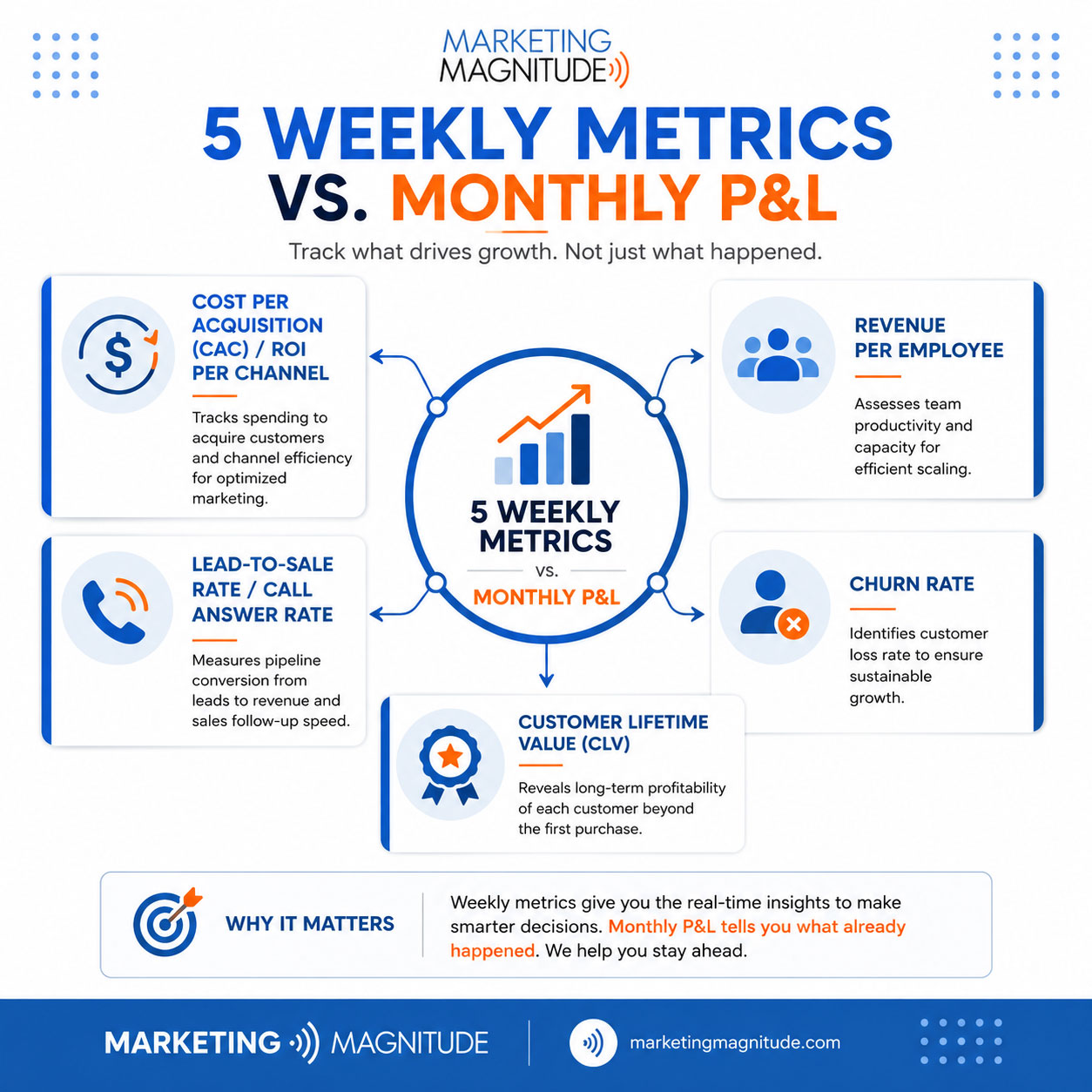
Here they are at a glance:
| # | Metric | What It Tells You |
|---|---|---|
| 1 | Cost per Acquisition (CAC) / ROI per Channel | How much you’re spending to win each new customer, and which channels are worth it |
| 2 | Lead-to-Sale Rate / Call Answer Rate | How well your pipeline converts interest into revenue |
| 3 | Customer Lifetime Value (CLV) | The true long-term value of each customer you acquire |
| 4 | Revenue per Employee | Whether your team’s time is translating into real output |
| 5 | Churn Rate | How fast you’re losing customers — and whether growth is actually sticking |
Most small business owners glance at their monthly profit and loss statement and assume that’s enough. It isn’t. A monthly P&L is a rearview mirror — it shows you what already happened. By the time you see a problem there, you’ve often lost weeks of margin, momentum, or customers you can’t get back.
Weekly metrics are different. They act like a windshield. They show you what’s coming.
Think about it this way: would you drive a car and only check the dashboard once a month? You’d miss the fuel warning, the overheating engine, the oil light. Your business works the same way.
The good news? You don’t need a data analyst or expensive software. You just need five numbers — checked consistently, every week.
I’m Kelly Rossi, founder of Marketing Magnitude and a digital marketing strategist with over 20 years of experience helping businesses track and improve the exact metrics that drive real growth. Knowing the 5 numbers every business owner should check weekly is something I’ve applied across hundreds of campaigns — from local Las Vegas businesses to large-scale entertainment brands — and it consistently separates businesses that scale from ones that stall.
Glossary for “The 5 Numbers Every Business Owner Should Check Weekly (And What They Mean)” Example: Cost per lead Cost per acquisition Lead-to-sale rate Call answer rate ROI per channel:
Why Weekly Tracking Beats Monthly P&L Statements
If you are only looking at your financial health once a month, you are essentially trying to navigate a ship by looking at the wake behind you. By May 2026, the speed of business in hubs like Austin and Las Vegas has only accelerated. Waiting until the 10th of the following month to see that your ad spend ballooned or your sales dipped is a recipe for disaster.
Weekly tracking provides proactive management. It allows us to spot a “short week” before it turns into a “bankrupt month.” One of the most critical habits we recommend is online marketing analysis performed on a weekly cadence. This creates an early warning system. For example, if your Cost Per Lead (CPL) spikes on Tuesday, you can pause the campaign on Wednesday. If you wait for the monthly P&L, you’ve already wasted three weeks of budget.
Beyond the numbers, this habit is a massive stress reducer. Uncertainty creates an “inner storm” for business owners. When you know your numbers, that anxiety is replaced by actionable facts. We suggest implementing a 13-week rolling cash flow forecast. This specific timeframe allows you to predict liquidity issues well in advance, giving you the “windshield” view necessary to adjust spending or ramp up collections before the tank hits empty. According to Most Important Numbers I Should Track Every Week as a Business Owner, this level of visibility is what separates the owners who sleep soundly from those who lie awake worrying about payroll.

The 5 Numbers Every Business Owner Should Check Weekly (And What They Mean)
To achieve sustainable growth, we have to look past “vanity metrics” like social media likes and focus on unit economics. These five numbers tell the real story of your business health. If you understand these, you understand your profitability.
| Metric | Formula | Healthy Benchmark |
|---|---|---|
| CAC | Total Marketing + Sales Cost / New Customers | LTV should be 3-4x higher than CAC |
| Lead-to-Sale | (New Customers / Total Leads) x 100 | 10-15% (Varies by industry) |
| CLV | Avg Purchase Value x Frequency x Lifespan | Rising over time |
| Revenue per Employee | Total Revenue / Number of Employees | Growth signals high efficiency |
| Churn Rate | (Lost Customers / Starting Customers) x 100 | Under 5% annually for SaaS |
Tracking these ensures you aren’t just “busy,” but actually productive. For those running paid ads, understanding Ppc 101 Basics Of Pay Per Click Management is the first step toward mastering these metrics. Let’s dive into what each of the 5 numbers every business owner should check weekly actually means for your bottom line.
1. Customer Acquisition Cost (CAC) and ROI per Channel
Customer Acquisition Cost (CAC) is the total price tag for “buying” a customer. If you spend $1,000 on Google Ads and get 10 customers, your CAC is $100. But to get a true picture, you need to look at both Blended CAC (total marketing spend across all channels) and Paid CAC (specifically what you pay for ads).
Why track this weekly? Because ad platforms are volatile. A sudden change in competition in the Las Vegas market can double your CPL overnight. By monitoring how much it should cost to manage a PPC campaign, you can identify which channels are providing the best ROI and shift your budget accordingly. If you’re spending $100 to acquire a customer who only brings in $50 of profit, you aren’t marketing—you’re gambling. Weekly checks allow you to stop the bleed before it ruins your month.
2. Lead-to-Customer Conversion Rate and Call Answer Rate
Your marketing might be doing its job by bringing in leads, but is your sales process holding up its end of the bargain? The Lead-to-Customer Conversion Rate measures the percentage of leads that actually turn into paying clients. If this rate is low, it usually points to one of three things: poor lead quality, slow follow-up, or a broken sales script.
A often-overlooked sub-metric here is the Call Answer Rate. In our experience, if you don’t answer the phone, you don’t get the business. We use call tracking for marketing campaigns to show clients exactly how many calls were missed. If your team is only answering 60% of inbound calls, you are literally throwing 40% of your marketing budget in the trash. Using website conversion tracking alongside call data gives you a 360-degree view of your lead velocity and follow-up efficiency.
3. Customer Lifetime Value (CLV) vs. Acquisition Spend
Customer Lifetime Value (CLV) is the total revenue a customer generates during their entire relationship with your business. It’s calculated by multiplying the average purchase value by the number of times they buy from you each year, and then by the number of years they stay a customer.
The “Golden Ratio” for business health is 3:1. Your CLV should be at least three times your CAC. If you spend $100 to get a customer (CAC), they need to bring in at least $300 in revenue over time (CLV) for your business to be sustainably profitable. Tracking this weekly helps you see if your repeat purchase rate is falling or if your Revenue per Visitor is dropping, signaling that you need to focus more on retention or upselling.
4. Revenue per Employee and Team Capacity
Are you hiring because you’re growing, or because you’re inefficient? Revenue per Employee (or per hour) is a critical productivity metric. You simply divide your total revenue by your headcount.
We look for the “sweet spot” in team capacity, which is usually between 60-80%. If your team is consistently operating above 80% capacity, it’s a trigger to either hire more staff or raise your prices. If they are under 60%, you have a productivity or sales problem. Tracking this weekly prevents the common mistake of hiring too late (which leads to burnout) or hiring too early (which eats your margins).
5. Churn Rate: The Leaky Bucket Metric
Churn rate is the percentage of customers who stop doing business with you over a specific period. It is the “leaky bucket” of the business world. You can pour as much money as you want into acquisition, but if your churn is high, the bucket will never fill.
The formula is simple: (Customers lost during the week ÷ total customers at the start of the week) x 100. A high churn rate is an immediate signal to stop focusing on new sales and start focusing on customer experience and loyalty programs. In May 2026, where customer acquisition costs are at an all-time high, keeping the customers you already have is the most profitable move you can make.
Setting Up Your Weekly Dashboard and Tracking Tools
You don’t need a PhD in statistics to track the 5 numbers every business owner should check weekly. A simple Google Sheet or Excel file with conditional formatting (Red, Yellow, Green) is often more effective than a complex dashboard.
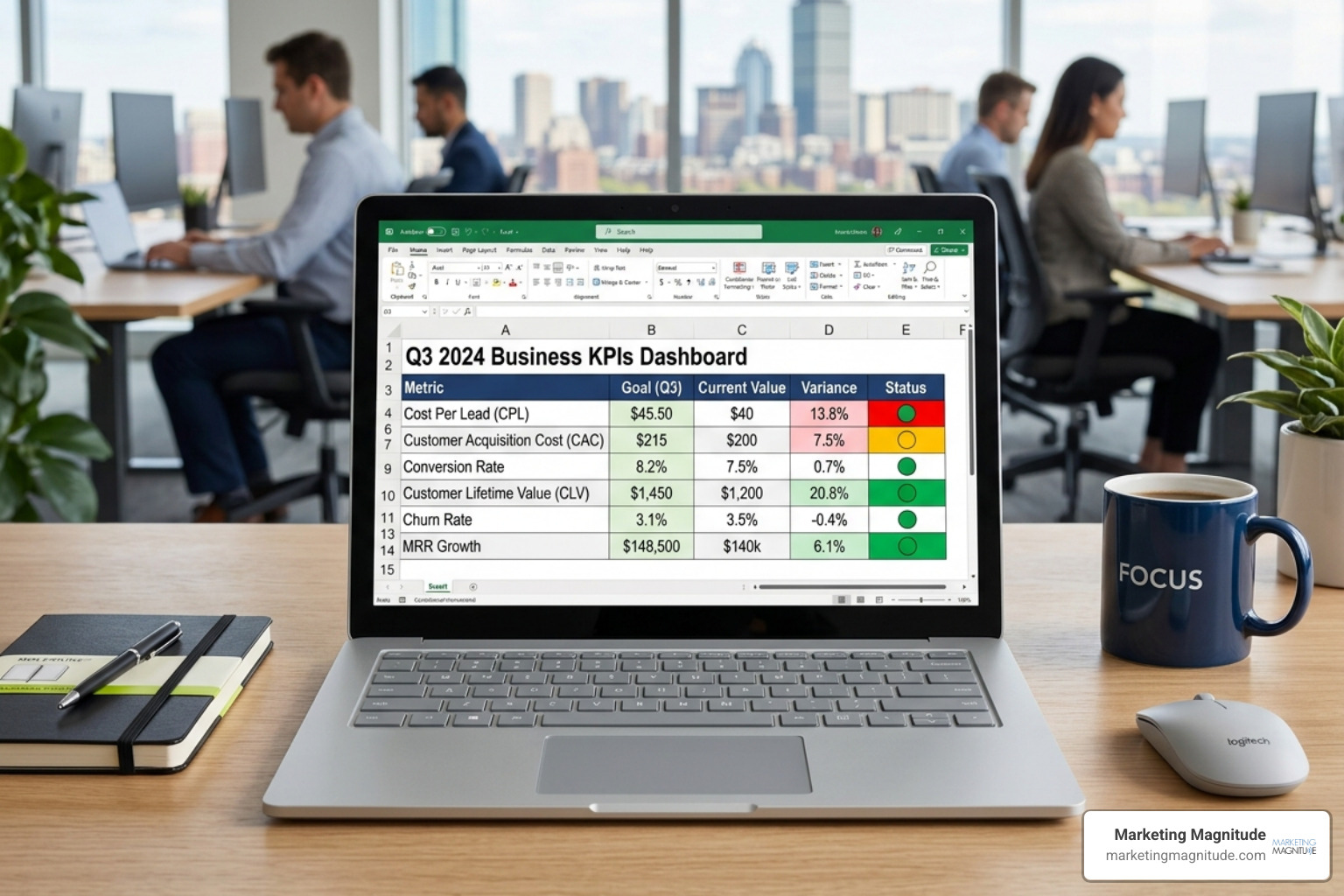
The key is a “Monday Morning Ritual.” Every Monday at 9:00 AM, we recommend reviewing these numbers with your leadership team. This ensures data cleanliness and creates a culture of accountability. When a metric turns red, you don’t panic; you follow a pre-set action plan.
How to Monitor “The 5 Numbers Every Business Owner Should Check Weekly (And What They Mean)”
To make this work, you need to integrate your tools. Your CRM (like HubSpot) should talk to your accounting software (QuickBooks) and your marketing platforms. This allows for real-time reporting without manual data entry errors.
- KPI Ownership: Assign one person to be responsible for each number. Marketing owns CAC; Sales owns the conversion rate; Operations owns team capacity.
- Trend Analysis: Don’t just look at the number in isolation. Is CAC higher than it was last week? Is it higher than this time last year?
- Predictive Power: Use a guide to online marketing analysis to turn these numbers into a roadmap for the next quarter.
Actionable Responses to “The 5 Numbers Every Business Owner Should Check Weekly (And What They Mean)”
Data is just “trivia” unless it leads to a decision. Here is how to react when the numbers flash a warning sign:
- Rising CAC: Audit your ad copy and targeting. You might be suffering from PPC mistakes that harm your digital marketing strategy.
- High Churn: Call your last five lost customers. Find out why they left and fix the service gap immediately.
- Low Conversion: Record your sales calls. Is the team following the script? Are they following up within 5 minutes of a lead coming in?
- Capacity > 80%: It’s time to hire or implement automation to handle the load.
Frequently Asked Questions about Weekly Business Metrics
What is the most important number to start tracking first?
If you only track one thing, make it your 13-week cash flow forecast. Cash is the lifeblood of your business. Even a profitable company can go under if it runs out of liquid cash. Knowing exactly what is coming in and going out over the next three months is the foundation of survival and growth.
How long does it take to manage a weekly dashboard?
Setting up the initial spreadsheet usually takes about two hours. Once the systems are linked, your weekly review should take no more than 10 to 15 minutes. Tools like QuickBooks and HubSpot can automate much of the data collection, leaving you more time to actually lead your team.
What does a low lead-to-customer conversion rate indicate?
A low conversion rate usually signals sales friction. This could be due to messaging misalignment (what the ad promised isn’t what the salesperson is offering), poor lead quality, or a slow follow-up process. If you aren’t reaching out to leads within minutes, your chances of closing them drop significantly.
Conclusion
Mastering the 5 numbers every business owner should check weekly is the difference between running a business on “gut feel” and running a scalable machine. In a competitive landscape like Austin or Nevada, data-driven leadership isn’t just a luxury—it’s a necessity for survival.
At Marketing Magnitude, we believe in radical transparency. That’s why we provide our clients with real-time tracking and reporting, so they never have to guess about their campaign performance. If you’re ready to stop flying blind and start growing with precision, we can help you set up the systems that turn raw data into a clear path forward.
Scale your business with expert digital marketing services and gain the clarity you need to lead with confidence.