
Most Businesses Are Drowning in Tools — And Still Flying Blind
Why most businesses are using 10+ tools… and still don’t know what’s working comes down to one painful truth: more software does not equal more clarity.
Here is the short answer:
- Too many disconnected tools create data silos — your CRM says one thing, your email platform says another
- Context switching kills productivity — workers lose up to 4 hours every week just toggling between apps
- “Best-of-breed” stacks break constantly — integrations fail, data gets lost, and no one knows which number to trust
- An all-in-one CRM fixes this — one platform, one source of truth, zero guesswork
- Simplicity = power — fewer tools, better decisions, more revenue
Picture this: it is Monday morning. Before you can do a single dollar of real work, you have already spent 45 minutes checking Slack, email, your CRM, your project board, your invoicing tool, and your analytics dashboard. And you still do not have a clear answer to the most basic question: what is actually working?
That is not a productivity problem. That is a systems problem.
The average small business now runs between 10 and 50 different software tools. Most of them barely talk to each other. The result is wasted hours, duplicate data, missed leads, and decisions made on incomplete information — every single day.
I’m Kelly Rossi, founder of Marketing Magnitude and a digital marketing strategist with over 20 years of experience helping businesses cut through exactly this kind of chaos. Having worked across SEO, PPC, analytics, and CRM implementation for companies ranging from local Las Vegas businesses to large-scale entertainment brands, I have seen how why most businesses are using 10+ tools… and still don’t know what’s working is one of the most expensive — and most fixable — problems in business today.
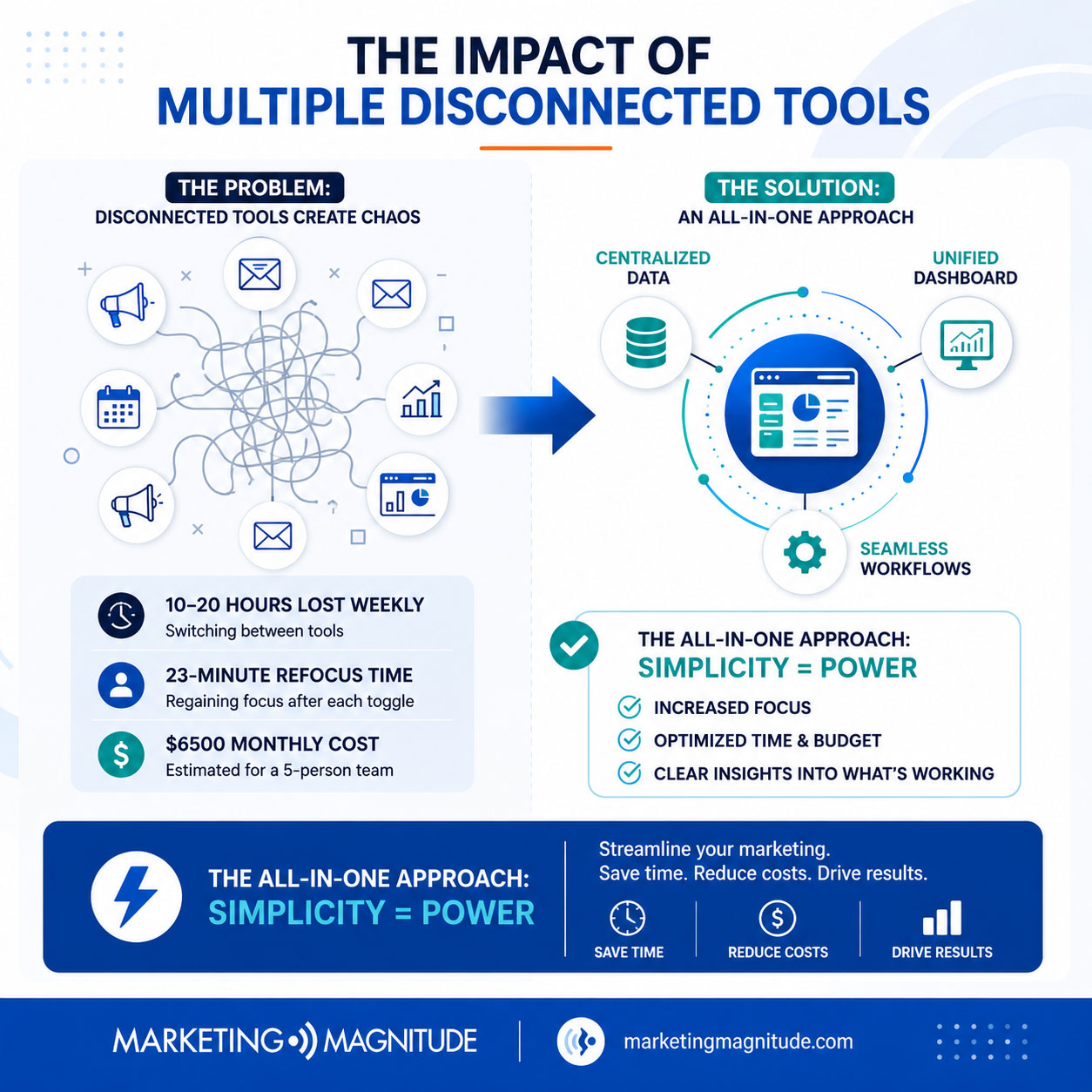
Important “Why Most Businesses Are Using 10+ Tools… And Still Don’t Know What’s Working” Then introduce: Your all-in-one CRM approach Simplicity = power terms:
The Hidden Cost of the “Toggle Tax” in 2026
In the business environments of Las Vegas and Austin, we often think that adding a new tool is the solution to every problem. Need better emails? Buy a tool. Need to track calls? Buy another tool. But by May 2026, the data is clear: we are paying a “Toggle Tax” that is draining our profits.
Research shows that the average worker switches between apps and websites nearly 1,200 times per day. Every time you switch from your CRM to a spreadsheet or from Slack to an invoicing tool, your brain pays a price. This is called context switching. It takes an average of 23 minutes and 15 seconds to fully regain deep focus after being interrupted by a different task or tool.
When you multiply this across a five-person team, the numbers are staggering. Small businesses lose between 10 and 20 hours every single week just to tool switching. That is half a work week gone! If you are paying a team member $35 an hour, that “copy-paste labor” and “app hopping” costs your business about $6,500 every month.
Beyond the time, there is the Online Marketing Analysis nightmare of manual data entry. When your tools don’t talk to each other, humans have to move the data. Industry standards show that manual transcription has a 5% error rate. That means one out of every twenty entries is wrong. Whether it’s a misspelled lead name or a missed digit in a phone number, these tiny errors snowball into massive lost opportunities.
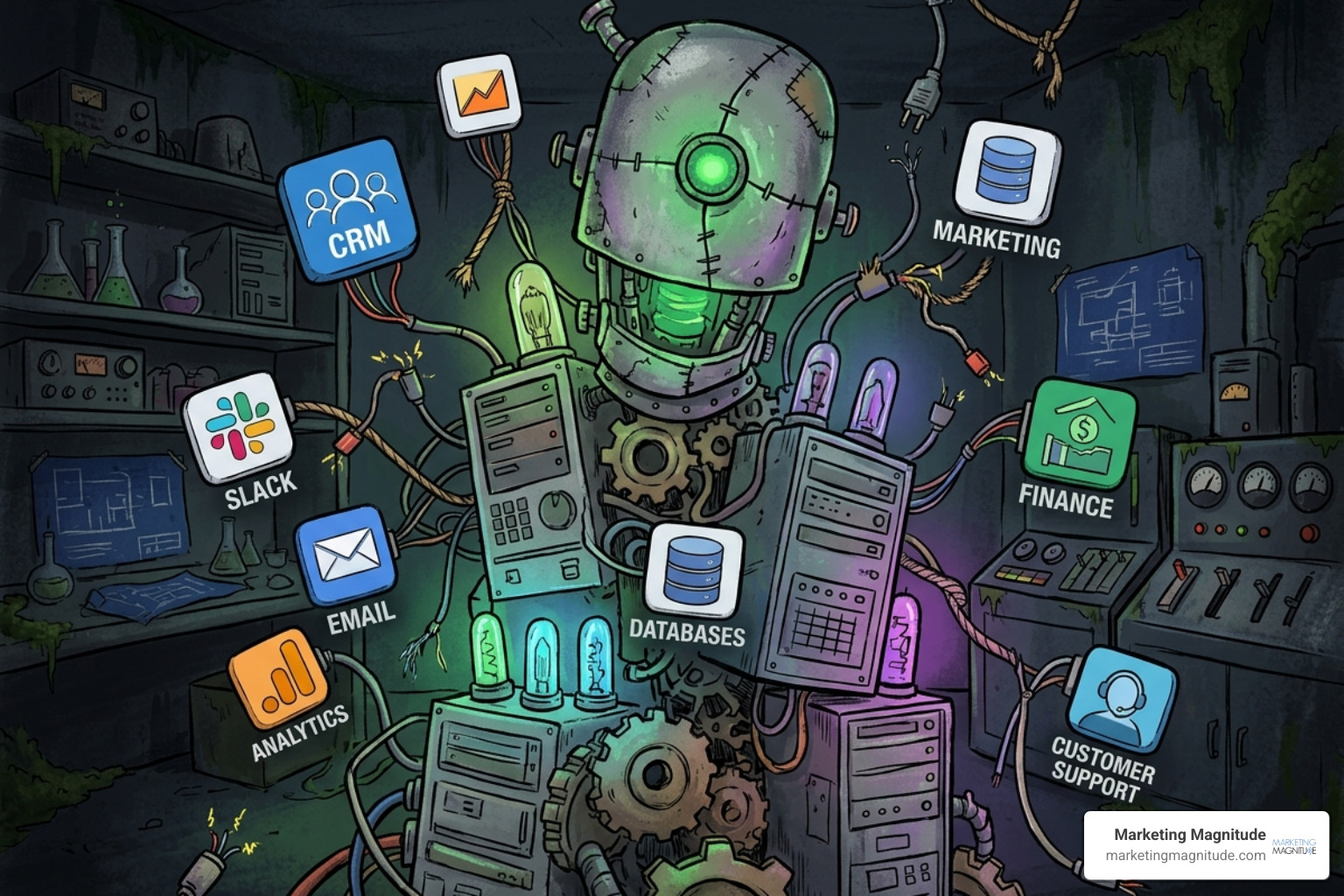
This “Digital Frankenstein” stack creates a massive cognitive overhead. Instead of focusing on strategy or closing deals, you and your team are acting as “human routers,” manually moving information from Screen A to Screen B. According to Why Small Businesses Waste 10–20 Hours a Week Switching Between Tools, this habit is secretly destroying 40% of your productivity.
Why Most Businesses Are Using 10+ Tools… And Still Don’t Know What’s Working
The core of the problem is that most businesses have “islands of data.” Your marketing tool shows you got 100 clicks, but your CRM only shows 5 new leads, and your accounting software shows only 2 sales. Because these systems are disconnected, you can’t see the bridge between them.
This creates what we call “information asymmetry.” The marketing team thinks a campaign is a huge success because the “vanity metrics” (likes and clicks) are high, but the sales team is frustrated because the leads are low quality. Without a unified Website Marketing Analytics system, you are left guessing which half of your advertising budget is being wasted.
| Feature | Fragmented Tools (10+ Apps) | Unified All-in-One CRM |
|---|---|---|
| Data Accuracy | High risk of duplicates & errors | Single source of truth |
| Reporting | Manual CSV stitching (hours) | Real-time dashboards (seconds) |
| Team Focus | Constant “Toggle Tax” | Deep work in one interface |
| Customer View | Fragmented & incomplete | 360-degree journey history |
| Cost | High “Integration Tax” & subscriptions | Consolidated, predictable ROI |
As noted in Why Your 12 SaaS Tools Are Making You Slower, the real cost isn’t just the subscription fees—it’s the “decision lag.” When it takes three days to pull a report from four different systems, you can’t pivot quickly. By the time you realize a campaign isn’t working, you’ve already spent thousands of dollars on the wrong audience. This is why a proper Guide To Online Marketing Analysis is impossible when your data is scattered across the digital wind.
The “Best-of-Breed” Trap: Why More Isn’t Better
For years, the “experts” told us to buy the “best-of-breed” tool for every single category. They said you should have the #1 email tool, the #1 landing page builder, and the #1 scheduling app. But in 2026, we’ve realized that “best-of-breed” often becomes “worst-of-bloat.”
The problem is the “integration tax.” To make these separate tools work together, you usually have to use “digital duct tape” like Zapier. While these connections work for a while, they are fragile. An API update on Tuesday can break your entire lead flow by Wednesday, and you might not even notice until the phone stops ringing.
This has led to a $96 billion marketing tool crisis globally. Companies are paying for dozens of tools they barely use. In fact, nearly 50% of SaaS licenses go unused for 90 days or more. You are essentially paying a “bloat tax” for features your team finds too complicated to actually implement.

When you rely on too many Know Your Customers Research Tools, you lose the “forest for the trees.” You might have the most sophisticated heat-mapping tool in the world, but if it isn’t connected to your sales data, it’s just a pretty picture. As Why ‘Best of Breed’ became ‘Worst of Bloat’: The $96B Marketing Tool Crisis points out, the time spent managing the tools often outweighs the benefit of the tools themselves.
Your All-in-One CRM Approach: Simplicity = Power
At Marketing Magnitude, we believe that simplicity = power. In 2026, the most successful businesses in Nevada and Texas aren’t the ones with the most tools; they are the ones with the most clarity.
Our all-in-one CRM approach moves your business from “managing software” to “executing strategy.” Instead of having your customer data spread across ten different logins, everything lives in one place. This creates a “single source of truth.” When a customer calls, your team doesn’t have to ask, “Wait, which email did we send them?” or “Did they pay that invoice?” Everything—from the first ad click to the final payment—is visible on one screen.
This is the power of Services/Crm Software Marketing Automation. When your tools are natively built to work together, automation actually works. You can set up a workflow where a new lead from a Facebook ad automatically gets a text, an email sequence starts, and a task is created for your sales rep—all without a single third-party integration that might break.
By using Digital Marketing Predictive Analytics, a unified platform can even tell you which leads are most likely to close based on their entire history with your brand. This isn’t possible when your “history” is trapped in four different apps.
Why an All-in-One CRM Approach: Simplicity = Power is the 2026 Standard
The shift toward consolidation is about operational leverage. When you simplify your tech stack, you reduce the training time for new employees. Instead of teaching a new hire 12 different interfaces, they only need to learn one. This gets them productive in days instead of weeks.
Team alignment also skyrockets. When everyone looks at the same dashboard, there are no more arguments about “whose numbers are right.” Marketing can see exactly how many sales their Services/Email Marketing Automation generated, and Sales can see exactly which pages a lead visited before the call.
As All-in-One CRM vs Best-of-Breed Tools 2026 explains, small teams are switching because they need a “digital spine”—a central system that holds the business together. This unified approach allows you to see the entire customer journey, identifying exactly where people are dropping off so you can fix the leak and increase your revenue.
Transitioning to an All-in-One CRM Approach: Simplicity = Power
If you are feeling the weight of your 10+ tools, it is time for a radical audit. Here is how we recommend you start:
- The Tool Audit: List every single software subscription you pay for. Note the last time someone actually logged in.
- Calculate Your “Tool Tax”: Add up the subscription costs, but also estimate the “human cost.” How many hours a week does your team spend moving data or fixing integrations?
- Identify the Core: Most businesses only need five core functions: Lead Capture, Communication (Email/SMS), Sales Management (CRM), Fulfillment/Project Management, and Analytics.
- Clean the Data: Before you move, delete the duplicates. Don’t move your “digital trash” into a new, clean house.
- Consolidate: Choose a platform that handles at least 80% of these needs natively.
By looking back at 5 Business and Marketing Automation Tools for 2020, we can see how far we’ve come. What used to require five separate, expensive tools can now be done in one streamlined platform. This isn’t just about saving money on subscriptions; it’s about reclaiming your mental energy. When you visit our category/analytics section, you’ll see that the best data is always the simplest data.
Frequently Asked Questions about Tool Consolidation
How do I calculate my business’s “Tool Tax”?
To find your true cost, use this formula: (Total Monthly Subscriptions) + (Hours spent on manual data/admin x Team hourly rate) + (Estimated lost revenue from broken integrations/missed leads). For most 5-person teams, this number is often north of $7,000 per month.
Will I lose specialized features by switching to one platform?
You might lose 10% of the “niche” features that a specialized tool offers, but you gain 100% visibility and 40% more productivity. Most businesses only use about 20% of the features in their “best-of-breed” tools anyway. The trade-off for simplicity is almost always worth it.
How long does it take to migrate from 10+ tools to one CRM?
For a typical small business with clean data, the transition usually takes 2 to 4 weeks. This includes auditing your current tools, mapping your workflows, and training your team on the new unified interface.
Conclusion: Reclaiming Your Time and Revenue
At the end of the day, your software should be a growth engine, not a ball and chain. If you find yourself wondering “Why Most Businesses Are Using 10+ Tools… And Still Don’t Know What’s Working”, it is time to embrace the mindset that Simplicity = Power.
At Marketing Magnitude, we don’t just provide services; we provide clarity. Whether we are handling your SEO in Las Vegas or managing a complex PPC campaign in Austin, our focus is always on real-time tracking and transparent reporting. We believe you should always know exactly how your investment is performing.
Stop paying the “Toggle Tax” and start focusing on what matters: growing your business. How Do You Measure Success? By the revenue in your bank account, not the number of apps on your phone.
Ready to simplify your stack and see what’s actually working? Explore Marketing Magnitude Services today and let us help you build a unified system that drives real results.
Get Started Now
Fill out this form to start your journey to next-level marketing solutions for your business.