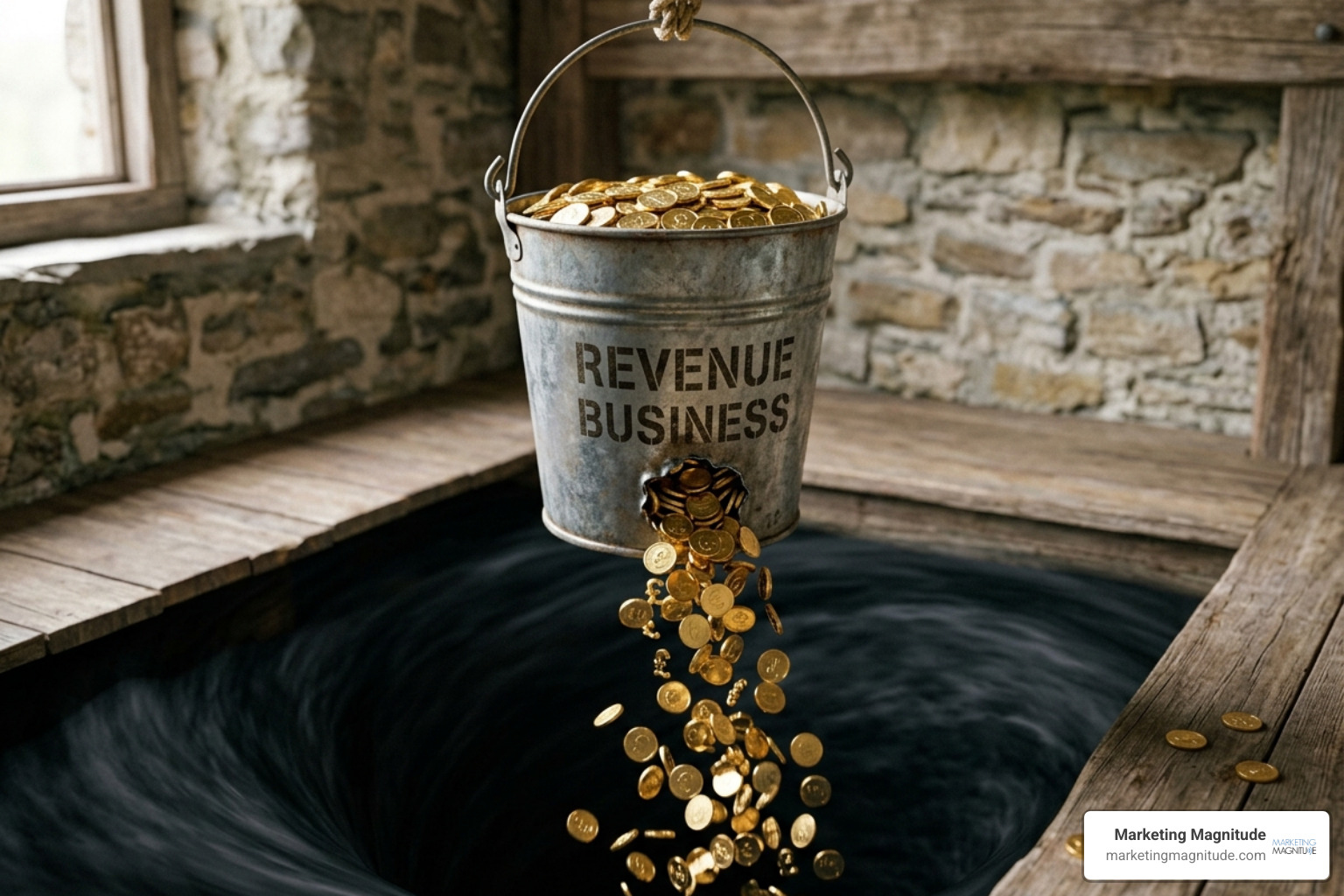
Could Your Business Survive a Sudden Disappearance — and Rebuild in 90 Days?
If your business disappeared tomorrow, could you rebuild it in 90 days? Talk about systems vs luck, owned assets (email list, SEO, brand), paid vs organic dependency — and most business owners go quiet.
Here is a fast answer:
A business you can rebuild in 90 days has these things in place:
| What You Need | Why It Matters |
|---|---|
| Documented systems (SOPs) | Others can run the business without you |
| Owned assets (email list, SEO, brand) | Survive platform shutdowns and algorithm changes |
| Diversified revenue | No single client or channel controls your fate |
| Organic + paid traffic mix | Paid disappears when budget stops; organic stays |
| Low founder dependency | Business runs — and recovers — without the owner |
If most of those boxes are empty, your business is not really a business. It is a high-stress job built on luck.
Think about this: a well-run agency with 15 people can grind to a halt in three weeks when the founder is unexpectedly out of the picture. Deadlines get missed. Leads go cold. Morale tanks. Not because the team is bad — but because the systems, the authority, and the knowledge all lived in one person’s head.
That is the fragility test. And most businesses fail it quietly, until something forces the truth.
Businesses built on replicable systems and owned assets can recover fast. Businesses built on founder heroics and rented traffic? They often do not recover at all.
I’m Kelly Rossi, founder of Marketing Magnitude and a digital marketing strategist with over 20 years of experience building resilient, growth-focused businesses across SEO, PPC, content, and analytics. The question of “if your business disappeared tomorrow, could you rebuild it in 90 days — focusing on systems vs luck, owned assets, and paid vs organic dependency” sits at the core of everything I help clients build toward sustainable, sellable growth.
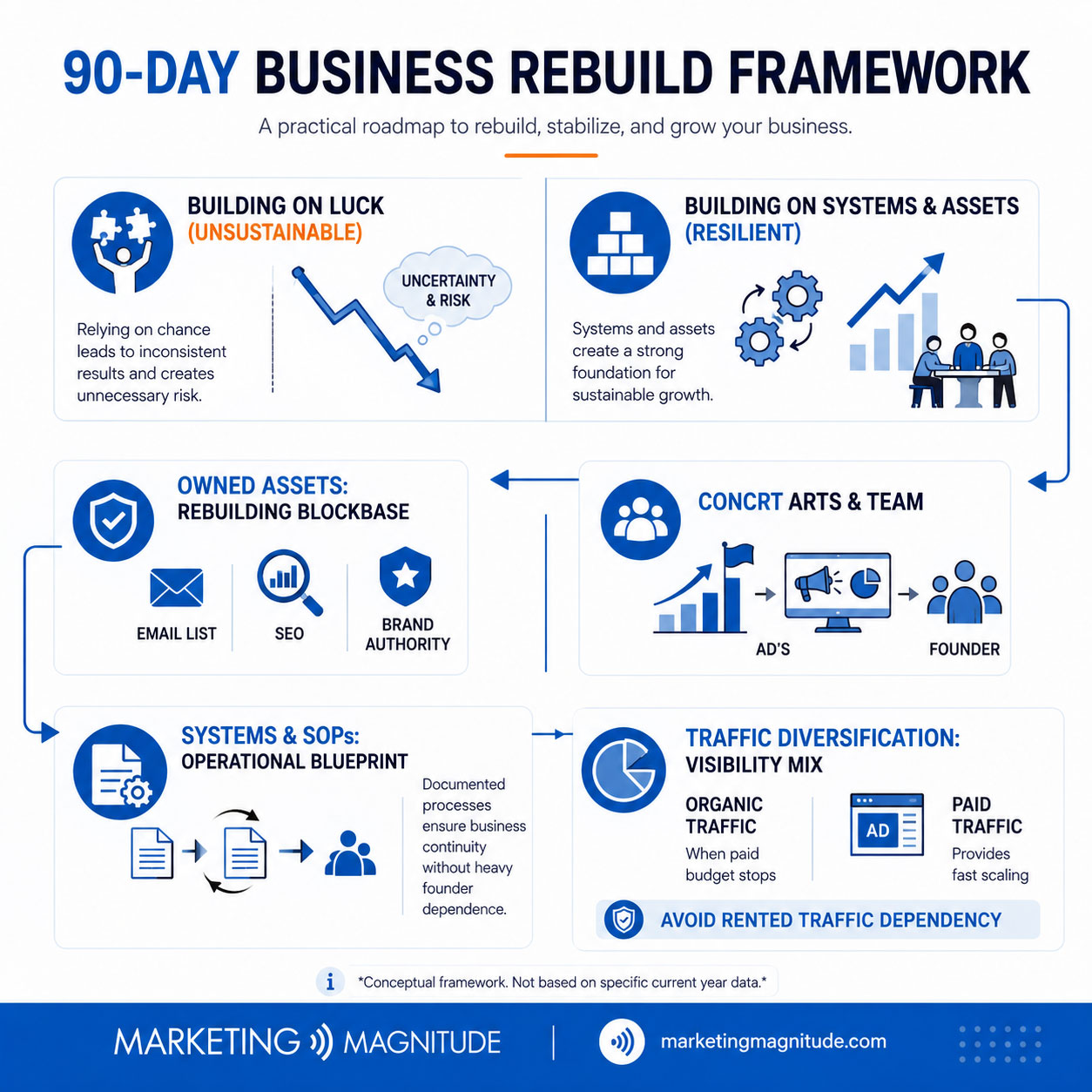
“If Your Business Disappeared Tomorrow, Could You Rebuild It in 90 Days?” Talk about: Systems vs luck Owned assets (email list, SEO, brand) Paid vs organic dependency basics:
Systems vs Luck: The Foundation of a Rebuildable Business
In our experience, most entrepreneurs mistake “momentum” for “stability.” If you are making money because you happen to be in the right place at the right time, or because you are personally closing every deal through sheer force of will, you aren’t building a business—you are riding a lucky streak.
To pass the 90-day rebuild test, you must move from luck-based growth to replicable systems. A system is a documented, repeatable process that produces a predictable result regardless of who is pulling the lever. This is where Standard Operating Procedures (SOPs) become your most valuable internal asset. Without them, your business has a massive “key person risk.”
Research shows that businesses can lose 20% to 30% of their value—or even more—due to founder dependency. If the owner is the only one who knows how to price a proposal or handle a client crisis, the business is fragile. When we look at hiring an agency vs in house, one of the primary benefits of an agency is the built-in systemization they bring to the table, shielding you from the brittle nature of individual “heroes.”
Moving from Hero-Founder to Systems-Architect
The “Hero-Founder” is the person who stays up until 2:00 AM fixing a website or personally answering every support ticket. While this is often necessary in the first 90 days of a startup, it becomes a fatal bottleneck as you scale.
To rebuild quickly, you need a team that possesses autonomy. This means:
- Decision Rights: Your team knows exactly what they can approve without asking you.
- Scalable Processes: Marketing and sales don’t stop just because you took a week off.
- The 30-Day Absence Test: If you went offline for 30 days today, would your revenue grow, stay flat, or crater? Most founders find that by week three, deadlines are missed and leads go cold.
Identifying Brittle Points in Your Infrastructure
A “brittle point” is a single point of failure that can cause a catastrophic collapse. As noted in the concept of Brittle Points: How to make companies robust, these can be technical (like a single server) or operational (like a single large client).
| Feature | Fragile Business Model | Resilient Business Model |
|---|---|---|
| Client Concentration | One client is >50% of revenue | No client is >25% of revenue |
| Knowledge | Lives in the founder’s head | Documented in SOPs and CRM |
| Marketing | Relies on one “hack” or channel | Diversified (SEO, PPC, Email) |
| Leadership | Founder makes every decision | Empowered Second-in-Command (2IC) |
“If Your Business Disappeared Tomorrow, Could You Rebuild It in 90 Days?” Talk about: Systems vs luck Owned assets (email list, SEO, brand) Paid vs organic dependency
In May 2026, the market is more volatile than ever. We’ve seen AI-driven search shifts and platform “balkanization” where users are scattered across dozens of different discovery engines. If your website were deleted and your social accounts banned today, how would you find your customers?
This is where the distinction between Systems vs luck Owned assets (email list, SEO, brand) Paid vs organic dependency becomes a matter of survival. Rebuild capability isn’t about having a backup of your website files; it’s about having the “gravity” to pull your audience back to you.
Rebuilding with Owned Assets: Systems vs luck Owned assets (email list, SEO, brand) Paid vs organic dependency
If you have a robust how to build your first content marketing strategy, you are building assets that you actually own.
- Email Lists: This is the ultimate “reset button.” If your site vanishes, you can email 10,000 people and tell them where to find the new one.
- SEO Authority: While Google’s index is “rented” space, the topical authority and entity definition you’ve built are portable.
- Brand Equity: If people search for your brand name specifically, you can rebuild on any platform.
Using website marketing analytics allows us to see exactly which assets are driving value so we can prioritize them during a recovery.
Balancing the Mix: Systems vs luck Owned assets (email list, SEO, brand) Paid vs organic dependency
A 90-day rebuild requires a dual-track approach. You use Paid Search for immediate cash flow—buying your way back into the market—while simultaneously re-deploying your Organic strategy for long-term stability. If you rely 100% on organic, you might starve before the search engines re-index you. If you rely 100% on paid, you are one credit card decline away from zero revenue.
The Power of Owned Assets: Email Lists, SEO, and Brand Equity
When we talk about “owned assets,” we are talking about things that no algorithm change can take away. In services content marketing services, we focus on creating first-party data.
Why SEO Authority Survives a Total Disappearance
You might think SEO is the most fragile asset because Google holds 92% of the search market. However, modern SEO is about “entity definition.” If you have spent years building your reputation as the “best Austin TX web developer,” Google’s Knowledge Graph associates your brand with that expertise.
Even if your domain changes, your search engine optimization services history helps you reclaim those rankings faster than a newcomer. There is a massive difference between organic seo services vs local seo services, but both rely on the “owned” trust you’ve built with the algorithm over time.
Brand Equity as the Ultimate Recovery Tool
Brand equity is the psychological “shortcut” your customers take. If your business disappeared, would people notice? Would they go to Reddit or TikTok and ask, “Where did Marketing Magnitude go?” If the answer is yes, you have brand equity. This trust allows for “community-based retrieval,” where your fans do the work of rebuilding your visibility for you.
Navigating the Dependency Trap: Paid vs Organic Channels
Dependency is the enemy of resilience. If your business is a “Google Workspace add-on” and Google decides to build that feature into their core product, your business is gone. This is the “rented land” trap.
The Risks of Paid Search Dependency
We love paid search management services for their speed, but they are a “brittle” channel.
- CPC Inflation: In 2026, costs per click continue to rise as more businesses move to paid search.
- Ad Click Share: While paid clicks are up 7-13%, your margins can be squeezed to zero if you don’t have an organic base to offset the costs.
- Budget Sensitivity: The moment you stop paying, the traffic stops.
Understanding ppc 101 basics of pay per click management is essential, but it should be used to fund your owned assets, not replace them.
Building Organic Resilience in a 2026 Search Landscape
Organic search isn’t just about Google anymore. It’s about being findable in an AI-native world.
- Balkanized Discovery: Users are searching on TikTok, ChatGPT, and Reddit.
- Structured Data: Using schema and entity tagging ensures that any AI can “read” your business and recommend you.
- Social Proof: A strong services social media management plan ensures your brand exists in the “real world,” not just in a search index.
Running a Disappearance Stress Test to Identify Brittle Points
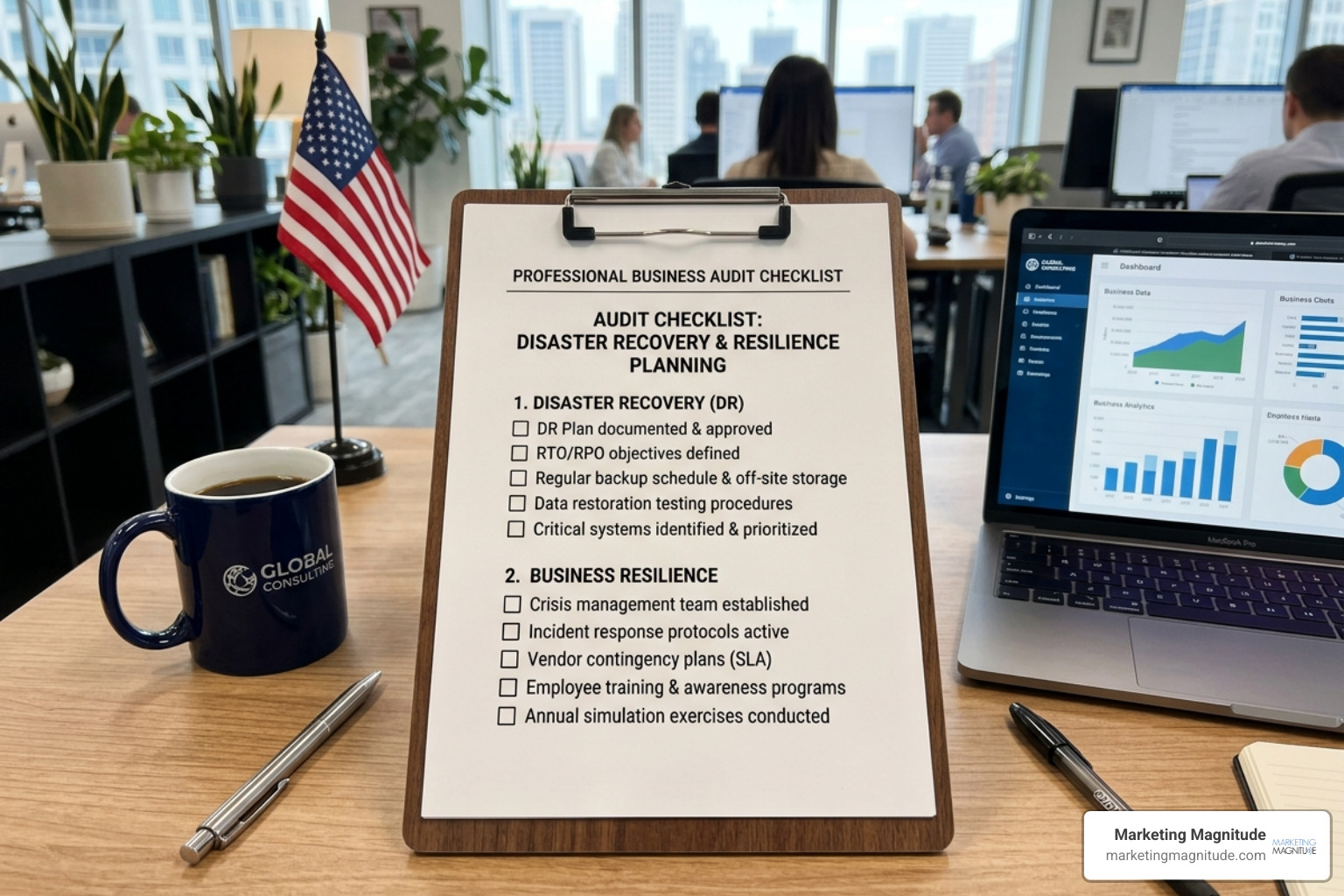
How do you actually know if you could rebuild in 90 days? You run a “stress test.” Imagine your main website is gone and your primary ad account is disabled.
Auditing Your External Platform Dependencies
- Hosting Isolation: Are all your clients or products on one “cheap” shared hosting account? If one gets hacked, they all go down. We recommend isolated environments to prevent cascading failures.
- API Risks: If your service relies on a third-party API (like Twitter or OpenAI), what happens if they change their terms tomorrow?
- Google Compliance: Are you building a brand, or just “compliance engineering” for one specific algorithm?
Practical Steps to Document and Delegate Today
You don’t need a 500-page manual to start.
- Loom Documentation: Instead of writing an SOP, record a 3-minute video of yourself doing a task. This transfers “institutional knowledge” out of your head.
- Project Templates: Use tools like Asana or ClickUp to create templates for recurring projects.
- Appoint a 2IC: Identify a “Second-in-Command” who has the authority to sign off on expenses or client proposals.
As part of a robust services email marketing strategy, ensure at least two people have access to your subscriber list and sending platform.
Frequently Asked Questions about Business Resilience
What is the biggest brittle point for small agencies?
The “Founder Bottleneck.” If the founder is the only one who can sell, the only one who can price, and the only one who can talk to the “big” clients, the business’s value is capped. High client concentration (where one client is 80% of revenue) is another fatal brittle point. If that client leaves, the business is effectively dead.
How do I start documenting systems if I’m too busy?
Start small. Document the three things you do most often that frustrate you. Use a “checklist” format—it’s faster than a full manual. Record a video while you work. The goal isn’t perfection; it’s to make the process repeatable by someone else.
Can a business really hit pre-disappearance revenue in 90 days?
Yes, if you have owned assets. If you have an email list of 50,000 customers and a strong brand, you can launch a “Minimum Viable System” and drive traffic immediately. If you have to start from “zero” with no brand and no list, 90 days is likely impossible. This is why we focus so heavily on search engine optimization services—it builds the “momentum” that carries you through a crisis.
Conclusion
Building a business that can be rebuilt in 90 days isn’t just a “disaster prep” exercise—it’s the best way to build a high-value, sellable asset. When you move from being the “hero” to being the “architect,” you create a business that provides freedom instead of a 70-hour work week.
At Marketing Magnitude, we specialize in helping businesses in Las Vegas, Austin TX, and across the US build this exact type of resilience. Whether it’s through diversifying your traffic or systemizing your lead generation, we provide the real-time tracking and transparent reporting you need to see exactly where your assets stand.
Ready to stop relying on luck and start building a resilient machine? More info about search engine optimization services can help you start building your owned assets today. Let’s make sure that if your business vanished tomorrow, the world would help you bring it back.
Get Started Now
Fill out this form to start your journey to next-level marketing solutions for your business.