


What Is Analysis Digital Marketing (And Why It Matters in 2026)
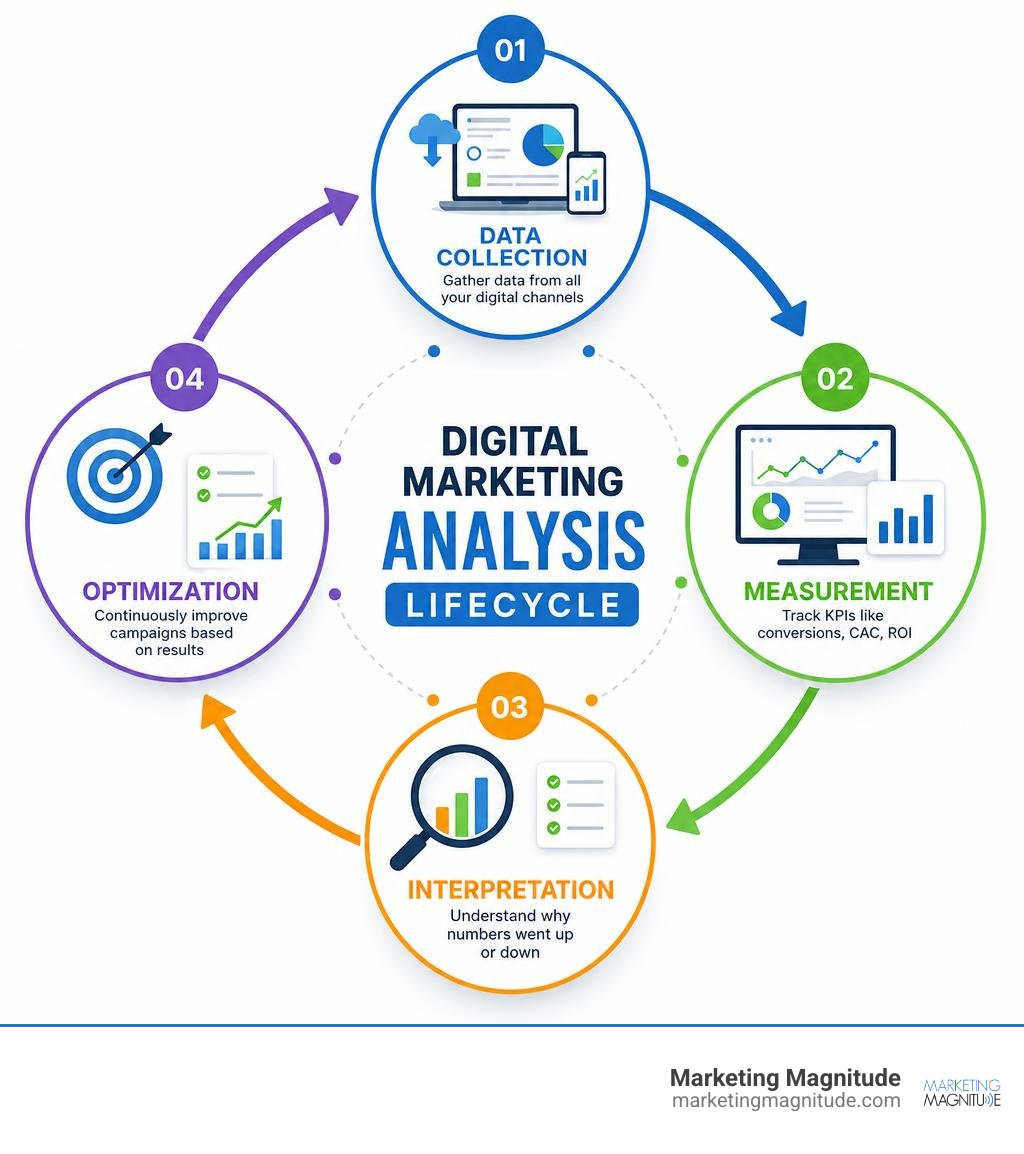
Analysis digital marketing is the process of collecting, measuring, and interpreting data from your website, ads, email, and social media to understand what’s working — and what’s not.
Here’s a quick breakdown of what it involves:
| Component | What It Means |
|---|---|
| Data Collection | Gathering data from all your digital channels |
| Measurement | Tracking KPIs like conversions, CAC, and ROI |
| Interpretation | Understanding why numbers went up or down |
| Action | Making smarter decisions based on what the data shows |
| Optimization | Continuously improving campaigns based on results |
If you run a service business, you already know the frustration: you’re spending money on marketing, but you’re not sure which part is actually bringing in clients. That uncertainty is expensive.
More than 80% of marketing professionals now rely on data to guide their decisions. Yet many small and mid-sized businesses still operate without a clear analytics framework — leaving real revenue on the table.
The stakes are higher in 2026. Marketing budgets are flat. AI is reshaping how people search. And 58–68% of Google searches now end without a single click. In this environment, guessing isn’t a strategy. Knowing what your data is telling you — and acting on it — is the only reliable path to growth.
The good news? You don’t need to be a data scientist. You need a clear process.
I’m Kelly Rossi, founder of Marketing Magnitude and a digital marketing professional with over 20 years of hands-on experience in analysis digital marketing across SEO, PPC, web analytics, and campaign strategy. In this guide, I’ll walk you through exactly how to analyze your digital marketing — step by step — so you can stop guessing and start growing with confidence.
Key terms for analysis digital marketing:
The Core Pillars of Analysis Digital Marketing in 2026
To build a growing business, we cannot look at marketing as a series of isolated projects. A local service brand, a wellness clinic in Las Vegas, or a professional consultancy in Austin all face the same challenge: customers do not follow a straight line from seeing an ad to booking a service.
Modern analytical marketing relies on data unification. This means connecting your website traffic, CRM pipelines, email interactions, and paid ads into one single, cohesive ecosystem. When we unify our data, we gain clear visibility into the entire customer lifecycle. This allows us to see exactly where a lead was introduced to our brand, how they were nurtured, and what ultimately drove them to convert.
To make sense of this lifecycle, we must utilize a balanced mix of analytical approaches. These are broken down into four essential methodologies. To dive deeper into how these elements interact, you can read our comprehensive Guide to Online Marketing Analysis.
Descriptive and Diagnostic Analysis Digital Marketing
Before we can look into the future, we must understand the past and the present.
- Descriptive analytics answers the question: What happened? It looks at historical data over a set period. This includes metrics like your total website visitors last month, your email open rates, or the number of new leads generated in a specific quarter.
- Diagnostic analytics takes it a step further by asking: Why did it happen? This is also known as root-cause analysis.
If descriptive data shows that your website inquiries dropped by 20% in Nevada last month, diagnostic analysis helps you dig into the “why.” Did a key landing page experience a sudden technical error? Did a competitor launch a aggressive local campaign? Diagnostic tools help us detect these anomalies and pinpoint the exact source of a shift, saving us from wasting budget on the wrong fixes. For a solid foundation on how to set up these initial tracking layers, explore Digital marketing analytics: The ultimate guide for beginners .
Predictive and Prescriptive Analysis Digital Marketing
Once we understand our historical patterns, we can use advanced models to guide our future steps.
- Predictive analytics answers the question: What is likely to happen next? By utilizing machine learning algorithms and historical user behavior, predictive models can forecast customer actions. For example, we can predict which email subscribers are at a high risk of unsubscribing, or estimate the lifetime value of a customer cohort before they even make their second purchase.
- Prescriptive analytics answers the ultimate question: What should we do about it? This approach uses intelligent recommendation engines to suggest concrete marketing actions. If a predictive model flags that a customer segment is likely to leave, prescriptive analytics might recommend sending a targeted, personalized SMS discount to retain them.
By shifting our focus from looking backward to planning forward, we can optimize our budgets in real time. To learn more about implementing these advanced forecasting methods in your business, check out our resource on Digital Marketing Predictive Analytics.
Step-by-Step Framework to Analyze Digital Marketing Campaigns
Analyzing your campaigns shouldn’t feel like staring at a chaotic wall of random numbers. To get clear, reliable answers, you need a structured workflow that turns messy data into clean, actionable insights.
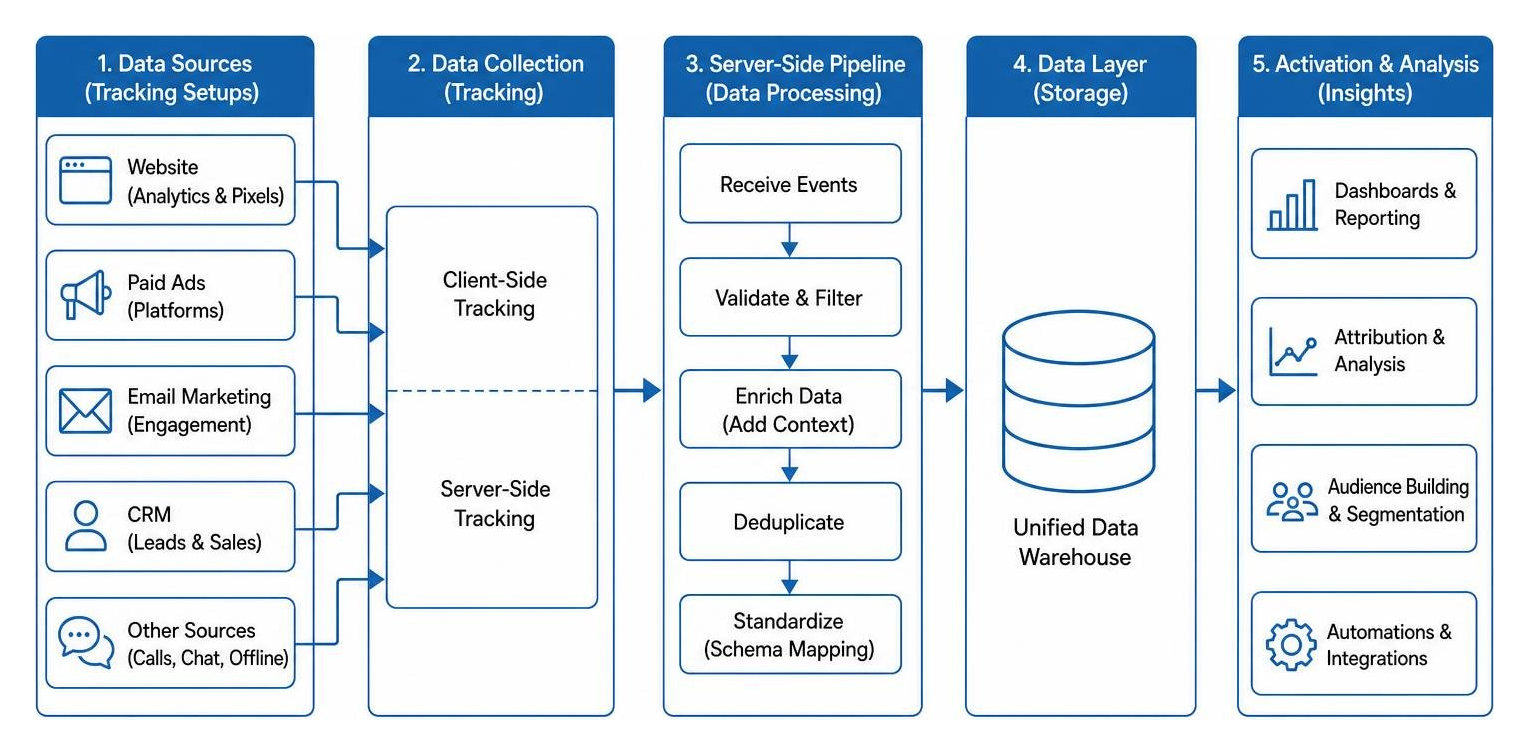
Here is our proven step-by-step framework to set up, clean, and run a successful marketing analysis.
Step 1: Define Your Core Business Objectives
Every successful analysis begins with a specific question. Instead of asking, “How are our ads doing?” ask, “Which paid search campaign in Austin generated the highest quality leads last quarter based on actual CRM conversions?” Align your data objectives directly with your primary business goals, whether that is lowering customer acquisition costs (CAC) or boosting customer retention.
Step 2: Establish Your Tracking Infrastructure
To track your customer’s journey across different platforms, you must use precise UTM parameters on every single link you distribute. However, standard browser-based tracking (client-side) is no longer enough. Modern privacy restrictions, ad blockers, and browser updates (like Safari’s Intelligent Tracking Prevention) block a significant portion of standard tracking codes.
To combat this, we recommend implementing server-side tracking. By routing your tracking data through a secure cloud server instead of the user’s browser, you bypass ad blockers, protect user privacy, and ensure your conversion data remains highly accurate.
Step 3: Centralize Your Multi-Channel Data
Avoid the trap of looking at your marketing in silos. If you look at Google Ads, email platforms, and social media metrics separately, you will end up with fragmented, conflicting reports. Use integration tools or a unified dashboard to pull all your marketing data into one centralized space. To learn more about how to set up a unified view of your marketing channels, take a look at our guide on Online Marketing Analysis.
Auditing and Cleaning Your Marketing Data
A major trap in marketing analysis is acting on bad data. Erroneous, duplicate, or incomplete tracking can easily lead to poor business decisions. Studies show that poor data quality can waste a significant portion of a business’s operational budget.
To keep your insights accurate, we recommend conducting a quarterly data audit:
- Remove Duplicates: Ensure your tracking pixels are not firing twice on a single conversion page.
- Standardize Naming Conventions: Keep your UTM tags consistent (e.g., use “social” instead of mixing “Social”, “social-media”, and “PaidSocial”).
- Filter Out Internal Traffic: Exclude your own team’s IP addresses from your analytics tools so your internal testing doesn’t skew your conversion rates.
- Check for Tracking Gaps: Regularly test your forms, buttons, and checkout pages to ensure conversions are recording correctly.
By keeping your data clean, you ensure that every strategic decision you make is based on consistent, real-world facts. For a deeper dive into maintaining clean, high-performing website data, check out our breakdown of Website Marketing Analytics.
Conducting a Comprehensive Competitive Analysis
You don’t operate in a vacuum. To win more market share in competitive areas like Las Vegas, Nevada, or Austin, Texas, you must understand what your competitors are doing.
A thorough competitive analysis using digital marketing data allows you to benchmark your performance and spot open opportunities:
- Analyze Share of Search: Track how often your brand name is searched compared to your top 5 to 10 regional competitors. This metric correlates closely with market share.
- Evaluate Content and SEO Gaps: Use search intelligence tools to see which keywords are driving organic traffic to your competitors. Look for high-intent questions they have missed.
- Monitor Paid Ad Strategies: Look at the active ad creatives your competitors are running on search engines and social platforms. What offers, hooks, and landing pages are they using to attract clients?
- Desktop vs. Mobile Engagement: Compare how users interact with your competitors’ websites on mobile devices versus desktop. This can reveal if you need to optimize your own mobile user experience to capture more local traffic.
Key Metrics and KPIs: Actionable vs. Vanity Data
When you open an analytics dashboard, it is easy to get overwhelmed by the sheer volume of numbers. To keep your strategy focused, you must separate the metrics that actually drive revenue from those that simply make you feel good.
| Metric Type | What It Includes | Why It Matters |
|---|---|---|
| Vanity Metrics | Raw page views, social media impressions, total follower count, email open rates (which are often inflated by auto-loading privacy pixels). | These metrics look impressive on paper, but they do not correlate directly with sales or business growth. |
| Actionable Metrics | Conversion rate, customer acquisition cost (CAC), customer lifetime value (LTV), email revenue-per-send, and lead-to-opportunity pipeline velocity. | These metrics show you exactly how efficiently your marketing budget is turning into business revenue. |
To master the basics of choosing the right indicators for your campaigns, read our introduction to Marketing Metrics 101: Know If It’s Working.
Financial and Lifecycle Metrics That Matter to the CFO
If you want to prove the true value of your marketing, you must speak the language of corporate finance. This means looking past simple engagement rates and focusing on core financial and lifecycle metrics:
- Net Revenue Retention (NRR): This measures the percentage of recurring revenue retained from existing customers over a set period. Acquiring a new customer costs five to seven times more than retaining an existing one. High NRR proves your marketing and customer experience strategies are successfully keeping clients happy.
- CAC Payback Period: This is the number of months it takes for a customer to generate enough gross profit to cover the cost of acquiring them. A shorter payback period means your business recovers cash faster, allowing you to scale more efficiently.
- Contribution Margin: This measures the profitability of individual products or services after subtracting direct variable costs (including active ad spend). Looking at your contribution margin prevents you from running campaigns that generate high sales volume but actually lose money after ad costs.
To understand how different marketing channels impact these financial metrics across various regions, review the comprehensive data in Digital marketing ROI by channel and region in 2026 .
Channel-Specific Performance Indicators
While financial metrics are your ultimate guide, you still need channel-specific KPIs to optimize your daily campaigns:
- Email Marketing ROI: Email remains one of the highest-performing channels in our mix, delivering an average return of $36 to $42 for every dollar spent. Instead of relying on open rates (which are heavily inflated by Apple Mail Privacy Protection), focus on click-through rates, list health, and revenue-per-send.
- Short-Form Video Completion Rate: Short-form video is ranked as the top ROI content format by 49% of marketers. When analyzing video performance, look closely at the “hook rate” (how many people watch past the first 3 seconds) and the “hold rate” (how many watch the video to completion).
- Google Ads Conversion Rate: For lead-focused campaigns, a strong conversion rate is key to keeping your cost-per-lead low. Always separate your branded search campaigns from non-branded campaigns to ensure your existing brand authority isn’t masking poor non-branded ad performance.
- First-Party Data Growth: With third-party cookie tracking fading away, building your own database of customer emails, phone numbers, and direct preferences is critical. Track the growth of your owned audiences as a core asset that competitors cannot take away.
Adapting Analytics for AI Search and Zero-Click Environments
The digital search landscape is undergoing its largest shift in decades. The rise of AI-driven search engines and conversational chatbots has changed how consumers find information online.
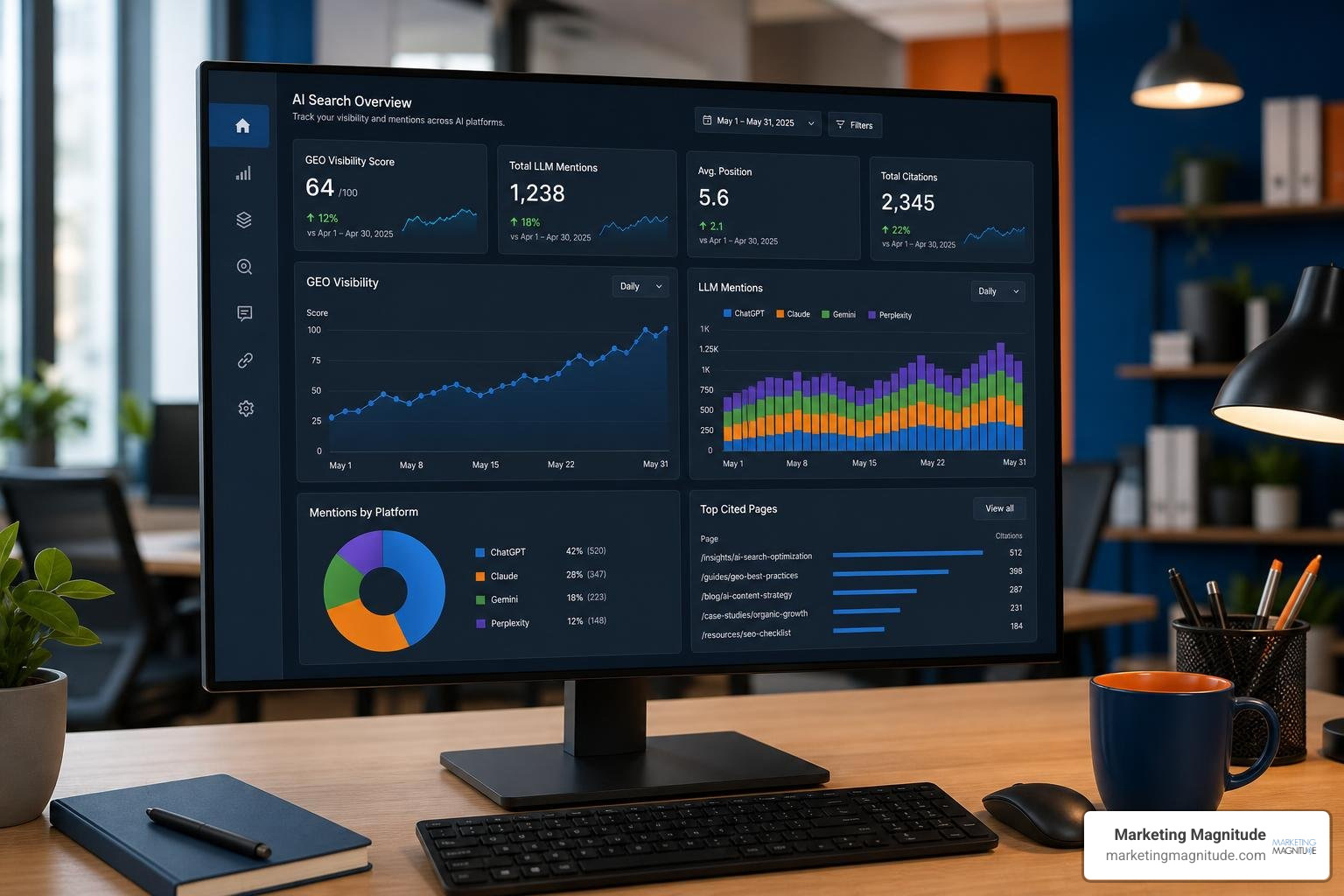
Today, roughly 37% of consumers start their searches with AI tools rather than traditional search engines. Furthermore, AI-driven traffic to retail websites has surged dramatically over the past year.
This shift has created a highly click-averse environment. When Google displays an AI Overview at the top of the search results, the organic click-through rate for the top organic listing can drop significantly. In fact, 58% to 68% of Google searches now end without a single click.
To survive and grow in this zero-click world, we must adapt our SEO strategies. We are moving away from traditional keyword-stuffing and embracing Generative Engine Optimization (GEO) and Answer Engine Optimization (AEO). This means structuring our website content to be easily read, understood, and cited by AI models like ChatGPT, Gemini, Claude, and Perplexity.
Measuring Visibility in the Age of AI Search
Because users are consuming direct, synthesized answers instead of clicking through to websites, traditional metrics like “organic sessions” are no longer the single source of truth. To measure your brand’s true reach, you must track new, AI-specific KPIs:
- AI Citation Rate: Track how often your website’s URL is cited as a source in Google AI Overviews or conversational search answers. Research shows that 76.1% of URLs cited in AI Overviews also rank in the top 10 of Google search results, proving that strong foundational SEO remains essential to securing these highly valuable citations.
- LLM Mention Frequency: Monitor how often your brand name is recommended or mentioned by large language models (LLMs) when users ask conversational queries (e.g., “What is the best family wellness clinic in Austin?”). Because LLM responses are dynamic, tracking this as a rolling 7-day average gives you a realistic view of your brand’s visibility.
- Conversational Query Performance: Analyze traffic coming from conversational search terms. While AI-driven search sessions may represent a smaller volume of your total traffic, they are incredibly valuable. AI search visitors are highly qualified and can convert at a rate up to 23 times higher than traditional search traffic.
To explore how these AI trends are projected to evolve over the coming years, read Digital Marketing Statistics 2027 (Forecast): 55+ Key Data Points & Trends | SaaSStatsHub.
Privacy-First Tracking and Ethical Data Collection
As we navigate these technological changes, we must also respect tightening global privacy regulations and changing consumer expectations.
- The Death of Third-Party Cookies: Browser restrictions have made third-party tracking cookies highly unreliable.
- The Rise of First-Party Data: To protect their campaigns, 92% of organizations are increasing their investment in first-party data strategies. This means focusing on building direct relationships with your audience through email lists, SMS sign-ups, and interactive website tools.
- The Trust Premium: Modern consumers value their digital privacy. 71% of consumers are more likely to buy from brands that are completely transparent about how they collect and use data.
By implementing clear consent management tools and giving users complete control over their data, you build deep, long-term trust that naturally improves customer retention.
Frequently Asked Questions about Digital Marketing Analytics
What is the difference between actionable and vanity metrics?
Vanity metrics (such as raw page views, social media likes, or total follower counts) look impressive on paper but do not correlate directly with sales or business growth. Actionable metrics (such as conversion rate, customer acquisition cost, and customer lifetime value) measure real business outcomes. Focusing on actionable data allows you to make strategic adjustments that directly increase revenue.
How is AI transforming digital marketing analytics in 2026?
AI has shifted marketing analytics from looking backward to planning forward. Instead of simply reporting on past campaign performance, AI-driven tools use predictive modeling to forecast future customer behavior, identify at-risk accounts before they churn, and automate real-time budget adjustments across active channels.
Why is server-side tracking becoming essential?
Traditional browser-based tracking (client-side) is increasingly blocked by ad blockers, browser privacy features, and cookie restrictions, leading to incomplete conversion data. Server-side tracking routes your analytics data through a secure cloud server instead of the user’s browser, ensuring highly accurate tracking while fully respecting user privacy.
Conclusion
Analyzing your digital marketing shouldn’t feel like a confusing chore. By focusing on actionable metrics, maintaining clean data, and adapting your strategy to the rise of AI search, you can gain complete clarity over your marketing investments.
At Marketing Magnitude, we believe that sustainable business growth happens when your marketing, CRM technology, automation, and analytics work together as one connected, high-performing ecosystem. We are not just here to generate temporary clicks or vanity impressions; we build complete, long-term growth infrastructures tailored for trust- and relationship-centered service businesses.
Whether you are looking to optimize your local visibility in Las Vegas, streamline your lead nurturing in Austin, or build a unified tracking system that proves your true financial ROI, we are here to help you scale with confidence.
Ready to turn your marketing data into a predictable engine for growth? More info about our digital marketing services. Let’s build a smarter, more scalable future for your business together.


