
Why Marketing Analytics Decision Making Determines Whether Your Budget Works or Wastes
Marketing analytics decision making is the process of using data from your campaigns, customers, and channels to guide where you spend, what you say, and who you target — instead of relying on gut feel.
If you’re looking for a quick answer on how to use marketing analytics to make better decisions, here it is:
- Track the right metrics — focus on Customer Acquisition Cost (CAC), Customer Lifetime Value (CLV), and Return on Ad Spend (ROAS), not vanity metrics like page views or follower counts.
- Understand what happened and why — use descriptive and diagnostic analytics before moving to predictive models.
- Prove what’s actually working — use incrementality testing and multi-touch attribution, not just last-click reporting.
- Let AI support decisions, not replace judgment — automate data synthesis, but keep humans in control of strategy and ethics.
- Build a data culture — break down silos and make analytics accessible across your team, not just to one analyst.
Here’s the problem most service businesses face: you have data, but it’s scattered across your ads platform, your website, your CRM, and maybe a spreadsheet or two. None of it talks to each other. So decisions still get made on instinct — or on whichever number looked best in last month’s report.
That gap between data and decisions is expensive. Research from Analytic Partners found that brands embedding analytics directly into their decision-making see five times more growth than those that don’t. Yet according to Gartner, analytics only influences about 53% of marketing decisions — meaning nearly half of all marketing choices still happen without data backing them up.
This guide is built to change that for your business.
I’m Kelly Rossi, founder of Marketing Magnitude and a digital marketing strategist with over 20 years of experience running data-driven campaigns across SEO, PPC, analytics, and growth strategy for service businesses. Throughout my career, I’ve seen how applying structured marketing analytics decision making transforms guesswork into predictable, measurable growth — and I’ve built this guide to give you a practical path to do the same.
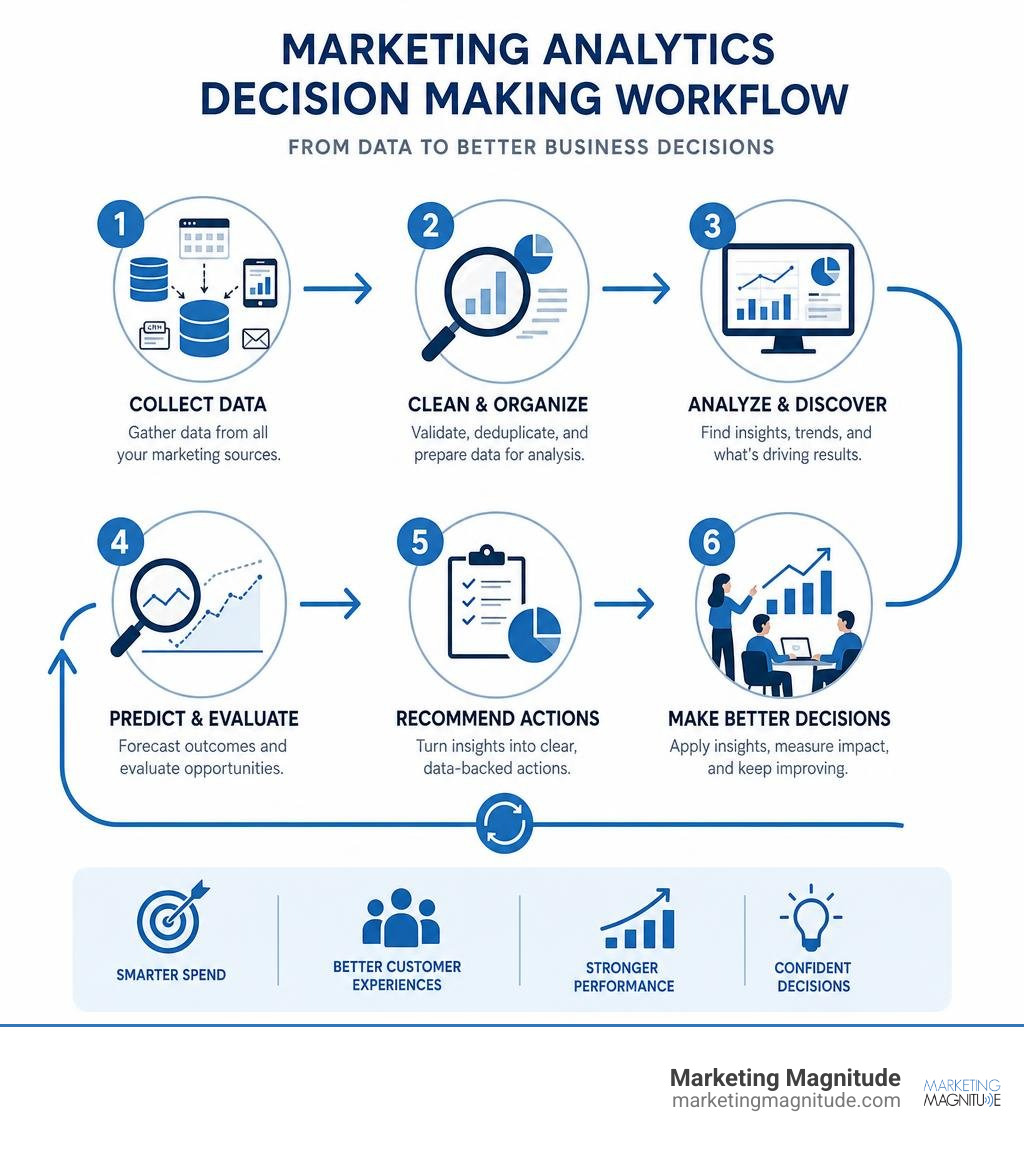
The Foundations and Evolution of Marketing Analytics Decision Making
To make smarter decisions, we first have to understand what marketing analytics actually is. At its core, marketing analytics is the practice of measuring, managing, and analyzing marketing performance to maximize its effectiveness and optimize return on investment (ROI).
Historically, marketing was seen as a purely creative endeavor. You came up with a catchy slogan, bought a billboard in Las Vegas or Austin TX, and hoped for the best. Today, in July 2026, marketing is deeply analytical. Because digital ecosystems are highly fragmented, we must rely on data to understand how customers interact with our brands across dozens of touchpoints.
When we align our analytics with strategic planning, we stop guessing and start scaling. For service-based businesses where trust and long-term relationships are critical, knowing exactly how a user moves from an initial search to a booked consultation is the key to sustainable business growth. If you are new to this landscape, our Guide to Online Marketing Analysis is an excellent starting point to understand how to map your digital presence.
Shifting from Retrospective Dashboards to Predictive Marketing Analytics Decision Making
Many businesses fall into the “dashboard trap.” They spend hours building beautiful, colorful charts that show what happened last month. While descriptive analytics (explaining what happened) and diagnostic analytics (explaining why it happened) are foundational, they are fundamentally reactive.
Modern marketing analytics decision making requires moving past the rearview mirror. The true power of data lies in forward-looking capabilities:
- Predictive Modeling: Using historical data, machine learning, and statistical algorithms to forecast future outcomes. For example, instead of asking how many leads we got last month, predictive systems help us forecast how many leads we will generate next month based on seasonal trends and budget shifts. You can dive deeper into this shift in our guide on Digital Marketing Predictive Analytics.
- Prescriptive Optimization: This is the pinnacle of decision intelligence. It doesn’t just tell you what will happen; it recommends the exact actions you should take to achieve the best outcome.
According to scientific research on data-driven insights, companies that transition from purely descriptive reporting to predictive and prescriptive models build a massive competitive advantage. They can spot customer churn before it happens, adjust ad copy on the fly, and dynamically allocate budgets to the highest-performing channels.
Key Metrics That Drive Data-Driven Marketing Decisions
If you measure everything, you measure nothing. The secret to effective decision-making is focusing on value metrics that directly impact your bottom line, rather than vanity metrics that only make you feel good.

To know if your marketing is actually working, you need to master a few core financial and performance metrics. If you need a refresher on the basics, check out our guide on Marketing Metrics 101.
Core Financial and Performance Metrics
When evaluating campaign performance, we look closely at three interconnected metrics:
- Customer Acquisition Cost (CAC): The total cost of sales and marketing required to acquire a single new customer.
- Customer Lifetime Value (CLV): The total revenue or profit a customer generates for your business over the entire span of their relationship with you.
- Return on Ad Spend (ROAS): Total campaign revenue divided by total campaign spend.
For service businesses, the relationship between these numbers is everything. We look for a healthy LTV:CAC ratio—ideally 3:1 or higher. If your ratio is 1:1, you are spending too much to get customers; if it is 5:1, you are likely underinvesting and leaving growth on the table.
Additionally, we must distinguish between average ROAS and marginal ROAS. Average ROAS is a retrospective metric that looks at your total return across all spend. Marginal ROAS looks forward, telling you the return you will get on the next dollar you spend. Because of the law of diminishing returns, your marginal ROAS will eventually drop even if your average ROAS looks fantastic.
| Metric Type | Average ROAS | Marginal ROAS |
|---|---|---|
| Focus | Backward-looking historical performance | Forward-looking incremental performance |
| Formula | Total Revenue / Total Spend | Change in Revenue / Change in Spend |
| Best Used For | General reporting and high-level evaluation | Budget optimization and scaling decisions |
| Risk | Can mask channel saturation and wasted spend | More complex to calculate and model |
Advanced Attribution and Conversion Tracking
To calculate these metrics accurately, you need robust tracking. In the past, marketers relied on simple “last-click” attribution, which gave 100% of the credit to the very last link a user clicked before converting. This model is incredibly dangerous because it starves the top-of-funnel campaigns that introduced the customer to your brand in the first place.
Today, we use multi-touch attribution (MTA) to distribute credit across the entire customer journey. However, tracking has become significantly harder due to privacy updates, ad blockers, and browser restrictions.
To bypass these limitations, we implement:
- Server-Side Tracking: Moving tracking tags from the user’s browser (client-side) to a secure server. This recovers lost conversion data and improves website speed.
- Call Tracking: For service businesses in Nevada or Texas, many leads still come via phone calls. Integrating call tracking allows you to tie offline conversations back to the exact search term or ad that triggered them.
- Conversion Systems: Setting up comprehensive Website Conversion Tracking to ensure every form fill, phone call, and calendar booking is mapped to its source.
Unifying the Measurement Triangle: MMM, MTA, and Incrementality
No single measurement method is perfect. To build a truly resilient decision framework, modern organizations must unify three distinct approaches into what we call the “Measurement Triangle.”
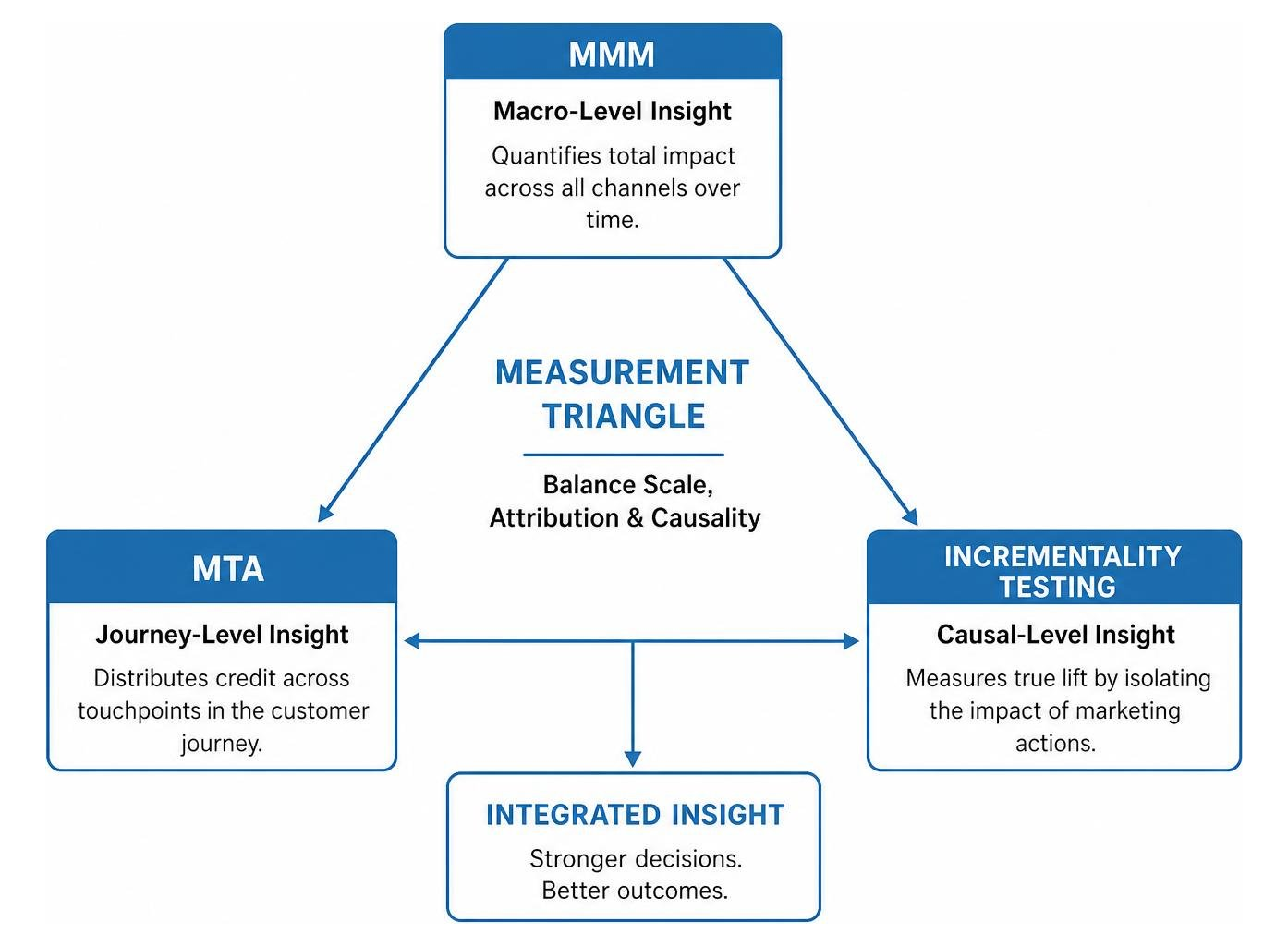
According to The AIMx framework study published in the Future Business Journal, integrating these three methodologies via AI creates an adaptive decision system that eliminates fragmented reporting.
Integrating Causal Frameworks for Adaptive Marketing Analytics Decision Making
Let’s break down how the three components of the Measurement Triangle work together:
- Marketing Mix Modeling (MMM): A top-down, macro-level econometric approach. It uses historical sales and spend data to calculate the overall impact of various marketing channels, accounting for external factors like seasonality, economic shifts, and competitor pricing.
- Multi-Touch Attribution (MTA): A bottom-up, micro-level approach. It tracks individual user paths across digital touchpoints to help you optimize daily campaign tactics, ad creatives, and keyword bids.
- Incrementality Testing (IT): The scientific source of truth. It uses randomized control trials (RCTs) and geo-based testing to compare a “treated” group (people who see your ads) against an “untreated” control group (people who don’t). This is the only way to prove causation—confirming whether an ad actually caused a conversion, or if that customer would have converted anyway.
By feeding incrementality test results back into your MMM as “prior beliefs” (Bayesian priors) and using MTA for real-time adjustments, you build a closed-loop system. This prevents you from overinvesting in channels that claim high ROAS but actually drive zero incremental growth.
The Role of AI, Automation, and Ethical Governance in Modern Decision Systems
Artificial intelligence is rapidly shifting from a helpful assistant to an active orchestrator of marketing decisions. According to the Analytic Partners 2026 report, top-performing brands are leveraging automated, context-rich commercial analytics to navigate data fragmentation and privacy constraints.
AI-Driven Forecasting and Real-Time Resource Allocation
AI brings speed and precision to resource allocation that humans simply cannot match manually. In modern marketing setups, AI-powered systems handle:
- Predictive Forecasting: Instantly simulating budget scenarios (e.g., “What happens if we increase our SEO spend by 20% in Austin TX?”) to project revenue outcomes.
- Automated Bidding and Dynamic Pricing: Adjusting ad bids and pricing models in milliseconds based on real-time search demand and competitor activity.
- Next-Best-Action (NBA) Engines: Processing real-time behavioral signals to determine the absolute best offer, message, or piece of content to show a specific prospect in the moment.
This level of automation allows businesses to catch spend anomalies and opportunities instantly, rather than waiting for a monthly or quarterly review.
Navigating Privacy, Data Quality, and Algorithmic Bias
However, complete automation carries risk. If you feed poor-quality data into an AI model, it will simply automate bad decisions at scale. Data quality is a major bottleneck; industry estimates show that erroneous or incomplete data can waste up to 27% of a business’s revenue.
Furthermore, we must navigate a complex regulatory environment. With regional laws like GDPR and CCPA, consumer privacy must be respected. This requires setting up robust consent modes and ensuring your data collection practices are entirely transparent.
To balance algorithmic power with safety, we advocate for Explainable AI (XAI) and strict human oversight.
We must ensure our models are not “black boxes.” Marketers and business leaders need to understand the underlying logic behind an AI’s budget recommendation. Strategic interpretation, brand alignment, and ethical compliance must always remain human responsibilities.
Shifting Culture: Transitioning from Intuition to Data-Driven Workflows
The hardest part of implementing marketing analytics is not the technology—it is the psychology. Many organizations suffer from “reporting theater,” where teams build complex dashboards but still make high-stakes decisions based on the CEO’s gut feeling.

Transitioning to a data-driven culture requires deliberate organizational change. If you are looking to revitalize your approach, we outline several foundational steps in our guide on 4 Ways to Improve Your Digital Marketing Strategy.
Building Data Literacy and Cross-Department Collaboration
To build a data-driven culture, we must focus on:
- Upskilling and Education: You don’t need every team member to be a data scientist, but everyone should have basic “numerical fluency.” Training your team to understand key metrics ensures everyone speaks the same language.
- Breaking Down Data Silos: Marketing, finance, and sales often look at different versions of the truth. A true growth ecosystem connects your CRM, ad platforms, and financial reporting into a single, shared source of truth.
- Aligning Marketing and Finance: Ensure your marketing metrics map directly to financial outcomes, such as net contribution to profit, rather than isolated click-through rates.
Driving Competitive Resilience and Strategic Adaptability
Markets are volatile. Consumer behaviors shift quickly, and economic conditions change. Organizations that rely on rigid, intuition-based planning struggle to adapt.
By embedding continuous, real-time analytics into your operational workflow, you build strategic adaptability. When you can see exactly how search demand is shifting, or where customer acquisition costs are rising, you can reallocate resources dynamically. This analytical agility is what keeps businesses resilient during market downturns.
Frequently Asked Questions about Marketing Analytics
What is the difference between average ROAS and marginal ROAS?
Average ROAS looks backward, dividing your total generated revenue by your total ad spend. It tells you how healthy your historical campaigns were. Marginal ROAS looks forward, measuring the additional revenue generated by the next increment of spend. It is the crucial metric for budget optimization because it helps you identify the exact point where increasing your budget will yield diminishing returns.
How do privacy regulations like GDPR and iOS14+ impact marketing analytics?
These updates have caused significant “signal loss,” making traditional browser-based cookie tracking highly inaccurate. To combat this, modern marketing setups rely on server-side tracking, Google Consent Mode, and first-party data integrated directly from CRM platforms to build a privacy-compliant, accurate picture of user behavior.
Why is incrementality testing superior to standard attribution models?
Standard attribution models (like first-click or last-click) only show correlation—they prove that a user clicked an ad before converting. They cannot prove that the ad caused the conversion. Incrementality testing uses scientific holdout groups to isolate true causal lift, ensuring you aren’t paying for conversions from customers who would have bought from you anyway.
Conclusion
Applying marketing analytics decision making is no longer optional for businesses that want to scale efficiently. The era of fragmented systems, siloed data, and guessing where your next customer is coming from is over.
At Marketing Magnitude, we believe that sustainable, long-term growth happens when your marketing, communication, CRM technology, and analytics work together as a single, connected ecosystem. By moving past basic dashboards and embracing a unified, data-driven framework, you gain the clarity needed to make decisions you can truly trust.
If you are ready to eliminate the guesswork and build a high-performing, measurable growth system for your business, explore our Website Marketing Analytics Services or reach out to us today for a strategic consultation.