Why SEO Is One of the Most Powerful Drivers of Business Growth
SEO for business growth is the practice of improving your website’s visibility in search engines so that more of the right people find you — without paying for every click.
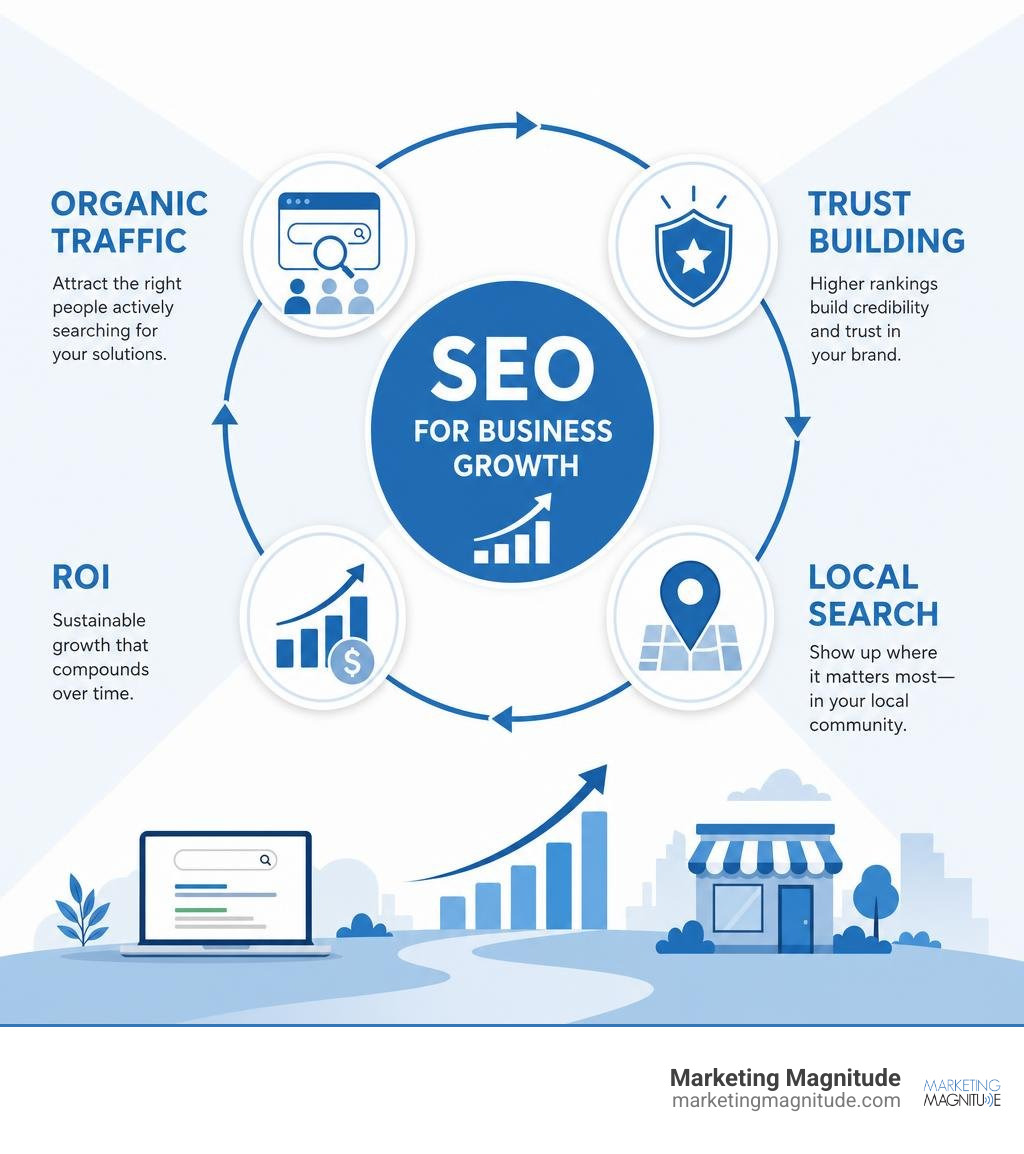
Here’s a quick summary of how it drives growth:
| What SEO Does | Why It Matters |
|---|---|
| Increases organic visibility | 53% of all online traffic comes from organic search |
| Drives qualified leads | Nearly 50% of users click the first organic result |
| Builds trust and credibility | High rankings transfer authority to your brand |
| Compounds over time | Unlike ads, results don’t stop when spend stops |
| Captures local demand | Almost half of all Google searches have local intent |
Your website is often the first impression a potential customer has of your business. But if they can’t find it, that impression never happens.
That’s the core problem SEO for business growth solves.
Organic search drives more than half of all online traffic — and contributes to nearly half of all revenue share across industries. Yet most service business owners are either invisible in search results, or they’re getting traffic that never converts.
This guide cuts through the noise. Whether you’re wondering if SEO is worth it, frustrated with an agency that sends reports you don’t understand, or ready to build a real long-term strategy — you’ll find clear, actionable answers here.
I’m Kelly Rossi, founder of Marketing Magnitude and a digital marketing strategist with over 20 years of experience helping service-based businesses build sustainable visibility through SEO for business growth. From running multi-location campaigns to growing community platforms from zero, I’ve seen what works — and what quietly drains your budget. Let’s get into it.
Demystifying SEO for Business Growth in 2026
If you have spent more than five minutes looking into digital marketing, you have likely run into a wall of technical jargon. Let’s strip away the “geek speak” and look at what is actually happening.
At its core, What is Search Engine Optimization? It is the systematic process of making your business website easy for search engines to find, understand, and recommend to people who are actively looking for what you offer.
Search engines like Google are fully automated discovery engines. They deploy crawler programs that constantly explore the web, analyze pages, and organize them into a massive index. When a user types a query, Google scans its index to deliver the most relevant, high-quality results.
Understanding a few Need to Know Search Engine Optimization Facts can save you thousands of dollars. First, Google accounts for 89.62% of all internet queries as of March 2025. Second, search engines prioritize the user experience above all else. If your site is slow, confusing, or filled with thin content, no amount of keyword stuffing will save your search engine optimization strategy. In fact, Google’s sophisticated systems easily recognize manipulative practices and will actively deprioritize your site.
How Search Engines Evaluate and Rank Your Content
Search engine algorithms are not static; they are highly dynamic, processing multiple updates every day. To secure a high ranking, your content must satisfy both the search engine’s technical criteria and the user’s search intent.
One of the most important concepts in modern search is E-E-A-T: Experience, Expertise, Authoritativeness, and Trustworthiness. While E-E-A-T is not a direct, individual ranking score, it is the conceptual framework Google uses to evaluate whether your content is helpful and reliable.
When your business ranks at the top of the search results, something magical happens: trust transference. Users inherently trust Google to filter out spam. By ranking your website highly, Google transfers its own brand trust to your business. This immediate credibility makes potential clients far more comfortable booking a consultation or calling your office.
To navigate this landscape, mastering a few basic SEO Terms You Need to Know — such as organic traffic, search intent, and indexing — is essential for communicating with your growth partners.
The Compounding Value of Organic Search vs. Paid Ads (PPC)
Many business owners ask us whether they should invest in organic search or paid advertising (PPC). While PPC offers immediate visibility, it is a transactional model. The moment you stop paying for ads, your traffic drops to zero.
Furthermore, in competitive sectors like legal, medical, or professional services, the cost-per-click (CPC) can easily range from $50 to $100 or more. Relying solely on paid ads in these competitive fields is a fast track to draining your marketing budget.
Organic search, on the other hand, acts as a compounding business asset. The optimization work you do today continues to drive traffic, capture qualified leads, and lower your customer acquisition costs months and years down the road.
| Feature | Organic Search (SEO) | Paid Search (PPC) |
|---|---|---|
| Cost Model | Long-term investment; no cost per click | Pay-per-click; ongoing ad spend required |
| Speed of Results | Compounds over 3 to 12 months | Instantaneous visibility |
| Trust & Credibility | High (users trust organic results over ads) | Moderate (clearly labeled as sponsored) |
| Sustainability | Traffic continues if budget is paused | Traffic stops immediately when budget stops |
| Funnel Alignment | Excellent for all stages of the buyer journey | Best for bottom-of-funnel transactional intent |
To dive deeper into how these two channels interact, check out our guide on SEO vs SEM What’s the Difference.
The Core Pillars of a Modern Search Engine Optimization Strategy
Achieving sustainable visibility requires a balanced approach. You cannot rely on content alone if your website is technically broken, and you cannot rely on technical fixes if your content is unhelpful.
We build our clients’ campaigns on four core pillars to ensure a highly effective, modern Search Engine Optimization SEO Strategies for Improved Online Visibility.
Strategic Keyword Research and Topic Clusters
Gone are the days of targeting isolated, highly competitive keywords. Modern search engines understand semantic relationships and search intent. To build real authority, we use topic clusters.
A topic cluster consists of a comprehensive “pillar page” that covers a broad topic in depth, surrounded by smaller “cluster pages” that answer specific, long-tail questions. These pages are linked together, signaling to search engines that your website possesses deep expertise on the subject.
When researching keywords, we look beyond raw search volume. We prioritize keyword difficulty (KD%) and search intent. Focusing on commercial and transactional keywords — where users are actively looking to buy or hire — yields a much higher return on investment than chasing high-volume, generic informational terms.
For a quick reference on these concepts, consult our A Brief Glossary of 12 Essential SEO Terms.
High-Quality Content and On-Page Optimization
On-page optimization is about making your content highly readable for both humans and search crawlers. This is what we call The Secret Sauce of On Page Optimization.
Your primary target keyword should appear naturally in your H1 heading, title tag, URL, and meta description. However, avoid keyword stuffing at all costs. Write naturally, use short paragraphs, and organize your thoughts with bulleted lists to make your content easy to digest.
To keep your rankings strong, make sure to read our breakdown of what to avoid: SEO Writers Avoid These 3 Content Marketing Mistakes. The most common errors include writing search-engine-first content that offers no real value, failing to match search intent, and ignoring user experience.
Technical SEO and Site Infrastructure
Your website’s technical infrastructure is the foundation that multiplies all your other search marketing efforts. If search engine crawlers cannot easily access, read, and index your site, your content will remain invisible.
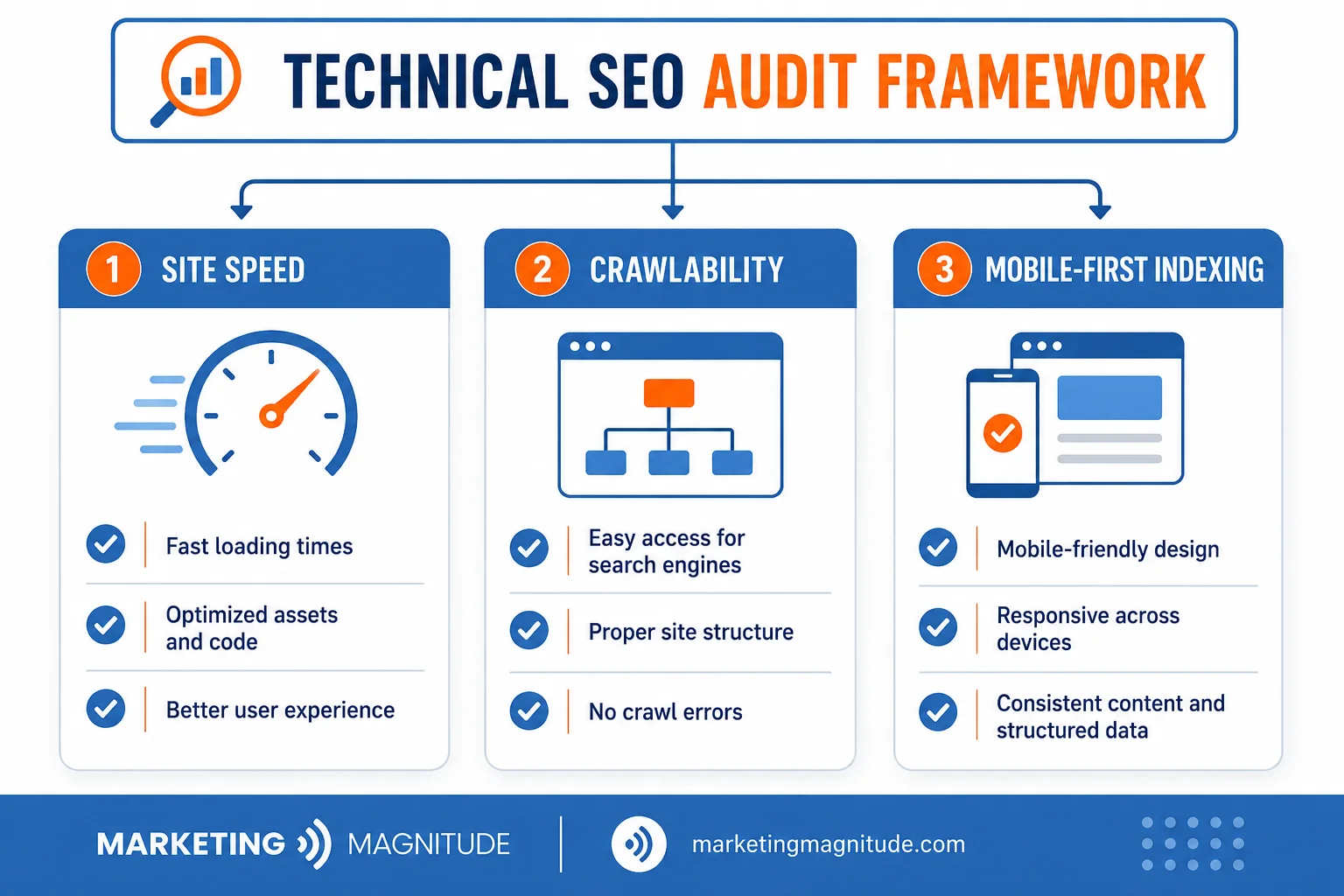
A solid technical setup requires attention to several key elements:
- Mobile-First Indexing: Google primarily ranks websites based on how their mobile versions perform. Your site must scale perfectly and load instantly on mobile devices.
- Core Web Vitals: Google uses real-world user experience signals — such as page load speed, interactivity, and visual stability — as direct ranking factors. If your site takes longer than 3 seconds to load, you are losing potential clients.
- Schema Markup: Implementing structured data helps search engines understand the context of your pages, making you eligible for rich snippets and AI-powered search citations.
- Security (HTTPS): Sites without SSL certificates are flagged as insecure by browsers and deprioritized by search engines.
Maximizing Local SEO for Service-Based Businesses
For service-based businesses operating in specific geographic regions, local visibility is the lifeblood of customer acquisition. Almost half of all Google searches have local intent, and 72% of consumers who perform a local search visit a physical location within five miles of their current position.
Understanding Local SEO Strategies to Boost Your Business is essential for capturing this high-intent traffic. To understand how this fits into your broader digital marketing budget, read our detailed comparison: Organic SEO Services vs Local SEO Services What’s the Difference.
Dominating the Google Maps Pack
The “Maps Pack” is the prominent section at the top of local search results displaying a map and three local business listings. Securing a spot here is the ultimate goal of local search optimization.
To improve your visibility, follow our A Z Guide to Maps Pack Ranking. The process starts with claiming and fully optimizing your free Google Business Profile. Ensure your primary business category is accurate, upload high-quality photos, post regular updates, and actively answer customer questions.
Consistency is critical. Your business Name, Address, and Phone number (NAP) must be identical across your website, social profiles, and local directories. These consistent local citations act as votes of confidence for Google’s algorithm.
For a deeper dive into the tactical steps, read Local SEO Services The Sneak Attack to Google Rankings.
Tailored Local SEO for High-Trust Industries
In high-trust, relationship-driven industries — such as healthcare, wellness, and professional services — local search optimization requires a nuanced touch. Potential clients are not just looking for the closest business; they are looking for the most reputable and reliable option.
For these sectors, reputation management is a core ranking signal. Google prioritizes businesses with a steady stream of authentic, positive reviews. We help our clients build automated systems to solicit reviews from satisfied patients or clients ethically and consistently.
Additionally, creating localized, educational content that addresses specific community concerns builds immense credibility. For example, we frequently implement the Best Local SEO Strategies for HVAC Plumbing and Roofing Companies, which involves building dedicated service and city-specific pages that address local weather patterns, regional building codes, and common neighborhood issues.
Navigating the AI Era: GEO, AEO, and AIO
The search landscape in 2026 is undergoing a massive shift. Generative AI tools like ChatGPT, Gemini, and Perplexity are changing how users find information. Rather than scrolling through a list of links, users are increasingly receiving direct, synthesized answers on the search results page.
This shift has introduced three new optimization models:
- GEO (Generative Engine Optimization): Optimizing your content to be cited as a source by generative search engines.
- AEO (Answer Engine Optimization): Structuring your data to provide direct, concise answers to conversational queries.
- AIO (Artificial Intelligence Optimization): Preparing your brand’s digital footprint to be recognized as an authoritative entity by AI models.
To stay ahead of these changes, see our guide on How to Rank Your Website with ChatGPT.
Adapting to Generative Engine Optimization (GEO)
Traditional search optimization targets ranked lists of links, covering roughly 62% of commercial queries. The remaining 38% of queries are increasingly resolved directly within AI-generated overviews without a single click.
To bridge this gap, businesses must adopt the principles outlined in The 2026 SEO And AIO Playbook: The Complete Strategy For Unbeatable Visibility – ClipKoi Search. Shorts. Sales..
GEO requires structuring your content with direct, authoritative answer blocks of 40 to 60 words. These concise summaries are highly attractive to AI models looking for quick, accurate answers to cite. Furthermore, targeting conversational, long-tail keywords that mimic natural human speech is essential.
While some marketers suggest focusing heavily on voice search, we offer a realistic perspective: Counterpoint Definitely Ignore Voice Search in SEO Campaigns. Instead of optimizing for outdated voice assistant devices, focus your energy on conversational AI search engines that deliver real, text-based answers and citations.
Building Authority for AI-Powered Search Engines
AI search engines do not just read your website; they evaluate your entire brand entity across the web. To recommend your business, an AI model requires high citation density and external validation.

Building brand authority in the AI era relies on several strategic actions:
- Entity Schema Installation: Implementing Organization and Person schema on your website verifies your brand entity, making your existing content instantly eligible for AI citations.
- VideoObject Schema: Embedding educational videos with structured VideoObject JSON-LD schema acts as a massive citation multiplier.
- Digital PR and Unlinked Mentions: Securing mentions in authoritative publications, local news outlets, and industry directories signals to AI models that your business is a trusted leader.
Measuring Success and Avoiding Common Pitfalls
The digital marketing industry has a transparency problem. Many agencies send monthly reports filled with confusing graphs and vanity metrics like “impressions” or “keyword rankings” while failing to explain how those numbers translate to your bottom line.
At Marketing Magnitude, we believe in complete clarity. We help our clients identify the difference between raw activity metrics and strategic key performance indicators (KPIs).
To protect your business from common industry traps, read our survival guides: How to Know Your SEO Person is Faking It and Don’t Get Ghosted by Your SEO Agency.
Key Metrics to Track for SEO for Business Growth
To measure the true return on investment of seo for business growth, you must connect search data directly to your customer relationship management (CRM) system.
We prioritize tracking metrics that reflect real business impact:
- Conversion Rate from Organic Traffic: The percentage of organic visitors who take a high-value action, such as submitting a form or calling your office.
- Pipeline Value: The total estimated revenue value of the leads generated through organic search.
- Customer Lifetime Value (LTV): Tracking how long organic search leads remain active clients compared to other acquisition channels.
- Branded Search Volume: An increase in users searching for your exact business name indicates growing brand awareness.
With a structured, conversion-focused approach, the results can be remarkable. For example, see our case study on how This Site Ranked for Over 700 Keywords in 4.5 Months by targeting commercially grounded search terms and optimizing user experience.
Critical Mistakes That Stifle SEO for Business Growth
Many well-intentioned business owners make critical mistakes that actively harm their search visibility.
First, avoid buying cheap, low-quality backlinks. Google’s spam policies are highly sophisticated, and manipulative link schemes can lead to severe ranking penalties. Read our warning: Don’t Go Broke Buying Backlinks. Real authority is earned through high-quality, helpful content and genuine partnerships.
Second, avoid working with agencies that promise overnight rankings or use “black hat” tactics. To understand why these transactional models fail, read The Ultimate Guide to Why Most SEO Agencies Fail in the First 90 Days. Sustainable growth requires a long-term, integrated strategy, not short-term algorithm-gaming tricks.
Frequently Asked Questions About SEO
How long does it take to see results from SEO?
The timeline for seeing measurable results from search engine optimization depends heavily on your domain authority, industry competition, and the current health of your website.
Generally, technical fixes can yield ranking and crawlability improvements within 2 to 4 weeks. Optimizing existing commercial content typically takes 3 to 6 months to reflect in search results, while publishing brand-new content assets may take 6 to 12 months to reach their full ranking potential.
For a detailed breakdown of the compounding timeline, read our FAQ: How Long Does SEO Take.
Can small businesses with limited budgets do SEO?
Yes, absolutely. In fact, search engine optimization is one of the most cost-effective strategies for small businesses because it allows you to compete with larger brands without matching their massive advertising budgets.
According to resources like the SEO for Small Business guide, small businesses possess a distinct advantage in targeting hyper-specific, localized, and long-tail search queries where broad domain authority matters less than specific relevance.
We recommend starting with these 3 Free Strategies to Improve Search Rankings and Engage Fans to build initial traction without significant upfront costs.
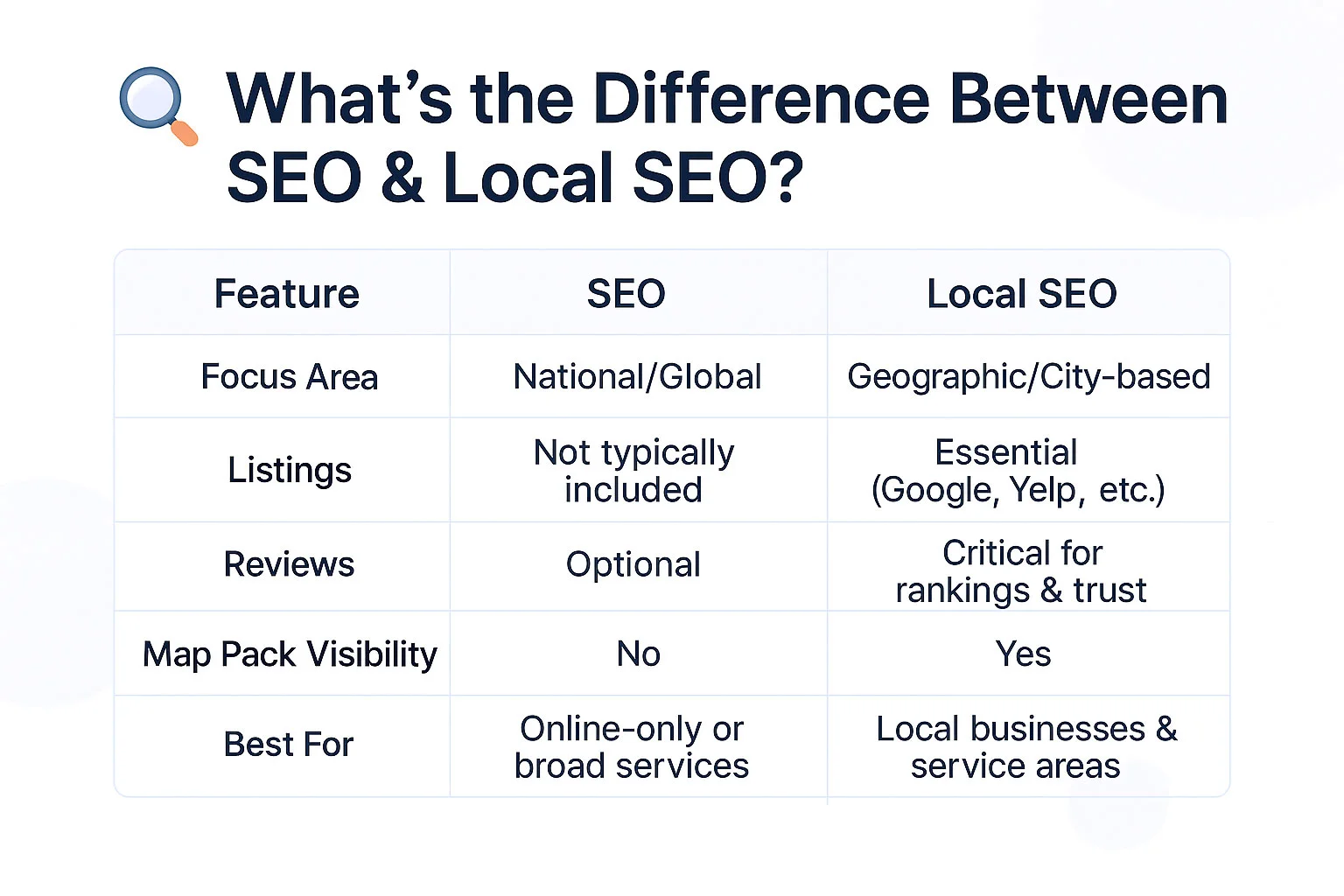
What is the difference between organic SEO and local SEO?
The primary difference lies in search intent and geography. Organic SEO focuses on improving your website’s visibility for broad, non-geographic search queries on a national or global scale.
Local SEO is specifically designed to capture search queries with geographic intent (such as “therapist near me” or “professional services in Las Vegas”). Local search optimization heavily prioritizes Google Maps Pack rankings, local directory citations, and localized review management.
To see how we help businesses dominate their local markets, check out our FAQ: Can You Help with Local SEO.
Conclusion
Sustainable business growth does not happen in a vacuum. It is not created by running isolated ad campaigns or publishing random blog posts. True, scalable growth happens when your marketing, customer management, automation, and operational systems work together as one connected ecosystem.
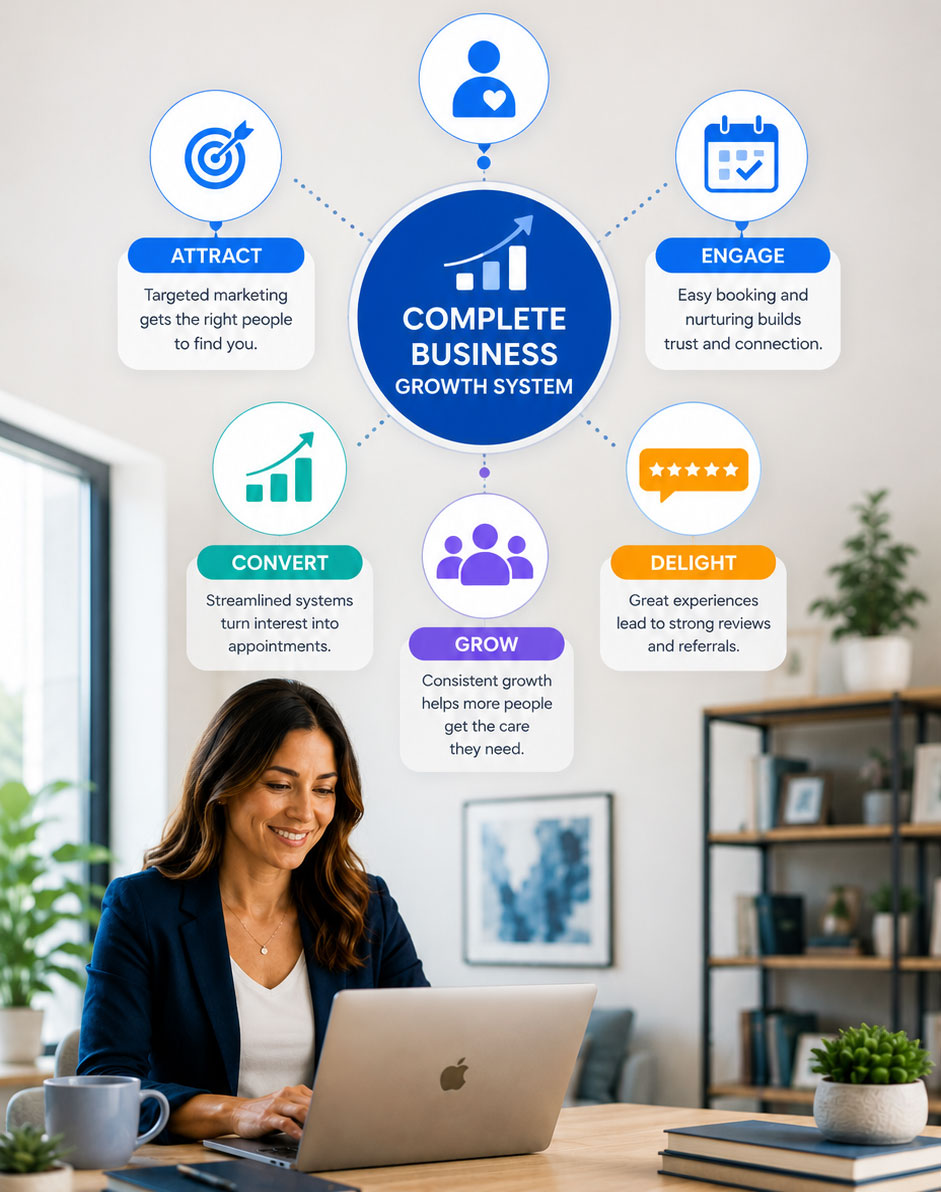
At Marketing Magnitude, we build complete growth infrastructures. We combine sustainable search engine optimization, advanced CRM technology, intelligent lead nurturing, and strategic consulting to help service-based businesses scale with clarity and predictability.
If you are ready to stop chasing vanity metrics and start building a compounding growth asset that drives real revenue, we are here to help.
Partner with us for Search Engine Optimization SEO Services and let’s build a sustainable, scalable future for your business together.